%201.webp)
02
AI Snaps
.svg)
.svg)
01
Our Work
03
About Us
04
Brand Audit
05
Contact Us
06
Client Success
12
07
Blogs
08
Careers
Book A Call
.svg)



.svg)
Need Help In Building Your Brand?
Click the button below & book a call with our founder directly.

Rishabh Jain
Managing Director
Amazon product packaging design should be compliant, protect your product and communicate the brand clearly.
As retail and ecommerce branding and packaging design specialists, we at Confetti break down amazon product packaging for you.
Learn all about Amazon FBA packaging requirements, best practices, and strategies to create packaging that converts on the world’s largest eCommerce platform.
.webp)
Amazon product packaging design is the process of creating packaging specifically for the e-commerce supply chain.
It is built to move through fulfillment centers, pass compliance checks, protect the product across multiple handling points, and deliver a controlled customer experience at home.
This is not just a variation of retail packaging. It is a different system with different constraints.
As a seller you must know about two packaging contexts:
Inbound or FBA packaging (How You Prep Products for the Warehouse)
This is the packaging that gets your products into Amazon’s fulfilment network safely and compliantly.
It protects your products in transit, meets structural requirements, and carries the correct FNSKU. If you get it wrong, Amazon may reject the shipment or charge prep fees.
Retail/Customer-Facing Packaging (What the Buyer Actually Receives):
This is the branded packaging your customer opens like the box, bag, or carton that carries your logo, colors, and brand story. The design decisions here directly impact growth by building recognition and customer loyalty.
1. Protection Across the Fulfillment Network
Your packaging must withstand:
Failure leads to damage, returns, refunds, and negative reviews.
2. Compliance With Amazon FBA Requirements: Non-compliant packaging may be reworked at your cost or blocked from sale. Key requirements:
3. Conversion Through Customer Experience; Your first physical brand interaction happens at home. Packaging must:
Well-executed packaging improves reviews, repeat purchases, and brand recall.
In retail, packaging drives purchase. On Amazon, packaging supports delivery and shapes post-purchase perception.
The Role of Aesthetics
Durability and Logistics
Space and Sustainability
Amazon FBA packaging requirements are mandatory rules covering barcodes, labeling, structural integrity, and product preparation.
If your packaging does not meet them, Amazon can reject inventory, charge reprocessing fees, delay inbound shipments, or remove listings.
Most brands approach packaging design as a creative exercise with brand colours, typography, photography. All of that matters.
But on Amazon, Design is the last step. Compliance is the first.
If your packaging fails compliance:
Design decisions happen after compliance, not the other way around.
FNSKU orFulfilment Network Stock Keeping Unit is Amazon's own internal barcode, different from a UPC or EAN.
It is how Amazon identifies your specific product in their warehouse.
Every product going into FBA needs a unique FNSKU on the exterior packaging. It cannot be covered, obscured, or placed in a location that is hard to scan (like a curved edge or a recessed panel).
A few rules that catch sellers off guard:
The barcode itself is generated in Seller Central when you create a product listing. You print it and apply it to your packaging artwork during the design phase.
If your product ships in a poly bag like apparel, plush toys, accessories, soft goods, Amazon's poly bag requirements apply:
Many sellers get this wrong and it becomes one of the most common reasons for FBA shipment rejections.
Outer packaging must be designed for automated handling. Your design must pass the 3-foot drop test without the box opening or the product breaking.
Also, for international shipments, weight limits can vary. Example: Japan and EU markets cap single boxes at 15 kilograms (approximately 33 pounds). Make sure you verify region-specific limits before finalizing amazon structural packaging design.
Amazon Frustration-Free Packaging (FFP) is a voluntary programme where your product ships directly in its retail packaging without an additional Amazon delivery box around it.
It is also called SIOC Ships in Own Container.
To qualify, your packaging must:
Benefits for sellers:
Applying for FFP requires submitting your packaging to Amazon's testing and certification process through the Amazon Packaging Support and Supplier Network.
This takes time to complete, factor this in during your design timeline, not at the end.
The requirements given above apply universally across Amazon FBA. But products in many categories have additional packaging rules:
Supplements and Ingestibles: Must display lot number, expiry date, and in some cases, a tamper-evident seal. Expiry dates must be in MM/YYYY format and visible on the exterior.
Electronics and Batteries: Must comply with battery packaging regulations (lithium battery warnings, transport restrictions). Packaging must show relevant certifications (UL, CE, FCC where applicable).
Toys and Children's Products: Must include age grading on the packaging exterior. Products intended for children under 3 must carry specific choking hazard warnings.
Food and Grocery: Expiry dates mandatory, allergen labelling required, packaging must be sealed and tamper-evident. Sell-by dates must not expire within Amazon's minimum remaining shelf life window for the category.
Liquids and Breakables: Must be sealed to prevent leakage and pass Amazon's drop test requirements. Double-boxing is often required.
Sharp items: Require puncture-proof packaging. Bubble wrap alone is insufficient; you must use corrugated boxes that prevent blades or edges from cutting through.
Sets and multipacks: Must be sealed so components cannot separate during handling. The outer packaging must clearly state “Sold as set” or “This is a set. Do not separate”
If your product falls into any of these categories, check the category-specific guidelines in Seller Central separately.
Print this out. Put it on the brief. Your designer cannot catch compliance issues they are not told to look for.
The right choice for your amazon product packaging depends on four things: your product type, your price point, your category norms, and what you want your brand to feel like when a customer opens it.
Here is a look at the types of packaging and which sellers it suits best:
Poly bags are the most widely used packaging format on Amazon. And the most frequently done wrong.
They're cheap, lightweight, widely available, and reduce dimensional weight and support FBA storage and fulfilment fees.
But poly bags have compliance requirements that we discussed above. A well-designed printed poly bag, with your brand colours, logo, and a clean product visual, does real brand work.
This is the most versatile packaging format for Amazon sellers.Folding cartons give you the most surface area for brand storytelling.
Front panel, back panel, side panels, top and bottom, every face is a design opportunity.
You can include usage instructions, ingredients, certifications, and brand narrative without cramming everything onto one face.
They're also highly customisable
From a compliance perspective, they also work well with Amazon FBA provided you use the right board weight (min 350gsm for smaller boxes)
Corrugated packaging (with distinctive fluted inner layer is the strongest packaging format for Amazon sellers.
It absorbs impact, resists stacking pressure, and keeps fragile products intact through demanding e-commerce logistics networks.
For years, corrugated boxes were once purely functional: brown, unbranded, and invisible. But , now that’s changing.
More Amazon sellers, especially in premium or high-AOV categories, now use custom printed mailer boxes as a brand touchpoint.
Exteriors showcase logos and brand colors, while interiors might include thank-you notes, QR codes, or visuals that make unboxing feel like an event.
This “unboxing experience” enhances the customer’s first impression and works on Amazon just as well as for influencer gifting.
Corrugated packaging also supports Frustration-Free Packaging (FFP) or SIOC certification, making these programs easier if planned from the start.
These serve a specific niche on Amazon, often as the only viable option.
Shrink wrap bundles multipacks or sets (e.g., mugs with coasters) into one shippable unit. Amazon requires these to be labelled “Sold as a Set — Do Not Separate” with the FNSKU visible.
Blister packs are common for hardware, small tools, batteries, and certain personal care items. They’re tamper-evident and let buyers see the product, but both formats offer limited branding compared to cartons or mailer boxes.
If you're in a category where tamper evidence is required or where multipacking is your main selling format, these are your packaging formats. If not, they're rarely the right choice for brand-building purposes.
Still not sure which format fits your product? Work through these four questions:
1. Is your product soft, pliable, or wearable? → Poly bag is your starting point. Invest in custom print to elevate the brand.
2. Is your product rigid, solid, and sub-2kg? → Folding carton box. Choose board weight carefully relative to product weight.
3. Is your product fragile, heavy, high-value, or do you want a premium unboxing experience? → Corrugated mailer or shipping box. Budget for the higher unit cost — it pays back in fewer damaged goods and stronger brand recall.
4. Are you selling a multipack, bundle, or a product in a tamper-evident category? → Shrink wrap or blister pack. Ensure labelling meets Amazon's multipack requirements.
Whatever format you choose, the decision should not happen in isolation.
Your choice affects FBA fees, fulfillment costs, sustainability (FFP eligibility), and the customer experience.
Top Amazon sellers consider all these factors together, picking a format that works structurally, financially, and for the unboxing experience. Get it right, and packaging becomes an asset; get it wrong, and it’s a recurring cost.

Packaging design on Amazon has to be conversion centric.
The creative choices you make including colour, typography, hierarchy, copy, etc. all need to serve a specific commercial outcome.
Here’s a process that works the best:
First focus on the Amazon listing image. Listing image converts the click and packaging is what the customer physically receives.
If they don't match (in colour, product angle,or visual style), buyers feel a subtle disconnect.
That disconnect creates doubt, which creates returns.
Be clear about the following and then brief your designer:
✅Main listing image
✅Hero angle of your product (front, 45°, flat lay)
✅Primary colour palette and if it works on packaging and on white backgrounds
✅Visual identity the brand to wants project
Your packaging front panel should function as a physical version of your main listing image.
Same product orientation. Same brand colours. Same tone.
A customer who saw your listing, clicked, and opened a box should feel complete visual continuity between those two moments.
This is one of the most actionable and often overlooked principles of Amazon packaging design.
On Amazon, your product appears in a search results grid as a thumbnail image (150 to 200 pixels wide).
That's tiny. And in that tiny space, your packaging needs to communicate enough to earn a click.
Here's how to test your design for thumbnail readiness:
✅Shrink your front panel mockup to 150px wide
✅Can you read the brand name? The product name? The key benefit?
✅Does the colour scheme still feel distinctive and on-brand?
✅Does the product itself still stand out?
If any of those answers are no, the design needs to be simplified.
The most common mistakes at thumbnail scale:
A bold product name, high contrast, and a clear visual beat complex designs that lose clarity at small sizes, every time.
This doesn’t mean simple; it means the key info must be instantly readable, even as a thumbnail. Everything else comes second.
There is a framework that applies directly to Amazon packaging that converts:
Clarity, Creativity, Consistency, and Consumer-Centricity.
✅Clarity: Instantly communicate what it is, what it does, and who it’s for. If it takes more than 3 seconds, it fails. Lead with the product name and core benefit.
✅Creativity: Stand out. Study your category’s visual norms, then choose: align with them or break them intentionally.
✅Consistency: Everything must feel unified. Color, type, imagery, and tone should work together. Inconsistency looks cheap.
✅Consumer-Centricity: Design for the buyer, not yourself. Address what they need to trust: safety, effectiveness, or value.
Before finalizing, check your design against all four. Each should have a clear answer.
These are the three mechanical elements that make or break packaging on Amazon:
Colour
Signals category and brand personality. Buyers scan fast, and colour acts as a shortcut.
Here, you can either choose to follow category cues (to build trust) or break them deliberately (to stand out).
✅Use max 2–3 colours: one dominant, one accent, one neutral.
✅Contrast is something that needs to be considered since it improves readability.
Some general category colour norms to be aware of:
Typography
This is where most non-professional packaging designs fail.
Some rules for Amazon packaging typography:
✅Use no more than two typefaces; one for headlines, one for body copy
✅Choose typefaces with clear legibility at small sizes
✅Avoid highly stylised or decorative fonts for key information
✅Hierarchy is everything: brand name, product name, and key benefit should each have a visually distinct weight or size that creates a natural reading order
✅Avoid all-caps for body text, it is harder to read and feels aggressive
Visual hierarchy determines the order in which the eye moves across your packaging.
On the front panel, the hierarchy should be:
Everything else goes on the back or side panels.
People don’t read packaging on e-commerce websites, they scan it. Your design should answer “what is this and why it matters” in under 3 seconds.
Treat every panel as intentional real estate.
The back isn’t for dumping information, it’s where you build trust and answer the buyer’s next questions after the front hooks them.
Side panels are underused. Add a short brand story, usage tip, or “what’s inside.” It costs nothing extra and builds real brand equity.
A packaging insert (a card, leaflet, etc) is one of the highest ROI brand investments an Amazon seller can make.
When done well,they help your brand:
Amazon has strict rules: No incentivised reviews or anything that looks like manipulation. But a genuine, well-designed thank-you card that invites customers to share their experience is completely fine and effective.
Keep inserts visually consistent with your packaging.
That moment the customer opens your package is the best opportunity to shift from a transactional sale to a brand relationship.
Sadly, most Amazon sellers waste it entirely by shipping in a plain poly bag with a sticker label.
The unboxing experience doesn’t need to be expensive, small upgrades compound:
✅A printed inner box (even just brand colour + logo) elevates the moment
✅Tissue wrap signals care before the product is seen
✅A simple thank-you card makes it feel personal
✅A QR code to a “getting started” video boosts satisfaction and reduces support
Thoughtful packaging drives shares, better reviews, and repeat purchases.
If you can tick every box on this list, your packaging is ready to earn its place on Amazon.

When you sell a wholesale or reseller product on Amazon, the packaging is fixed. You work with whatever the manufacturer provides.
Private label is different. You own both the product and the packaging. Every decision: colour, finish, front-panel hierarchy, inserts, messaging, is entirely yours.
Most private label sellers think about packaging too late and too narrowly.
They find a product, source it, register a brand name and then, at the end get a logo printed on a box.
It looks fine, but it doesn't look like a brand. It's just a product with a sticker on it.
On Amazon, private label packaging is the only physical touchpoint your customer has with your brand. So, it deserves a strategy.
This is where most sellers go wrong.
They launch Product A with one designer. Product B with another. By Product D, the line looks like it was briefed by four different people in four different countries, because it was.
The fix is simple, but the decision has to come before the first product launches.
A packaging system is the set of visual rules that governs how every product in your line looks, regardless of how many SKUs you have or how many years pass between launches.
It has four layers:
If you're building a private label brand, Amazon Brand Registry is foundational.
It unlocks A+ Content, Brand Stores, Sponsored Brand ads, and Brand Analytics. All of which reinforce the identity your packaging builds.
One practical implication: the brand name on your packaging must match your Brand Registry trademark exactly: spelling, casing, formatting.
If you get it wrong and changing it later would mean new artwork, new trademark registration, and a new enrolment.
Get it right once. It's worth the extra thought at brief stage.
Getting Amazon packaging right is harder than it looks.
Most sellers discover this the expensive way. after a reprint run, a compliance rejection, or a product launch where the packaging simply does not do justice to the product inside.
In most cases, the problem is the brief.
Generic freelancers design for aesthetics, not for FNSKU placement, dimensional weight, thumbnail legibility, or Brand Registry alignment. Those gaps cost real money.
As an award-winning packaging and brand design agency. Confetti works specifically with e-commerce and Amazon sellers.
We help you with brand design and Amazon packaging strategy.
Confetti starts where most designers don't: with compliance and listing strategy, before a single panel is designed.
Every project begins with a packaging audit: format selection, dimensional weight implications, FBA compliance requirements, and listing image alignment.
The creative work is built on top of that foundation, not instead of it.
For private label sellers building a product line, Confetti develops a full packaging system: brand identity, master panel template, variant differentiation logic, and a dieline reviewed against the seller's manufacturer specifications.
The result is packaging that scales, where Product 5 looks like it belongs to the same brand as Product 1, without briefing from scratch each time.
Every project includes:
For sellers launching their first product or refreshing an underperforming line, that process removes the most common and costly mistakes before they reach the warehouse.
Good packaging is not a cost centre. In the hands of the right agency, it's the highest-ROI brand investment an Amazon seller can make.
Sustainability is quickly becoming central to the Amazon packaging system. As a seller, this change affects your costs, your visibility, and your product eligibility.
New materials are entering the supply chain
Amazon India partnered with IIT Roorkee to develop packaging from agricultural waste—wheat straw and bagasse converted into paper mailers. India generates 500 million tonnes of agri-waste annually; repurposing it creates home-compostable, recyclable alternatives to virgin wood pulp. What qualifies in India today often becomes available in other markets tomorrow.
Compliance now carries direct financial penalties
Amazon discontinued FBA prep services in the US as of January 2026. Non-compliant packaging triggers chargebacks up to $1.99 per unit. The three-tier system—Prep-Free, Ships in Product Packaging (SIPP), and Frustration-Free Packaging (FFP)—determines fees. Tier 1 FFP requires 100% curbside recyclable materials and opening under 120 seconds without tools.
Climate Pledge Friendly (CPF) is mandatory for certain categories
By June 30, 2026, baby skincare, electronics accessories, and textile bedding products must comply. Uncertified products risk de-ranking, search suppression, or a 0.5–2% environmental adjustment fee.
The CPF green leaf badge boosts conversions
CPF-certified products see 60% higher click-through rates and 30–50% higher conversion rates. The badge also grants access to exclusive events and eco-conscious search filters.
AI accelerates packaging reduction
Amazon Australia used machine learning to identify products that can ship without added outer packaging—adding 12,000 products in one month, a process previously taking 18 months. Over 150,000 products now qualify, with 50% of global orders shipping with reduced or eliminated packaging.
Cost savings align with sustainability
Since 2015, Amazon cut packaging weight per shipment by over 41%, saving more than 2 million tons of material. SIPP-certified products receive FBA fee discounts from $0.04 to $1.32 per unit. Packaging decisions directly affect both fees and carbon footprint.
EP3 packaging is now FFP approved
EP3 packaging—a 100% sustainable EPS replacement—is now Amazon FFP approved. Products using foam or non-recyclable void fill face higher fees and potential listing suppression by late 2026.

❌ Designing before checking the FBA packaging requirements
❌ Using generic white label packaging with just a sticker label
❌ Over-designing to the point where the product cannot be identified at thumbnail size
❌ Missing required label elements (suffocation warnings, expiry date, country of origin)
❌ Not leaving enough bleed or safe zones on dieline artwork
❌ Choosing cheap packaging that damages the product en route, leading to returns and negative reviews
❌ Ignoring the side and back panels, a valuable brand storytelling real estate
❌ Ignoring dimensional weight (DIM weight) optimization
❌ Using materials that interfere with automated scanning
❌ Failing to test with actual fulfillment center conditions
❌ Treating all markets as identical
What are Amazon's packaging requirements for FBA sellers?
Some of the most important Amazon FBA seller packaging requirements are: ensure all units have a scannable FNSKU barcode on the exterior, are fully enclosed, have suffocation warnings on poly bags with openings over 5 inches, include expiry dates for consumables, and meet Amazon's weight and dimension guidelines.
Can I use my own branded packaging for Amazon FBA?
Yes. Amazon allows and encourages branded custom packaging. Your branded boxes, bags, or cartons must still comply with FBA requirements, particularly around barcodes, labelling, and structural integrity. Many private label sellers use branded packaging as a key differentiator.
How do I find a designer for my Amazon product packaging?
You can hire freelance designers on platforms like online platforms like Dribbble. For a more strategic, compliance-aware approach, specialist e-commerce packaging agencies, like Confetti which offer end-to-end packaging design services that include dieline review, compliance check, 3D mockup, and listing image alignment.
Does packaging design affect my Amazon ranking?
Packaging design doesn’t directly affect your search ranking on Amazon. However, it has a strong indirect effect: better packaging leads to fewer damaged goods, fewer returns, higher review scores, and more compelling listing images. All of which improve conversion rate and, therefore, organic rank.
What information is required on Amazon product packaging?
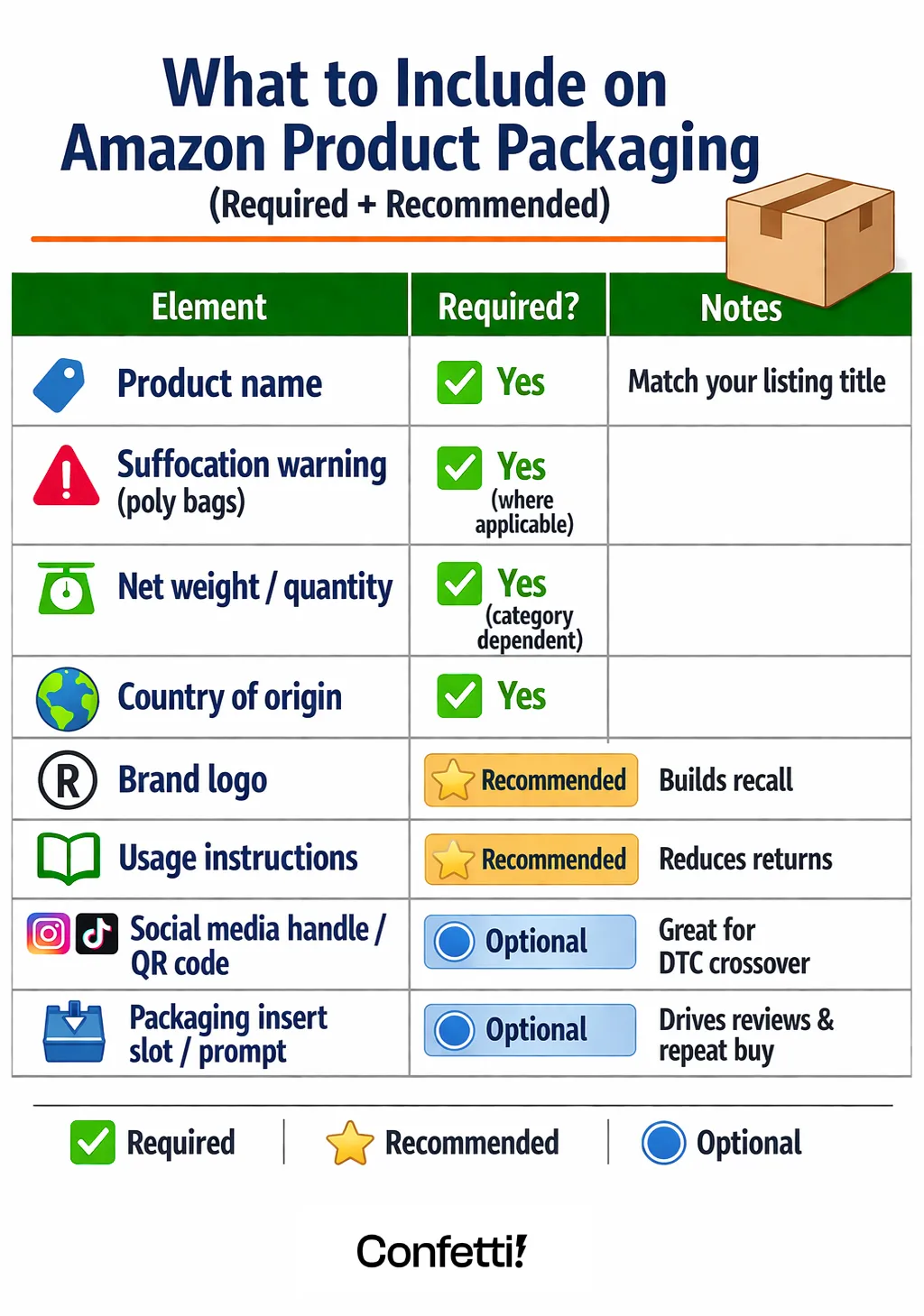
At minimum: product name, FNSKU barcode, country of origin, net quantity or weight, and any legally required warnings (suffocation warnings for poly bags, allergen info for food products). Depending on the category, additional requirements may apply, such as ingredient lists, UL certifications, or childproofing statements.
Want strategic branding and packaging like this for your business?





.webp)
.webp)

.webp)
.webp)
.webp)
.webp)
.webp)







.svg)
.webp)