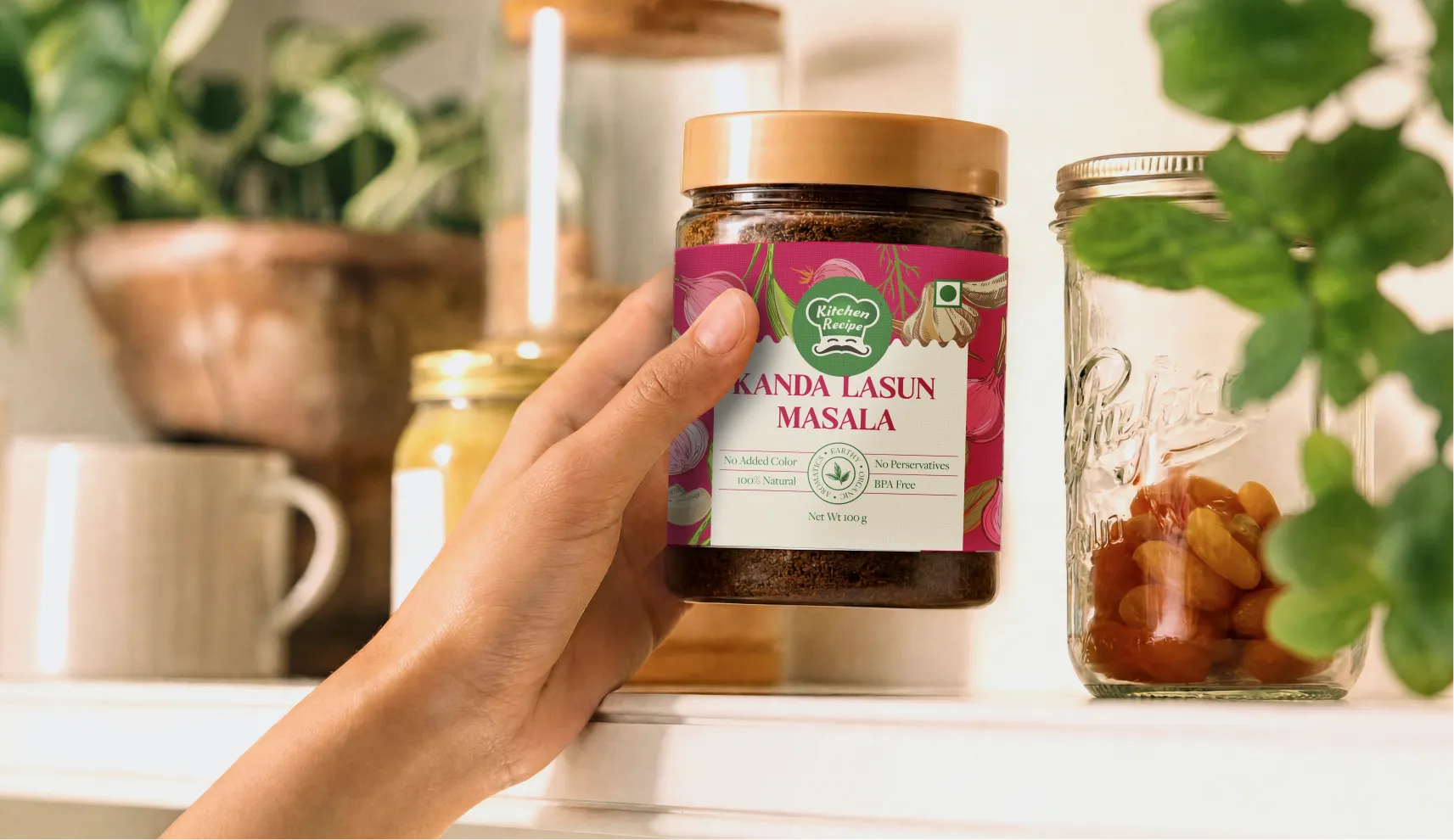
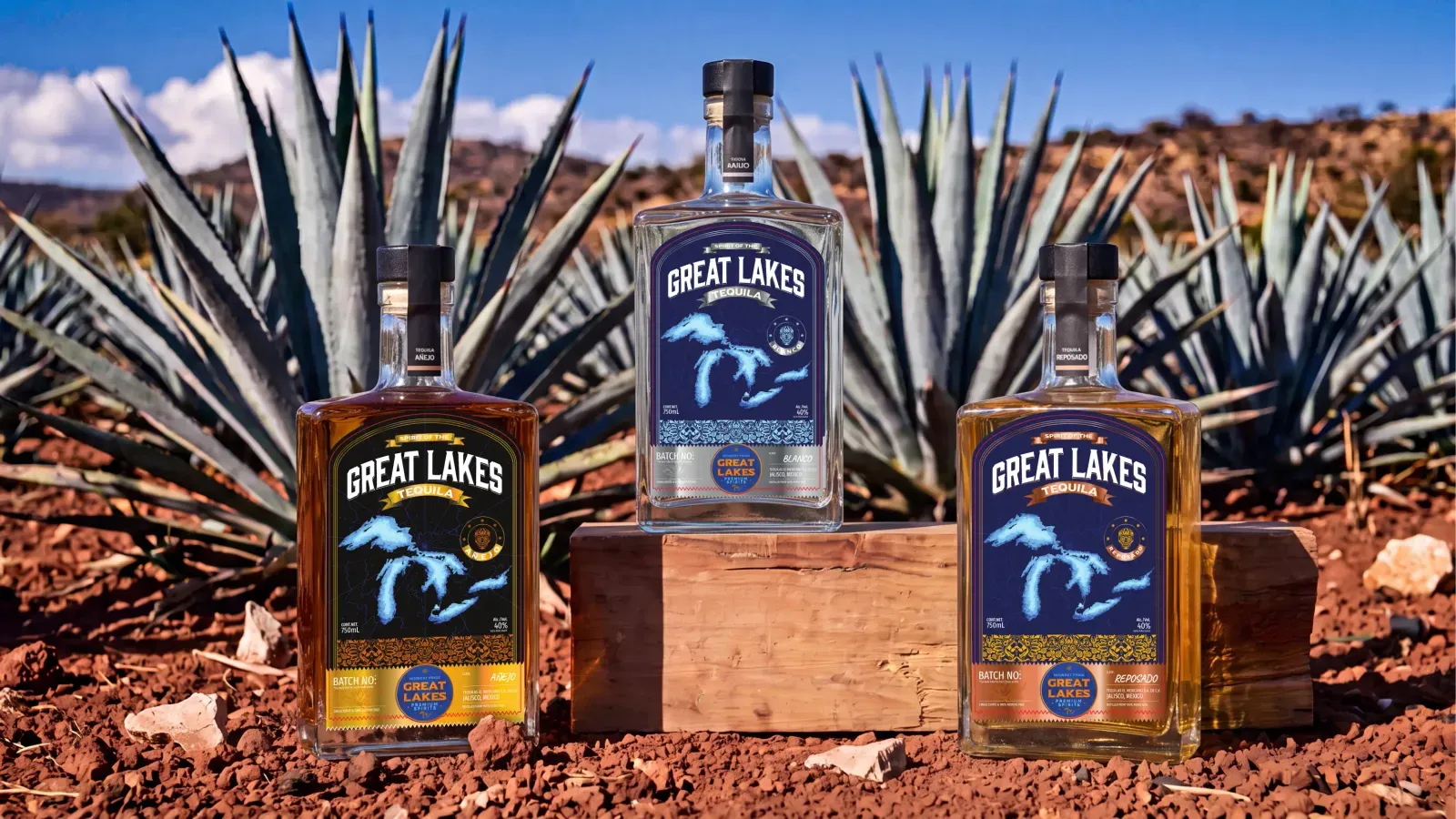
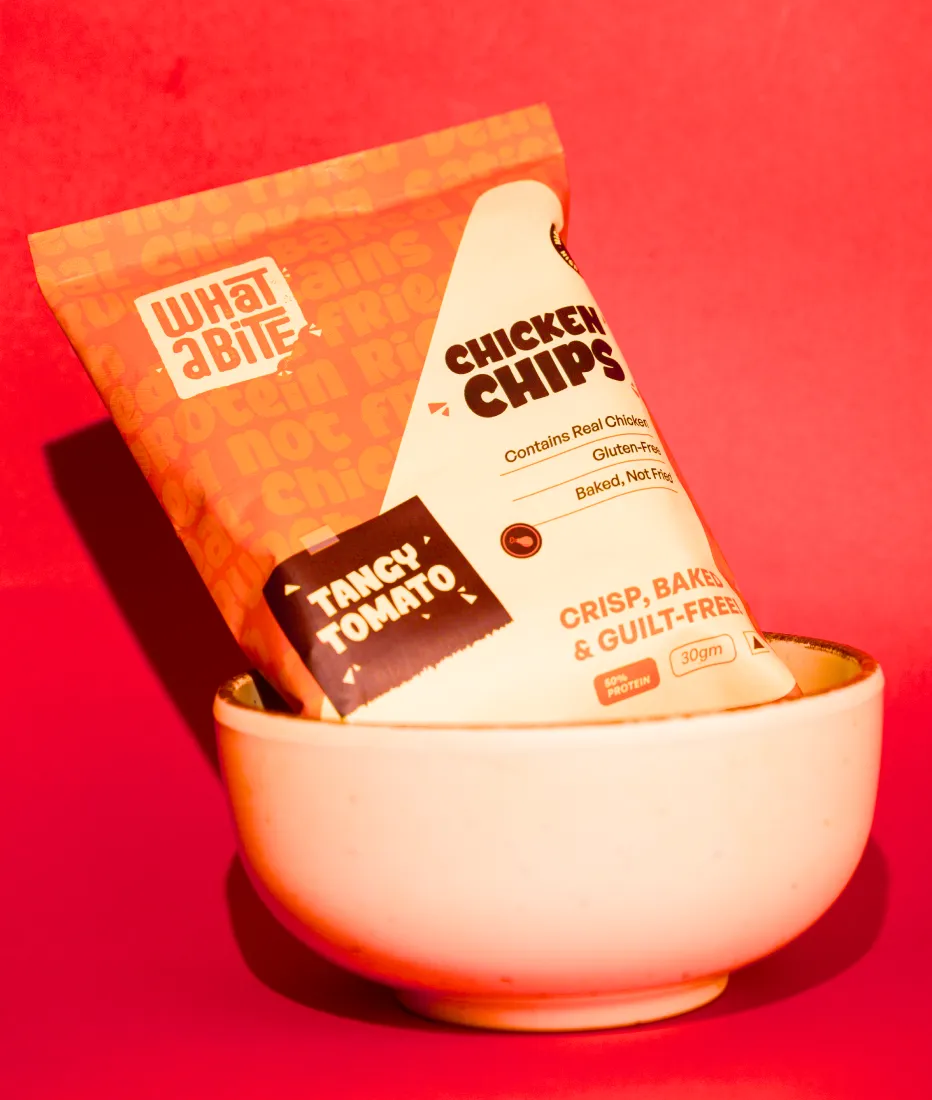
%201.webp)
02
AI Snaps
.svg)
.svg)
01
Our Work
03
About Us
04
Brand Audit
05
Contact Us
06
Client Success
12
07
Blogs
08
Careers
Book A Call
.svg)



.svg)
Need Help In Building Your Brand?
Click the button below & book a call with our founder directly.

Rishabh Jain
Managing Director
Every brand that gets onboarded on Zepto has passed through a category manager review, an NPI evaluation, and a commercial negotiation.
This guide covers the full picture of the Zepto onboarding process, document requirements, commission structure, and the packaging decisions that most brands get wrong while applying on Zepto as a seller.
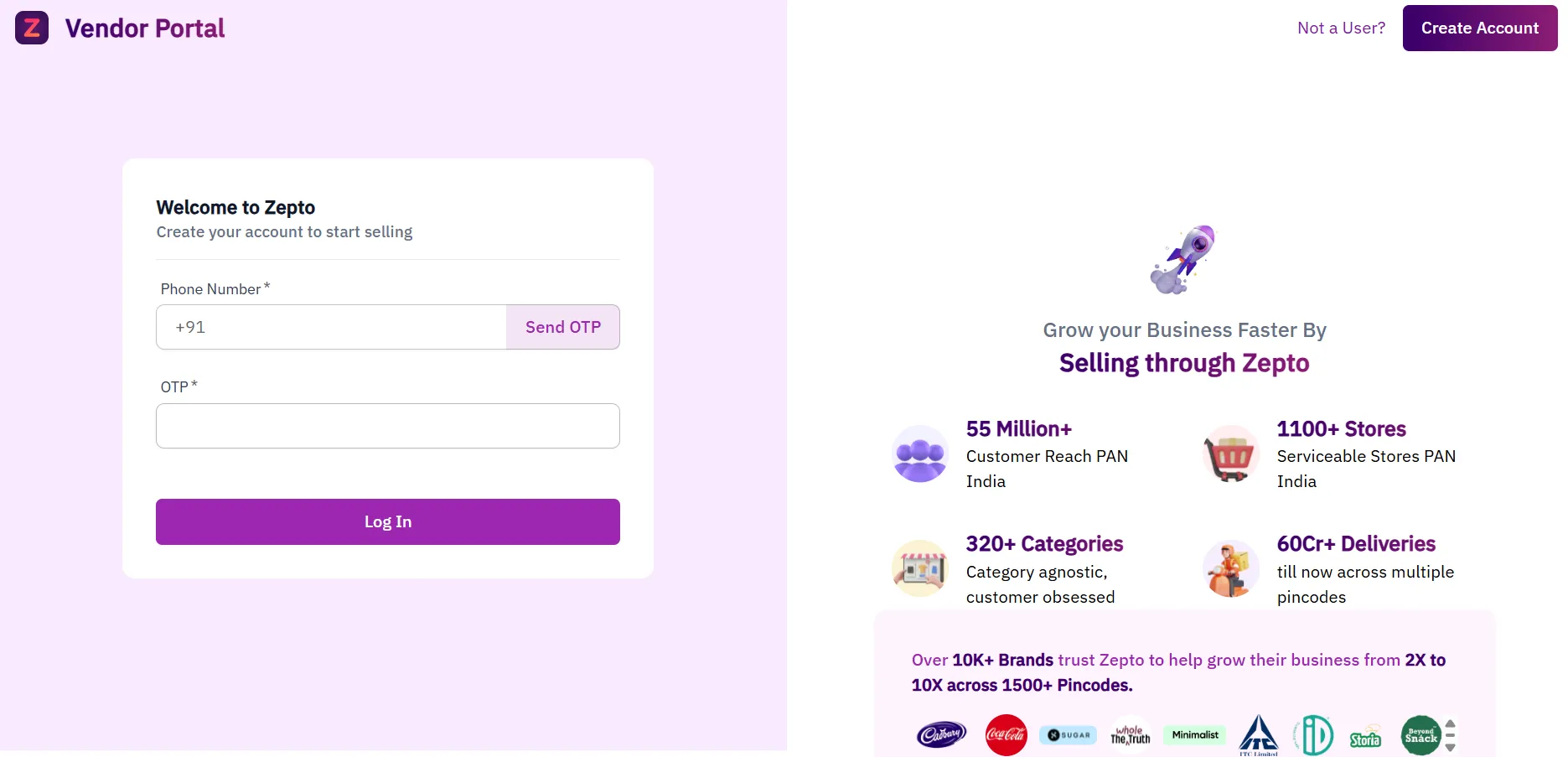
On Amazon or Flipkart, you create a seller account, upload your catalogue, set your price, and wait for traffic. Zepto doesn't work that way. There's no self-serve portal where you list a product and go live.
The onboarding process is centralised through category managers, who act as your gateway into Zepto's dark store network. They are not customer support. They are internal buyers.
A category manager is a Zepto employee who
Category managers have targets, category P&Ls, and limited shelf slots and they're evaluating dozens of brands at any given time.
If your pitch deck is thin, your product images are lifestyle shots, or your supply chain story is vague, you don't get a second meeting.
Zepto also evaluates brands, not just products. Category fit, pricing architecture, supply consistency, and brand credibility are all assessed before a listing is approved.
A well-packaged product from an unknown brand with no distribution history will face harder scrutiny than a mid-tier FMCG product with proven regional sell-through unless the newer brand has clearly done its homework on the q-commerce environment.
Zepto runs a network of over 1,000+ dark stores across urban cities. Each one is compact, located inside dense residential neighbourhoods, and staffed by pickers who assemble orders in under two minutes.
🚫There are no browsing shoppers. No eye-level gondolas. No promotional signage on shelves.
🛍️A picker navigates the store with a device that tells them exactly where to go. They grab the item, scan it, and move on.
The entire interaction with your product lasts about 3 seconds. That has direct consequences for how your packaging must be designed:
Beyond the physical shelf, there's the app. When your product appears on Zepto's interface, it displays as a thumbnail roughly 200×200 pixels.
At that scale, a product that looks premium on Instagram can become an unreadable blur. If the brand name disappears, if the variant colour is indistinguishable, if the product type isn't clear at a glance, the consumer scrolls past it.
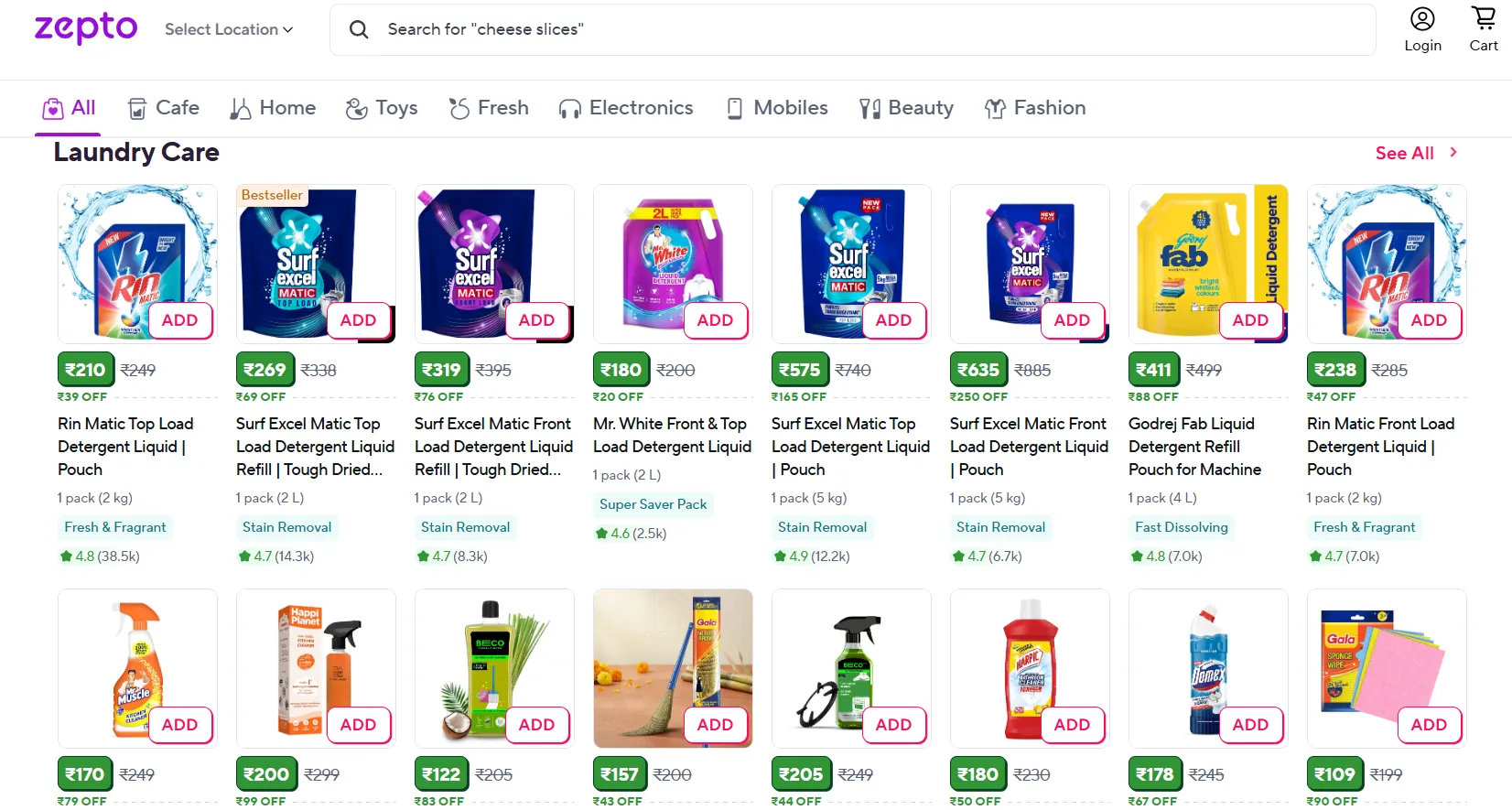
Unlike platforms where sellers manage uploads via a self-serve dashboard, Zepto's category manager actively guides sellers through the process from negotiation to onboarding.
💡This means your category manager will see your product images before your listing goes live.
If those images look like they were shot for an Instagram grid rather than an app thumbnail, it signals that your brand hasn't prepared for this environment and that perception carries into the rest of your NPI evaluation.
Zepto accepts brands across:
What Zepto actually evaluates is your commercial and operational readiness. What they actually evaluate:
👁️Product-market fit: high-frequency, fast-moving, or impulse items. A ₹200 snack works; a ₹3,500 blender doesn't.
👁️Valid GST registration: plus APOB GST in each state where Zepto operates dark stores if you're supplying across cities.
👁️Trademark or authorised distribution rights: no grey-market products.
👁️Inventory reliability: repeated stockouts get you deprioritised quickly.
👁️Margin structure: Zepto takes 18–22% commission. Build that into your MRP from the very start.
Best-Performing Categories & Price Points
Some products work better than others on quick commerce.
For Zepto, the sweet spot is ₹50–₹500, the low-deliberation, high-frequency purchases. Strong categories include packaged snacks, beverages, dairy, personal care, and household cleaning.
Now, important here is that Zepto is actively expanding premium D2C: health supplements, specialty foods, natural beauty, and functional snacking. If your brand isn't on modern trade shelves yet, that's a positioning advantage.
Products priced above ₹1,000 can work, but only when: the product is a regular repurchase (a protein powder, a skincare set), the brand has enough recognition, and the category manager sees it driving basket value.
One unofficial but influential factor: visual brand credibility. Professional packaging and app-ready imagery speeds up NPI approval and often improves initial PO volumes.
Documents Required for Zepto Onboarding
Optional but useful: MSME/Udyam Registration, Amazon/Flipkart listings, and a brand website all strengthen your credibility during category manager evaluation.
The FSSAI Mistake to Avoid
A State FSSAI license only covers the state it's issued in. Expanding to a new city without coverage creates a compliance block that costs two to four weeks per city.
The fix: Apply for a Central FSSAI License from the start if there's any chance you'll operate across states. It covers your entire India footprint. If you're already live on a state license, begin the Central application now. Don't wait for your category manager to flag it.
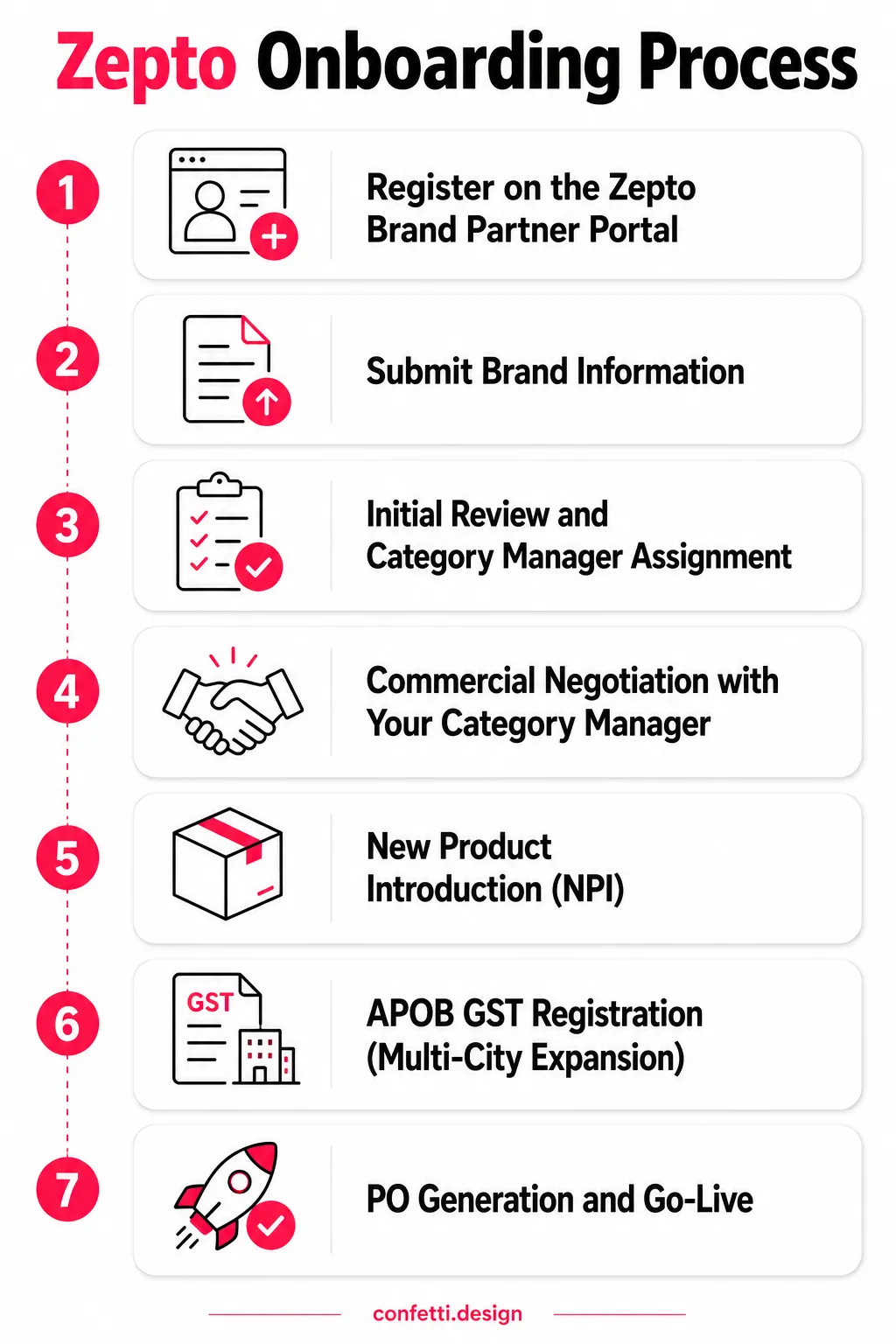
Zepto's onboarding has seven distinct stages, each with its dependencies.
You should know the full sequence before you start, so that you can run several steps in parallel and avoid the 4-6 week delays.
Visit Zepto’s official website. Click "Register Now," verify your mobile number via OTP, and create an account using your business email.
Time: Same day
Once registered, navigate to the Brand Information section. You'll fill in contact details, brand name, manufacturer or distributor status, and product category.
The second part covers business turnover range, selling price band, website URL, existing platform presence, and geographic reach. Upload your product portfolio here.
Time: 1–2 hours if your catalogue is ready
Zepto's team uses this submission to decide whether your brand is worth assigning a category manager to.
A clean portfolio, clear category positioning, and documented online presence all improve your chances of being shortlisted.
Zepto reviews your submission and, if approved, assigns a dedicated category manager as your single point of contact for everything that follows.
Realistic timeline: Zepto's official partner page states onboarding within 15 business days for qualifying brands. The wait from submission to first CM contact is usually 2–6 weeks, depending on category demand and how complete your submission was.
If you don't hear back after 30 days, follow up directly with Zepto's brand partnerships team. There's no automated rejection, brands that don't qualify are often simply left waiting.
Your CM evaluates four things when reviewing your application:
This is the meeting brands must prepare for really well. Your CM will cover:
Build your P&L before this conversation. Example:
If your gross margin is below 30%, Zepto requires a careful pricing strategy before negotiations make sense.
Brands with unique positioning, demonstrated consumer demand, or willingness to co-invest in promotions consistently get better commercial terms.
Come with data, your sell-through on other platforms, customer demographics, and repurchase rates, if you have them.
After commercial terms are agreed, your CM initiates the NPI process. This is where most brands stall, either because their SKU data is incomplete or their product images don't meet Zepto's requirements.
You'll need to submit:
Timeline: 5–10 working days after complete submission.
NPI image requirements: most brands get this wrong:
Run your images through this checklist before submitting.
Images that fail Zepto's internal review go back to you for a resubmission cycle which adds another 5–7 days each time.
To supply Zepto's dark stores outside your registered state, you need APOB (Additional Place of Business) GST registration in each target state.
This is a tax compliance requirement, you're registering Zepto's warehouse as an additional place of business under your GST, not establishing a physical office.
A Bengaluru-based brand going live in Delhi and Mumbai needs APOBs in both Delhi (NCT) and Maharashtra before inventory can legally move to those dark stores.
Timeline: APOB registration takes 7–15 working days per state.
Start this in parallel with your NPI submission. It's the most common cause of delayed multi-city launches, and it's entirely avoidable with early planning.
Once NPI is approved and APOBs are in place, Zepto raises your first Purchase Order. PO volumes are based on Zepto's demand forecast for your category, your agreed supply commitment, and target cities.
You ship to Zepto's central warehouses, not to individual dark stores. Zepto's logistics system redistributes stock to dark stores based on real-time demand signals.
Time from NPI approval to go-live: 5–10 additional working days.
Keep 15–20 days of buffer stock at the warehouse at all times. Running out of stock triggers automatic removal from the app.
This is the single most common mistake brands make in their first month and rebuilding your app ranking after a stockout takes longer than maintaining it.
First 30 days post-launch:
You can clear every compliance requirement, get your category manager excited, and pass NPI approval and still underperform on Zepto. The reason is almost always failing quick commerce packaging.
Quick commerce creates three distinct competitive moments for your product. Your packaging either wins all three or it leaks conversion at each one.
A product designed for a D-Mart gondola or an Instagram grid is optimised for none of these three moments.
Modern trade packaging assumes browsing behaviour, good lighting, and a consumer who can pick up the pack and turn it over. Zepto gives you none of those conditions.
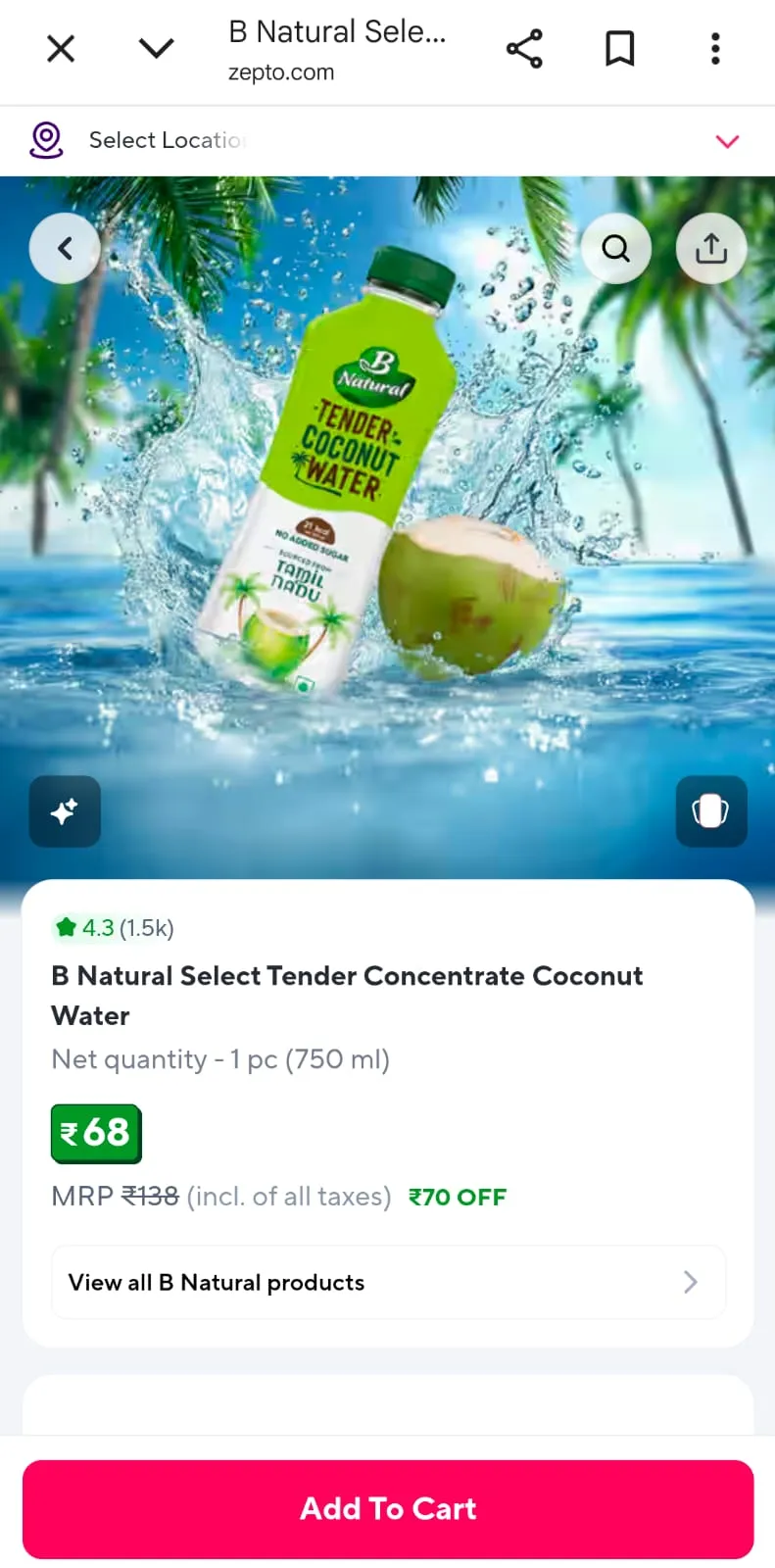
At Confetti, we design packaging specifically for quick commerce platforms, creating bold, high-clarity packaging systems that stand out in fast-scroll, thumbnail-first shopping environments. Once such example is coconut water for B Natural
These mistakes come up repeatedly with brands entering quick commerce for the first time.
1. Brand name buried under the product descriptor
A pack that reads "Organic Cold-Pressed Alphonso Mango Juice" in large type, with the brand name in a small font at the bottom, shrinks to an unreadable thumbnail on the app. The consumer sees a flavour description. They don't see a brand.
There's no recognition, no trust signal, no reason to tap. Brand name should sit in the top third of the pack, in the largest or second-largest type element on the front face.
2. Identical packaging across variants
Multi-SKU brands where every variant uses the same base colour and layout are a picker liability. In a dark store moving at speed, a strawberry variant and a mango variant that look 80% identical will be confused repeatedly.
Wrong variants get picked, delivered, and returned. Enough returns and your seller metrics start to slip. Variant differentiation isn't a design preference on Zepto; it's an operational requirement.
3. Barcode placed on the pack base
Pickers work with handheld scanners at shelf height. A barcode on the bottom of the pack requires them to flip it, break their picking rhythm, and slow down.
It causes friction at the dark store level, increases error rates, and creates the kind of operational noise that your category manager eventually hears about. Barcode placement should be on the side panel or lower front face visible without repositioning the pack.
4. Lifestyle photography submitted as NPI images
Zepto's image requirements are explicit: white or plain light background, product-forward, no props, no contextual staging. Brands that submit lifestyle images: the kind that perform well on Instagram or a brand website, get their NPI submission returned.
That's a 5–10 day delay per resubmission cycle, sometimes more if the Category Manager's review queue is long.
5. Pack size not prominently displayed
A consumer orders what they think is a 500ml bottle and receives 250ml. The product is technically correctly listed, but the size wasn't clear on the thumbnail or the product detail page. One-star review. Possible return.
And on Zepto, where impulse purchases dominate, a product accumulating early negative reviews loses category rank fast.

Talk to Confetti experts about getting marketplace-ready
Book A Call
Most brands come to us after something has already gone wrong. NPI got returned. The listing went live but isn't converting. The category manager asked for better images and the brand doesn't know what that means.
We've worked with enough FMCG and D2C brands from early-stage D2C founders to established names like ITC, Daburl to recognise these gaps before they surface.
Our work on Zepto-bound brands runs across different phases, depending on where you are in the process.
Pre-Onboarding: Building Brand Credibility First
Before a brand even approaches Zepto, Confetti helps build the brand presence that makes category managers say yes.
This includes packaging design, brand identity, product photography, and digital footprint, all the signals that communicate legitimacy during NPI evaluation.
A brand with professional, app-ready visuals moves faster through approval and often lands better initial PO volumes.
Packaging Designed for the Q-Commerce Grid
Confetti treats quick commerce packaging requirements as its own discipline, not an adaptation of offline design.
Every project is tested against real Zepto, Blinkit, and Instamart mock screens, with the client's product placed alongside competing brands exactly as a shopper would see it. Issues with legibility, contrast, or category communication get resolved before the product goes live.
We design across all surfaces, since back-of-pack and side panels feed into secondary listing images that influence purchase decisions once a shopper clicks through.
Onboarding & Pricing Consultation
Once the brand is ready, Confetti supports the actual onboarding process:
This covers the full setup on Zepto, Blinkit, and Instamart.
Performance Optimization After Launch
Post-listing, Confetti manages in-app advertising, listing optimization, and campaign strategy. One pet care brand saw GMV grow 5x and ROAS jump from 2.4 to 6.5 in six months under their management.
For brands preparing to sell on Zepto, Confetti handles every layer, from first impression to ongoing growth.
Before you negotiate with your category manager, you need a working P&L.
The brands that struggle commercially on Zepto are almost never surprised by the commission rate, they're surprised by what the commission looks like alongside everything else.
Does Zepto charge an onboarding or registration fee❓
No. There is no upfront fee to apply, register, or get listed on Zepto. The platform earns through commission on orders, not from charging brands to enter.
How much commission does Zepto charge❓
Zepto charges 8–25% of order value, depending on category and negotiated terms. Rough benchmarks by category:
These are indicative ranges. Your actual rate depends on your category, brand positioning, and what you bring to the commercial conversation. A brand willing to invest in joint promotions often negotiates a more favourable base commission.
What other costs should you plan for?
₹ In-app promotional spend:
Optional, but practically necessary in months 1–3. Banners, search boosts, and sampling campaigns are how new listings build velocity and category rank. Budget 5–8% of GMV for this during launch.
Brands that skip it often see slow initial sales and incorrectly conclude the platform doesn't work for them.
₹ Return handling fees:
Applied on damaged or refused inventory. Minimised by consistent packaging quality and accurate listings, misleading product descriptions and unclear pack sizes are the most common triggers.
₹ APOB GST registration:
A one-time professional fee per state, usually ₹3,000–₹8,000 per state depending on your CA or consultant. Not a Zepto charge, but a real cost of multi-city expansion.
₹ Replenishment logistics:
Freight to Zepto's central warehouses. Varies by volume, geography, and your existing distribution setup.
How do you register your brand on Zepto?
Visit brands-onboarding.zepto.co.in and click "Register Now." Verify your mobile number via OTP, create an account, and complete the Brand Information form with your company details, product categories, turnover range, and portfolio.
Submit. Zepto's team reviews your application and assigns a Category Manager if your brand qualifies for their catalog.
How to onboard a product on Zepto?
After your brand account is approved and a Category Manager is assigned, the product onboarding happens through the NPI (New Product Introduction) process.
You submit SKU-level data: product name, barcode, MRP, pack size, along with compliant product images (white background, front/back/picker angles) and category-specific compliance documents. Zepto's team approves each SKU before it goes live.
How much is the onboarding fee in Zepto? Does Zepto have an onboarding fee?
There is no upfront registration or onboarding fee on Zepto.
The platform charges a commission of 8–25% on each sale, depending on your product category and the commercial terms agreed with your Category Manager. Additional costs include return fees and optional in-app promotional spend.
What is the commission for Zepto sellers?
Zepto's commission usually ranges from 8% to 25% of order value. Grocery and FMCG products generally fall in the 10–15% range.
Personal care and specialty brands usually see 12–20%. Commission rates are negotiated with your Category Manager during the commercial discussion and depend on category, brand strength, volume commitment, and promotional spend.
How long does Zepto onboarding take for a new brand?
If your brand qualifies and your documents are complete, Zepto states that onboarding can be completed within 15 business days. The full process, from portal registration to first Purchase Order, usually takes 3–6 weeks.
Multi-city launches take longer due to APOB GST registration requirements (7–15 days per additional state).
Can a new D2C brand with no offline presence get listed on Zepto?
Yes. Zepto actively seeks differentiated D2C brands in food, personal care, wellness, and home categories. particularly products not available in traditional retail.
Having an active D2C website, strong product imagery, and existing traction on Amazon or Flipkart improves your chances of Category Manager approval, even without offline distribution.
What items sell best on Zepto?
Fast-moving daily-use products perform best: packaged snacks, beverages, dairy, personal care, household essentials, and instant foods.
Products priced in the ₹50–₹500 range convert at higher rates due to impulse-buy dynamics. Premium and specialty products can succeed if they're in the repurchase cycle, health supplements, specialty foods, and baby care products are growing categories.
Want strategic branding and packaging like this for your business?





.webp)
.webp)

.webp)
.webp)
.webp)
.webp)
.webp)







.svg)
.webp)