%201.webp)
02
AI Snaps
.svg)
.svg)
01
Our Work
03
About Us
04
Brand Audit
05
Contact Us
06
Client Success
12
07
Blogs
08
Careers
Book A Call
.svg)



.svg)
Need Help In Building Your Brand?
Click the button below & book a call with our founder directly.

Rishabh Jain
Managing Director
Packaging sustainability audit is not a mere compliance task, it’s way more than that.
Whether you're preparing for a retailer onboarding, managing an EPR compliance deadline, or simply refreshing a product line, this is where to start.
This guide covers how to run a packaging sustainability audit properly. We delve into what to measure, how to prioritize, what most brands miss, and how the findings should shape your next design decision.
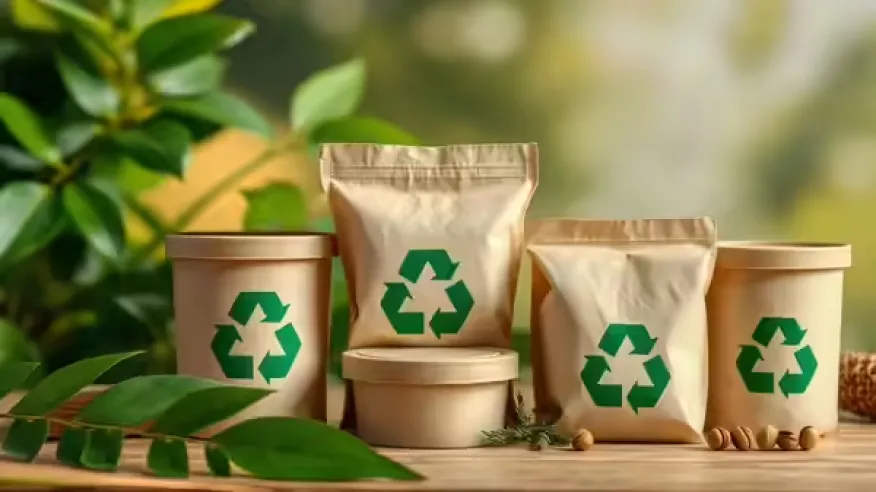
A packaging sustainability audit is a systematic, structured, cross-functional assessment of your entire packaging portfolio across its full lifecycle.
This includes materials, formats, sourcing, and end-of-life pathways to identify environmental impact, compliance exposure, and cost inefficiencies across every SKU you produce.
A true audit goes deeper than environmental metrics. It tests packaging against four real-world constraints:
A packaging audit is not a redesign. It is the diagnostic that tells you whether a packaging redesign is even necessary or whether targeted optimizations will deliver higher ROI with lower risk.
🍀Regulatory pressure: EPR regulations are tightening globally. India’s Plastic Waste Management Rules and 2022 EPR guidelines impose collection, recycling, and recycled-content obligations on packaging producers.
Simultaneously the EU is pushing for all packaging to be recyclable by 2030.
🍀 Cost savings are immediate and measurable: Operational savings from lighter packaging, reduced waste, and more efficient design can cut material and shipping costs.
Reducing packaging weight and volume lowers dimensional weight charges and transport emissions simultaneously.
🍀Brand value and consumer preference: The sustainable packaging market is projected to reach USD 448.53 billion by 2030. This growth is driven by consumer preference for low-waste, recyclable packaging.
Packaging is often a customer’s first interaction with a brand. An audit helps improve sustainability without hurting usability or brand image, while reducing greenwashing risk.
🔍Packaging costs have crept up without a clear cause: Material costs, shipping rates, and supplier pricing may have drifted.
An audit benchmarks your specifications against industry rates and identifies over-engineered elements that inflate per-unit cost without adding value.
🔍Entering a new retail channel or geography: Different channels have different packaging requirements: e-commerce demands drop-test durability; export markets impose specific labeling and recyclability rules.
An audit tests whether your current pack is fit for purpose
🔍New product launch: The right moment to audit is before a packaging specification is finalized, not after 50,000 units have been printed.
A pre-launch audit catches material choices, claim language, and format decisions while they're still inexpensive to change.
🔍Regulatory change: A new EPR law goes live. A labeling standard is updated. A retailer revises their sustainability requirements for vendor approval.
These are reactive triggers, but they're common and they're accelerating as regulation tightens globally.
🔍Rebranding or packaging refresh: A packaging redesign is the correct moment to also reconsider material choices.
The design process and the sustainability audit should run in parallel with audit findings feeding directly into the design brief. Separating these two exercises wastes both.
🔍ESG reporting cycle: Companies building sustainability reports need baseline packaging data.
An audit provides it: material volumes, recycled content percentages, recyclability rates, in the format that ESG frameworks require.
🔍Never mapped your packaging portfolio: Many brands cannot answer basic questions: total material weight by SKU, recycled content percentage, recyclability rate by market, or the percentage of packaging that is over-specified.
An audit establishes that baseline.
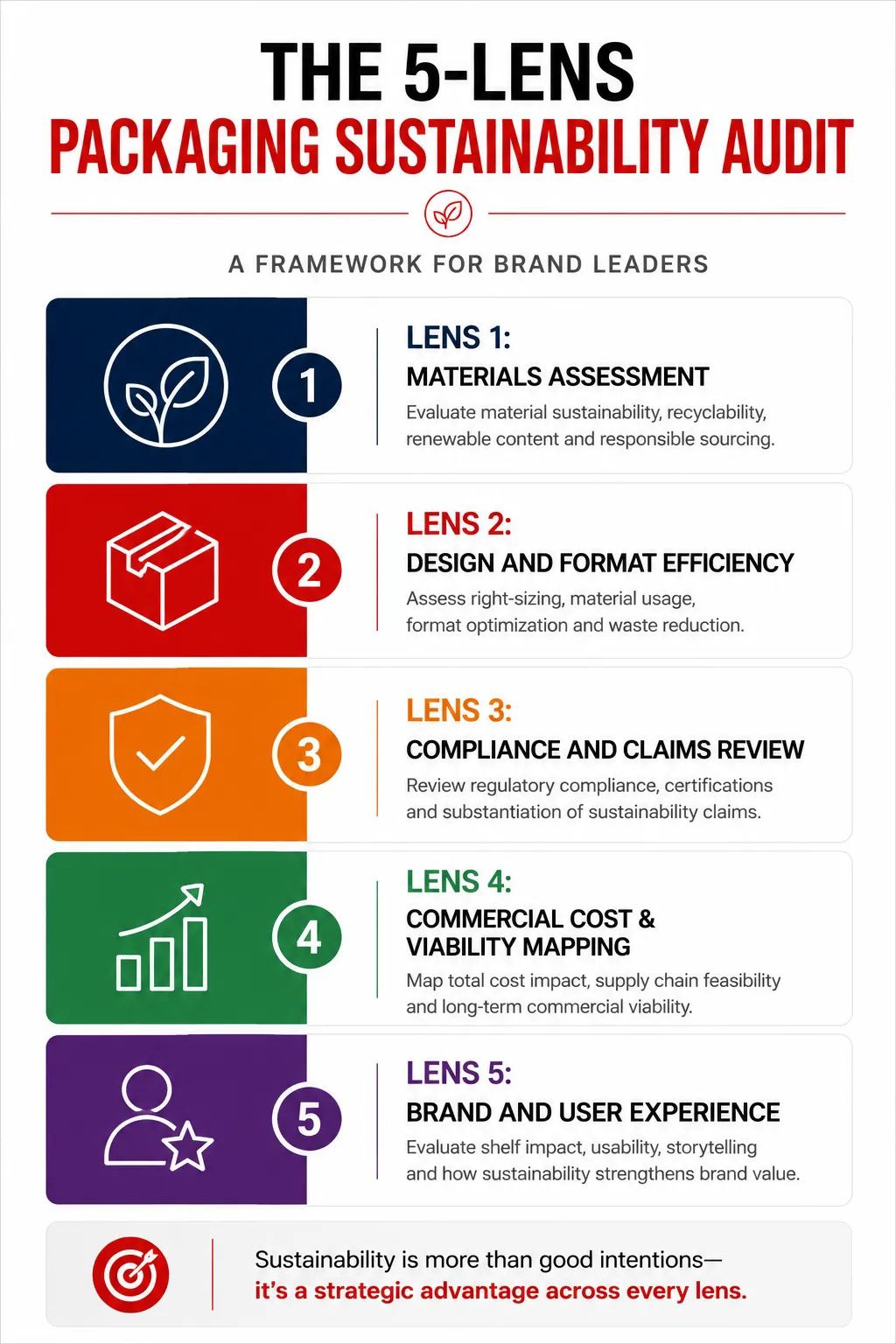
Most sustainability audit frameworks give you a checklist, we give you a decision architecture.
The 4-Lens Packaging Sustainability Audit evaluates your packaging system across material, design, compliance, and commercial dimensions simultaneously.
This lens measures what goes into your packaging and what happens to it after disposal.
❓Key questions this lens answers:
You need to assess theoretical recyclability against operational recyclability. A package labeled "recyclable" based on material properties may be completely unrecyclable in your customer's location if the local infrastructure doesn't support it.
This is especially relevant for India. India's packaging labeling requirements are clear that claims must reflect actual conditions, not best-case scenarios.
A mono-material HDPE container is recyclable in most metros. The same claim on a multi-layer laminate sachet is not defensible anywhere.
This lens examines form, structure, and weight. It has the most immediate commercial impact
Design efficiency is structural. An oversized box isn't just a waste problem. It raises your DIM weight shipping costs, signals carelessness to consumers, and inflates the cost of every unit you move. The design lens quantifies all of this.
❓Key questions this lens answers:
The Volume-to-Value Ratio: One useful metric for this lens is the ratio of packaging volume to actual product volume.
A high ratio, anything above 2:1, is both an environmental signal and a logistics cost indicator. It means you're moving more air than product, and paying for it.
A D2C food brand using standard off-the-shelf cartons across all SKUs regardless of size will will have a volume-to-value ratio of 3:1 or higher on their smallest products. Right-sizing alone can reduce material cost by 15-25% and void fill requirements by over 50% with no change to product protection.
The design lens also evaluates how packaging communicates sustainability to the consumer.
Natural textures, minimalist layouts, and visible material honesty. Like kraft paper shows its grain, glass shows the product. All score higher in consumer sustainability perception than a green-colored wrapper with vague eco claims.
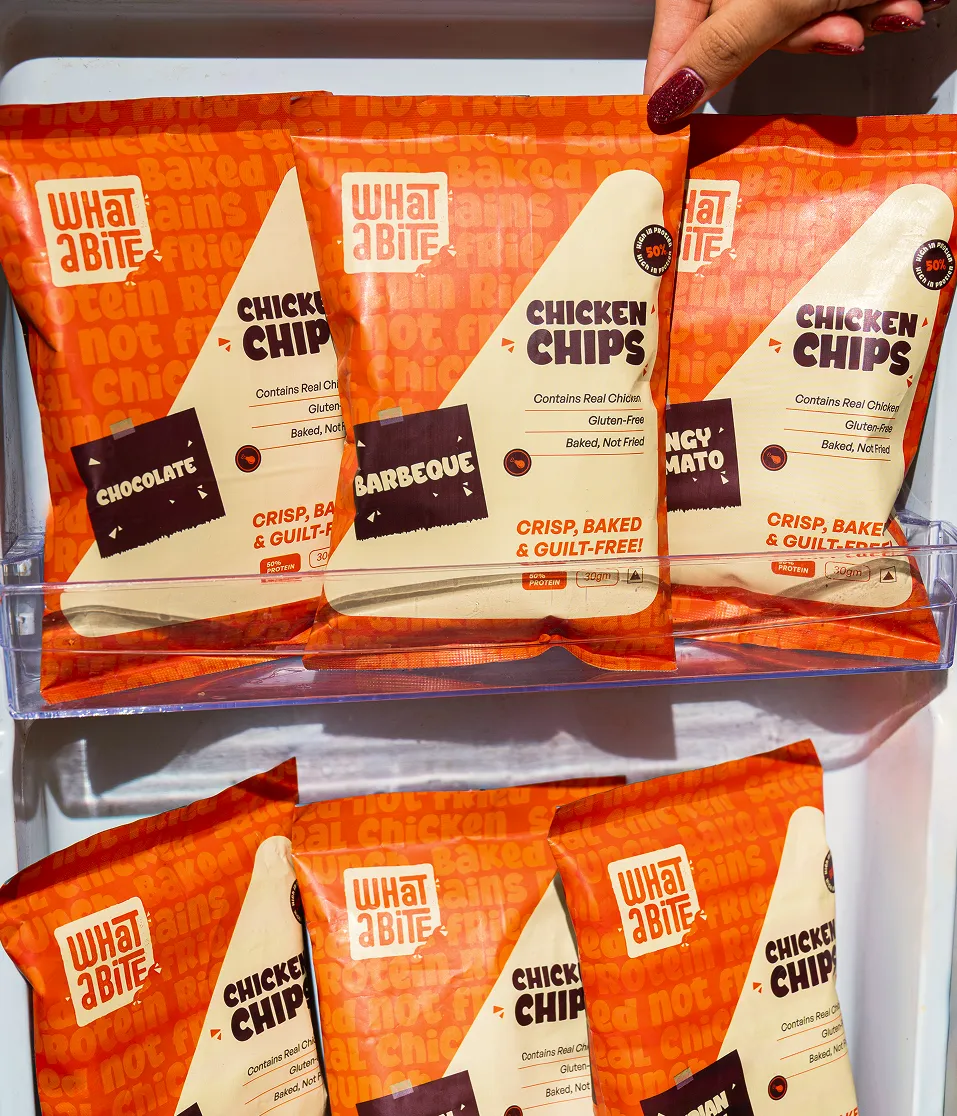
Example: In our What A Bite packaging work, format efficiency and visual communication were addressed together. The packaging structure was simplified to reduce material, while the design system was built to communicate product quality and brand character simultaneously.
Sustainability claims on packaging are now legal statements, and they are being scrutinized.
The compliance lens audits every claim on your packaging against the evidence that supports it and against the regulatory frameworks that govern what you can and cannot say.
❓Key questions this lens answers:
India's Advertising Standards Council (ASCI) guidelines on environmental claims require that sustainability assertions be specific, accurate, and capable of substantiation. Vague terms like "eco-friendly" or "green packaging" without qualifying evidence are considered potentially misleading.
Example: A personal care brand labels its packaging “100% recyclable,” but an audit finds the reseal strip uses a different plastic that makes the entire package non-recyclable in standard curbside systems. The issue is caught before 50,000 units go to print.
Sustainability and cost reduction are more aligned than most brands assume.
This lens quantifies where they intersect and makes the internal business case for audit-driven changes.
❓Key questions this lens answers:
DIM (dimensional) weight pricing means that every cubic centimeter of empty space inside a package has a direct logistics cost. For e-commerce and quick commerce brands, oversized packaging is a double cost: you pay for the excess material, and you pay for the air it encloses in every shipment.
According to Paramount Global's packaging audit research, companies that simplified their packaging layers saw immediate material cost reductions with no impact on product protection. The commercial lens makes these opportunities visible by attaching numbers to each finding.
This lens evaluates how packaging changes affect perception, usability, and purchase behavior.
❓Key questions this lens answers:
A matte paper tube may align with your carbon goals. But if it feels flimsy, tears on opening, or leaks in transit, consumers will not reward the intention.
They will punish the experience. Sustainability cannot win against frustration.

Our experts can help you do it right!
Book A Call
A packaging sustainability audit is most useful when it produces a design-ready brief, not just a compliance report. These seven steps move you from inventory to action.
List every packaging component used across every SKU:
Include both outbound packaging (what you ship to customers) and inbound packaging (what arrives from your suppliers).
Most brands have never seen their complete packaging footprint in one view. This step alone can tell you a lot.
Many brands discover duplicate components, redundant layers, and inconsistencies across SKUs that nobody had noticed because nobody had looked at the full system at once.
For multi-SKU brands, a clean FMCG packaging brief structure helps organize this inventory systematically, especially when packaging varies significantly across product lines.
For every component in your inventory, record:
The end-of-life classification must reflect actual infrastructure in your key markets. Check what is accepted by municipal collection systems in the cities where the majority of your consumers live. A package recyclable in Mumbai under one collection system may not be accepted in Surat or any tier-2 market.
The WBCSD Packaging Sustainability Assessment framework provides a globally accepted reference for environmental assessment that supports this classification step.
Flag any multi-material components like where two or more material types are permanently bonded as potential recyclability liabilities.
These require priority attention in the redesign brief.
For each SKU, measure the internal volume of the shipping package against the volume of the product it contains.
Any ratio above 2:1: two units of packaging volume per unit of product, is a priority redesign candidate.
Calculate what percentage of total shipment weight is packaging material versus product. Categorize all void fill by type: paper, air pillows, foam, crinkle paper.
In our experience at Confetti Design Studio, we have seen brands get the fastest commercial wins using this step.
Right-sizing and void fill substitution are changes that can often be implemented within a production cycle, with no change to the product itself or to brand aesthetics.
Pull every sustainability claim currently printed, embossed, or labeled on your packaging.
Cross-check each claim against: material data from Step 2, any certifications held (and their expiry dates), and the applicable regulatory standard for that claim in each market where the product is sold.
Any claim that cannot be substantiated with data is a liability.
Either it gets removed, replaced with a substantiated version, or the material reality changes to match it. There is no third option that doesn't create risk.
For Indian brands, label design compliance issues are already a frequent source of costly reprints and launch delays. Adding sustainability claim review to the standard label audit helps catch these issues before they become problems.
If you sell across states, regions, or countries, list the applicable EPR or extended producer responsibility regime for each.
For India: the Plastic Waste Management Rules 2022 apply nationally, but enforcement priorities and collection infrastructure vary by state.
For brands exporting to the EU or UK, separate EPR regimes apply with distinct reporting timelines and fee structures.
Identify your reporting deadlines, registration requirements, and whether your current material portfolio attracts penalty fees under each regime. EPR laws typically require brands to report on packaging materials, pay fees based on recyclability and volume, and maintain documentation, all of which require the material data assembled in Step 2.
Not every audit finding requires equal urgency or equal resources.
Create a simple 2x2 prioritization matrix: impact (environmental plus commercial) on one axis, ease of change (effort and investment required) on the other.
✔️Quick wins:
High-impact, low-effort changes. Right-sizing a top SKU, switching void fill type, updating an unsubstantiated label claim. These can typically be actioned within one production cycle.
✔️Medium-term projects:
Material substitution, redesign of a high-volume SKU, EPR registration in a new market. These require planning and investment but deliver measurable environmental and commercial returns.
✔️Strategic redesigns:
Complete packaging system overhaul, format change, structural innovation. These sit in the high-impact, high-effort quadrant and belong on a 12-18 month roadmap.
The prioritization matrix is what converts an audit from a document into a workplan.
The audit output isn't a compliance report to file away. It is a brief for your packaging design team.
Specify:
Attach commercial rationale like cost savings, DIM weight reduction, EPR fee reduction to each recommendation. Define who owns each workstream and when it needs to be complete.
This step is where most brands lose the value of the work they've done. The audit findings sit in a spreadsheet and don't translate into designed outcomes. Building the redesign brief as the final audit deliverable prevents this.
Understanding how a packaging design strategy should be built helps frame what the brief should prioritize and how to brief a design partner effectively once the audit is complete.
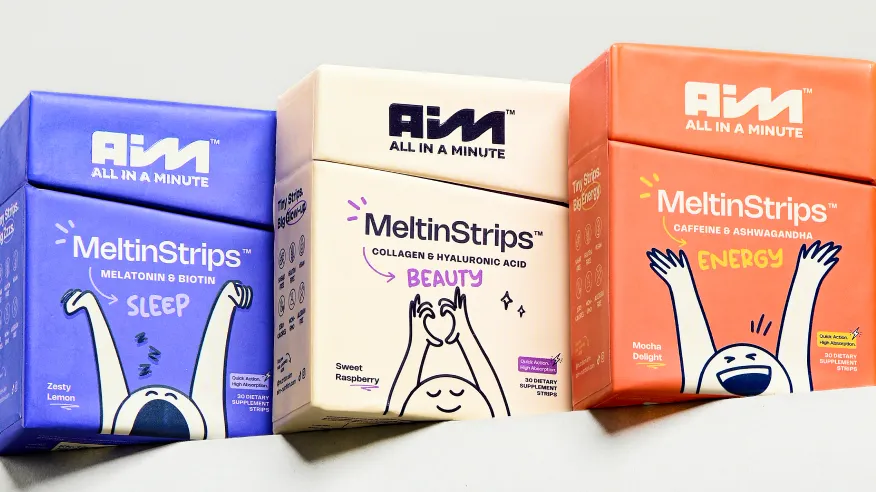
Most packaging audits are run by procurement teams or sustainability consultants who have no design capability.
The recommendations they produce are often technically correct but commercially unusable.
For example, a suggestion that says "Switch to mono-material packaging" is sound but becomes complicated the moment you ask how it affects shelf presence, structural integrity, the unboxing experience, or the printing constraints of your current supplier.
So, as branding and packaging design experts, we answer a different question: “What packaging changes will deliver sustainability outcomes without destroying brand value or commercial viability?”
At Confetti, we embed sustainability assessment within a broader packaging diagnostic. We evaluate packaging across four dimensions: cost, design effectiveness, structural performance, and sustainability compliance.
This helps us identify what is working, what is creating waste, and what may be impacting sales or operational efficiency.
Sustainability is assessed alongside shelf impact, manufacturing realities, supply chain constraints, and consumer usability. A packaging change that reduces carbon but increases damage rates or customer friction is not a viable solution.
Our audits bring together perspectives that are often evaluated in isolation.
We combine procurement insights on material costs and supplier availability, operations input on line efficiency and transit performance, brand considerations around perception and user experience, and compliance review of regulatory requirements and sustainability claims.
The result is a cross-functional decision-making tool rather than a standalone sustainability report.
We deliver a prioritized roadmap focused on implementation. This includes:
Each recommendation includes cost implications, operational considerations, regulatory rationale, and brand impact assessment.
Our work on ITC Bingo's packaging, Pawsible Foods, and The Indus Valley reflects how material and structural decisions get made when brand stakes are high and format constraints are tight.
Here’s a quick reference checklist for brand reviewing packaging sustainability before a redesign, relaunch, or retailer onboarding.
A quick reference tool for brand and marketing teams reviewing packaging before a redesign, relaunch, or retailer onboarding.
✅ List every packaging component for each SKU: primary container, secondary carton, labels, inserts, void fill, tape, and seals
✅ Write down the material type for each component
✅ Note the weight of each component in grams
✅ List every market where the product is currently sold
✅ Write down every sustainability claim on your packaging, word for word, exactly as printed
✅ Record the recycled content percentage for each component
✅ Flag every multi-material or laminated component, these are almost always non-recyclable
✅ Verify recyclability against actual collection infrastructure in your key markets, not just what the material is technically capable of
✅ Check whether "compostable" materials require industrial composting, and whether that facility exists where your customers actually live
✅ Confirm inks, adhesives, and labels don't contaminate the recyclability of the packaging they're applied to
✅ Check whether you're using virgin plastic where a recycled alternative exists at a comparable price
✅ Calculate your volume-to-value ratio; how much of your package is air versus product. Anything above 2:1 needs attention
✅ Identify what void fill you're using and how much of your shipment volume it takes up
✅ Flag any polystyrene or foam void fill immediately; switch to paper or right-sizing
✅ Check whether secondary packaging is doing a job or just adding material
✅ Confirm disposal instructions on pack are visible, specific, and something a consumer can actually act on
✅ Check that recyclability symbols include resin identification codes; generic recycling arrows without codes are not sufficient
✅ Assess whether your packaging design visually communicates your sustainability position or contradicts it
✅ Cross-check every sustainability claim on pack against your actual material data
✅ Verify "recyclable" claims cover every single component — not just the primary container
✅ Replace vague claims like "eco-friendly" or "green packaging" with specific, verifiable language or remove them
✅ Confirm "compostable" claims reference the applicable standard: IS 17088 for India, EN 13432 for EU markets
✅ Check all certifications printed on pack are current and not expired
✅ Confirm your plastic packaging is registered under India's PWM Rules 2022 and your PRN is obtained from CPCB
✅ Verify your EPR targets are calculated and a compliance plan is in place for this financial year
✅ Check that no single-use plastic categories banned under Indian regulations appear anywhere in your packaging
✅ List your top 3 changes that can be made within one production cycle: right-sizing, void fill switch, claim update
✅ Identify which SKUs need a structural or material redesign within the next 6–12 months
✅ Calculate the logistics cost penalty from oversized packaging: DIM weight charges add up faster than most teams realise
✅ Estimate EPR fee exposure based on your current plastic packaging volume
✅ Flag any claim that cannot be substantiated with supplier documentation, these are reprint and liability risks
✅ Turn your findings into a one-page brief before approaching your design team
If your audit is surfacing issues that need a packaging design solution, our team at Confetti works with FMCG and D2C brands to translate packaging audit findings into packaging that performs.
A packaging sustainability audit can itself become a greenwashing instrument if used selectively.
This happens when brands audit only the components they know will score well, then publish those findings without addressing the full system.
Research from 2023 on consumer responses to sustainability claims found that claim-fact discrepancies: where sustainability claims outrun actual product performance, lead to perceptions of greenwashing and deception.
The consumer impact is direct: purchase intention drops, and brand trust erodes.
The most common greenwashing patterns a rigorous audit should surface and eliminate:
❌The single-component exception: Claiming a package is "100% recyclable" when one component, a liner, a seal, a cap, is non-recyclable and contaminates the recycling stream for the entire unit.
❌The infrastructure disconnect: Using "compostable" claims on materials that require industrial composting facilities to degrade. In India and across most consumer markets, industrial composting infrastructure is not accessible to the average consumer.
❌The virgin plastic pivot: Reducing plastic weight by 10% and calling it a sustainability milestone while the absolute volume of plastic per SKU has increased due to higher sales volumes. Weight reduction claims should always disclose absolute volumes.
❌The selective highlight: Switching to kraft paper outer packaging while keeping the inner structure unchanged, then marketing the kraft paper change as the brand's sustainability initiative.
Our audit of Phool's packaging is a useful reference case here. Phool is a brand built on a genuinely sustainable supply chain, incense made from temple flowers.
The audit evaluates whether the packaging system supports and communicates that sustainability story honestly, and where there are gaps between the brand's values and what the packaging actually delivers.
That's what the greenwashing lens of a sustainability audit is for: not to catch brands lying, but to catch the gap between intent and execution before consumers or regulators do.
What is a packaging sustainability audit?
A packaging sustainability audit is a structured review of your entire packaging system including materials, formats, sourcing, and end-of-life pathways to identify environmental impact, regulatory compliance gaps, and cost inefficiencies.
For brands, it also functions as a design brief: the findings should directly inform packaging redesign decisions across all SKUs, not just generate a compliance report.
How often should a brand conduct a packaging sustainability audit?
At minimum, annually. More practically: before any major packaging redesign, before entering a new retail or quick commerce platform, whenever EPR regulations change in a market where you sell, or when launching a new product line.
For fast-growing D2C brands adding SKUs regularly, building the audit into the product development process produces better outcomes at lower cost.
What is the difference between a packaging audit and a packaging sustainability audit?
A standard packaging audit typically covers supply chain efficiency, material costs, and quality control. A packaging sustainability audit focuses specifically on environmental performance like material composition, recyclability, carbon impact, and regulatory compliance.
A combined packaging sustainability audit integrates both: it quantifies environmental performance while identifying the commercial and design opportunities that improvement creates.
What do brands discover in a packaging sustainability audit?
Common findings include: oversized packaging with measurable void fill cost and DIM weight penalties; multi-material components that contaminate recycling streams; on-pack sustainability claims that don't meet current regulatory standards; and EPR obligations that haven't been mapped or registered.
Is a packaging sustainability audit relevant for small or early-stage D2C brands?
Yes and in some ways more immediately impactful than for large brands. Small brands have simpler SKU sets, faster decision cycles, and more direct consumer relationships.
A single audit can identify material and format changes that simultaneously reduce cost per shipment and build genuine sustainability credibility with an audience that's actively evaluating brands on these criteria.
Want strategic branding and packaging like this for your business?





.webp)
.webp)


.webp)
.webp)
.webp)
.webp)
.webp)







.svg)
.webp)