%201.webp)
02
AI Snaps
.svg)
.svg)
01
Our Work
03
About Us
04
Brand Audit
05
Contact Us
06
Client Success
12
07
Blogs
08
Careers
Book A Call
.svg)



.svg)
Need Help In Building Your Brand?
Click the button below & book a call with our founder directly.

Rishabh Jain
Managing Director
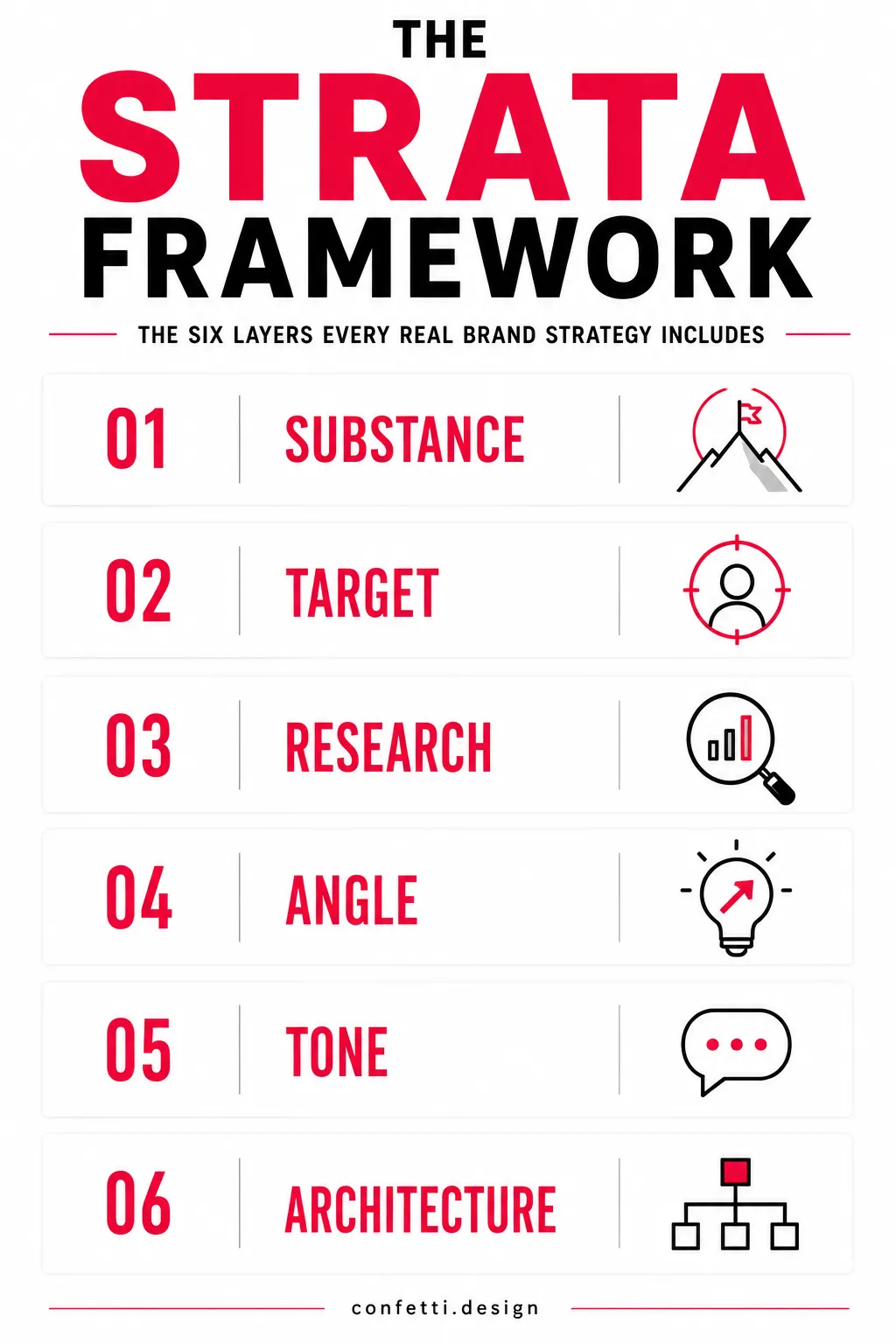
Brand strategy includes 6layers of decisions: purpose, audience, research, positioning, voice, and architecture, that must get documented before beginning any design work.
Our guide here breaks each layer down using the STRATA structure. We cover what a real strategy deliverable looks like at every step.
Brand strategy helps you determine who a brand is for, what it claims, and why that claim beats the alternative.
A brand strategy is a layered system and each layer depends on the one beneath it. When you skip a lower layer, everything built on top destabilizes.
STRATA structures brand strategy as six interdependent layers, built bottom-up. Each layer answers a specific question, and each layer must be resolved before the one above it can hold.
SUBSTANCE:
❓Why does the business exist beyond revenue
This layer defines your purpose, vision, mission, and values, the operating principles that won't flex under pressure. Without Substance, everything above it lacks gravity.
TARGET
❓Who exactly are you for
This is not demographic sketching. It is behavioral and category-specific audience definition with detailed personas that reveal decision drivers, pain points, and channel habits.
RESEARCH
❓Where are the market's gaps and clichés
Competitive and category analysis grounds your strategy in reality. You cannot position against nothing.
ANGLE
❓What is your claim, and why can't a competitor credibly make the same one
This is positioning and differentiation the single most leveraged decision in the entire framework.
TONE
❓How does the angle sound and feel once it's said out loud
Personality, archetype, voice, and messaging architecture translate positioning into human communication.
ARCHITECTURE
❓How does the strategy hold together across products, sub-brands, and time
Brand architecture, naming systems, and governance ensure consistency and scalability.
One of the first things brand strategy must include is Substance. It defines the foundational truths that guide every decision, from product development to which partnerships you reject.
This is the layer that defines your brand’s purpose, vision, mission, and values:
👉Purpose is why the company exists beyond making money, the underlying reason your brand would still matter if profit weren't the goal.
Patagonia's purpose, for instance is that the company is in business to save its home planet, is the clearest working example in branding.
👉Vision is the future state you're aiming at. It is forward-looking and usually time-bound in spirit even when it isn't in wording.
For example, Ikea's vision, to create a better everyday life for many people. This sets a destination that influences its pricing, accessibility, and product design decisions.
👉Mission is what the company does today to move toward that vision.
Nike's mission, to bring inspiration and innovation to every athlete in the world, defines the current scope of the business, who it serves and what it does for them. It guides product and marketing decisions for the brand.
👉Values are the behavioural rules that govern how your company operates while pursuing the mission. They should be specific enough to be enforceable.
✅Your Stress-Test Checklist
Before you sign off on the Substance layer, put your agency’s work through a rigorous reality check:
The Logo Swap:
Ask the agency to swap your logo out of the Purpose statement and insert a competitor’s. Read it again. If it still sounds equally true for your competitor, it’s not specifically enough and needs revision.
The ‘No’ Test:
Ask for one concrete example of a decision your Values statement would say no to. “We value transparency” says no to nothing. “We publish our supply chain even when it’s uncomfortable” says no to hiding a bad sourcing decision. If they can’t give you a specific example, the statement hasn’t been stress-tested.
The New Hire Rule:
If you are a founder juggling growth pressure, ask your agency to write the Substance layer so it is clear enough to be handed to a new hire six months from now. It should equip them to push back on a partnership or shortcut that doesn’t fit.
Substance is a filter that saves you from the wrong partnerships, the wrong hires, and the wrong shortcuts.
If the persona slide in your agency's deck says "25 to 35, urban, health-conscious, middle to upper income," stop the meeting.
A persona defined only by age, income, and city tells you who might buy the product. It won't tell you why, when, or what would stop the sale, and that's the part you're paying an agency to figure out.
Two buyers can share that exact profile and behave completely differently at checkout.
For example, one is scrolling Blinkit at 11pm because she forgot dinner, the other planned her order on Sunday with a list already made.
Your agency should be able to tell you which one they built your strategy around, and why.
A real actionable persona should tell you:
👉Category habit: how often does this buyer purchase in your category, and what does that mean for how price-sensitive they are. Ask your agency to show you why this changes your pack messaging.
👉Price sensitivity band: does this buyer trade down for price or pay for trust. If your agency can't tell you which one you're building toward, ask them directly, because running a discount-heavy launch while your positioning claims premium trust means the two decisions are working against each other.
👉Primary purchase trigger: is this buyer replenishing on autopilot, buying on impulse, or solving a specific problem right now. This should visibly change what the agency recommends for your pack-front hierarchy.
👉The one competitor they're actually comparing you against: the single name in the buyer's head at the moment of decision. If your agency's competitive analysis names ten competitors and never narrows to the one that matters for this specific buyer, ask them to narrow it before you approve the deliverable.
✅Your Stress-Test Checklist
Ask for the source:
Where did this persona data come from? Real customer interviews or platform behavioural data? Or is it a founder’s assumption dressed up with a stock photo? A guess with a name attached isn’t research.
The Copywriter Test:
Ask yourself: “If I handed this persona to a new copywriter with zero context, could they write a compelling product description from it?” If the answer is no, it’s not finished.
A list with five or six logos, price points, and follower counts, is an inventory, not research.
What should actually be getting is a list of which words and claims in your category have become invisible, phrases every brand repeats so often that buyers have stopped registering them as claims at all.
For example, in the protein snacking category, "high protein, low sugar" was a genuine differentiator once. It isn't anymore, because nearly every brand on the shelf leads with some version of it.
If your agency's positioning recommendation for you still leans on a claim like that, ask why, because it means the category-saturation work either wasn't done or wasn't applied.
👉What to ask for before you accept this deliverable:
✅The Stress-Test
Check “If we stripped our logo off and ran this research blind, would we still be able to identify which category we are in?” If the answer is yes, the research hasn’t gone deep enough. Generic research yields generic strategy. You need specificity that exposes where the white space actually is.
👉Positioning is the claim your brand makes about where it stands in the buyer's mind relative to every alternative.
👉Differentiation is what makes that claim ownable rather than interchangeable with the brand next to it. Together, they're the layer every branding conversation calls "the core" of brand strategy,
If your positioning statement reads like "premium, natural, for health-conscious consumers," that’s a category description.
A real positioning statement must answer four things: who it's for, what it delivers, why that matters, and why it's different from the alternative.
For example, two D2C snack brands can launch a roasted makhana line with near-identical ingredient decks, same protein, same low oil, same clean-label claims, and still end up with completely different positioning.
One claims portion-controlled protein snacking for people managing their diet with intention, its tone leans clinical, its pack copy talks in grams and macros.
The other claims the snack tastes good enough to not feel like a health decision at all, its tone leans playful, its pack copy talks in flavour and craving.
Same product, opposite angle, and everything related, tone, pack hierarchy, category comparison, diverges from there.
✅The Swap-Test
Take the line written for your brand, and swap your brand name for your closest competitor's. Read it out loud. If it still sounds true, you must find the gap that only your brand can fill, that's what you're paying for in this phase.
What to do while hiring a branding agency:
Tone is how your brand sounds and feels once the angle is said out loud. A brand personality is built from 3-5 voice attributes, each on a spectrum. Formality, optimism, humor, confidence, warmth, energy.
👉Personality is who your brand would be if it were a person at a dinner party, would they hold court or ask questions, crack jokes or speak carefully.
👉Archetype, borrowed from Jungian psychology and widely used in branding, groups that personality into a recognisable pattern, the Hero, the Sage, the Outlaw, the Caregiver, twelve in total.
For example, Nike leans Hero, built around achievement and pushing limits. Dove leans Caregiver, built around reassurance and acceptance. Archetype gives you an emotional register to write in.
👉Voice is where that register becomes usable. It governs sentence length, formality, humour, whether you say "you" or keep distance, whether a copy reads like a friend or an institution.
👉Messaging architecture is where tone becomes operational, the actual deliverable a copywriter or social media manager works from. It needs 3 tiers:
✅What to Demand from Your Branding Agency
Ask to see the exclusion list explicitly. If it isn’t in the deliverable, ask them to write it. Knowing what you won’t say is as important as knowing what you will.
Ask for three sample lines of copy in the recommended voice. Check them yourself against the assigned archetype. If a Hero-archetype brand’s sample copy sounds soft and reassuring, flag the mismatch before it reaches your creative team.
Ask: “If I gave this messaging architecture to a new copywriter with zero brand context, would they produce on-brand copy?” If the answer is no, it’s not finished.
👉Brand architecture Architecture is the structural decision behind every product you sell: does your next launch live under your existing brand name, or does it need its own identity?
👉Naming systems keep every new SKU consistent as your range grows.
👉Governance is the written rule for who can approve a brand extension and what must stay fixed.
If you’re a single-SKU brand right now, you may not feel the need for it, but honestly, you will.
Three models your agency should walk you through, and what to ask about each:
Branded house (one master brand, like Google across Maps, Drive, and Photos) fits if your next products share the same category logic as your first.
Ask your agency to confirm this is genuinely your situation.
House of brands (independent identities, like P&G's Tide, Pampers, and Gillette) fits when your next product serves a different audience or price tier.
If you're planning to launch into a category with no logical connection to your current one, e.g., a snack brand entering skincare, ask your agency directly whether that product needs its own identity. If they don't raise this themselves, raise it yourself.
Endorsed brands (like Courtyard by Marriott, borrowing trust from the parent) fits when a new sub-brand needs credibility but also needs room to build its own identity.
What to ask for before you approve this section, or before you sign a contract that doesn't include it:
A complete brand strategy engagement delivers a document that contains the following components with sufficient depth to be actionable:
👉Positioning Statement
This is the core claim, who you are for, what you deliver, why it matters, and why you are different. It is an internal guide that passes the swap test. A positioning statement should be concise, niche-specific, and clearly differentiate from competitors.
👉Audience and Persona Documentation with Behavioral Detail
It includes category habits, price sensitivity bands, primary purchase triggers, and the specific competitors your audience compares you against. It answers who your brand is for and who it is not for. Most engagements produce 2–4 detailed personas.
👉Messaging Hierarchy with Defined Exclusions
Primary claim, supporting proof points, and explicit "never claim" list. A core messaging guide should include 3–5 key messages for copy, social and landing pages.
👉Brand Personality and Archetype Rationale
The reasoning behind why this personality fits your positioning and category context. Voice attributes with guardrails for what you are.
👉Naming and Architecture Guidance (if relevant)
The structural model for your portfolio, branded house, house of brands, or endorsed brands with naming conventions that let the brand scale without a rebuild.
👉Research Summary
A diagnostic summary showing the competitive and category analysis that led to the conclusions. This is not decorative. It is the evidence base that makes the positioning defensible.
👉Executive Summary (1 page)
A concise overview of the entire strategy for stakeholders who need the headline.
👉Visual Language Principles (depending on scope)
Guidance on how the strategy translates into visual identity, sometimes included in the strategy phase, sometimes delivered in a separate identity engagement.
👉Measurement Dashboard (if applicable)
A framework for tracking whether the strategy is working, key metrics, reporting cadence, and success criteria.
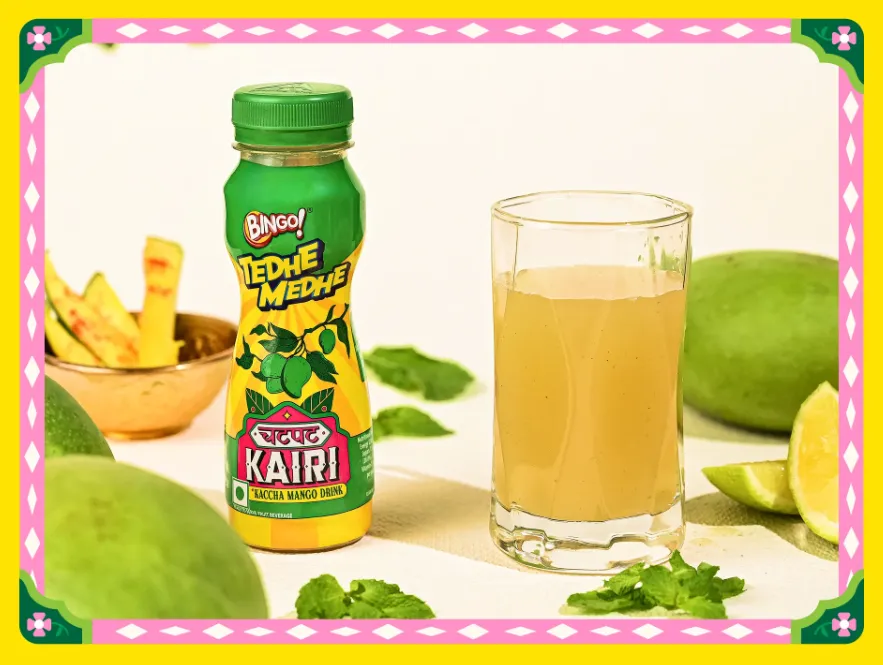
We treat brand strategy as infrastructure. Every layer in the STRATA framework above is a stage we actually run.
Our Process in Practice
Substance and Target come from research, never from assumptions. Angle gets stress-tested against direct competitors before it's signed off, if it fails the swap test, it goes back. Architecture gets planned even for single-SKU brands, because most of them won't stay single-SKU for long.
We work with FMCG, D2C, and retail brands across India, the USA, the UK, Australia, and the UAE. Category-saturation research in the Research layer usually has a directly comparable project behind it; we've seen which claims have gone invisible across multiple categories.
Our Four-Stage Framework: Lock, Flex, Navigate, Scale
Timeline and Deliverables
The strategy-to-packaging timeline from Confetti is usually six weeks from brand strategy through final packaging design. In that time, we move from brand story and positioning to logo and visual identity to packaging design and production-ready artwork.
📌For our work on ITC Bingo Chatpat Kairi, the brand strategy phase did the heavy lifting before any design happened. The category-saturation research identified that beverage packaging in India was dominated by a western design grammar.
The Angle was built around Indian truck art and cultural nostalgia. The Tone followed: loud, summery, bilingual, with Devanagari script and bold English lettering fused together. The Architecture planned for a beverage extension under the Bingo master brand.
Here are six proven models to structure your brand strategy, each with a distinct function and application.
.webp)
A PESTLE analysis helps you understand the external forces that shape your market before you define your brand position .
Political Factors:
What is the current political landscape? Are there any trade agreements or regulations that could impact your business? What are the tax incentives or disincentives for your industry?
These are all important questions to consider when formulating your brand strategy.
Economic Factors:
What is the state of the economy? Are interest rates high or low? What is inflation like? What is the unemployment rate?
These economic indicators will have a direct impact on your business, so it’s important to understand where they’re heading in order to make sound decisions about your brand strategy.
Social Factors:
What are social trends? What demographics are you targeting? What are their buying habits? What motivates them?
Understanding these will help you better target your marketing efforts and make sure your brand resonates with your audience.
Technological Factors:
What new technologies are emerging that could impact your business? Are there any changes in the way people are using technology that you need to be aware of?
Keeping on top of these trends helps you make sure your brand is using the latest and greatest technology to reach its target audience.
Legal Factors:
Are there any new laws or regulations that could impact your business? What about changes to existing laws?
It’s important to stay up-to-date on these developments in order to ensure compliance with any applicable regulations.
Environmental Factors:
What is the state of the environment? Are there any trends that could impact your industry?
For example, if you’re in the fashion industry, you’ll want to stay on top of trends like sustainable fashion in order to make sure your brand is perceived as eco-friendly.
.webp)
SWOT analysis assesses internal strengths and weaknesses alongside external opportunities and threats. It is a situational tool that helps you identify where your brand has leverage.
A SWOT analysis is most useful early in the strategy process, before you define positioning. It ensures your brand strategy is grounded in reality rather than aspiration.
For example, if your analysis reveals a weakness in distribution and a threat from a new competitor entering your category, your strategy might prioritize channel partnerships over new product development.
.webp)
The Brand Pyramid structures your strategy from foundation to execution:
This model works well for brands that need to articulate their full strategy in a clear, hierarchical format. It is particularly useful for internal alignment because it forces clarity at each level before moving to the next.
.webp)
The Evolutionary Brand Cycle maps how customers move through stages of relationship with your brand: Awareness → Trial → Loyalty → Advocacy.
Each stage is an opportunity to build trust. This framework shifts focus from what you want to say to what your audience needs to experience at each phase .
Use this model when your challenge is customer retention rather than acquisition. It helps you diagnose where your brand is leaking trust and design interventions for each stage.
.webp)
The Marketing Sales Funnel shows how potential customers move from discovering a brand to becoming loyal customers.
It is a tactical deployment model.
This framework is useful when your primary challenge is conversion efficiency. It helps you match messaging and channel strategy to each stage of the funnel. However, it is a marketing structure so it should be derived from your brand strategy.
.webp)
The Experience Ecosystem puts the customer experience at the center of your brand strategy. It requires four elements:
1. A clear understanding of your target audience: Who are they? What do they need? What do they want? How can you serve them better than anyone else?
2. A differentiated value proposition: What makes your brand unique? Why should customers care about your products or services?
3. A consistent brand identity: Your branding should be recognizable and consistent across all touchpoints, from your website to your social media channels to the way you answer the phone.
4. An integrated approach to marketing: All of your marketing efforts should work together to create a seamless, cohesive customer experience that reinforces your brand messaging and delivers on your promises.
This framework is suitable when your brand competes on service, community, or omnichannel experience.
What does brand strategy include?
Brand strategy includes six layers: substance (purpose, vision, values), target audience definition, competitive and category research, positioning and differentiation, personality and messaging voice, and brand architecture. Together they form the decisions that every future design and marketing choice gets checked against.
What's the difference between brand strategy and a brand strategy framework?
Brand strategy is the actual set of decisions a specific brand makes. A brand strategy framework is the repeatable method used to arrive at those decisions like STRATA. The framework is the process and the strategy is the output that process produces for one brand.
Is a brand strategy the same as a brand identity?
No. Brand strategy defines what a brand stands for and who it's for, it's a document. Brand identity is the visual and verbal system (logo, color, typography, packaging) that expresses that strategy. Identity work follows strategy.
What's the difference between brand strategy and marketing strategy?
Brand strategy defines who you are and why a customer should choose you. Marketing strategy is the tactical execution, the campaigns, channels, and messaging used to reach people with that positioning. One is foundational and long-term; the other is deployment-focused and evolves constantly.
How long does a brand strategy engagement usually take?
Most focused brand strategy engagements run several weeks, covering research, positioning workshops, and messaging development before sign-off. Timelines extend with the number of audience segments, markets, or product lines involved, since each adds a layer of research and validation.
Do small businesses and startups need a full brand strategy?
Yes, though the depth scales down. A startup entering one category with one audience still needs positioning and a messaging hierarchy. Skipping straight to a logo means design decisions get made on aesthetic guesswork instead of a defined market position.
Want strategic branding and packaging like this for your business?





.webp)
.webp)


.webp)
.webp)
.webp)
.webp)
.webp)







.svg)
.webp)