%201.webp)
02
AI Snaps
.svg)
.svg)
01
Our Work
03
About Us
04
Brand Audit
05
Contact Us
06
Client Success
12
07
Blogs
08
Careers
Book A Call
.svg)



.svg)
Need Help In Building Your Brand?
Click the button below & book a call with our founder directly.

Rishabh Jain
Managing Director
Clothing tag and label design are small but important elements of your apparel brand identity.
This guide breaks down all you need to know about how you build a clothing tag system that works and strengthens your brand.
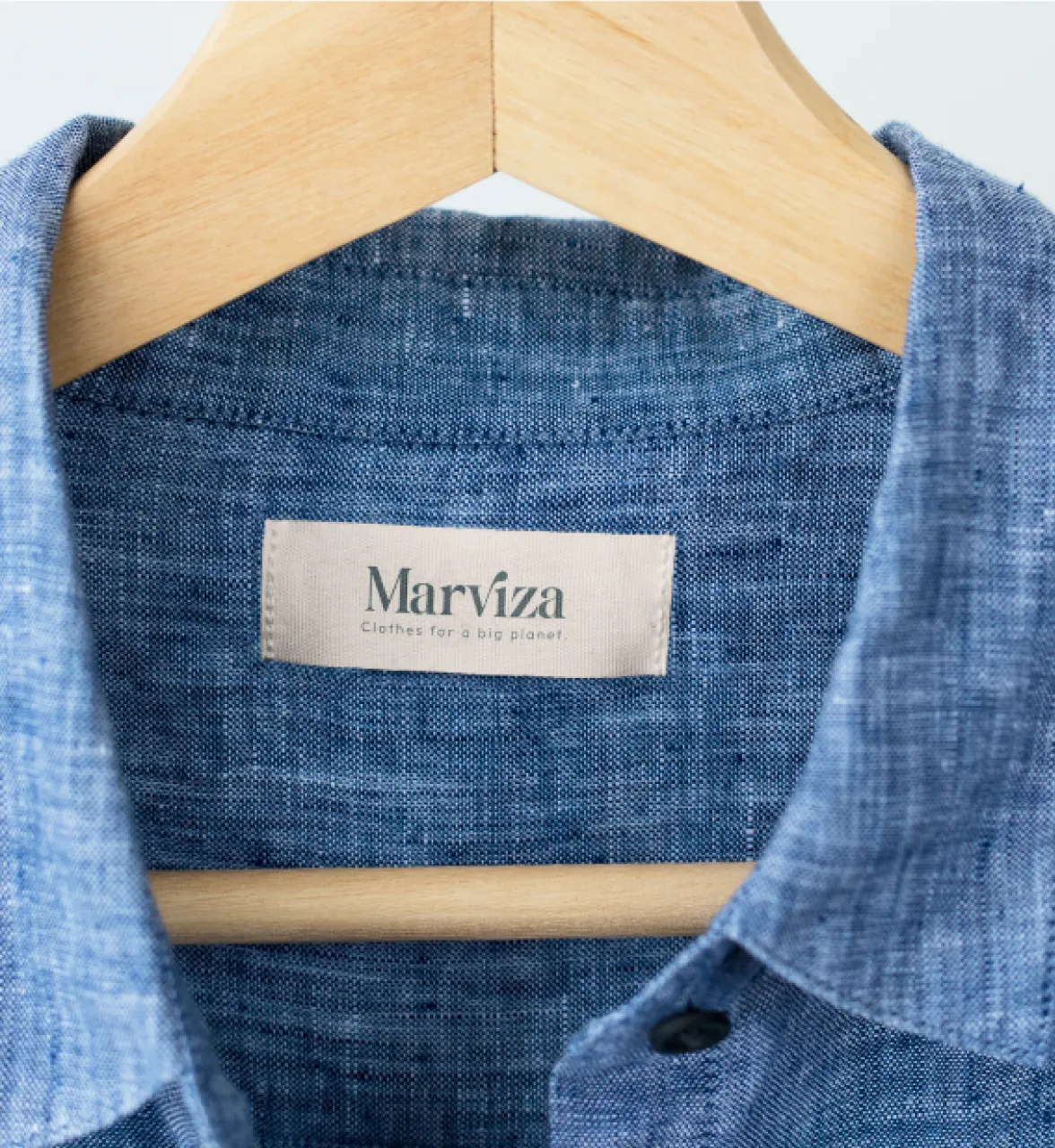
Clothing tags and labels form a small but important part of the brand identity system. Each solves a different purpose and communicates different things to your end buyer.
A garment usually carries anywhere between 4-7 separate tags and labels. Each is a physical touchpoint your brand has with a customer.
Everytime someone puts on your garment, takes it off, washes it, or puts it away, they interact with your label. Over the life of a single piece of clothing, that’s hundreds of interactions.
Label is a recurring physical reminder of the brand. So, its typography, proportions, material, construction and placement needs to relate to the wider visual identity.
The material and finish you choose should support the positioning of your brand and the price of the product.
Every element on the garment has different functions and should be planned separately.
Although a label or tag is no guarantee of a clothing piece well made, customers often use its physical and visual quality to overall assess your brand.
Imagine you pick up a premium t-shirt with good stitching and fabric, but a scratchy, badly cut label with inconsistent printing. You would assess it along with the entire t-shirt, as part of the same experience.
In contrast, a well-made woven label, clean typography, accurate colours, and comfortable construction will indicate that the product you are holding is consistent with the brand online or in-store.
This means you must consider label design alongside the garment itself.
Labels can carry more than a logo. They may tell you about the fibre composition, country of origin, care information, certifications, manufacturing details or a short brand message.
A garment that carries a recognised certification, it can act like a useful trust signal. Similarly, clear fibre-content information gives your customer something specific to evaluate rather than relying on claims.
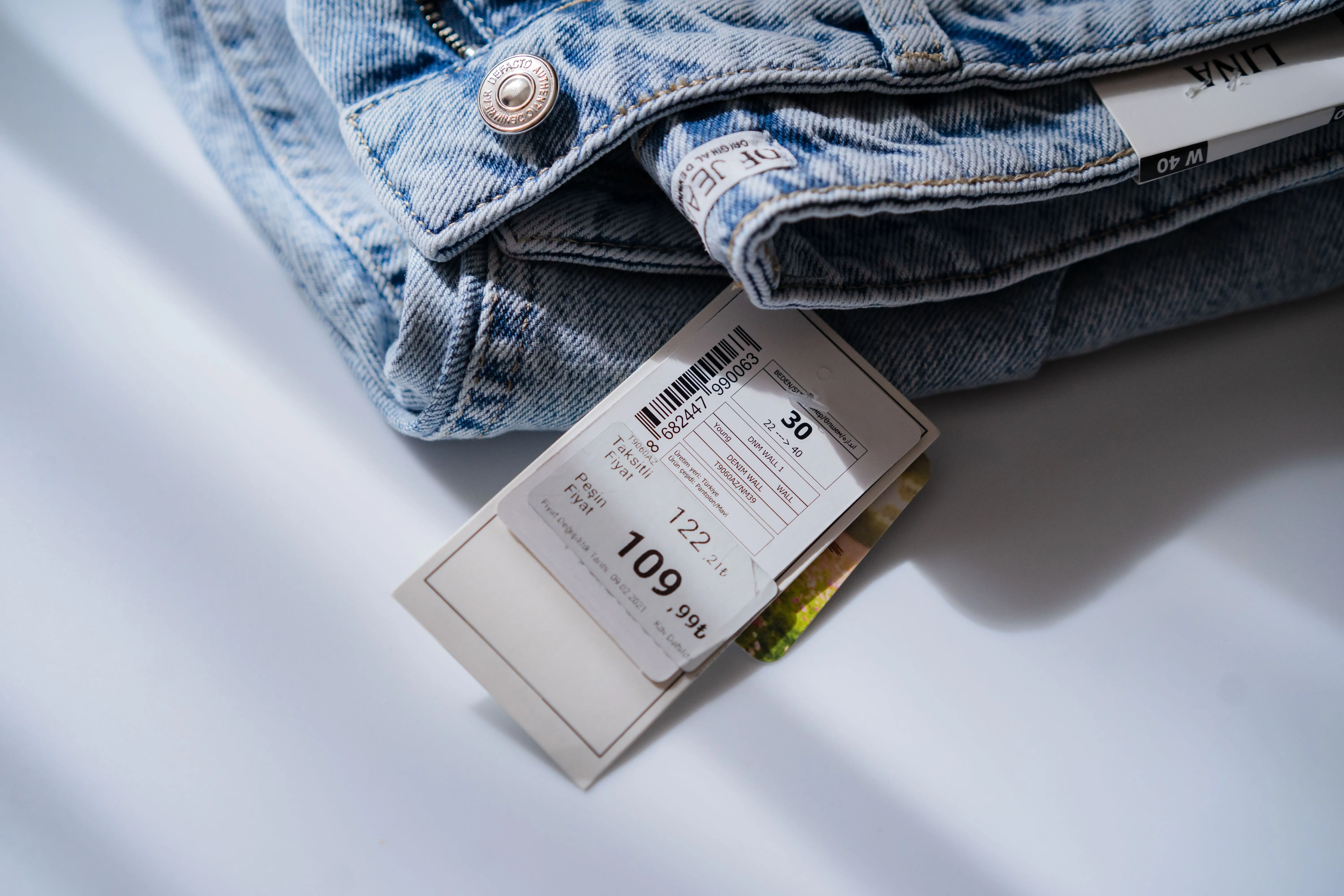
A clothing label system may carry several identification, information, and branding elements depending on the garment, market, sales channel, and regulatory requirements
1. Brand or neck label
It's usually sewn into the inside back neckline and is your garment's primary permanent brand identifier. It commonly carries the logo or brand name, with a tagline or other short brand element where space allows.
Keep this label focused.
Size, care instructions, fibre composition, and other required information can be placed on a separate label or combined with another permanent label where the rules allow it.
Match the construction to the garment.
Woven damask or satin labels are common for fashion apparel, while printed labels can be preferable where softness and low bulk matter, such as lightweight or sportswear garments.
2. Size label
Can be integrated into the neck label or placed separately, like at the side seam. A separate size tab makes the information easy to find without adding visual clutter to the main brand label.
If you sell across markets, you need to supplement the size system - XS, S, M, L, and XL by measurements or other information depending on the market and sales format.
3. Care label
This provides instructions for maintaining the garment, including relevant washing, bleaching, drying, ironing, or professional-care information.
This label needs to remain legible and attached through the life of the clothing.
In the US, for example, the FTC requires manufacturers and importers covered by the Care Labeling Rule to provide care instructions and attach them so consumers can find them.
Care instructions should also be based on the actual behaviour of the finished garment.
4. Fibre-content or composition label
States what the garment is made from, such as 100% cotton or 60% cotton, 40% polyester.The exact disclosure rules depend on the market you are selling.
In the US, covered textile products generally need the generic names and percentages of constituent fibres, subject to the rules' specific thresholds and exceptions. In the EU, textile composition must generally be stated in decreasing percentage order using the permitted fibre names.
This information needs to come from the garment's verified material specification.
5. Country-of-origin information
When a brand uses multiple factories or sources garments from different countries, this becomes very important. The origin should be verified against the actual production.
For example, US textile labelling rules require covered products to disclose country of origin, while customs requirements can also affect how imported goods must be marked.
6. Manufacturer, importer, or marketer information
Depending on the destination market, your clothing label may also need to identify the responsible business entity like the manufacturer, importer, or another responsible business. The specific rules governing how this identification is done varies between markets.
Make sure to establish compliance requirements before finalising the label artwork. The brand name customers recognise is not necessarily the same legal entity that must appear in a required disclosure.
7. Hem or exterior brand tag
From a branding perspective, a hem tag is optional. It is usually more relevant to some fashion categories, like streetwear, casualwear, and contemporary apparel.
Because it is outside of the garment, its size, placement, stitching, and contrast with the fabric should be done while designing the garment.
8. Hang tag or swing tag
The hang tag is removable and gives you more creative freedom. It can carry the product name, price, SKU, brand story, QR code, collection information, or other retail-facing content, subject to applicable requirements.
It is also the easiest element to change between collections or campaigns because it does not have to remain attached throughout the garment's life.
9. Price or MRP information
In certain markets price declarations are regulated, pricing information needs to be handled separately from purely promotional brand copy.
In India, the applicable Legal Metrology requirements depend on how the garment is packaged and sold. You must verify the current rules for its specific product and sales format rather than assuming that every garment can use the same MRP sticker or hang-tag format.
How to assign the information?
These categories can sometimes be combined.
For example, a permanent label may carry brand, size, fibre, origin, and care information if the finished label remains legible, accessible, and compliant with the relevant market requirements.
Your main aim should be to give each piece of information an appropriate location while keeping the garment comfortable, readable, manufacturable, and compliant.
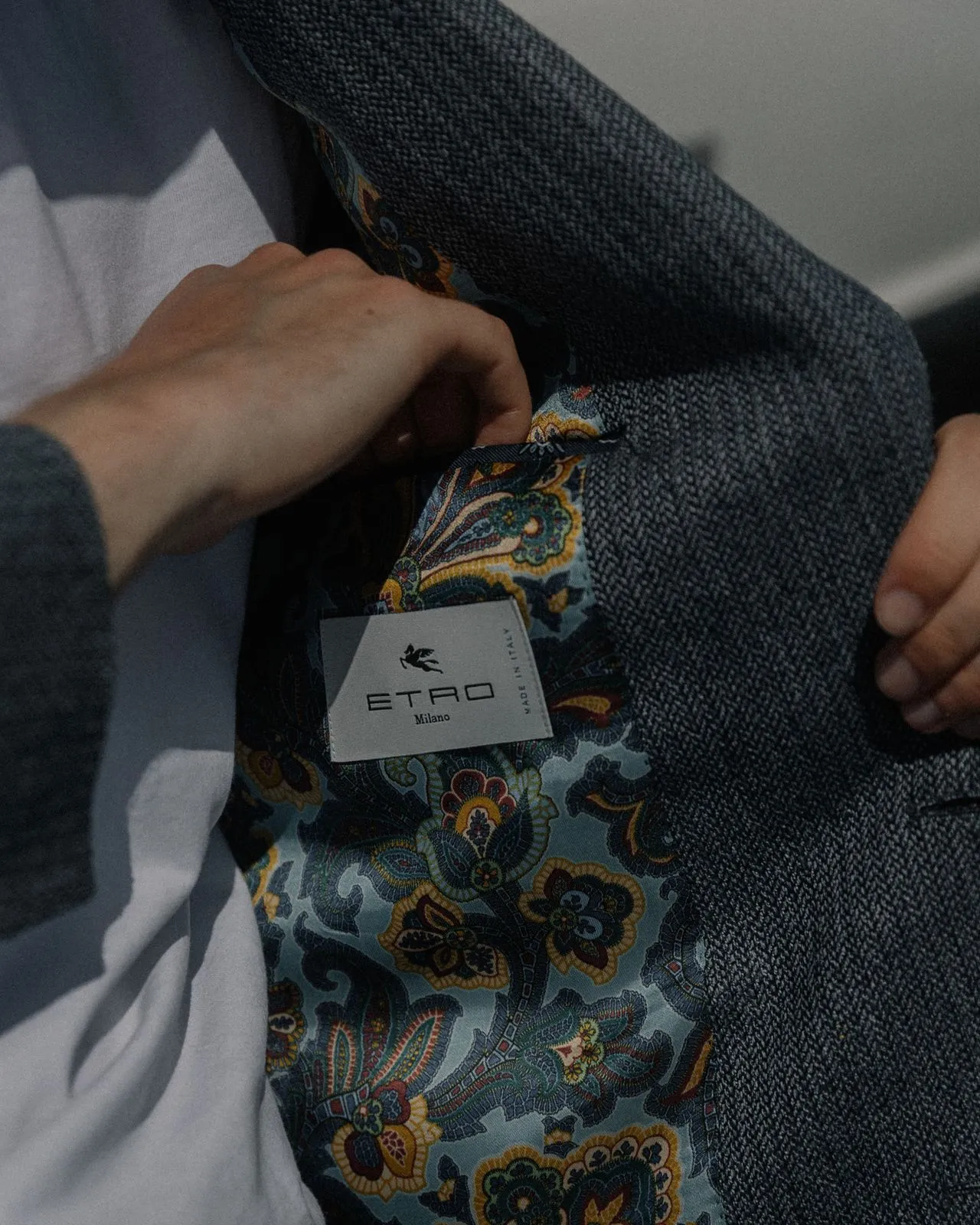
Here’s a quick look at the mandatory requirements across regions:
India
India has published a draft Textiles Committee's (Labelling and Marking for Textiles Apparels and Made-Up Articles) Regulation, 2025. Under the proposed, every apparel and made-up article must carry:
It also specifies English and Hindi/Devanagari labelling and refers to a minimum durability of 20 domestic washes or five dry-cleaning cycles
E-commerce platforms in India enforce country-of-origin and fibre-content declarations strictly.
All labels must comply with relevant Indian Standards (IS) published by BIS, specifically IS 14452 / ISO 3758 (care-labelling code using symbols), IS 15798 (Part 2):2021 (requirements for labelling and marking of apparel and made-up articles) and IS 667 (methods for identification of textile fibres)
United States
The FTC Care Labeling Rule (16 CFR Part 423) and the Textile Fiber Products Identification Act govern apparel labels in the USA.
Mandatory information:
Also, care instructions must include at least one satisfactory method of care, or state that the garment cannot be cleaned. Labels may use words or symbols; if symbols are used, they must follow the ASTM care-symbol system.
EU & UK
The EU Regulation 1007/2011 regulates textile-fibre names and fibre-composition labelling.
Mandatory requirements:
Care symbols, country of origin and responsible-person details should be assessed under separate EU, national, customs or product-specific rules.
The regulation also requires additional information in certain cases.
For example, textile products containing non-textile parts of animal origin must carry the statement “Contains non-textile parts of animal origin.”
Great Britain has its own Textile Products (Labelling and Fibre Composition) rules, while Northern Ireland may be affected by EU requirements under the applicable post-Brexit framework.
UAE & GCC
The UAE and GCC (Saudi Arabia, Qatar, Kuwait, Bahrain, Oman) follow harmonised textile labelling standards under the Gulf Standards Organisation (GSO): GSO 2065 and GSO 1692.
Mandatory information:
Arabic is mandatory on all care and size labels. English can be added as secondary text, but pure English labels will be rejected at Saudi and UAE customs.
Conformity marks:
UAE: Textile products must display the Emirates Conformity Assessment Scheme (ECAS) mark
Saudi Arabia: Products require the SABER标识 (blue shield logo)
Labels and products must meet GCC textile safety standards with no harmful azo dyes or heavy metals (lead, cadmium, nickel).
Avoid patterns, symbols, or text that conflict with local cultural norms.
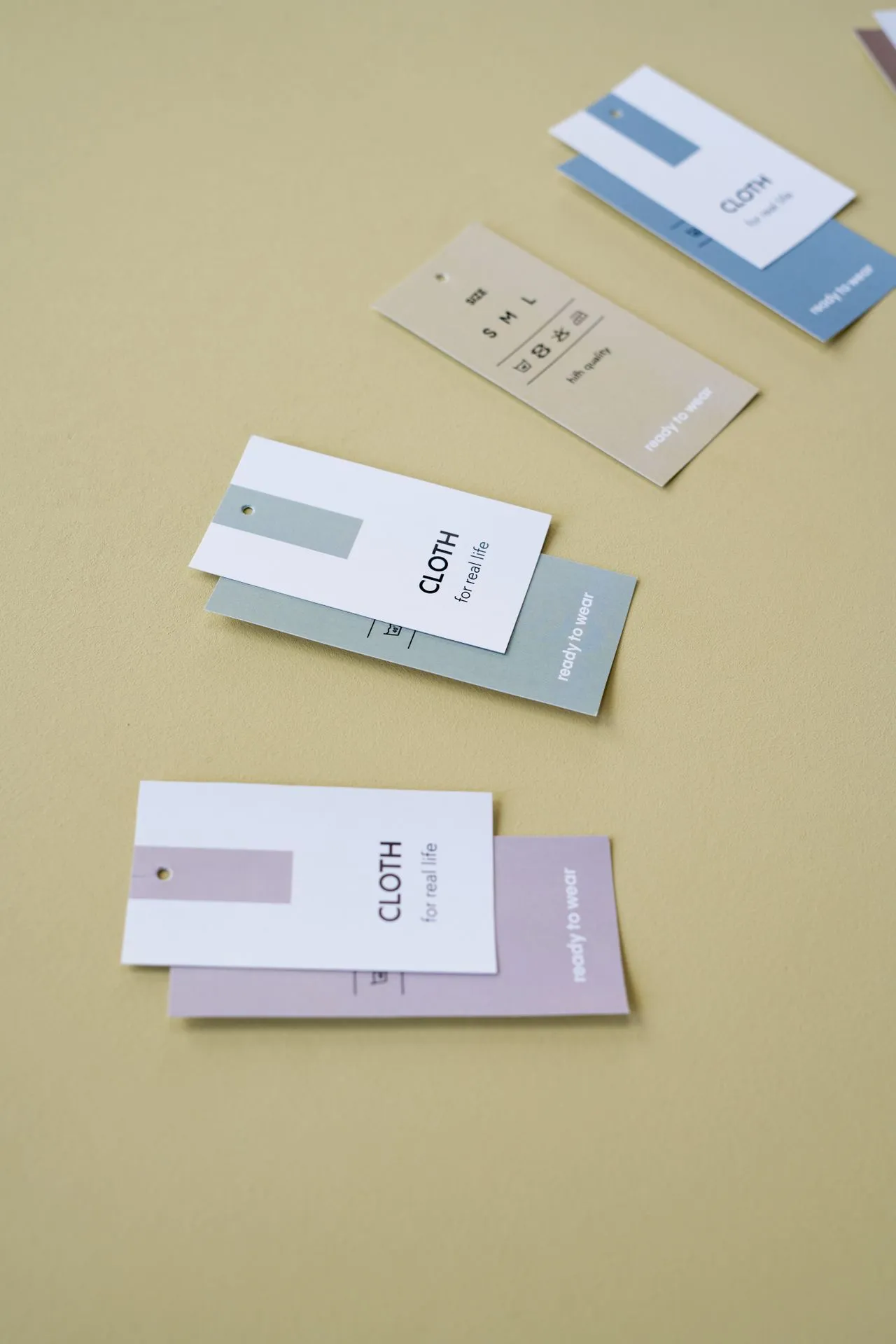
Your choice of clothing tags and label designs should signal quality, build trust, and ensure your garments can actually be sold in your target markets.
Here is how to do it:
Woven, printed, or satin, each option says something different and comes with distinct trade-offs.
Woven labels are built on looms from coloured yarn. Here, the artwork becomes part of the fabric. They are durable, never fade, and feel premium to the touch.
The textured, threaded finish signals craftsmanship. Use woven when you want the most premium brand label and your logo is mostly solid shapes.
Printed labels apply ink or dye to a base material like satin, which allows tiny text, gradients, and rapid updates. They turn around faster than woven, 5–7 days versus 10–14 days. Plus, they are cheaper at low volumes (under 500 pieces), around 30–50% less than woven.
Satin printed labels are somewhere in the middle. They are soft, and colourful, giving a premium look at lower cost than woven. They are ideal for kidswear and casual D2C.
Cost Check: printed taffeta is cheapest at every volume, woven is costliest, and satin is in the middle. At low volumes (50–500 pieces), printed labels are usually 30–50% cheaper per piece than woven. Above 1,000 pieces, the cost gap starts to narrow.
✅What we recommend: Use woven for your neck label (brand identity) and printed for your care label (dense information). This gives you a premium feel where it matters most and cost efficiency where information density is the priority.
Clothing labels undergo repeated washing, drying heat, friction, stretching, and prolonged contact with skin. Material and construction choices therefore need to be tested against the apparel's expected lifespan.
Choose the right material:
Construction is equally important. Center fold labels are secured at both ends and work well for neck applications. End fold labels create a flatter profile, while loop labels are useful at side seams or as small external branding elements.
Avoid rough edges, poorly finished cuts, and materials that cause irritation. A label that scratches the wearer or fades after a few washes is a production failure, regardless of how good the artwork looks.
If sustainability is part of the brand positioning, consider material composition, recycled content, relevant certifications, and whether trims can be separated or removed efficiently at end of life.
These choices should be verified with suppliers rather than treated as sustainability claims based on material names alone.
A label that does not read at a glance does not work. Prioritise:
Font choice
Sans-serif for modern, clean brands. Serif for heritage or premium positioning. Keep it simple because intricate fonts become illegible on woven labels.
A brand with "bold, elegant typography" signals confidence. A brand with "clean, essential, and decisive" typography signals clarity.
Colour and contrast
High-contrast pairings like white on navy, black on cream, gold on deep green, ensure legibility. Low-contrast combinations (grey on white, pastel on pastel) disappear.
On woven labels, thread colour is the only colour. You cannot print gradients or subtle shades. Design for the medium.
Check: If it does not read from a standard arm's length, it does not work. Test your label design at actual size before production.
Smart labels are becoming standard. Instead of simply displaying a brand name, labels will carry deeper functions. QR codes on woven or printed labels connect the garment to the internet. Digital "Care Guides" are replacing text-heavy instructions.
A good approach is to add a QR code at near-zero cost, then trial NFC on hero pieces.
A garment's tags and labels should read as one coherent brand system, even if customers hardly see all of them side by side at once.
Typography, logo treatment, and color choices should stay consistent across the hang tag, the neck label, and the care label.
Inconsistency across these touchpoints can grow subconsciously over time, the same way inconsistent packaging does across a broader product line.
A customer who's bought from a brand multiple times builds a mental picture of what that brand "feels like" from dozens of small, half-noticed details, a care label that looks like it belongs to a different, lower-quality brand chips away at that picture even if the customer never consciously registers why.
Check: Pull a hang tag, a neck label, and a care label from the same garment, lay them side by side, and ask whether a stranger would immediately recognize them as belonging to the same brand. If the answer isn't a yes, the tag and label system needs the same level of design attention as the rest of the identity.
A clothing label is part of a brand system that includes the neck label, care label, size tab, hang tag, and sometimes a packaging insert.
When these elements share the same visual language, the brand feels one, when not, the brand feels fragmented.
A complete clothing label system includes five elements. Each has a specific job. Together, they create a consistent brand experience.
In order for the work to be effective and consistent, you need it to be documented. Create a single reference document that specifies every component.
This document becomes the guiding light for every manufacturer, supplier, and team member who touches your labels.
What to include in the document:
The hang tag is the most flexible element in a clothing label system.
Unlike permanent labels, it can be removed, updated, and designed specifically for expressing the brand’s personality.
A study of 764 consumers found that explicit social-responsibility information and third-party logos on hang tags produced more favourable evaluations of the tag and brand, with brand attitudes which predict purchase intentions.
Give the Tag a Clear Job
A useful hang tag should answer key pre-purchase questions without becoming a mini brochure. Depending on the product and sales channel, include:
Relevance is important here. If there’s a real sourcing story, material certification, or useful styling content, the hang tag can link to it.
Sustainability claims need care. Only use certifications when the product and supplier meet the relevant requirements. For example, FSC claims require the appropriate certification and certified supply chain.
Use Design to Communicate Value
Paper stock, typography, printing, finishing, shape, and attachment all contribute to how the tag is experienced.
A 300 to 350 GSM card may be appropriate for an everyday apparel brand, while heavier board or specialised finishing can suit a premium positioning.
There is no universal GSM that makes a hang tag feel premium, so pick the specification as per the apparel, price point, and overall identity.
You can also include finishing options like matte or soft-touch coatings, foil stamping, embossing, debossing, and spot UV. Use them selectively. A well-designed uncoated tag can feel more appropriate for a natural or understated brand than an elaborate finish applied simply to make the tag look expensive.
The attachment needs to be considered as well. Cotton or paper cord can support a natural positioning, while a more refined cord or fastening system may suit premium apparel.
Even small details such as the hole position, string length, and fastener should be tested on the actual garment.
Extend the Brand Beyond the Logo
Instead of generic claims such as “premium quality” or “made with care,” use specific information the customer can understand and verify such as:
Be selective. It gives the customer enough information to make a decision, enough brand character to make the product memorable, and a useful reason to engage further if there is more to say.
Each mistake below traces back to a specific gap between what a label needs to do legally, functionally, and creatively and what it actually ends up doing when one of those three gets prioritized over the others.
Missing legally required information on care or content labels
A brand ships garments missing country of origin or fibre percentages. Marketplaces block listings. Customs holds shipments.
Fix: Create a compliance checklist per target market. Audit every label before production.
Inconsistent branding across hang tag, neck label, and care label
Different vendors handle different label types with no shared brief. The hang tag uses a different font from the neck label. The system technically works but does not read as one brand.
Fix: Provide every vendor with the same brand guidelines document.
Materials that fade or fray before the garment does
This undermines both brand perception and the customer's ongoing access to legally required washing instructions.
Fix: Label durability must match garment longevity.
Scratchy or poorly placed neck labels
The label irritates the skin, the customer cuts it out, and the brand touchpoint disappears.
Fix: Test labels on different skin types before production.
Treating the hang tag as just a price sticker
A flimsy, generic hang tag signals a cheap product. The customer judges quality by the tag before they touch the fabric.
Fix: Use thick cardstock, a premium finish, and a useful QR code. Choose quality attachments, cotton string over plastic.
Skipping the physical proof before production
Digital artwork looks different in production. Colours shift. Material feels different. The result: thousands of labels that do not match the design intent.
Fix: Always request a physical proof before bulk. Review colour, material, legibility, and size.
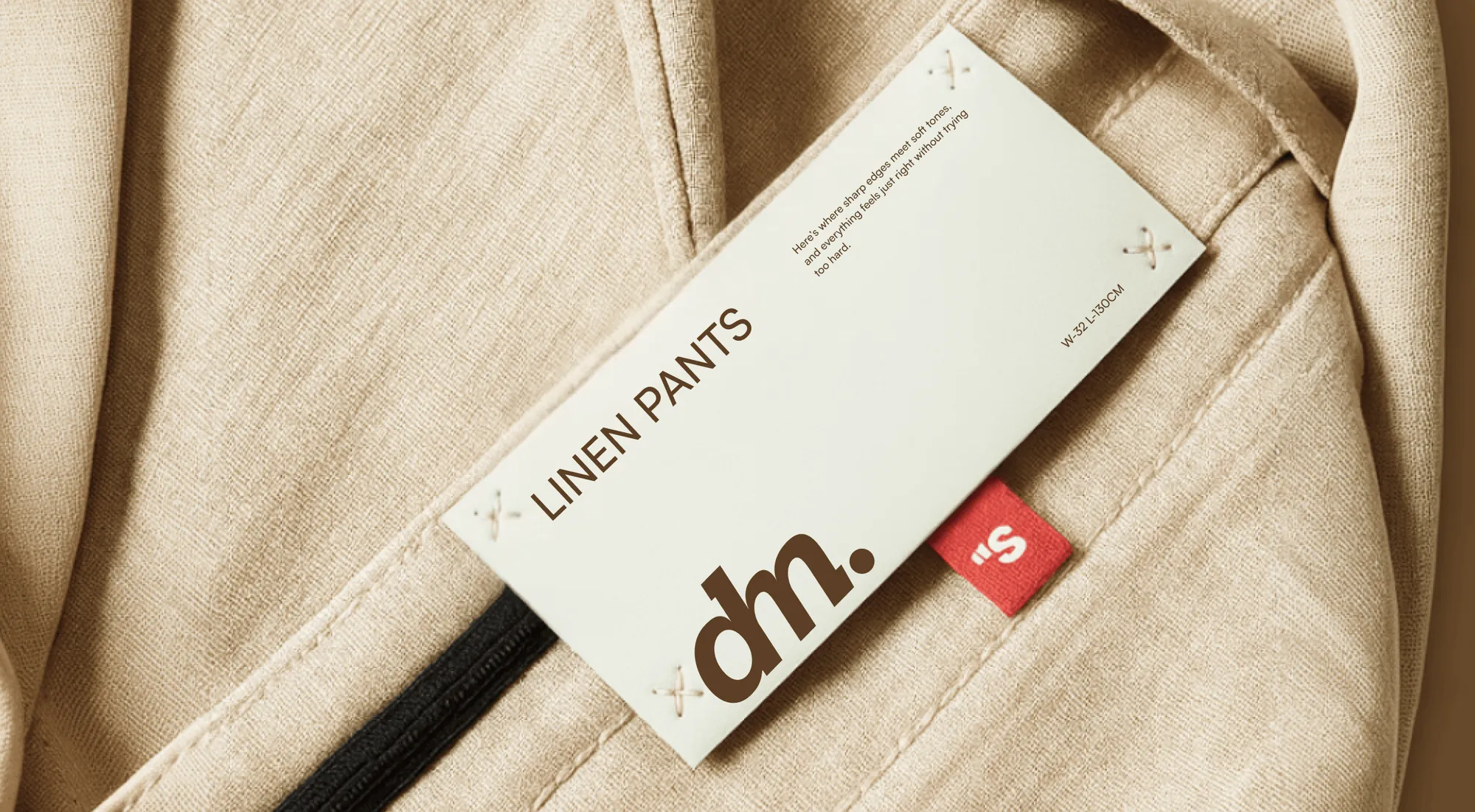
At Confetti, we treat clothing tags and labels as permanent brand touchpoints which is why our clothing brand strategy includes these elements from the very start.
This is how we put this into our work:
Desi Minimals stands for “presence, comfort, and intentional living”. Clothes that don’t shout, but show up quietly and stay with you.
Before the rebrand, the brand lacked a cohesive identity that reflected this chill, laid-back vision.
Confetti refined its visual and verbal system to make it:
We carried that same philosophy into the tag and label system.
From the hang tag to the neck label to the care label, every element reinforces the same quiet confidence.
How We Avoid the Common Branding Mistakes
1. Compliance comes first
We use a compliance checklist for every target market, India, USA, EU, UK, and UAE/GCC, so mandatory information never gets missed.
2. Every vendor works from the same system
We provide consistent brand guidelines including logo files, colour values, and typography, so the hang tag, neck label, and care label feel like one system.
3. Materials match the garment’s lifespan
We specify materials for durability and use case, such as printed taffeta for washable care labels and fine-thread woven labels designed to resist fraying.
4. Comfort is tested, not assumed
Neck labels are tested on different skin types to ensure they don’t cause irritation.
5. Physical proofs are approved before production
We always review a physical proof before bulk production to catch typos, colour mismatches, and sizing errors before they become expensive reprints.
The Result: A label system that feels intentional, cohesive, and unmistakably on-brand, building recognition with every wear.
What is the difference between a hang tag and a clothing label?
A hang tag is a removable, marketing-facing tag that’s usually discarded after purchase. A clothing label such as a neck label or care label is permanently sewn into the garment and often carries legally required information for the product's entire life.
Do I need different labels for loose garments vs. pre-packaged garments?
Yes. Loose garments, which customers try on and select by fit, carry lighter labeling requirements, generally product description and standard size indicators. Pre-packaged garments require the full MRP and manufacturer declaration set.
What material lasts longest for clothing labels?
Woven labels generally offer the best durability for high-contact applications like neck labels, holding up well to repeated washing and wear. Printed labels cost less but are more prone to fading over time.
Can a hang tag be used for brand storytelling, not just pricing?
Yes, and it's one of the most underused opportunities in garment branding. QR codes, brand story cards, and care instructions written in brand voice all turn a hang tag into genuine marketing rather than pure price display.
How much does custom clothing tag and label design cost?
Costs vary based on the number of tag types needed, material choice (woven versus printed), order volume, and whether compliance review and brand guideline development are included in scope. A complete system usually costs more per unit for woven neck labels than printed hang tags, reflecting the durability difference.
Want strategic branding and packaging like this for your business?





.webp)
.webp)

.webp)
.webp)
.webp)
.webp)
.webp)







.svg)
.webp)