%201.webp)
02
AI Snaps
.svg)
.svg)
01
Our Work
03
About Us
04
Brand Audit
05
Contact Us
06
Client Success
12
07
Blogs
08
Careers
Book A Call
.svg)



.svg)
Need Help In Building Your Brand?
Click the button below & book a call with our founder directly.

Rishabh Jain
Managing Director
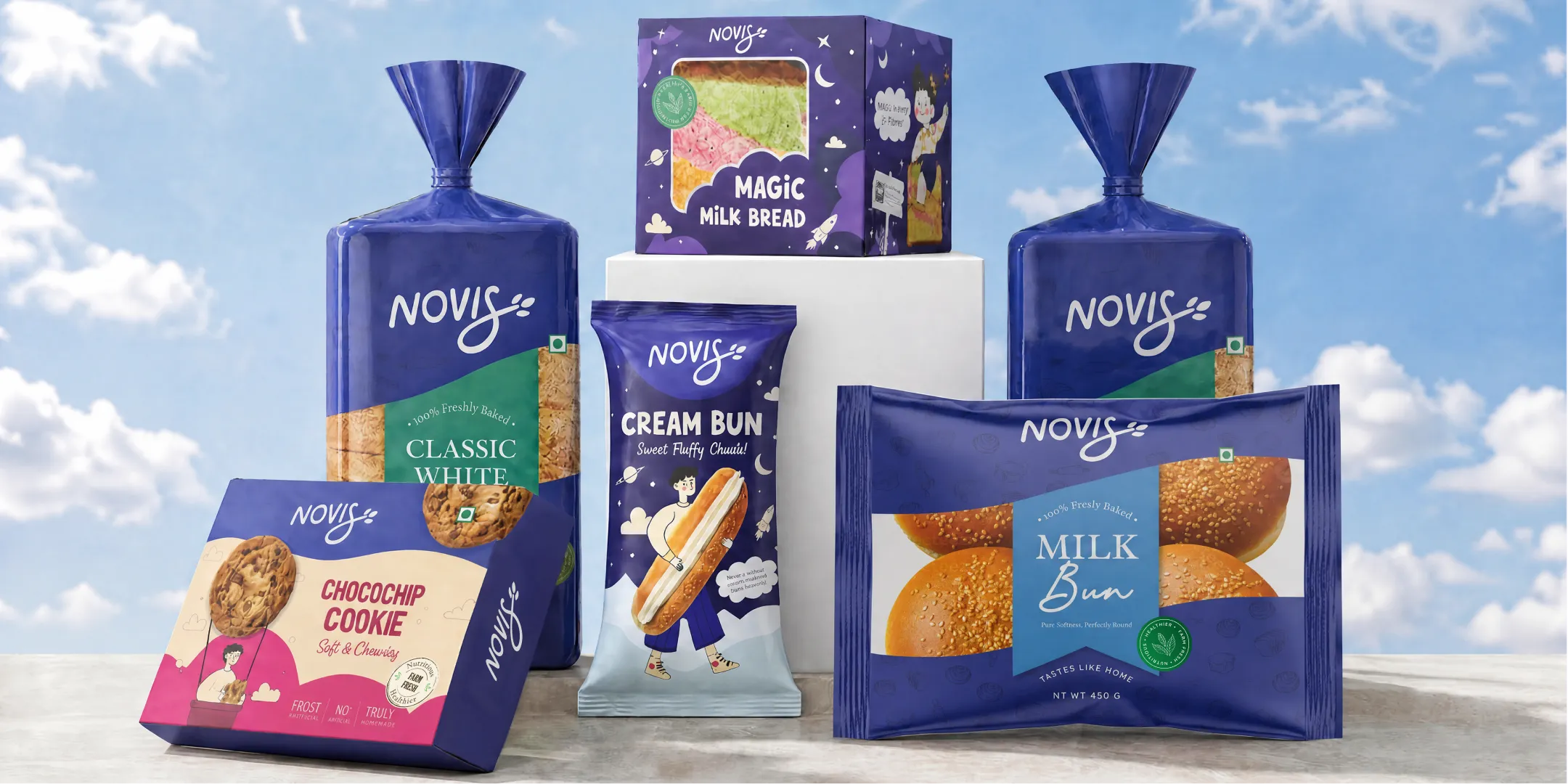
Food packaging design requirements in the UAE is a layered system that shapes your layout before a single creative decision gets made.
This guide breaks down the actual governing standards, what has to legally appear on pack, the UAE-specific halal certification detail, and how to design around compliance. You also get a pre-print checklist.
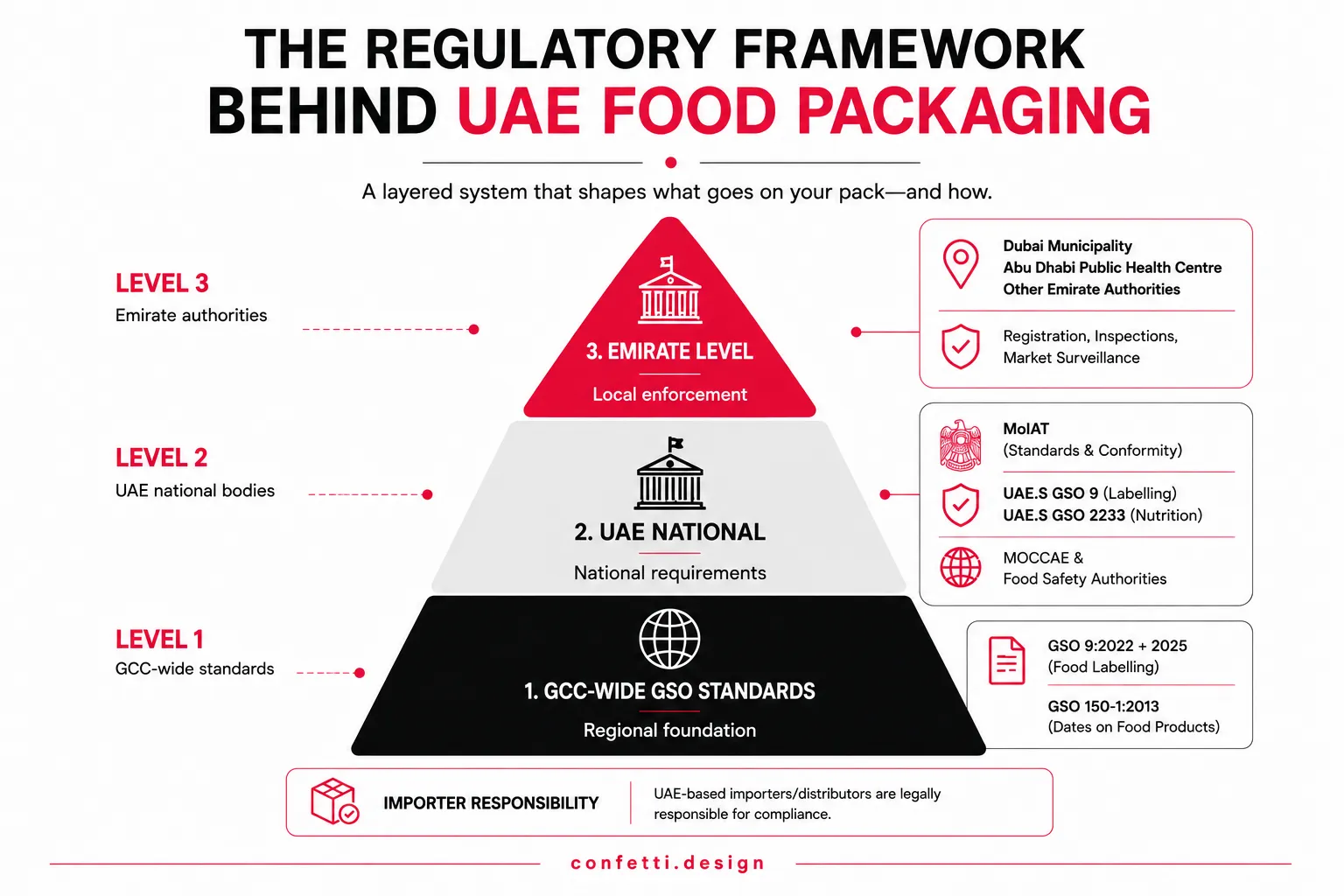
Food packaging design in the UAE is shaped as much by regulation as it is by branding.
Before colours, typography, or structural packaging are considered, brands need to understand the compliance framework that determines what information must appear on the pack and how it should be presented.
The UAE follows a layered regulatory system where GCC-wide standards provide the foundation, national regulations define mandatory labelling requirements, and local authorities oversee product registration and enforcement.
Here’s what you need to know:
The Gulf Standardization Organization (GSO) develops food labelling standards adopted across all six GCC countries. The primary standard is GSO 9:2022 (Labelling of Prepackaged Foodstuffs), together with its 2025 amendment, which defines the mandatory information required on food packaging across the region.
Another important standard, GSO 150-1:2013, specifies how production and expiry dates should be displayed on food products.
While GCC standards provide the baseline, the UAE has formally adopted and enforces its own national versions of these regulations, including UAE.S GSO 9 for food labelling and UAE.S GSO 2233 for nutritional labelling.
The Ministry of Industry and Advanced Technology (MoIAT) develops and maintains national standards and oversees conformity assessment programmes for regulated products. Depending on the product category, brands may also need certification or registration before entering the UAE market.
Food safety is coordinated by the Ministry of Climate Change and Environment (MOCCAE) together with national food safety authorities, while local bodies such as Dubai Municipality and the Abu Dhabi Public Health Centre (ADPHC) manage product registration, inspections, and market surveillance within their respective emirates.
For imported products, the UAE-based importer or distributor is legally responsible for ensuring that packaging and labelling comply with local regulations.
Food packaging regulations in the UAE continue to evolve, making compliance an ongoing priority. From 1 June 2025, selected food and beverage products must display the Nutri-Mark front-of-pack nutrition label, with a colour-coded rating from A to E.
Brands launching dairy products, beverages, cheese, or children's food should confirm whether the requirements apply before finalising packaging.
Sustainability rules are also shaping packaging choices, with expanded restrictions on single-use plastics encouraging recyclable, compostable, paper-based, bagasse, and other approved alternative materials for both retail and food service packaging.

Talk to our team about adapting your pack design to the region.
Book A Call
Once you understand the regulatory framework, the next challenge is ensuring every mandatory detail appears on the packaging in the correct format.
Even a small omission, such as an incomplete Arabic translation or an incorrectly displayed expiry date, can delay customs clearance, prevent retail listing, or require an expensive packaging reprint.
Most pre-packaged food products sold in the UAE are required to display the following information clearly and legibly:
All mandatory information must appear in Arabic on the original label or primary packaging. English may be included alongside Arabic, but Arabic text must be complete and equivalent to English.
Among all compliance requirements, the production and expiry dates are one of the most closely monitored by UAE authorities.
In most cases, these dates must be permanently printed on the original packaging using non-erasable marking and cannot simply be added later using stickers.
While limited exemptions exist for certain products, brands should incorporate date coding into the packaging design and production process from the beginning rather than treating it as a post-print addition.
The Nutrition Facts panel must appear on the back or side of packs:
Certain food categories are also subject to the UAE's Nutri-Mark front-of-pack nutrition labelling system, making accurate nutritional analysis increasingly important during packaging development.
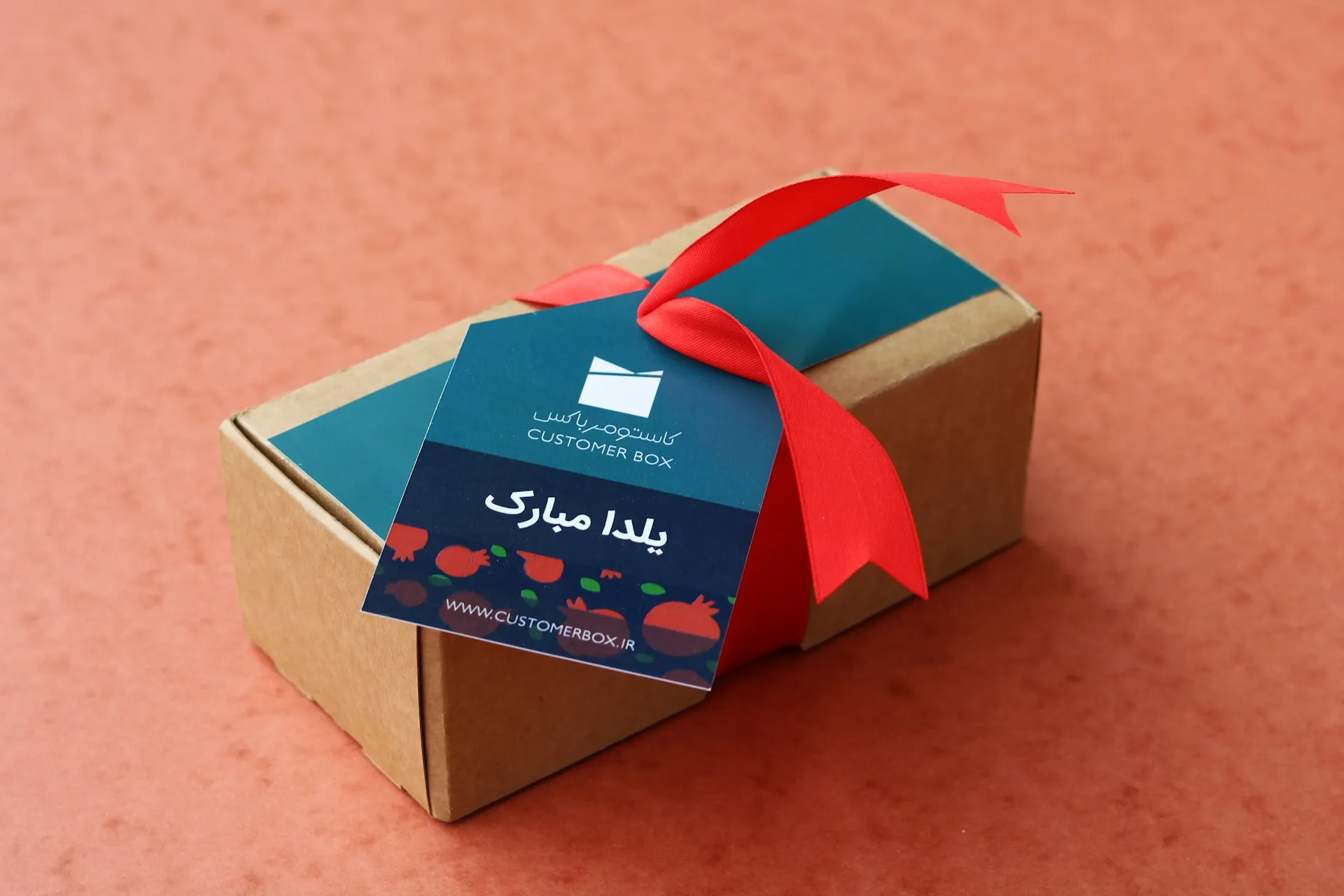
For many food brands entering the UAE, Halal certification is one of the most misunderstood areas of compliance. A common assumption is that a Halal certificate accepted in another GCC country will automatically be recognised in the UAE.
Well, that is not always the case.
While the UAE follows GCC-wide Halal standards, it also has its own certification and recognition requirements. Failing to verify these before production or shipment can lead to customs delays, product registration issues, or rejected imports.
The primary Halal standard across the Gulf is GSO 2055-1, which establishes the general requirements for Halal food throughout the supply chain including:
UAE-Specific Requirements
The UAE requires that Halal certification be issued by a certification body recognised by the UAE authorities. A certificate accepted in another GCC market may not automatically be accepted for import into the UAE if the issuing certification body is not on the UAE's approved list.
For exporters, this is important. Verifying that your certification body is recognised in the UAE should be part of the packaging and market-entry process, not something checked after products have been manufactured.
Documentation Requirements for Halal Certification
Halal certification is mandatory for several food categories, including:
Even products that appear vegetarian may require additional ingredient verification if additives, enzymes, flavourings, or processing aids are derived from animal sources.
Halal certification is not limited to displaying a certification mark on the packaging. Certification covers the entire production process, including:
For animal-derived products, slaughtering methods must also comply with the applicable Halal standards.
📌International brands such as Nestlé, Almarai, and BRF (Sadia), along with Indian exporters like ITC, MTR Foods, and Aachi Foods, integrate Halal compliance into product development, sourcing, packaging, and certification from the outset rather than treating it as a final packaging requirement.
A common mistake is to develop a visually appealing package first and address regulatory requirements later. At that stage, designers often have to squeeze in Arabic text, nutrition panels, allergen declarations, Halal certification marks, QR codes, and other mandatory information into a layout that was never designed to accommodate them.
The result is packaging that feels cluttered, compromises readability, and often requires multiple rounds of revisions before approval.
A more effective approach is to build the packaging around compliance from the outset.
Non-compliance is expensive. Shipment rejections at Jebel Ali Port can cause average delays of 7–14 days. Fines can reach up to AED 100,000, and non-compliant products face immediate shelf removal under the new Nutri-Mark system.
When compliance is treated as a postscript, the cost multiplies:
Before exploring colours, typography, or graphics, map every mandatory element that the pack needs to carry, including:
Once these elements are planned within the layout, the visual design can be developed around them instead of competing for space.
Treat bilingual communication as part of the core design system. This allows both languages to be integrated naturally while maintaining hierarchy, readability, and brand consistency.
Global brands such as Nestlé, Unilever, and Coca-Cola have refined bilingual packaging across GCC markets by designing for both languages simultaneously rather than adapting existing artwork.
Mandatory information doesn't have to weaken shelf appeal. In fact, when integrated thoughtfully, compliance elements can strengthen consumer confidence.
A clearly presented Halal certification mark, an easy-to-read nutrition panel, and well-organised ingredient information communicate transparency and professionalism. Consumers may not consciously analyse these details, but they often associate organised, easy-to-read packaging with higher product quality and greater trust.
The same principle applies to retailer requirements. Major supermarket chains such as Carrefour, Lulu Hypermarket, and Spinneys expect products to meet regulatory standards before listing, making compliance an essential part of commercial success rather than simply a legal obligation.
Building compliance into the design process also reduces business risk. Identifying mandatory content during concept development is far less expensive than discovering missing information after artwork has been approved, packaging has been printed, or products have been shipped.
Early collaboration between packaging designers, regulatory specialists, printers, and local distributors helps ensure that both creative and compliance requirements are addressed together. This shortens approval timelines, reduces rework, and makes market entry considerably smoother.
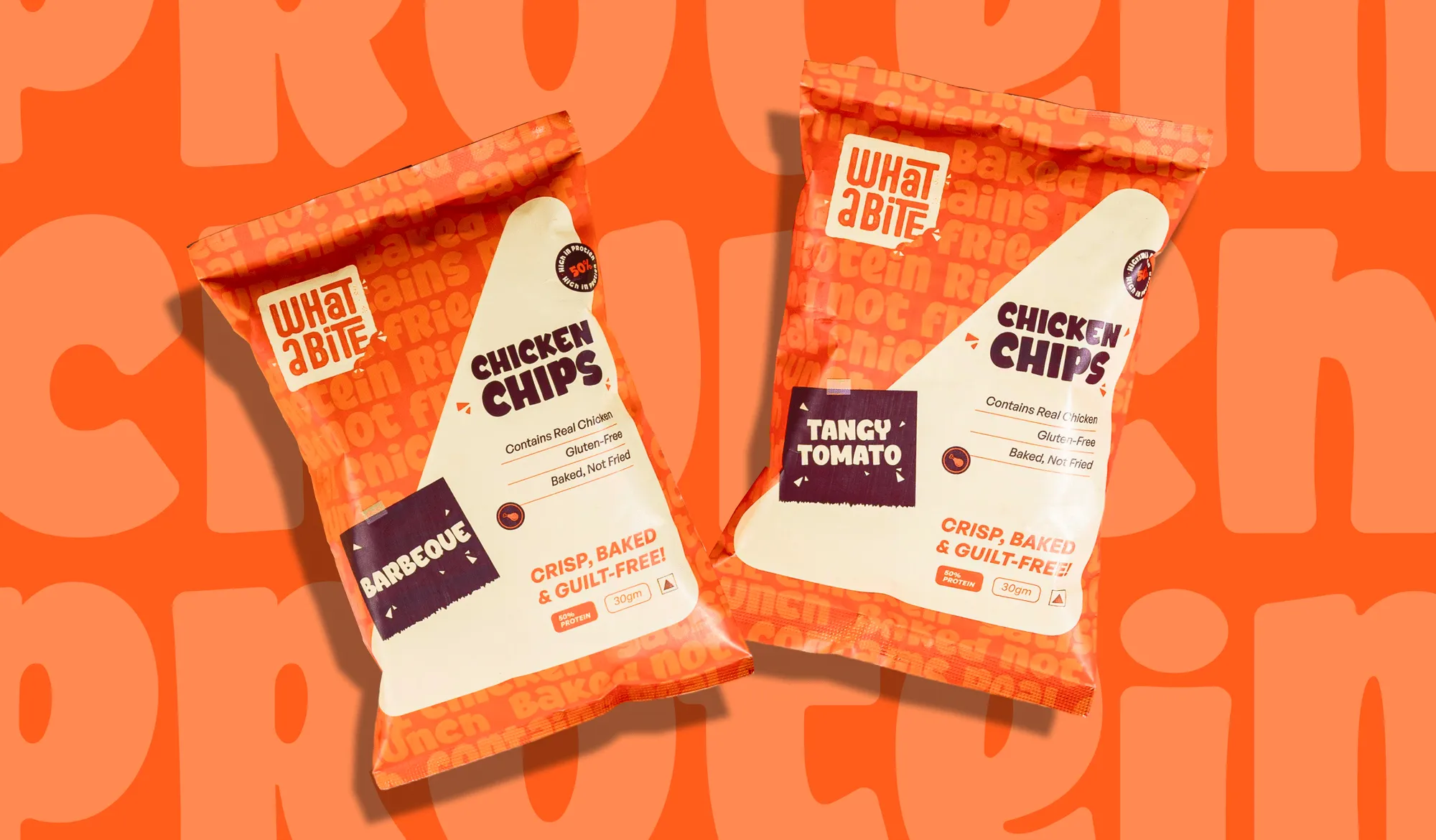
Meeting UAE food packaging regulations is the minimum requirement for entering the market. Winning at retail requires much more.
In a market where consumers regularly encounter global brands and premium imports, packaging has to communicate quality, trust, and relevance within a matter of seconds.
Retail shelves in the UAE are highly competitive, particularly in FMCG categories. Shoppers often make purchasing decisions in just a few seconds, making visual clarity more valuable than visual complexity.
Effective food packaging should:
Many leading brands, from Almarai and Lacnor to Kellogg's, achieve standout shelf presence through consistent branding and clear information rather than visual clutter.
The UAE's population is one of the world's most diverse, bringing together local Emirati consumers alongside expatriates and international visitors. Packaging should therefore balance regional relevance with global appeal.
Consumers increasingly judge products by how easy they are to use, not just how they look.
Depending on the product category, features such as resealable closures, easy-open packs, clear portion guidance, ergonomic structures, and transparent windows can improve both usability and perceived quality.
Packaging that solves everyday problems often becomes a competitive advantage long after the initial purchase.
Trust remains one of the strongest purchase drivers in food retail.
Packaging should make important information easy to find rather than hiding it in dense text. Clear Halal certification, country of origin, expiry dates, ingredient transparency, and professionally presented nutritional information all contribute to consumer confidence.
For locally manufactured products, highlighting Made in UAE can also reinforce quality and support local sourcing initiatives where relevant.
Premium finishes can elevate perceived value, but they should support the brand rather than overwhelm it.
Selective use of finishes such as embossing, foil stamping, textured coatings, or spot UV can draw attention to logos or key product information without making the packaging appear excessive.
The finish should also align with the product's positioning and price point to deliver a strong return on investment.
Great packaging should work as efficiently for retailers as it does for consumers.
Shelf-ready packaging (SRP) can reduce replenishment time, improve product presentation, and minimise in-store handling. Durable, lightweight, and recyclable materials also support operational efficiency while aligning with retailers' growing sustainability expectations.
These practical considerations are increasingly important when supplying large retail chains and supermarket groups.
Today's UAE shoppers often discover products online before purchasing them in-store or through quick commerce platforms.
Packaging therefore needs to remain recognisable across multiple viewing conditions:
The rapid global success of Dubai's viral pistachio-kunafa chocolate products illustrates how packaging can become a powerful marketing asset when it photographs well, communicates premium quality, and creates a memorable visual identity.
Sustainability is increasingly influencing purchasing decisions, retailer expectations, and government policy across the UAE.
Brands are steadily adopting recyclable mono-material packaging, paper-based solutions, bagasse, and other lower-impact materials while reducing unnecessary packaging components. The goal is no longer simply to meet environmental regulations but to communicate environmental responsibility without compromising product protection or brand appeal.
📌A useful test before finalizing any UAE food packaging design: does this read as trustworthy, premium, and specifically built for this market to a design-literate UAE shopper, or does it look like compliance requirements were satisfied at the expense of everything else.
If a package technically passes every regulatory check but would look out of place next to genuinely market-native competitors on the same shelf, it hasn't finished the design process yet, regardless of how clean the compliance layer is.
At Confetti, we design packaging that begins with compliance but extends far beyond it.
We consider how your product will perform on the shelf, in e-commerce thumbnails, across quick commerce platforms, and throughout the entire consumer journey.
By combining regulatory expertise with strategic branding and structural design, we help brands create packaging that is:
✅ Compliant: Built to meet UAE.S GSO 9:2022, Nutri-Mark, Halal certification, and single-use plastic requirements from the first sketch
✅ Commercially effective: Designed to win shelf space in Carrefour and across the UAE's sophisticated retail environment
✅ Built to scale: Systems that hold together across product lines and markets
With an established presence in the UAE, our team provides local market insight and on-ground support, helping you navigate both regulatory requirements and the realities of competing in one of the region's most sophisticated retail environments.
This is genuine, ongoing regional experience, not adapted casework.
We build compliance into the design from the first sketch, not retrofitted later. The result is packaging that earns trust, wins shelf space, and protects your brand from costly rejection.

This comprehensive checklist consolidates UAE federal regulations, GCC-wide standards, and retailer-specific requirements.
Use it as a pre-submission audit tool before artwork goes to print. Non-compliance can result in shipment rejection at UAE ports, fines, or immediate shelf removal.
1. GSO 9:2022 Core Labeling Requirements
☐ Product Name / Trade Name: Accurately reflects nature and use; not misleading or ambiguous
☐ Brand Name: Commercial name under which the product is marketed
☐ Country of Origin: Specific manufacturing country; no abbreviations (e.g., "Made in the EU" is not acceptable)
☐ Net Weight or Volume: In metric units (grams, kilograms, milliliters, liters)
☐ Ingredients List: Listed in descending order by weight; all additives and preservatives must be explicitly mentioned
☐ Allergen Declaration: Top 9 allergens must be highlighted in bold
☐ Storage Conditions: Proper storage guidelines must be provided
☐ Barcode: International barcode (EAN-13 standard) must be filled as written on the label
☐ Manufacturer / Distributor Info: Full name, address, and contact details of manufacturer and UAE-based distributor
☐ Production and Expiry Dates: DD/MM/YYYY format; clear, non-erasable ink; printed on original packaging not applied by sticker
☐ Lot Number: For traceability and recall management
2. Arabic Language Requirements
☐ All mandatory information in Arabic: Must appear in Arabic on the original label or primary packaging
☐ Bilingual format: Labels must be in Arabic only or Arabic/English bilingual format
☐ Arabic font size not smaller than English: Arabic text must be complete and equivalent to English
☐ Arabic takes precedence: In case of discrepancies, Arabic text is authoritative
☐ Right-to-Left (RTL) layout correctly formatted
☐ Certified translation: Translations must be precise and certified by an accredited translation agency
☐ No grammatical or typographical errors: Errors can result in product rejection
☐ Sticker durability: Arabic stickers must be tamper-proof and permanent
3. Nutritional Information Panel
☐ Energy Value: In kJ and kcal; include % Daily Reference Intake (DRI) based on 2,000 kcal diet
☐ Total Fat: Breakdown: saturates, trans fats (<1% of total fat limit)
☐ Cholesterol: Must be declared
☐ Sodium: In mg; salt equivalent calculated
☐ Total Carbohydrates: Including dietary fiber, total sugars, added sugars
☐ Dietary Fiber: Mandatory if >3g/100g; supports Nutri-Mark A/B grades
☐ Protein: Per serving; key for high-protein claims
☐ Vitamins & Minerals: If claimed or >15% DRI; fortified foods need ESMA pre-approval
☐ Serving Size: Realistic serving size with servings per pack clearly stated
☐ GMO Declaration: Products containing GMOs must be clearly marked
Note: Minimum mandatory nutrient declaration includes energy, total fat, saturated fat, trans fat, cholesterol, sodium, total carbohydrate, dietary fiber, total sugars, added sugars, and protein.
4. Nutri-Mark Front-of-Pack Labeling (Effective 1 June 2025)
☐ Nutri-Mark displayed on front of pack: Mandatory for affected categories
☐ Affected categories: Cheese, milk-based drinks, flavored beverages, fat emulsions, foods for children
☐ Grade A-E displayed: A (dark green, healthiest) to E (red, least healthy) with colour coding
☐ Calculated per 100 ml: Nutritional rating calculated per 100 ml
☐ Exemption confirmed: Single-ingredient foods (rice, tea, coffee, sugar), food additives exempt
☐ Responsibility: Food business operator or UAE-based importer assumes responsibility
☐ Nutri-Mark on primary display panel
5. Halal Certification Requirements
☐ Halal Certification: Mandatory for meat and poultry; strongly expected for most food categories
☐ ESMA-Approved Certifier: Certification must be from an ESMA-approved certifying body
☐ UAE.S GSO 2055-1:2015: Main standard specifying general requirements for Halal products
☐ All stages of Halal chain: Includes sourcing, preparation, packaging, labeling, transportation, distribution, storage, display
☐ Halal National Mark: Follow process to obtain Halal National Mark from ESMA/MoIAT
☐ Test Report: From recognized laboratory (accredited ISO 17025) as per UAE.S GSO 2055-1
☐ Representative Artwork: Product label artwork must be submitted as part of Halal certification application
☐ Certificate of Raw Materials: Certificates ensuring Halal origin of raw materials and packaging materials
☐ Packaging Materials Free from Non-Halal: Must not be prepared or produced by equipment contaminated with non-Halal materials
6. Production and Expiry Dates
☐ Printed on Original Packaging: Must be printed on the original packaging, not applied by sticker
☐ No stickers: This is the most enforced compliance failure point at UAE ports
☐ Mandatory and cannot be changed: Expiration dates governed by UAE.S 150-1
☐ Clear, non-erasable ink: Dates must be clearly legible and permanent
☐ DD/MM/YYYY format: Date format must follow UAE regulations
7. Single-Use Plastic Ban (Effective 1 January 2026)
☐ No beverage cups and lids
☐ No cutlery (spoons, forks, knives, chopsticks)
☐ No plates
☐ No straws
☐ No stirrers
☐ No Styrofoam food containers
☐ No single-use bags under 50 microns: Regardless of material, including paper
☐ Exemption confirmed: Products made from recycled content within UAE are exempt
☐ Export products exempt: Must be clearly labeled for export
☐ Fresh food wrap exempt: Very thin plastic bags used to wrap fresh food items exempt
☐ Approved alternatives used: Plant-based PLA, paper-based, wooden, bagasse-based alternatives
8. MoIAT/ECAS Conformity Requirements
☐ ECAS Certification: Certain regulated product categories require ECAS conformity assessment
☐ ECAS Mark Affixed: MoIAT requires manufacturers to affix ECAS marks to certified products
☐ Product Registration: May require product registration before market entry
☐ Artwork Reflects Approval: Packaging artwork must reflect applicable approval or conformity information
9. Dubai Municipality and Abu Dhabi Requirements
☐ FIRS Compliance: Food Import and Re-export System for Dubai
☐ Label Assessment: Dubai Municipality assesses food labels via FIRS system
☐ ADPHC / QCC Compliance: Abu Dhabi Public Health Centre / Quality and Conformity Council oversight for Abu Dhabi
☐ HACCP Implementation: Baseline expectation for food suppliers
10. UAE-Based Distributor Requirement
☐ UAE-Based Distributor: Mandatory for regulatory compliance
☐ Importer Responsibility: If operator not based in UAE, importer assumes responsibility
11. Technical Artwork Specifications
☐ High-Resolution Images: Provide high-resolution images to avoid rejection
☐ Label Image: Image of the sticker "artwork" with all details
☐ Product Image: Image of the packaging (glass bottle, carton, plastic packet, etc.)
☐ Barcode Registration: International barcode must be registered in Dubai Municipality system
☐ HS Code: Must be provided for customs
☐ Trade Name Capitalization: Beginning of each letter should be capitalized
12. Final Pre-Submission Audit
☐ All mandatory elements present and legible
☐ Bilingual Arabic-English layout complete
☐ Nutri-Mark prominently displayed (if applicable)
☐ Halal certification mark visible
☐ Country of origin clearly stated
☐ Production and expiry dates on original packaging
☐ Barcode correctly formatted
☐ Single-use plastic ban compliance
☐ Artwork validated by retailer
☐ Label assessment completed (Dubai Municipality FIRS)
What labelling standards govern food packaging in the UAE?
UAE food packaging follows GSO 9 for general pre-packaged food labelling and GSO 2233 for nutrition labelling specifically, both GCC-wide standards adopted nationally. Local authorities like Dubai Municipality and ADAFSA in Abu Dhabi add emirate-level registration and enforcement requirements on top of this baseline.
Does food packaging in the UAE need to be bilingual?
Yes. Mandatory label information must appear in Arabic, with English commonly used alongside it, particularly for non-mandatory marketing content. Production and expiry dates specifically must be printed on the original packaging and generally cannot be applied afterward as a sticker.
Is halal certification mandatory for food packaging in the UAE?
For most food categories, yes, and the UAE specifically only accepts halal certificates from UAE-ESMA-approved certifying bodies. A certificate valid in another GCC country does not automatically satisfy this UAE-specific requirement, so verification before finalizing packaging is essential.
Can I use a sticker to add Arabic text or dates to existing packaging for the UAE market?
Arabic stickers are generally permitted for most mandatory information, but production and expiry dates must appear on the original packaging itself in most cases, not as a sticker. For serious UAE market entry, integrating Arabic into the master artwork produces stronger compliance and shelf performance than a sticker approach.
How is UAE food packaging different from other GCC countries?
While GSO standards apply GCC-wide, the UAE has specific enforcement layers, including ESMA-approved halal certification and emirate-level requirements from bodies like Dubai Municipality and ADAFSA, that don't map directly onto requirements in Saudi Arabia or other Gulf markets.
What happens if food packaging doesn't meet UAE compliance requirements?
Non-compliant packaging can be held at customs, rejected from retail listing, or subject to penalties, and correcting compliance issues after production means reprinting and re-registering packaging, a significantly more expensive process than building compliance into the design from the start.
Should compliance or design come first when creating UAE food packaging?
Neither in isolation. Mapping mandatory compliance content and reading hierarchy before visual design begins prevents the costly cycle of finalizing a creative direction and then retrofitting regulatory requirements into a layout that wasn't built to hold them cleanly.
Want strategic branding and packaging like this for your business?





.webp)
.webp)

.webp)
.webp)
.webp)
.webp)
.webp)







.svg)
.webp)