%201.webp)
02
AI Snaps
.svg)
.svg)
01
Our Work
03
About Us
04
Brand Audit
05
Contact Us
06
Client Success
12
07
Blogs
08
Careers
Book A Call
.svg)



.svg)
Need Help In Building Your Brand?
Click the button below & book a call with our founder directly.

Rishabh Jain
Managing Director
Listing on Zepto and being visible on Zepto are two different things. If you mix up the two, you'll spend the next 90 days wondering where the sales went.
This guide covers the zepto full visibility system, paid and organic. That includes how Zepto's Jarvis platform works, what the ranking algorithm responds to, why your packaging directly affects your search ranking, and how to sequence your first 90 days on the platform.
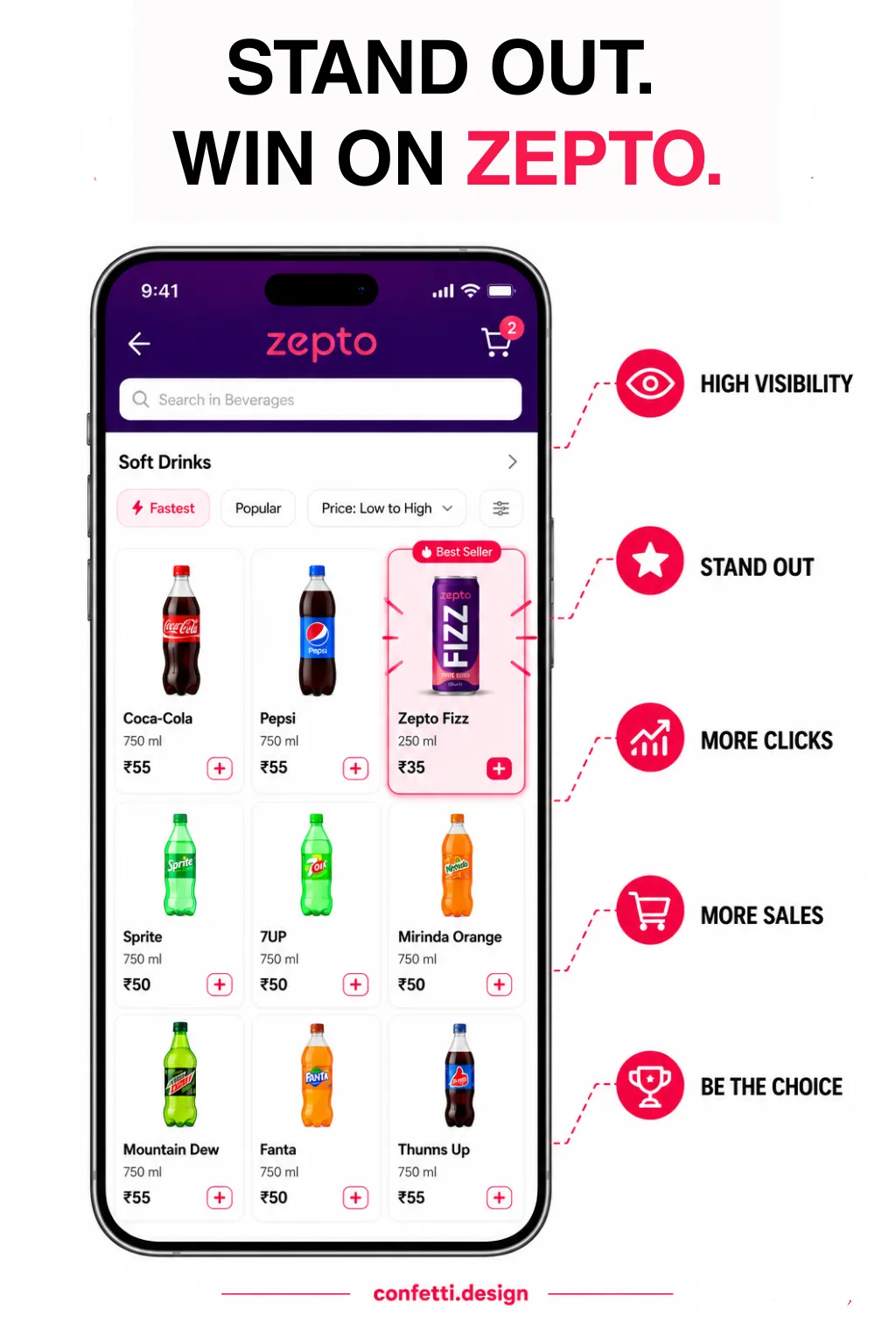
On Zepto, the rules of discovery, ranking, and conversion are quite different. If you apply marketplace logic to a quick commerce environment, you’ll end up burning ad spend and watching competitors take shelf space you could’ve owned.
Let's see how visibility works on Zepto. You’ll understand why paid and organic operate as a single system, not two separate tracks.
Zepto crossed ₹1,000 crore in annualised advertising revenue within less than 3 years of launching its ad business. That is roughly ₹83 crore per month. Blinkit crossed the same milestone.
Together, quick commerce ad revenue in India now rivals major broadcast networks.
Here is what that means for you.
Zepto and Blinkit are media businesses that happen to deliver groceries. The ads platform is the business model.
Zepto's Jarvis (an AI-powered advertising and marketing platform) has already served over 15 billion ad impressions. Their ad income exceeds 4% of sales, above the industry benchmark of 3–3.5%.
Now compare that to your current ad mix.
If you are allocating 20–30% of your performance budget to Meta and Google, and treating Zepto as experimental spend under 5%, you are misaligned with where the transaction actually happens.
When someone opens Zepto, their payment credentials are already saved. They have a need, hunger, a missing ingredient, a restock. They expect delivery in minutes. The entire decision window per product is under 3 seconds.
This is high-intent, low-patience, friction-free purchasing.
On Amazon, a user might scroll for 45 seconds. On your D2C site, they might read descriptions. On Zepto, they scan, tap, and move to the next item.
Your packaging, your listing image, your sponsored placement, these are conversion mechanisms firing at the exact millisecond of purchase intent.
Zepto visibility operates on two tracks that feed each other:
🟪Track 1: Paid Visibility (The Accelerator)
Includes sponsored listings, search placements, homepage banners, in-app video ads, push notification campaigns, and brand takeovers through the Jarvis platform. Paid visibility gets you seen before you have any sales history, any ratings, or any organic rank.
Without paid placement on day 1, your product sits at the bottom of search results behind established brands with thousands of units sold.
Zepto's algorithm has no reason to surface you. You have no velocity signal.
🟪Track 2: Organic Visibility (The Engine)
This is where Zepto's ranking algorithm decides to show your product without a sponsored tag.
The algorithm weighs real-time inventory availability, local demand signals from that specific pin code, sales velocity over the last few hours, pricing competitiveness against nearby alternatives, and your ratings and review count.
Organic visibility is the goal, not the starting point. It reduces your cost-per-acquisition over time and makes your unit economics sustainable.
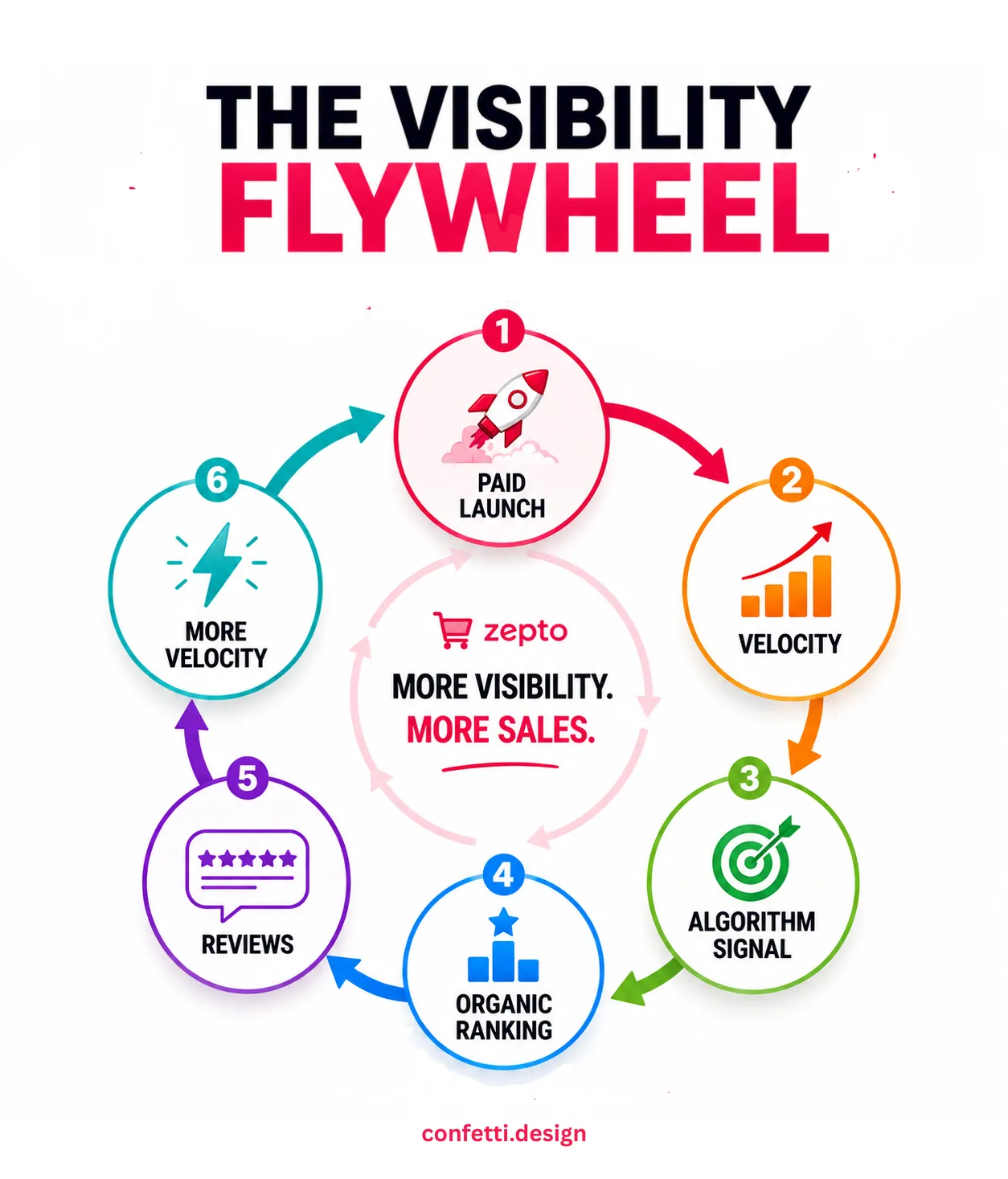
You cannot build Zepto visibility without paid investment.
The platform is engineered to reward brands that spend. But spending blindly burns cash.
You need specific formats, realistic budgets, and a sequencing plan that respects how Zepto's algorithm learns. This is exactly what we at Confetti help brands with.
Zepto launched Jarvis in late 2024. It is now the primary interface for all brand campaigns on the platform.
It is built directly into Zepto's dark store network and real-time inventory system. Every ad decision uses live data about what is in stock, where it is located, and how quickly it is moving.
What Jarvis gives you that other ad platforms do not:
Zepto claims up to 8x returns on ad spend through Jarvis. That’s your optimistic benchmark. Real ROAS (Return on Ad Spend) varies by category, creative quality, and competition.
Your advertising geography must match your inventory geography. No other platform forces this constraint. Ignoring these requirements can lead to unnecessary costs.
What new brands miss: Jarvis is designed for the full funnel.
Most new brands jump straight to search ads and ignore the awareness layer. That works for high-intent categories like baby food or medical supplies.
It fails for impulse categories like snacks or beverages where users need to recognise your brand before they click.
Minimum campaign budgets start at a few thousand rupees per week. But "accessible" does not mean "automatic." You still need to understand the format selection, bidding strategy, and sequencing.
Brands that use Jarvis directly as a strategic tool and build in-house expertise tend to outperform those that rely entirely on external partners.
🔵Sponsored search listings are where your budget should go first. They appear at the top of results when users search specific terms: "atta," "protein bar," "face wash," "chips."
The intent signal here is direct: the user typed what they want. You showing up at that moment is not advertising in the traditional sense. It is shelf placement.
🔵Category page placements work when users are browsing without a specific brand or product in mind.
Lower purchase intent than search, but higher discovery potential, particularly useful for new or impulse-purchase categories where you want to intercept a browsing consumer before they default to a familiar brand.
🔵Homepage banners are CPM-based and visibility-heavy. They make sense if you are anchoring around a specific launch moment, a new SKU, a seasonal campaign, a price promotion, where you need broad reach in a short window.
For a brand with no existing presence and a limited budget, homepage banners are not a first investment.
🔵In-app video is a growing format as Jarvis matures.
The production cost is higher, but engagement rates are much better than static formats when the creative is built for mobile: short, fast-cutting, with the product front and centre in the first two seconds.
🔵Push notifications work best as part of a promotional burst, not as a standalone tactic.
An offer-led notification ("₹50 off your next snack order, valid for 4 hours") to opted-in users can generate a sharp conversion spike. Without an offer hook, the open rate drop.
🟠Minimum viable spend for niche, low-competition categories, speciality health supplements, pet care, artisanal foods is ₹10,000–₹20,000 per month.
Enough to build initial velocity data and test keyword-format combinations.
🟠Recommended spend for competitive categories, packaged foods, personal care, beverages is ₹30,000–₹50,000 per month. These sub-categories have established brands already running always-on Jarvis campaigns.
Underspending here means you are invisible against incumbents with mature organic rankings.
🟠Scale-stage spend for brands targeting aggressive market share gains in high-competition sub-categories is ₹50,000–₹1,00,000 per month.
The most common mistake new brands make: treating Zepto ads as a 30-day test. The algorithm needs time to accumulate signal data before it begins responding organically.
☑️The first 30 days generate that data.
☑️Days 31–60 is where the algorithm starts to act on it.
☑️Days 61–90 is where organic lift becomes measurable.
Brands that cut spend at day 30, before organic traction has had any chance to build, lose all the velocity they paid to create.
Budget for 90 days minimum. Think of it the way you think about slotting fees in modern trade, the cost of holding the shelf until consumers develop a repeat purchase habit.
Once organic impressions start growing week-on-week, you can begin pulling back spend selectively on lower-intent placements (category browse, push) while maintaining search ads for your hero SKUs.

Talk to Confetti experts about onboarding, visibility, clicks, and conversions on quick-commerce platforms.
Book a Strategy Call
Let’s understand this step by step:
🟤Step 1: Start with search ads on your highest-intent keywords.
Keep the list tight, 5 to 10 terms. For example, for a protein bar: "protein bar," "high protein snack," "healthy snack." For a face wash: "face wash," "gel face wash," "daily cleanser."
Spreading a ₹30,000 budget across 40 keywords in week one means you are running at subcritical spend on every term. Concentration wins early-stage campaigns.
🟤Step 2: Pick 3–5 hero SKUs, not your full catalogue.
A ₹30,000 monthly budget split across 15 SKUs is ₹2,000 per product per month. That is invisible in any competitive category.
Concentrate spend on the products with the strongest margin, best imagery, and clearest differentiation. Build velocity on those first. Expand once they have traction.
🟤Step 3: Set geographic targeting to match your inventory.
If your stock is in Bengaluru dark stores, restrict your ads to Bengaluru.
Ads served where Zepto cannot fulfil the order generate impressions you cannot convert and they cost you the same as impressions that do convert.
🟤Step 4: Review ROAS weekly, not daily.
Early campaign data is noisy. A single low-volume day will look like a failed campaign; a single high-order day will look like a breakthrough.
Weekly patterns are where the signal is. Give each configuration 7–10 days before making significant bids or budget changes.
🟤Step 5: Use a launch offer to seed reviews in weeks 1–2.
A time-limited promotion: 10% off for the first 100 orders, or a bundle deal, combined with sponsored search creates the conditions for early reviews to accumulate. Reviews are a long-term organic signal.
They feed the algorithm, build trust for the next buyer, and improve your product page's conversion rate. The earlier you seed them, the faster the flywheel begins to turn.
Most brands spend their first three months on Zepto focused entirely on ad spend. But, paid placement is temporary, the moment you stop spending, you disappear.
Organic ranking is what keeps you on the shelf without paying for every impression. You need to know exactly how Zepto's algorithm weighs signals, what you can do to boost sales without ad spend, and how to sequence organic efforts so they grow over time.
Zepto's algorithm is real-time and hyperlocal. It weights five things:
🔷Real-time inventory availability
If your product is out of stock in a dark store, it vanishes from search results for every customer in that store's delivery zone. Not just de-ranked, removed.
Brands that experience frequent 2–3 day stockout windows are algorithmically penalised even after they restock, because the platform has logged the unreliability.
Every stockout is an organic ranking setback. Every week of consistent availability is an organic ranking investment.
🔷Sales velocity in the last 7 days
Recent performance carries more weight than historical data. A new brand that generates 50 orders in week one in a specific zone starts rising in that zone's organic results.
The algorithm interprets recent velocity as a demand signal, proof that real customers want this product now, not six months ago.
🔷Local demand signals
Zepto ranks products at pin-code level, not city level. A product that sells consistently in Bandra ranks differently in Powai. Your organic position is not a single number, it is a patchwork of micro-rankings across each dark store's catchment area.
Brands that concentrate inventory and ad spend in specific zones see better organic results there than brands that spread thin across a metro.
🔷Pricing competitiveness
The algorithm evaluates your price relative to comparable products in your sub-category. Being priced above alternatives suppresses your organic ranking even when velocity is otherwise strong.
This does not mean you need to be the cheapest but pricing that is conspicuously out of range relative to the category pulls down your position.
🔷Ratings and review volume
A product with 200 ratings at 4.3 stars will systematically outrank one with 10 ratings at 4.7 stars. The algorithm weights confidence in the data, not just the score.
A brand-new product with five reviews gives Zepto almost no predictive signal about future performance. Review volume builds that confidence over time.
📌For example, consider two D2C snack brands in the same category, same price point. Brand A replenishes dark stores every 14 days and has regular 2–3 day stockout windows. Brand B replenishes every 7 days and maintains near-100% in-stock availability.
After 60 days, Brand B holds materially higher organic ranking across every dark store zone it supplies, not because it outspent Brand A on Jarvis, but because the algorithm has learned Brand B is reliable. The difference in organic impressions between the two compounds weekly.
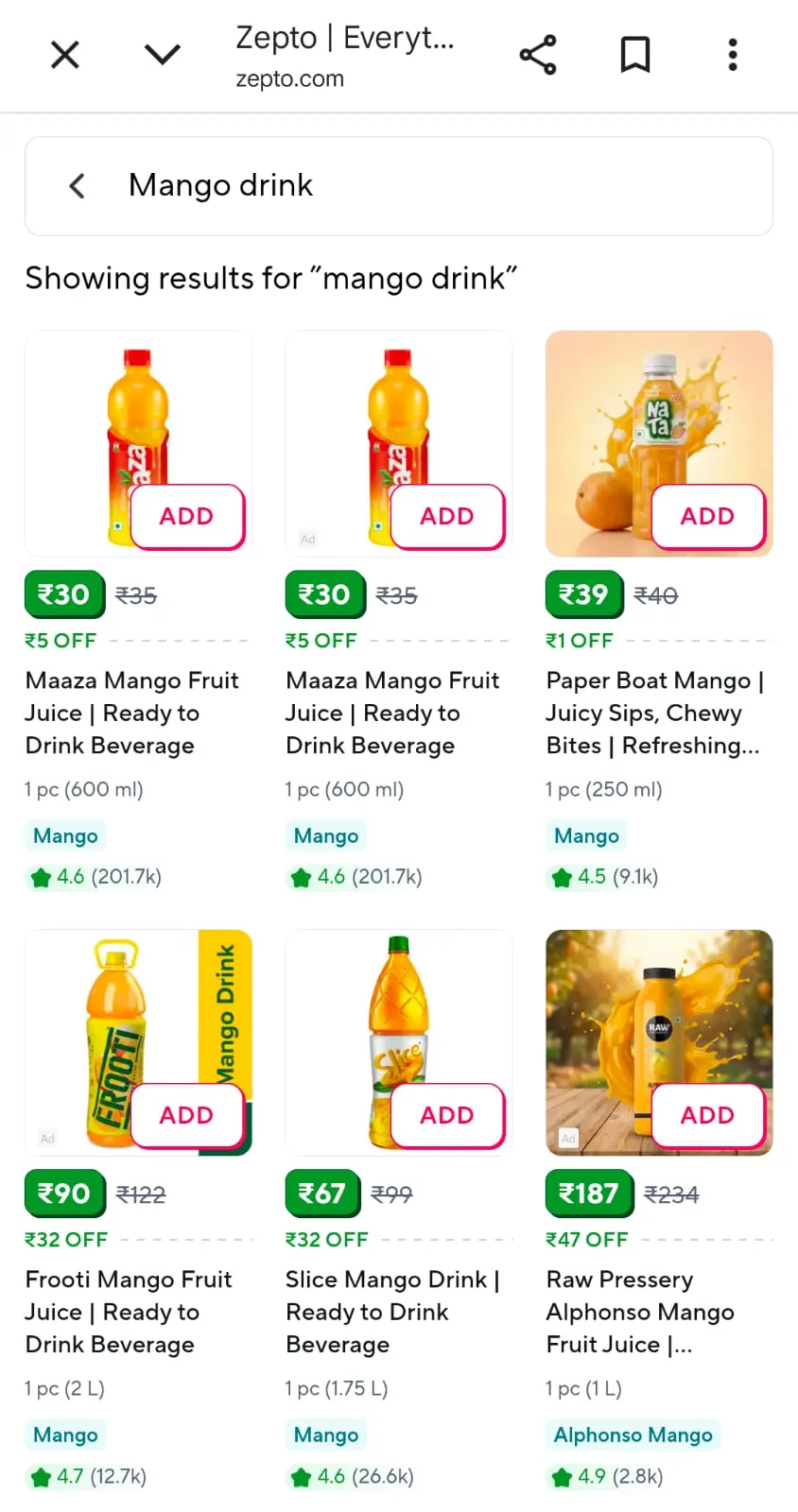
When a user types "mango drink," "oat biscuit," or "vitamin C serum" into Zepto's search bar, the algorithm matches that query against your product title, description, and category tags.
Most new brands get this wrong in two ways:
Strong catalogue optimisation on Zepto looks like this:
🔶Product title: Lead with the highest-intent generic search term, then brand and variant. "Mango Drink 500ml - Real Fruit, No Added Sugar | BrandName" will outperform "BrandName Summer Mango Delight 500ml" in search because it front-loads the terms customers actually type.
🔶Product description: Answer the purchase question first, what is it, who is it for, what differentiates it. Keyword density matters far less than clarity. A specific, direct description converts better than a marketing paragraph.
🔶Category and sub-category tagging: Tag your product across every relevant sub-category, not just the most obvious one. A protein bar tagged only under "protein" misses the "healthy snacks," "gym food," and "high-protein" browse journeys entirely.
🔶Primary product image: At thumbnail size, roughly 200×200px on mobile, most product images become illegible. A strong primary image has bold product name text, a readable variant callout, and high contrast against the background. More readable thumbnails earn more clicks. Better CTR signals the algorithm that your product is a strong match for the search query.
📌At Confetti, we help brands go beyond onboarding by building the foundation for long-term success on Zepto and other quick-commerce platforms.
Getting your first 30–50 reviews is the most important organic investment you can make in the first 60 days, more important than homepage banners, more important than push notifications.
Use a time-limited launch promotion (a small discount or bundle offer) combined with sponsored search to drive your first 50–100 orders. A portion of those buyers will leave reviews without any prompting.
💡Respond to every review, positive and negative.
Zepto factors seller responsiveness into some placement decisions, and a brand that engages with feedback signals operational maturity to both the platform and the next buyer reading the reviews.
💡Do not attempt to directly incentivise reviews. Zepto prohibits this and enforces it.
What you can control is the conditions, maximise order volume in the first 30 days, ensure the product matches the listing description exactly, and make sure packaging holds up through the delivery process without damage.
Reviews that arrive naturally from a good product experience are the only ones that compound cleanly into long-term organic visibility.
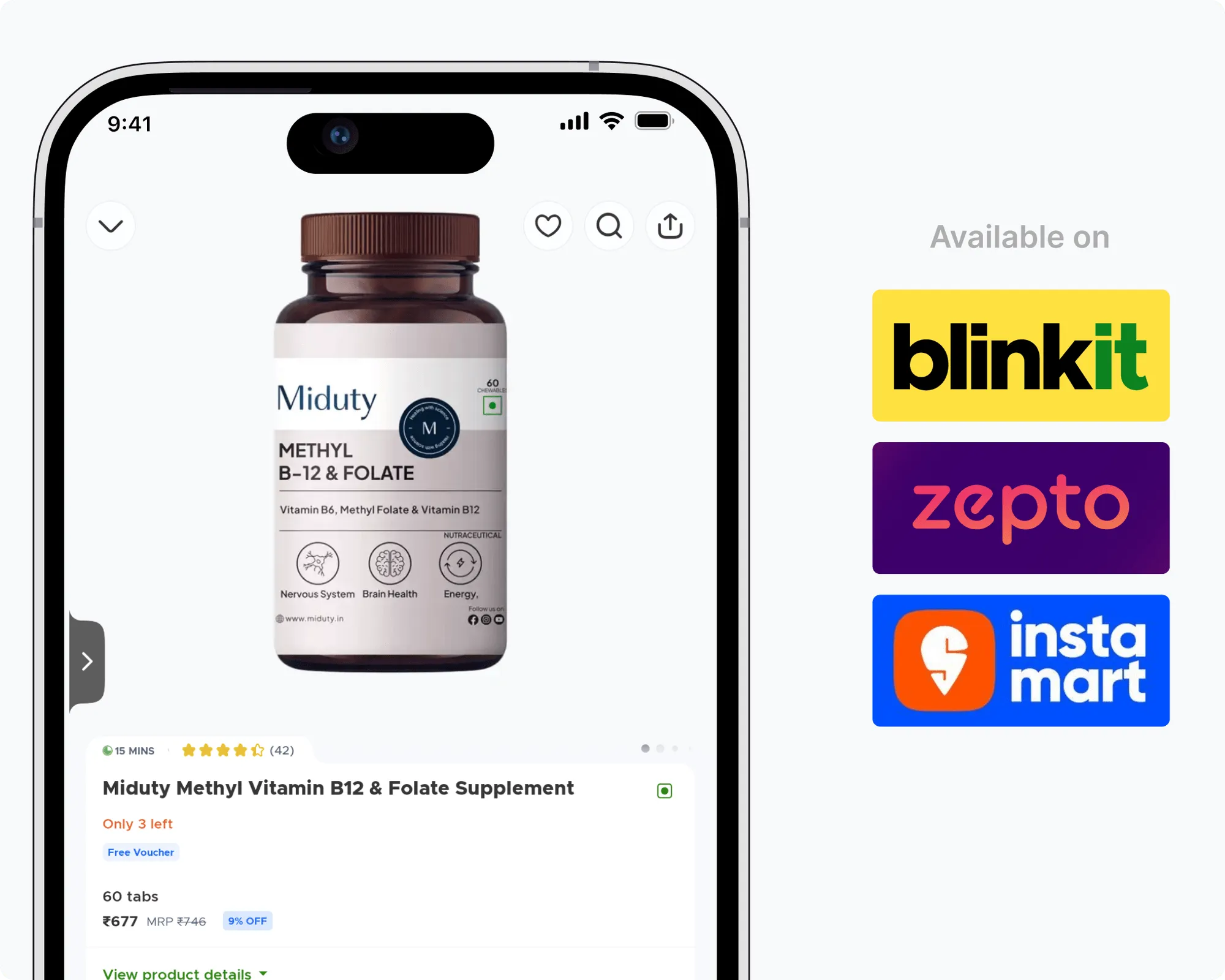
On Zepto, your packaging continues to affect visibility long after you go live.
Two separate loops, both starting with how you design and photograph your product.
Zepto's algorithm tracks click-through rate (CTR) as a relevance proxy.
When two products appear in the same search results and one consistently earns more clicks, the algorithm reads the higher-clicked product as a stronger match for that query and ranks it higher organically.
Over 8–10 weeks of accumulated impressions, that gap becomes material.
💡The primary driver of CTR difference between similarly priced products in the same sub-category is the product image.
On Zepto's category and search pages, your product thumbnail renders at around 200×200 pixels on a 5–6 inch mobile screen. Customers are scanning a grid of options.
The products that earn the click are the ones:
For example, a 5% CTR improvement grows over 90 days of algorithm exposure. A product earning 105 clicks per 1,000 impressions versus 100 clicks will rank measurably higher after two months without any additional ad spend.
Most brands never do this experiment because they treat product photography as finalised at launch.
📌At Confetti, when we design packaging for quick commerce, the thumbnail is treated as a primary design deliverable.
The question we ask at every packaging review is: does this product win the scan at 200×200px? If the answer is no, the hierarchy, contrast, or variant communication needs reworking before assets go to the catalogue.
In dark stores, products are picked from shelves, placed into delivery bags, and dispatched quickly. Thin cartons, poorly sealed pouches, labels that shift out of barcode-scan position when stacked creates damage during fulfillment.
Damaged products generate returns or complaints. Returns and complaints feed into Zepto's review and ratings system. And ratings, as covered earlier, are a direct organic ranking input.
💡The chain is indirect but consistent:
Structurally weak packaging → fulfillment damage → poor delivery experience → negative review → lower algorithm confidence → suppressed organic ranking.
Brands that invest in dark-store-durable packaging, drop-resistant construction, secure sealing, properly positioned barcodes, labels that remain scannable in shelf orientation: Generate fewer fulfillment problems from the start.
Fewer complaints that lead to more consistent organic ranking over time.
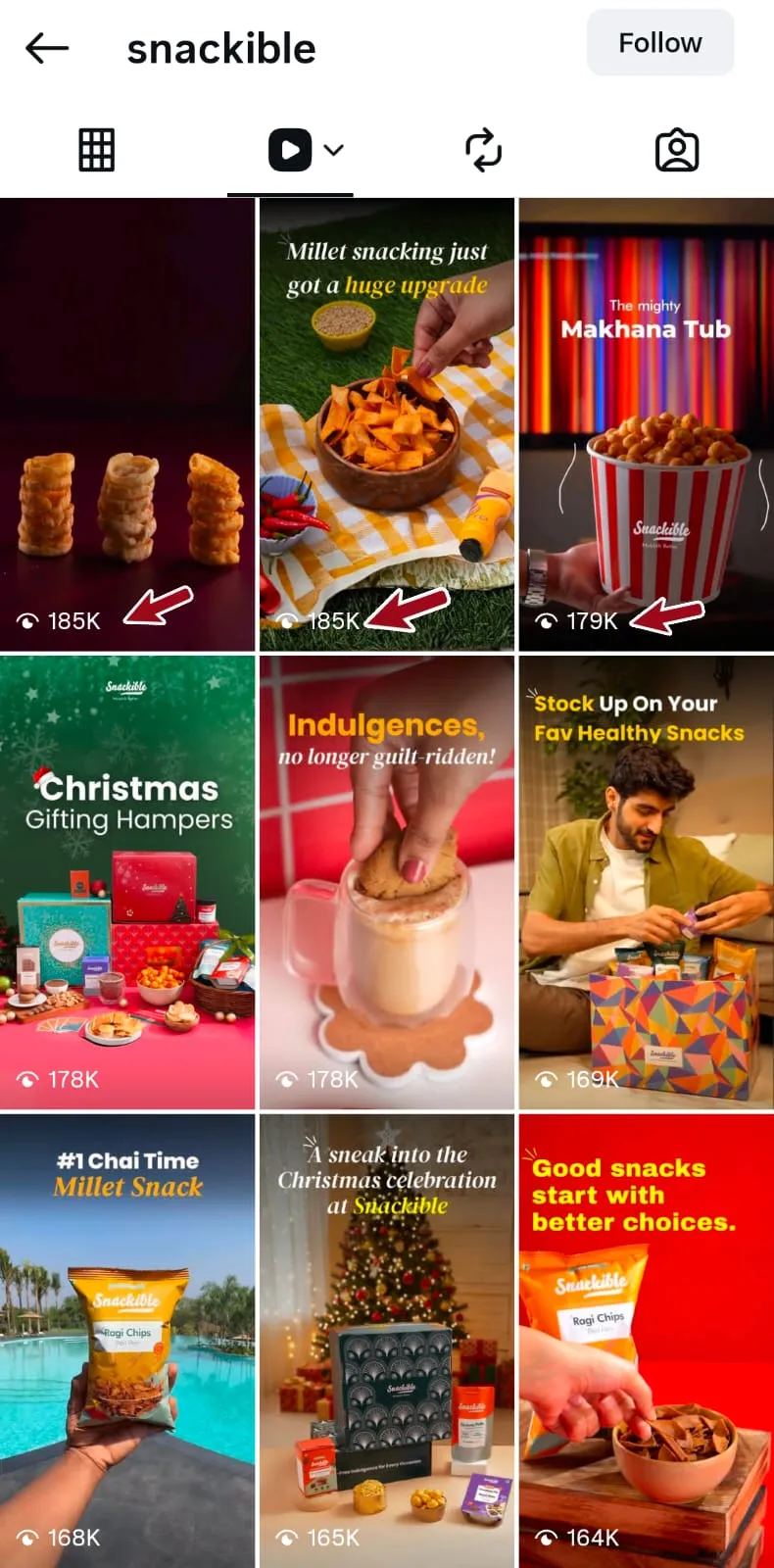
Most brands believe Zepto visibility starts and ends inside the Zepto app.
💡Zepto's algorithm responds to sales velocity. It does not track where that velocity comes from. External demand looks identical to in-app demand from the algorithm's perspective and it accumulates the same velocity signals that improve organic ranking over time.
Brands with existing audiences, social followers, email lists, influencer partnerships, can activate this without increasing Jarvis spend.
A purchase originating from a Meta ad that directs someone to Zepto counts identically to a purchase from a sponsored search placement inside the app.
💡The algorithm sees one thing: an order was placed. Attribution is irrelevant to the ranking signal. For D2C brands with an active social media presence, this is a significant leverage point.
For example, a brand with 50,000 Instagram followers that drives 200–300 Zepto purchases per month from social content is building organic Zepto ranking without spending a rupee on Jarvis.
Include content that names Zepto explicitly as the purchase channel: "Order on Zepto, delivered in 10 minutes", rather than generic "available online" messaging. Put the Zepto listing link in your bio or story.
When running paid social, geo-target your ads to pin codes where your Zepto dark stores are stocked. There is no value in driving social demand in areas where Zepto cannot fulfil the order.
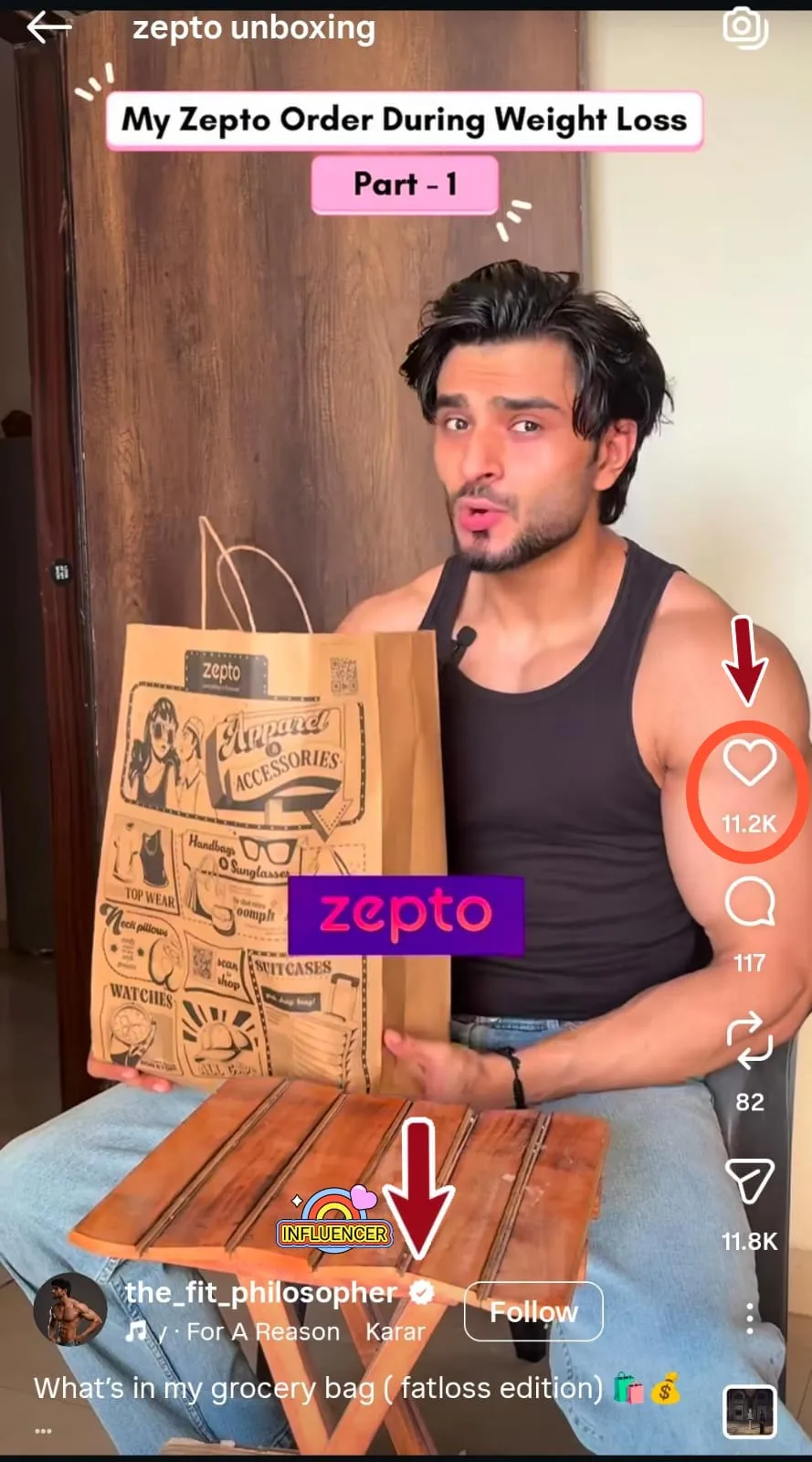
Zepto's user base skews urban, 22–35, metro-concentrated. Instagram and YouTube micro-influencers in the 50,000–500,000 follower range reach this demographic more efficiently than most paid channels and at a fraction of the cost-per-reach of homepage banners.
A food or FMCG brand that includes 3–5 micro-influencer activations in a launch city with influencers explicitly directing their audience to search the brand on Zepto, creates a concentrated geographic demand spike.
Because Zepto's algorithm is hyperlocal, that concentration is very important.
500 orders generated in South Mumbai in a single week produces a far stronger algorithmic effect than 500 orders spread across 10 cities over a month.
Example: A new protein snack brand launches in Bengaluru. They partner with four Bengaluru-based fitness micro-influencers with a combined following of 300,000.
All four post content directing their audience to search for the brand on Zepto. The brand runs Zepto search ads simultaneously in Bengaluru dark store zones.
🟰Rough math: if 1% of the combined audience acts on the content, that is 3,000 profile visits to the Zepto listing. If 15–20% of those convert, the brand is looking at 450–600 orders in Bengaluru within 72 hours.
Combined with sponsored search impressions running in parallel, that velocity spike registers strongly across Bengaluru's dark store zones and the organic ranking lift that follows persists for weeks after the campaign spend stops.
The influencer cost for four micro-activations in a Tier 1 city usually ranges ₹40,000–₹80,000 total, depending on category and follower quality.
The organic ranking effect from the velocity spike often delivers more long-term value than an equivalent spend on Jarvis banners.
Zepto has platform-wide promotional events throughout the year, festive sale periods, category spotlight weeks, new product launch windows, and branded partnership programmes.
During these events, participating brands receive above-the-fold banner placements, homepage features, and push notification campaigns that would cost more to access through standard ad spend.
💡New brands that align their Zepto launches with these promotional windows and actively negotiate participation through their category manager, get platform-amplified visibility at cost efficiencies that standard always-on campaigns cannot match.
Your category manager is the most underused visibility resource available to you on Zepto. The platform has finite promotional inventory. It is not distributed equally, it goes to brands that are communicative, prepared, and proactive about proposing participation.
Brands that share performance data with their category manager, flag upcoming inventory readiness ahead of promotional periods, and bring specific ideas to the table get more opportunities than brands that treat the relationship as purely administrative.
Getting listed on Zepto is only the beginning. The real challenge is getting discovered, generating sales, and building momentum.
How Confetti Helps Brands Succeed on Zepto
✅ Pin-Code Expansion Strategy: Identify the right pin codes and dark stores to maximise reach and demand.
✅ Listing Optimisation: Optimise product titles, descriptions, keywords, and thumbnails to improve search visibility and conversions.
✅ Visibility & Advertising: Launch sponsored campaigns and in-category promotions to help new products stand out from established brands.
✅ Performance-Driven Growth: Build the sales velocity and performance signals that Zepto's algorithm rewards with greater visibility.
✅ Scale Beyond Onboarding: Move from simply being listed to achieving sustainable growth across multiple pin codes and categories.
The goal isn't just to get your products live on Zepto, it's to create the visibility, traction, and sales needed to win on quick commerce.
How do we help brands in packaging❓
Brands that enter Zepto with Q-commerce-ready packaging and imagery, earn higher CTR from their first listing day, build algorithm signals faster, and reduce their paid spend dependence earlier than those who upload assets designed for a different channel.
Without the click, the algorithm never builds the organic signal that would reduce dependence on paid ads. The brand ends up spending indefinitely on Jarvis to compensate for a problem that originates in the design brief.
We work with brands entering Zepto at the packaging and brand asset stage, before the catalogue goes live.
We focus mainly on:
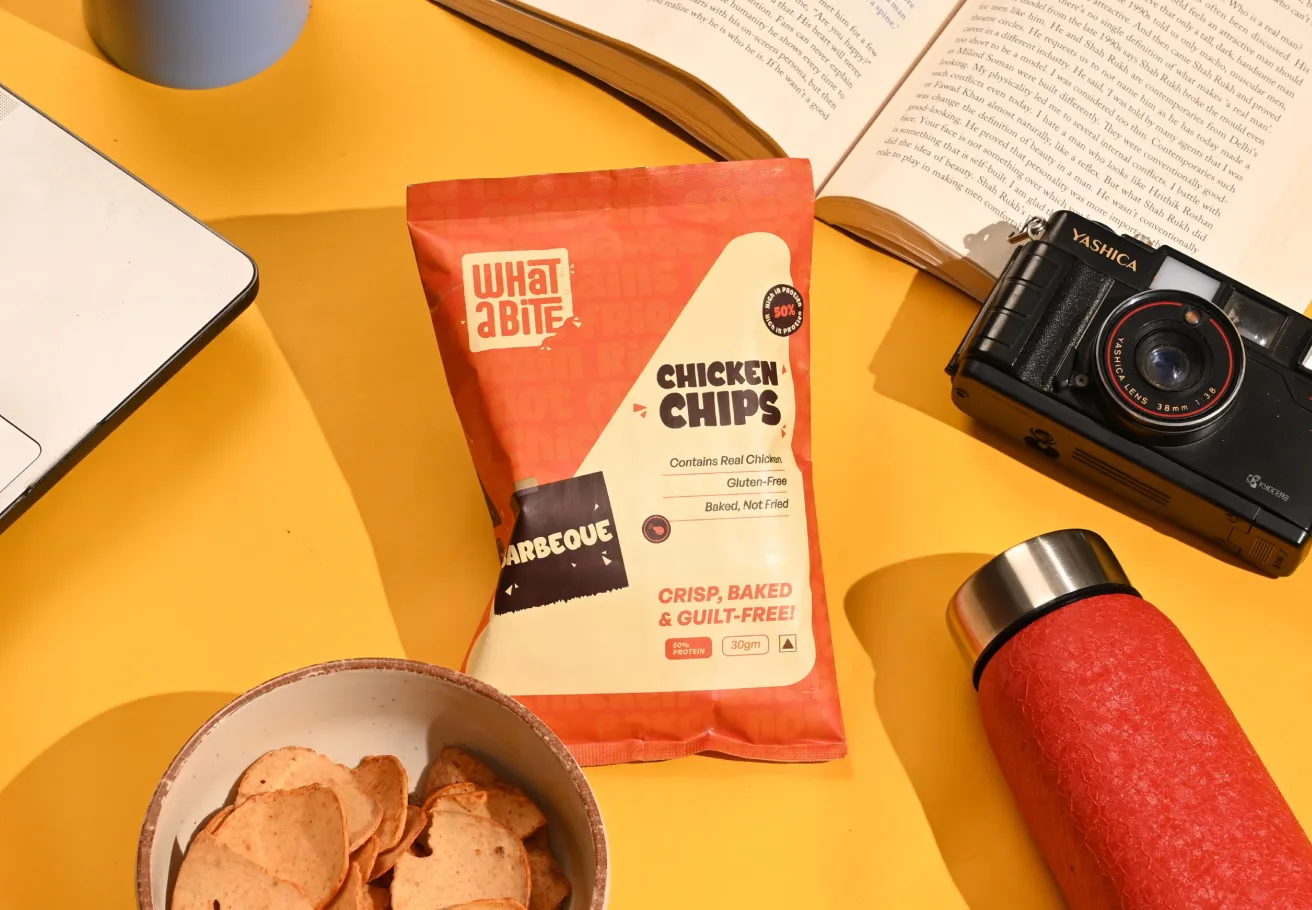
📌Our quick commerce work spans large FMCG partners and first-time D2C brands.
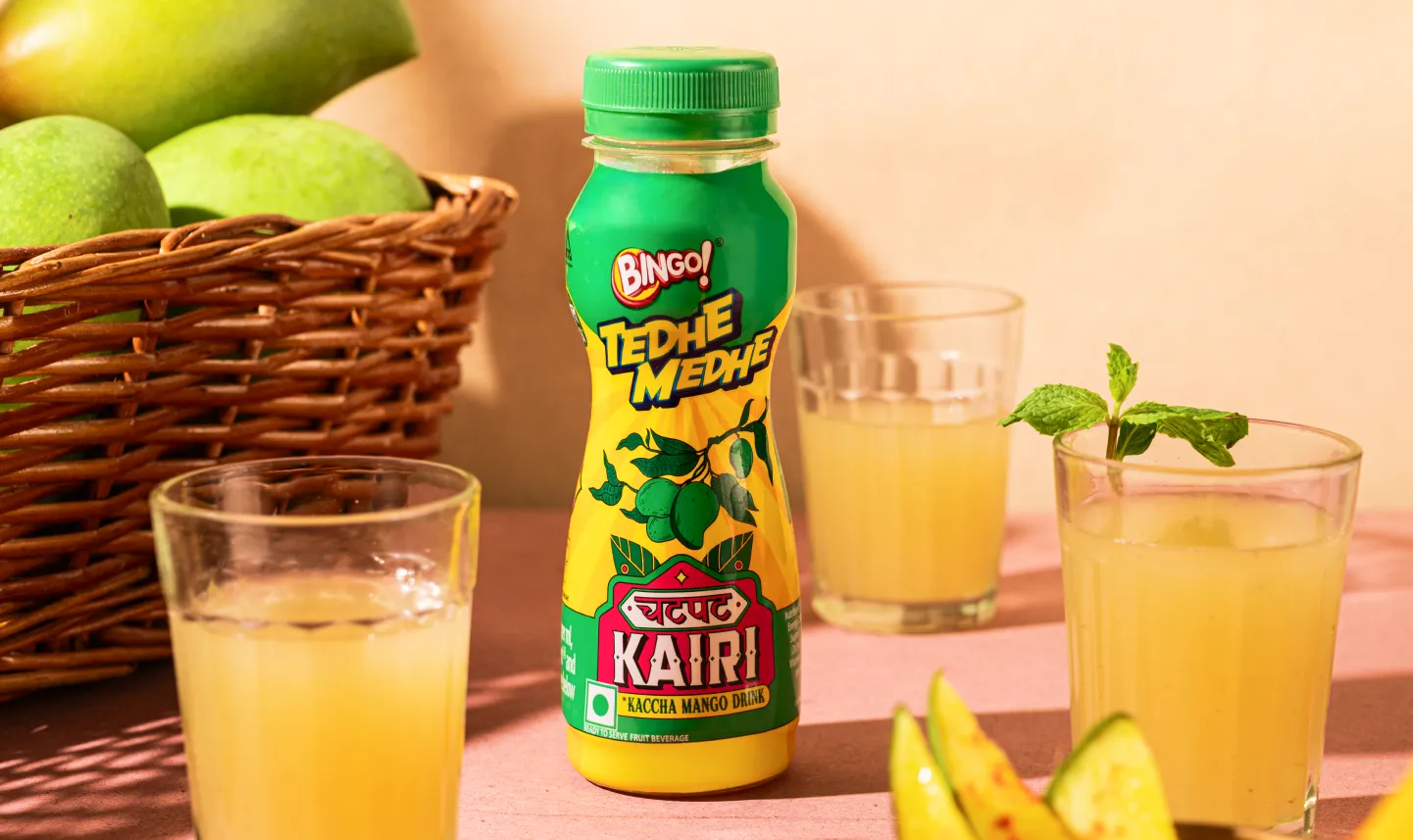
For ITC Bingo's Chatpat Kairi variant, a project that went on to win the World Brand Design Society Award 2025, the packaging had to perform on shelf, in catalogue photography, and at quick commerce thumbnail scale simultaneously.
Those are three different design problems that require a unified solution.
New brands that build durable Zepto visibility don't stumble into it. They sequence their moves deliberately, paid first, organic second, scale third.
The first 30 days are entirely about generating the sales data the algorithm needs to start working for you. Organic visibility is not possible yet.
Every decision in this phase should serve one objective: create velocity.
By day 31, you have enough data to make informed decisions. This phase is about cutting what isn't working, doubling down on what is, and watching for the first signs of organic traction.
If the first 60 days went to plan, organic impressions should now represent a measurable share of your total Zepto visibility.
This phase is about reducing reliance on paid placement, expanding your SKU footprint, and building the geographic depth that makes your Zepto presence hard to displace.
How long does it take for a new brand to get organic visibility on Zepto?
Most new brands see the first meaningful organic impressions, where the algorithm begins surfacing their products without paid support, between weeks 6 and 10 of being live, assuming consistent inventory availability and active sponsored listings during that period.
Brands that launch without sponsored listings or experience stockouts in the first 30 days usually take longer to build organic traction.
What is the minimum budget to get visibility on Zepto as a new brand?
For a niche category with limited competition, ₹10,000–₹20,000 per month is enough to generate initial velocity.
For competitive categories like packaged snacks, personal care, or beverages, ₹30,000–₹50,000 per month is the practical minimum for meaningful visibility.
Budget for at least 90 days, not 30. Brands that cut spend after one month lose the velocity they built before the algorithm has had time to respond.
What is Zepto Jarvis and how does it help new brands?
Jarvis is Zepto's in-house advertising platform, launched in late 2024. It allows brands to come up with sponsored search placements, category ads, homepage banners, and other formats directly within the Zepto app.
It uses real-time data from Zepto's user shopping behaviour and dark store network to target and optimise campaigns. For new brands, it is the primary tool for building the initial sales velocity that feeds Zepto's organic ranking algorithm.
Does having good product images actually affect visibility on Zepto?
Yes, more directly than most brands expect. Zepto's algorithm tracks click-through rate as a relevance signal. Products with higher CTR, driven almost entirely by how the product image reads at 200x200px thumbnail size, earn better organic ranking over time.
A packaging design or product image optimised for retail shelf or print will often underperform at thumbnail scale, costing the brand algorithmic ranking without any obvious explanation.
Can off-platform marketing improve a brand's visibility on Zepto?
Yes. Zepto’s algorithm responds to sales velocity regardless of where demand comes from. Social media, influencer campaigns, and Meta ads that drive purchases on Zepto generate the same ranking signals as in-app promotions, often at a lower cost per order.
Combining external demand generation with in-app Jarvis campaigns is one of the most effective visibility strategies for D2C brands.
How important are reviews for Zepto visibility?
Reviews are a slower-building but highly durable ranking signal on Zepto, indicating consistent product performance and boosting algorithm confidence.
They also improve conversion: a product with 50 reviews at 4.2 stars often outperforms one with 5 reviews at 4.8 stars because review volume builds trust in a split-second purchase decision. Seeding the first 30–50 reviews through launch promotions in the first month is one of the highest-ROI actions for a new brand.
Want strategic branding and packaging like this for your business?





.webp)
.webp)

.webp)
.webp)
.webp)
.webp)
.webp)






.svg)
.webp)