%201.webp)
02
AI Snaps
.svg)
.svg)
01
Our Work
03
About Us
04
Brand Audit
05
Contact Us
06
Client Success
12
07
Blogs
08
Careers
Book A Call
.svg)



.svg)
Need Help In Building Your Brand?
Click the button below & book a call with our founder directly.

Rishabh Jain
Managing Director
Confused about whether to redesign your packaging or run an audit first? We are here to help
A full packaging redesign can cost 3-5x more than a packaging design audit and replaces your existing design entirely. The right choice depends on whether your packaging has structural problems or just surface-level inefficiencies.
Let Confetti guide you to make a smarter choice between packaging redesign vs audit by comparing costs, timelines, and outcomes.
A packaging design audit is an in depth review of your existing packaging. It examines what your current packaging does and fails to do, across the shelf, supply chain, and consumer behaviour.
It evaluates your packaging across four key dimensions: cost, design effectiveness, structural performance, and sustainability compliance to identify what's working, what's wasting money, and what's costing you sales.
It is not a redesign. It's the evidence based analysis that tells you whether a redesign is even necessary.
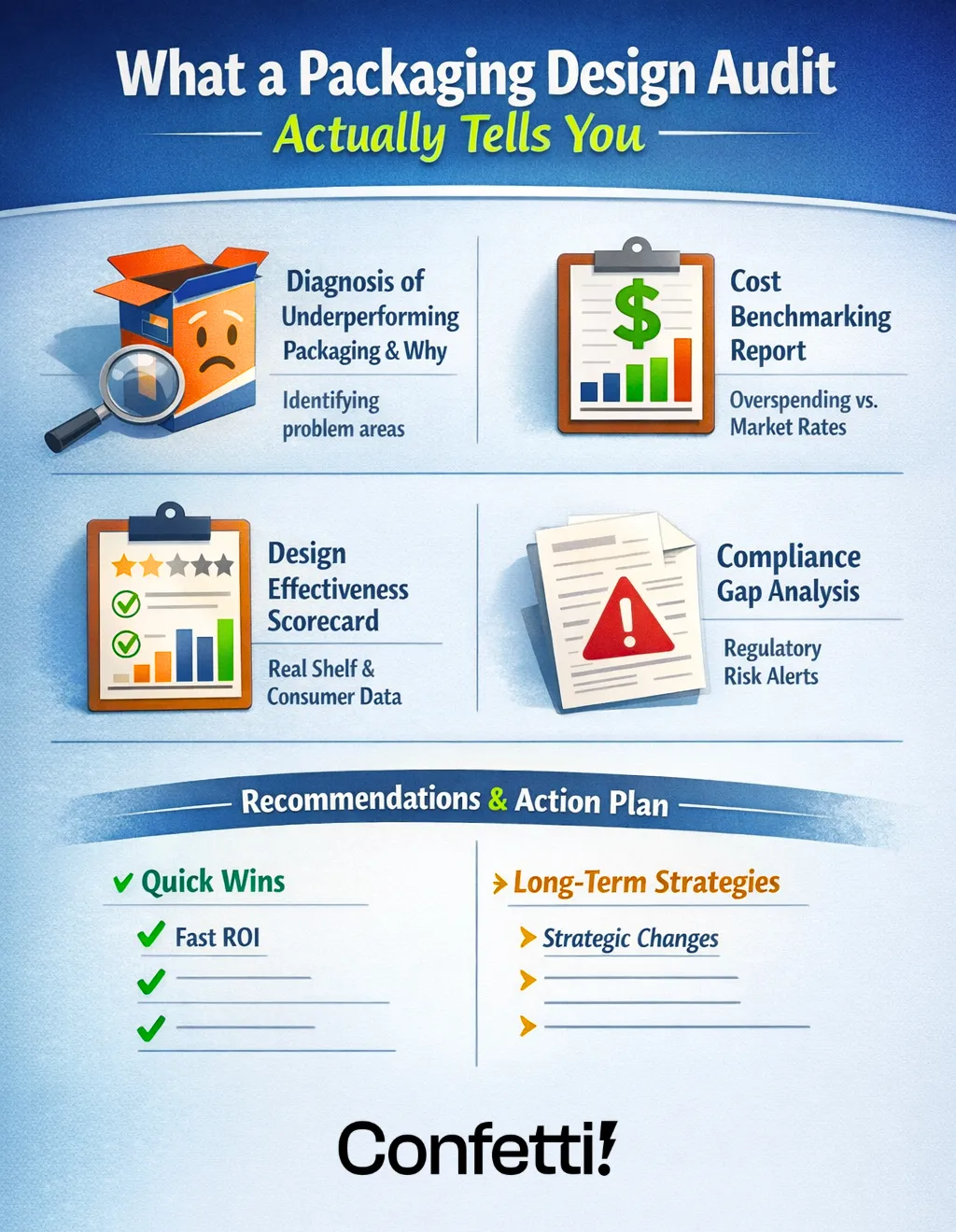
A well-run packaging audit goes deeper into the data behind the packaging.
Here's what a thorough audit covers:
1. Cost Efficiency
A packaging design audit benchmarks your current material costs, supplier pricing, and packaging specifications against industry rates.
It identifies over-engineered elements like extra layers, heavier substrates, unnecessary components, that are quietly inflating your cost-per-unit without adding consumer value.
2. Design Effectiveness
It evaluates whether your packaging is actually doing its job on shelf.
This is based on real data like retail observation, eye-tracking studies, or competitor benchmarking data.
It tells you whether your packaging is an asset or an obstacle at the point of purchase.
3. Structural Efficiency
This section of the audit looks at the structure efficiency of your packaging. This includes damage rates, fill ratios, packaging weight relative to product weight, and how well the structure protects the product in transit.
Poor structural performance has a direct cost in returns, in customer complaints, and in retailer relationships.
4. Sustainability and Regulatory Compliance
With regulations tightening across markets, this pillar has become increasingly important.
The audit checks your packaging against current and incoming legislation, identifying recycled content gaps, non-recyclable components, and over-packaging risks before they become fines or retailer delistings.
Honestly speaking, most brands that haven't had an audit in the last 12–18 months, should consider getting one.
But specifically, a packaging audit is the right move if:
❗Your packaging costs have crept up but you're not sure where the inefficiency is
❗Sales are flat or declining and you suspect the packaging may be a factor
❗You're preparing to brief an agency on a redesign and want the data to back it up
❗You're entering a new retail channel or geography and need to know if your current pack is fit for purpose
❗Your category has shifted: new competitors, new formats, new consumer expectations, and you haven't reviewed your pack against the new landscape
A full packaging redesign is an overhaul of how your product presents itself to the world: structurally, visually, and strategically.
Here you make major changes such as: structure, materials, typography, colour system, information layout, and often the brand’s visual hierarchy itself.
Depending on scope, a full redesign can include:
The numbers vary significantly, depending on who you work with and what you actually need.
Here's an honest breakdown of packaging redesign cost ranges across different provider types:
Not all packaging redesigns cost the same. Several factors can push a project significantly above or below its initial estimate.
📈Factors that increase cost:
📉Factors that keep cost down:
The agency fee is only the beginning. Most packaging redesign budgets fail to account for the full cost of implementation.
Tooling and plate costs: If you're changing structural format or print colours, new plates and tooling are often required. These can run to tens of thousands of pounds or dollars depending on print process and scale.
Photography and imagery: New packaging often needs new photography, lifestyle shots, product images, usage occasions. This is frequently scoped separately and can easily add a substantial amount.
Legal and regulatory review: Any change to on-pack claims, nutritional information, or labelling in regulated categories requires sign-off. This takes time and often involves external legal or regulatory resource.
Inventory write-off: Existing stock in old packaging has to go somewhere. Depending on the size of the inventory, this can represent a significant cost — one that rarely appears in the redesign brief but absolutely appears on the P&L.
Retailer re-listing and range reviews: In grocery and retail channels, a pack change can trigger a range review, a range reset cost, or simply the risk of temporary delisting. This is a real commercial consideration.
SKU proliferation: Every flavour, size, or market variant multiplies artwork time. A “simple” redesign for 5 SKUs becomes 50 SKUs when you factor in multilingual back panels, regional legal text, and retailer-specific callouts.
Now that we have clarity on what a packaging redesign and an audit are, let’s compare them head on:
An audit is the right call when the problem isn't fully diagnosed yet.
Choose a packaging audit when:
A redesign is the right call when the diagnosis is already done and the prescription is clear.
Choose a full packaging redesign when:
✅Quick Decision Framework:
For most brands, especially those in competitive grocery, FMCG, or CPG categories , the best option is: an audit then redesign.
The audit surfaces the intelligence. The redesign acts on it.
Together, they produce packaging that is better, in the ways that matter, backed by data that gives the whole project a far higher chance of success on shelf.

Both deliver measurable ROIs, but how they do it differs.
A packaging audit doesn't grow your revenue overnight. What it does is stop money from leaking out of a packaging budget that nobody has formally reviewed in months or years.
The numbers that show up most frequently in audit outcomes:
Material cost reductions of 10–30% through right-sizing, substrate changes, and supplier renegotiation
Logistics cost savings of 1–5% from dimensional weight improvements and reduced packaging footprint
Manufacturing efficiency gains of 1–5% by removing over-engineering and unnecessary components
Compliance risk avoided in EPR fines, plastic tax exposure, and retailer delistings can each run to six figures; an audit catches these before they become invoices
Example: A brand spends $100,000 per year on packaging materials that discovers a 10% inefficiency through an audit has found $10,000 in annual savings. If the audit cost $2,000, that's a 500% return in year one.
The cost is higher, the timeline is longer, and the return is primarily revenue-side rather than cost-side.
But, this also means, the risk is greater.
Research cited by Packaging Digest says about 10% of package redesigns spike sales and 20% cause declines, suggesting that many redesigns are neutral in their measurable sales impact.
Price premium: If done right,a redesigned product pack can communicate “premium”. It can justify higher prices and improve margins.
E-commerce conversion: Poor pack photography and inconsistent branding cost you clicks. A redesign that creates “shelf-ready” 3D renders and thumbnail-friendly layouts improved CTR. No ad spend increase.
Reduced write-offs: When a redesign fixes structural fragility, breakage drops, and the brand saves on transit breakage.
The zero-ROI trap: You get nothing back if you redesign for vanity. New colours without hierarchy clarity. Fancy finishes that don’t communicate benefit. Structural changes that increase cube and freight cost.
Example: A frozen food brand spent $50,000 on a “premium” rounded-corner box. Retailers delisted it because it didn’t stack. Zero ROI. Negative ROI.

Confetti is India’s top-ranked design agency for FMCG and CPG brands, with clients including ITC, Dabur, Aditya Birla Group,and more.
When talking about packaging redesign, our work begins with a blank canvas: a clear understanding of what’s actually happening with your brand’s packaging. The goal isn’t just execution, but measurable impact, helping founders understand how packaging influences perception, logistics, and overall brand performance.
This makes us a strategic partner rather than a studio that simply executes briefs. The priority is defining the right brief before any design begins.
What That Looks Like in Practice
For brands that aren't sure whether they need a redesign or an audit, Confetti's process begins with a structured brand and packaging review.
We cover the same ground as a formal packaging audit
but it's framed through the lens of what the brand is actually trying to achieve commercially.
Output: a clear answer to a practical question: is a redesign the right next step, and if so, what specifically needs to change, and why?
For brands that are ready to redesign, that audit foundation produces a tighter brief, fewer concept iterations, and a faster path to production-ready artwork that actually performs on shelf.
For brands that aren't ready, or don't actually need a redesign, it saves the significant cost of finding out mid-project.
A Track Record Built on Getting It Right
Confetti’s results come from aligning strategy and design from the start.
The ITC Bingo Chatpat Kairi project, winner of the World Brand Design Society Award (2025), is a strong example. The challenge was to launch a legacy snack brand into a new beverage category while balancing nostalgia with disruption.
That outcome was only possible because the strategic foundation came first.
How much does a packaging audit cost?
A packaging audit typically costs between $1,000 and $10,000, depending on the number of SKUs, the depth of analysis, and whether it includes consumer research or competitor benchmarking.
How much does it cost to redesign packaging?
Packaging redesign costs range from $200 for a basic freelance single-SKU design to $50,000+ for a full strategic brand packaging system from a specialist agency. Most mid-sized CPG brands spend between $1,000 and $20,000.
Should I do a packaging audit before redesigning?
In most cases, yes. A packaging audit identifies structural inefficiencies, cost savings, and consumer perception gaps that directly inform a stronger redesign brief. Brands that audit first typically spend less on the redesign and get better results.
How long does a packaging audit take?
A focused packaging audit on a single product range typically takes 2–4 weeks. A full portfolio audit across multiple SKUs can take 6–8 weeks, depending on data availability and the depth of consumer research included.
How do I know if my packaging needs a redesign?
Key signals include: declining shelf visibility vs. competitors, consumer research flagging confusion or negative perceptions, a change in brand positioning, packaging that's 5+ years old, or a consistent pattern of returns or damage.
Want strategic branding and packaging like this for your business?





.webp)
.webp)

.webp)
.webp)
.webp)
.webp)
.webp)







.svg)
.webp)