%201.webp)
02
AI Snaps
.svg)
.svg)
01
Our Work
03
About Us
04
Brand Audit
05
Contact Us
06
Client Success
12
07
Blogs
08
Careers
Book A Call
.svg)



.svg)
Need Help In Building Your Brand?
Click the button below & book a call with our founder directly.

Rishabh Jain
Managing Director
Arabic packaging design requirements have two dimensions: what the law mandates and what the market actually expects.
In this guide we cover both the requirements with country-by-country specifics for UAE and Saudi Arabia, a bilingual design execution guide, a halal compliance section, a cultural design strategy section, along with a pre-print checklist.
All prepackaged products wanting to enter the GCC and MENA markets must be compliant with arabic packaging design requirements as it determines market access:
The legal framework for packaging in the Gulf region is built on a layered system. Here’s a breakdown:
The Gulf Standardization Organization (GSO) sets the baseline food labeling standards adopted across all 6 GCC member states: UAE, Saudi Arabia, Kuwait, Bahrain, Oman, and Qatar.
The GSO 9 standard governs labeling for prepackaged foods across the GCC. GSO 9:2022 (adopted as GSO 9:2023) specifies the mandatory information required on every food label.
📢 Critical rule: All mandatory information must appear in Arabic on the original label or primary packaging. Labels must be legible, indelible, and clearly visible.
If you're applying Arabic information via sticker rather than direct printing, the sticker must be durable and permanently affixed, not something that can peel off in transit or on the shelf.
Non-food products, including cosmetics, household goods, and electronics, follow category-specific GSO standards. The Arabic language requirement applies across all regulated product categories, not only food.
The UAE enforces GSO 9 as the baseline but adds its own layer of specificity.
Key UAE-specific rules:
💡Design implication: Date markings must be integrated into the packaging artwork, requiring coordination between the packaging design agency and production team before finalizing the artwork.
The UAE has also introduced front-of-pack (FOP) nutrition labeling requirements for certain food and beverage categories, which came into effect in 2025. This is an evolving area, and brands should check whether their product category falls under these newer regulations.
The Saudi Food and Drug Authority (SFDA) is the primary regulatory body for food, cosmetics, and health products sold in Saudi Arabia.
Key Saudi-specific requirements:
The SFDA evaluates both inner and outer packaging units for labeling accuracy. If your product is sold in a gift set or multipack with items from different countries, you need harmonized ingredient and manufacturer information across all units.
SFDA is among the most stringent enforcement authorities in the GCC. Labeling non-compliance is one of the top reasons for shipment rejection at Saudi ports.
See our export packaging and labeling guide for broader multi-market compliance strategies.
Kuwait, Bahrain, Oman, and Qatar all adopt GSO as the baseline standard but have country-specific enforcement agencies and occasional local additions.
💡The safest approach is to design a bilingual label that meets the strictest GCC requirements (usually those of Saudi Arabia and the UAE), then make minor adjustments by market.
Adding Arabic to your packaging isn't as simple as pasting translated text into your existing layout.
Arabic is a right-to-left (RTL) script, and that changes the flow of information and the placement of visual elements.
At Confetti, our design experts are equipped in building a packaging layout that handles both Arabic and English without visual chaos, hierarchy collapse, or cultural misfire.
Arabic is written and read right-to-left (RTL). English is left-to-right (LTR). When both appear on a pack, the entire reading and design flow flips.
Here's what actually changes:
✅At Confetti, we approach RTL layouts by designing the Arabic and English versions in parallel. This ensures that the visual hierarchy works in both directions. We also test layouts with native Arabic speakers early in the process.
We’ve seen two formats work:
✔️Mirror layout: Arabic appears on the right and English on the left, with each language following its natural reading direction. Best for wide-format packaging like cartons, boxes, and pouches.
✔️Integrated stacked layout: Arabic and English are placed together, stacked or side by side, within the same panel. Ideal for bottles, jars, tubes, and other narrow labels.
📌Always right-align Arabic text. Left-aligning Arabic disrupts its natural reading flow and creates an unprofessional experience for native readers.
Use professional Arabic translation. Word-for-word or machine translations often produce awkward phrasing and errors, especially for product claims, ingredients, and usage instructions. Native-quality copy helps ensure clarity, compliance, and consumer trust.
Not every typeface supports Arabic script. Even among those that do, the quality varies dramatically.
Arabic typography has its own rules: letterforms connect differently depending on their position in a word, diacritics affect legibility, and the overall feel of a font can range from traditional calligraphic to modern minimalist.
Key considerations for font selection:
✅At Confetti, we use a curated library of Arabic typefaces proven to perform well in print. Every font is tested for legibility, brand fit, and cultural appropriateness before it's used on packaging.
Three style families for packaging:
✔️Naskh-based fonts (e.g., Adobe Arabic, Noto Naskh Arabic, Scheherazade): Highly legible and best for body text, ingredient lists, and regulatory copy. They remain readable at small sizes (around 7pt), making them ideal for dense packaging information.
✔️Kufi-based and geometric fonts (e.g., Kufam, Lemonada, Tajawal): Modern and distinctive, suited to brand names, headlines, and primary display text. They can communicate a premium, design-led feel.
✔️Thuluth and calligraphic styles: Best reserved for luxury, heritage, or cultural products (e.g., perfumery or gifting). Suitable for logos or decorative use, but not for small text or regulatory information.
📌Avoid “extended” Latin fonts with Arabic added. They often have poor spacing, weight balance, and proportions that feel unnatural to native readers.
Keep primary Arabic text at 7pt or above for legibility. Also, make sure to plan for text expansion. Arabic copy can be 20–30% longer than English, so grids for ingredients and nutrition panels must allow for it.
DO NOT treat English as the primary design language.
The regulatory requirement in most GCC countries is that Arabic must be at least as prominent as English.
This means you need to design a hierarchy that works for both English and Arabic audiences.
Arabic brand name rendering, Arabic headline copy, and Arabic product claims need to be given equal or primary visual weight on the front panel.
📌At Confetti, we follow the following approaches while designing for Gulf markets:
A common approach that works: Use English for the brand mark and identity (logo/brand name) and Arabic for all product information and communication.
English acts as the identity marker, while Arabic carries the functional content, ensuring readability and engagement in GCC markets. This structure is widely understood and helps balance brand consistency with local language needs.
✔️Any front-panel claims (e.g., “High Protein,” “100% Natural,” “Sugar Free”) must also appear in Arabic on the front. They cannot be moved to the back, as shoppers rarely turn packs in retail environments.
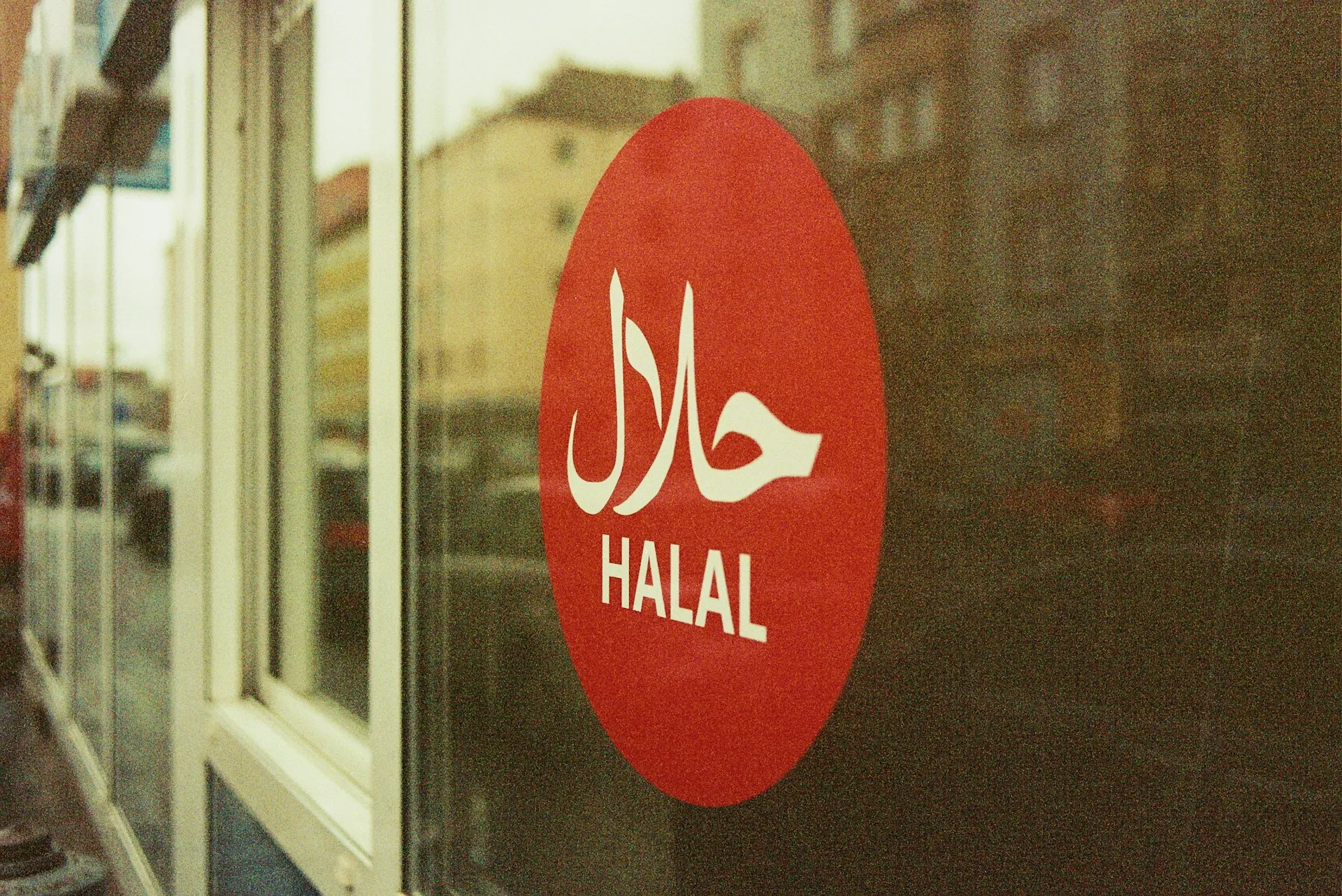
In many GCC categories, Halal packaging design compliance is legally required. In almost all GCC food categories, it is commercially essential regardless of legal requirement.
The GSO 2055-1 standard defines halal food requirements across the entire food chain, from receiving and preparation to packaging, labeling, and distribution
Where halal certification is mandatory:
Where halal certification is strongly recommended:
Even when not legally required, halal certification provides a significant competitive advantage and builds consumer trust. In markets where Islamic identity is central to daily life, the halal mark signals quality, safety, and cultural alignment.
📌Before applying any Halal mark to your packaging, verify that your specific certifying body is on the SFDA accepted list for Saudi Arabia, as body acceptance varies by country.
The Halal mark is a trust signal that GCC consumers are trained to look for, and they know the difference between a recognized mark and a generic one.
If your product is halal-certified, the mark must be displayed correctly:
Legal compliance gets your product into the market. Cultural design intelligence determines whether it performs once it is there.
GCC consumers, particularly in UAE and Saudi Arabia, are sophisticated. The retail environments in Dubai, Riyadh, and Doha are among the most design-literate in the world.
Packaging that looks dated, culturally generic, or clearly designed for a different market will not perform, even if every label requirement is satisfied.
Color choices carry specific weight in GCC consumer perception:
❌Avoid overly saturated neon palettes: These can signal a discount-tier product in GCC premium retail environments.This is especially important for modern trade and premium e-commerce positioning.
Also, color choice alone isn’t the issue, how the palette is applied and perceived should be planned by channel before finalizing artwork.
At Confetti, we research color associations specific to the target market and product category rather than applying a one-size-fits-all “Middle Eastern” palette.
Islamic art is rich with geometric patterns and calligraphic traditions. These motifs can be powerful design elements when used thoughtfully.
But they can also feel clichéd or appropriative when applied without understanding.
Rules that matter:
✔️Do not use Quranic text or religious scripture on packaging, as this is considered disrespectful in most GCC markets, especially for items that are discarded after use.
Distinguish clearly between Quranic text and decorative Arabic calligraphy, and work with designers like Confetti Design Studio familiar with Arabic script and Islamic cultural norms.
✔️Arabic calligraphy may be used as a design element separate from functional label text, particularly for brand names, headlines, or decorative framing.
But it should be created by a skilled calligrapher to ensure cultural and aesthetic authenticity.
✔️Geometric patterns inspired by Islamic art can be used to create culturally resonant packaging
They should be applied subtly, as restrained accents or background textures rather than overwhelming full-surface decoration.
✔️Avoid generic or clichéd “Arabian Nights” visuals such as overused arabesques, caricatured desert motifs, camel imagery, or tourist-style aesthetics, which can signal cultural inauthenticity.
Avoid cultural clichés in general design choices, as GCC consumers are globally aware and can easily identify superficial “Arabized” branding approaches.
✔️Food imagery: should be authentic and appetizing. Overly stylized or heavily retouched food images can read as inauthentic to consumers who value tradition and natural ingredients.
✔️Modesty in human imagery: While not universally prohibited, images of people. particularly women, should be approached with care. In Saudi Arabia especially, conservative sensibilities may make certain imagery problematic..
✔️Religious imagery: acceptable as cultural markers but must be used intentionally, not decoratively. A crescent or star motif used as thoughtful design has different reception than the same element used as filler.
✔️Symbols and icons: should be checked for cultural meaning. A symbol that's neutral in one culture may carry unintended connotations in another.
❌Do not include any imagery associated with pork, non-halal food preparations, or alcohol consumption anywhere on the packaging.
This applies even to unrelated product categories. The association creates brand risk that is disproportionate to any design benefit.
In GCC, each country has its own consumer behavior, regulatory emphasis, and design expectations.
The UAE's population is approximately 85% expatriate. Your packaging needs to appeal to Emiratis, other Arabs, South Asians, Europeans, and others, all shopping in the same aisles.
This diversity means:
Saudi Arabia is the GCC's largest market by population and economic weight. It's also the most conservative in terms of regulatory enforcement and cultural expectations.
Key considerations:
Based on our experience at Confetti, here are the most frequent and costly mistakes brands make with Arabic packaging:
❌ Adding Arabic as a sticker afterthought: although Arabic stickers may be legally permitted under GSO in some contexts, they signal low-quality market entry, create compliance risks, and should instead be fully integrated into the master artwork from the start.
❌ Relying on machine translation for Arabic packaging text: translation errors are immediately noticeable and damage consumer trust; all consumer-facing Arabic copy should be written or reviewed by a qualified Arabic copywriter.
❌ Applying production or expiry dates via post-production stickers: this practice is rejected by UAE and Saudi customs; date-marking must be built into the original artwork and production process.
❌ Use of unrecognized or generic Halal markings: they are worse than no certification; only officially recognized certifying body logos should be used to avoid compliance and trust issues.
❌ Allowing unclear visual hierarchy in bilingual packaging: equal or competing Arabic and English layouts can create confusion; a deliberate primary language hierarchy must be defined.
❌ Placing mandatory regulatory information such as country of origin in secondary or low-visibility areas; must appear clearly on the primary display panel in both English and Arabic (e.g., “Made in India / صُنع في الهند”).
❌ Including culturally inappropriate imagery: using alcohol, pork products, immodest visuals, or Quranic text used decoratively, creates immediate retail and brand risk in GCC markets.
❌ Incomplete or vague ingredient declarations: such as “flavoring” without proper breakdown, may violate GCC disclosure requirements and regulatory standards.
We are a branding and packaging design studio based in India and UAE, serving clients across the globe in categories including FMCG, supplements, food and beverage, and cosmetics
Here are some reasons that make us one of the best choices for packaging and design agencies for Gulf markets:
✅ Strategy-led, not just decorative: We treat packaging as a complete brand experience, not a flat visual to be signed off, so your Arabic packaging works commercially, not just aesthetically.
✅ Battle-tested with 200+ projects: With over 200 successful projects delivered for leading retail brands including ITC, Dabur, and Sunfeast, we bring the rigor of FMCG-grade execution to every brief.
✅ Deep cultural and regulatory fluency: Based in Dubai and working with brands entering the UAE and wider GCC market, we blend global design sensibilities with local cultural nuance and a precise understanding of regional compliance.
✅ Parallel bilingual design, not translation: We design Arabic and English in parallel from day one, not as an afterthought, so both languages carry equal visual weight and your layout works in both reading directions.
✅ Award-winning pedigree: Our work has been recognised internationally with the Manifest Award (2024), the Clutch Global Award (2025), and features on Packaging of the World, The Dieline, and the World Brand Design Society.
✅ End-to-end execution, from strategy to print: We guide brands from concept development and structural design through to artwork and production guidance, so you don't get stuck with a beautiful design that fails in production.
✅ Built for premium shelf impact: In a region where premium presentation is not optional but expected, we refine structure, layout, and finishing through multiple iterations to ensure your packaging meets the elevated standard of Dubai's retail landscape.
✅ 360° packaging system, not one-off designs: We design packaging as a complete system where every surface has a clear role to play, typically across two to three weeks, ensuring consistency across multipacks, gift sets, and product variations.
✅ Direct access to the founder and senior team: Founded and led by Rishabh Jain, who has worked with 100+ brands from Fortune 500 organisations to family-run businesses, you get strategic leadership on your project, not junior execution.
Use this checklist before releasing any packaging artwork for GCC market production. It covers both mandatory compliance fields and design quality standards.
☐ Product name present in Arabic on primary packaging
☐ Full ingredient list in Arabic, in descending order by weight
☐ Net quantity declared in Arabic, in metric units
☐ Country of origin in Arabic on the primary display panel ("صُنع في الهند" for India-origin)
☐ Manufacturer or packer name and full address in Arabic
☐ Production date and best-before or use-by date printed on original packaging (not sticker)
☐ Lot or batch identification code present
☐ Storage and usage instructions in Arabic (where applicable)
☐ Allergen declarations in Arabic (where applicable)
☐ Nutritional information panel in Arabic
☐ Halal certification mark from a recognized body on the primary display panel (mandatory for meat; strongly recommended for all food)
☐ Halal certifying body name or logo is the actual recognized body, not a generic mark
☐ All mandatory text meets minimum legibility size standards (Arabic body text: minimum 7pt)
☐ Arabic font size is equal to or larger than English font size on all panels (UAE requirement)
☐ UAE-based distributor or importer name and address present (for products sold in UAE)
☐ Country of origin stated as the specific manufacturing country (no abbreviations like "EU" or "GCC")
☐ Barcode is registered, scannable, and compliant with local GS1 standards
☐ Allergens are highlighted in Arabic (bolded, underlined, or capitalized) as per SFDA requirements
☐ Health or nutritional claims are substantiated and do not require pre-approval (e.g., no unapproved "boosts immunity" claims)
☐ Product name does not contain misleading or unapproved terminology
☐ Date format follows the specific country requirement (Day/Month/Year or Month/Year; Hijri or Gregorian as specified)
☐ All information on outer packaging and inner units is harmonized (no conflicting details between multipack and individual units)
☐ Shelf-ready packaging (where applicable) has all mandatory information visible without removing outer wrapping
☐ Translation has been certified by an accredited translation agency (where required)
☐ Country-specific warning statements or additional disclosures are included (e.g., GMO labeling, additive declarations)
☐ Arabic body text is right-aligned throughout all panels
☐ Arabic typeface is purpose-built for Arabic script (not a Latin font with Arabic glyph overlay)
☐ Bilingual content architecture was determined before layout began, not retrofitted
☐ Visual hierarchy is clearly assigned: one language leads, the other supports
☐ Arabic translation was done by a qualified Arabic copywriter, not an automated tool
☐ Front panel benefit claims appear in Arabic as well as English
☐ Halal mark is placed on the front or primary display panel
☐ Imagery contains no non-halal food references, alcohol, immodest representation (for conservative channels), or Quranic text used decoratively
☐ Color palette is appropriate for target market positioning and product category
☐ Date markings are built into the original artwork layout, not planned as a post-production sticker application
☐ Arabic text wrapping and line breaks have been reviewed by an Arabic-literate reader, not only validated visually
☐ RTL layout has been tested for logical reading flow—not just right-aligned text but full mirroring of columns, grids, and directional cues
☐ Numerals and measurements within Arabic text are positioned correctly (numbers read left-to-right even within RTL text)
☐ Arabic and English typefaces are visually harmonious and feel like they belong to the same brand family
☐ Font licenses have been secured for both Arabic and English typefaces used in the final artwork
☐ Arabic text has been proofread for grammatical accuracy, diacritic placement, and typographic errors by a native speaker
☐ All text has been tested for legibility at actual print size on the intended substrate (not just on-screen validation)
☐ Cultural motifs or calligraphy used are authentic and not generic or appropriative
☐ No religious text (Quranic verses or Hadith) has been used on packaging unless explicitly approved by relevant authorities
☐ Imagery containing human figures has been reviewed for appropriateness in conservative channels (especially Saudi Arabia)
☐ Front-of-pack (FOP) nutrition labeling has been included where required by recent UAE regulations
☐ Bilingual layout has been tested with both Arabic-first and English-first readers to ensure intuitive navigation
☐ Brand identity is consistently applied across both language versions without compromising either
☐ Structural design (die-cut, folding, window placement) does not interfere with mandatory information visibility
☐ Packaging has been reviewed against country-specific requirements beyond GSO baseline (SFDA, UAE-specific, etc.)
☐ All typography, icons, and visual elements have been checked for unintended cultural connotations
☐ Product claims and messaging are consistent in tone and meaning across both Arabic and English versions
☐ Sustainability claims or environmental labeling are substantiated and follow local guidelines
☐ Artwork has been reviewed by a regulatory consultant or local legal expert for the specific destination country
☐ Print-ready files include all required bleeds, crop marks, and color separations with correct Arabic text embedding
What information is legally mandatory on packaging for GCC countries?
Under GSO 9:2019, prepackaged food must include key mandatory information such as product name, ingredients, net quantity, origin, manufacturer details, date markings, lot number, and storage instructions or warnings. All required information must appear in Arabic on the primary label. In addition, Halal certification is required for meat and poultry products across GCC markets.
Is Arabic the only language allowed on packaging sold in UAE and Saudi Arabia?
No. Bilingual Arabic and English labeling is the standard across GCC markets. Mandatory information must be present in Arabic, with English allowed alongside it. In the UAE, English is commonly used for non-mandatory marketing content, while in Saudi Arabia Arabic is the primary language for consumer communication.
Can I use an Arabic sticker on my existing English packaging to enter GCC markets?
Arabic stickers are permitted under GSO provided they are tamper-evident and cover all mandatory fields. However, UAE and Saudi Arabia both require production and expiry dates to be on the original packaging, these cannot be stickered. For serious GCC market entry, integrating Arabic into the master artwork produces better compliance outcomes and stronger shelf performance than a sticker approach.
Is Halal certification required for all food products in GCC markets?
Halal certification is mandatory for meat and poultry across the GCC. For other food categories, its not always legally required, but products containing animal-derived ingredients (such as gelatin, emulsifiers, or flavorings) are often difficult to place in GCC retail without a recognized Halal mark. In Saudi Arabia, Halal expectations are applied more broadly across many food categories.
How should Arabic text be handled in a bilingual packaging layout?
Arabic must always be set right-aligned. Never set it to left-align. For bilingual packs, plan the layout architecture before building design, decide whether you are using a mirror layout (Arabic right side, English left) or a stacked bilingual format. Use a purpose-built Arabic typeface. Have the translation done by a qualified Arabic copywriter. Build the layout to accommodate both languages from the start.
Does one GCC-compliant label design work for all six GCC countries?
A bilingual Arabic/English master label that satisfies UAE ESMA and Saudi SFDA requirements will generally clear the GSO baseline for Kuwait, Bahrain, Oman, and Qatar. The primary risks in those markets are category-specific product registration requirements and Halal body recognition differences. Verify with a local compliance consultant for each specific target market.
What are the best Arabic fonts for packaging design?
For body text and regulatory copy: Naskh-family fonts (Adobe Arabic, Noto Naskh Arabic) offer the best legibility at small sizes. For product names and display text: Kufi-based fonts (Tajawal, Lemonada, Kufam) are effective at larger sizes. For luxury or heritage positioning: calligraphic styles (Thuluth) work well for display-only use.
Want strategic branding and packaging like this for your business?





.webp)
.webp)

.webp)
.webp)
.webp)
.webp)
.webp)






.svg)
.webp)