02
AI Snaps


01
Our Work
03
About Us
04
Brand Audit
05
Contact Us
06
Client Success
07
07
Blogs
08
Careers
Book A Call




Need Help In Building Your Brand?
Click the button below & book a call with our founder directly.

Rishabh Jain
Managing Director
Brand architecture for UAE family groups defines how the family name connects to owned businesses, consumer brands and international franchises. Most adopt a hybrid approach, balancing corporate identity, consumer positioning and family governance.
This guide introduces the Name, Own and Host framework, explores leading UAE examples, and covers when the family name should lead, and what two of the UAE's best-known groups show.

UAE family groups expand through acquisitions, franchise agreements, distribution rights and new ventures, often across unrelated sectors.
Their brand architecture must organise that complexity without weakening the trust attached to the family name.
In many UAE family groups, the family name represents years of relationships with customers, suppliers, banks and business partners.
Using it across every venture can transfer trust, but it can also expose the wider group to the reputation of an individual business.
The decision is not simply whether to display the family name. It is where that name should endorse a business, where a separate identity is more appropriate, and where the family connection should remain invisible.
Groups such as Al-Futtaim and Majid Al Futtaim have built diverse portfolios spanning retail, automotive, real estate, leisure and international partnerships.
These businesses do not all have the same relationship with the parent group.
That creates three distinct brand roles:
Treating all three in the same way can create confusion, limit brand independence or expose the family name unnecessarily.
Family businesses make up roughly 90% of private companies in the UAE . The architecture problem is not a niche issue.
It is the dominant ownership structure in the market, and it is under-served by generic brand architecture frameworks that assume a corporate parent with a single, centrally controlled brand.
As new generations take responsibility and launch ventures, a documented brand architecture helps prevent every new business from reopening the same debate.
At Confetti, we approach the family name as a reputational asset, not just a logo. The goal is to define where its trust should extend, where businesses need independence and how the portfolio can grow without losing coherence.

A UAE family group may own homegrown businesses, operate international franchises and use its family name to build trust with partners.
These are three different brand roles, and each needs a clear set of rules.
The family or group name represents the wider business to banks, investors, government, partners and employees. Its job is to communicate trust, continuity and reputation.
Keep it consistent across corporate communications, but use it selectively on consumer-facing businesses. The family name should add credibility where it matters, not appear on every brand by default.
These are businesses the group creates or acquires and can position independently. Their identity should reflect their category, customers and commercial goals.
For example, Majid Al Futtaim launched THAT Concept Store as a homegrown retail concept. A brand like this needs its own customer-facing identity, while the group can retain visibility in corporate communications or use an endorsement where it adds value.
The decision is whether each owned brand should stand alone, carry a group endorsement or use the family name directly.
These are international brands the group operates through franchise, distribution or licensing agreements.
The group manages the local business, but the brand owner controls key identity elements.
Al-Futtaim, for example, operates IKEA in the UAE and other regional markets. IKEA's consumer identity remains distinct from the operator's corporate brand.
The priority is to follow the agreement, protect the international brand and build the group's reputation through strong local execution. Also plan for what happens if the partnership ends.
List every business and assign it a role: Name, Own or Host. Then decide how visible the group brand should be in each case.
This avoids two common mistakes: using the family name everywhere, regardless of fit, or allowing the portfolio's most recognisable franchises to overshadow the group's own identity.
Have a clear architecture that protects the family reputation, gives owned brands room to grow and respects the brands the group hosts.

For a UAE family group, the family name can transfer trust to a business, but it can also expose the wider family to reputational risk.
What you need to decide is where the name adds value and where it should stay out of the customer's view.
Lead: Make it the primary brand
This works when trust, accountability and longevity are central to the purchase, as in real estate, financial services and automotive businesses.
The family name becomes a direct promise of quality and service, so the family must be willing to stand behind it.
Endorse: Let the business lead, with the family name as support
This suits owned brands with their own customer proposition that benefit from the family's reputation. The endorsement should appear consistently across agreed touchpoints; otherwise, it loses its value as a trust signal.
Step back: Keep the family name out of consumer-facing communications
This often suits international franchises, where the original brand owner controls the identity, and homegrown brands targeting audiences who may not know or need the family connection.
The group can remain visible in corporate communications without appearing on the product or storefront.
Stay out: Deliberately separate the business from the family name
This may be appropriate where reputational risk, category fit or family governance makes an association undesirable.
Document the decision rather than leaving it to individual businesses.
Before applying the family name, ask:
The answers help determine whether the name should lead, endorse or step back.
The same rules should cover initials, shortened family names and businesses established by different family branches. Trademark ownership and the right to use the surname become especially important when interests separate across generations.
At Confetti, we approach the family name as a reputational system with rules of application, not a logo with variations.
The rules should be written down, agreed by the family, and applied consistently across generations and businesses.
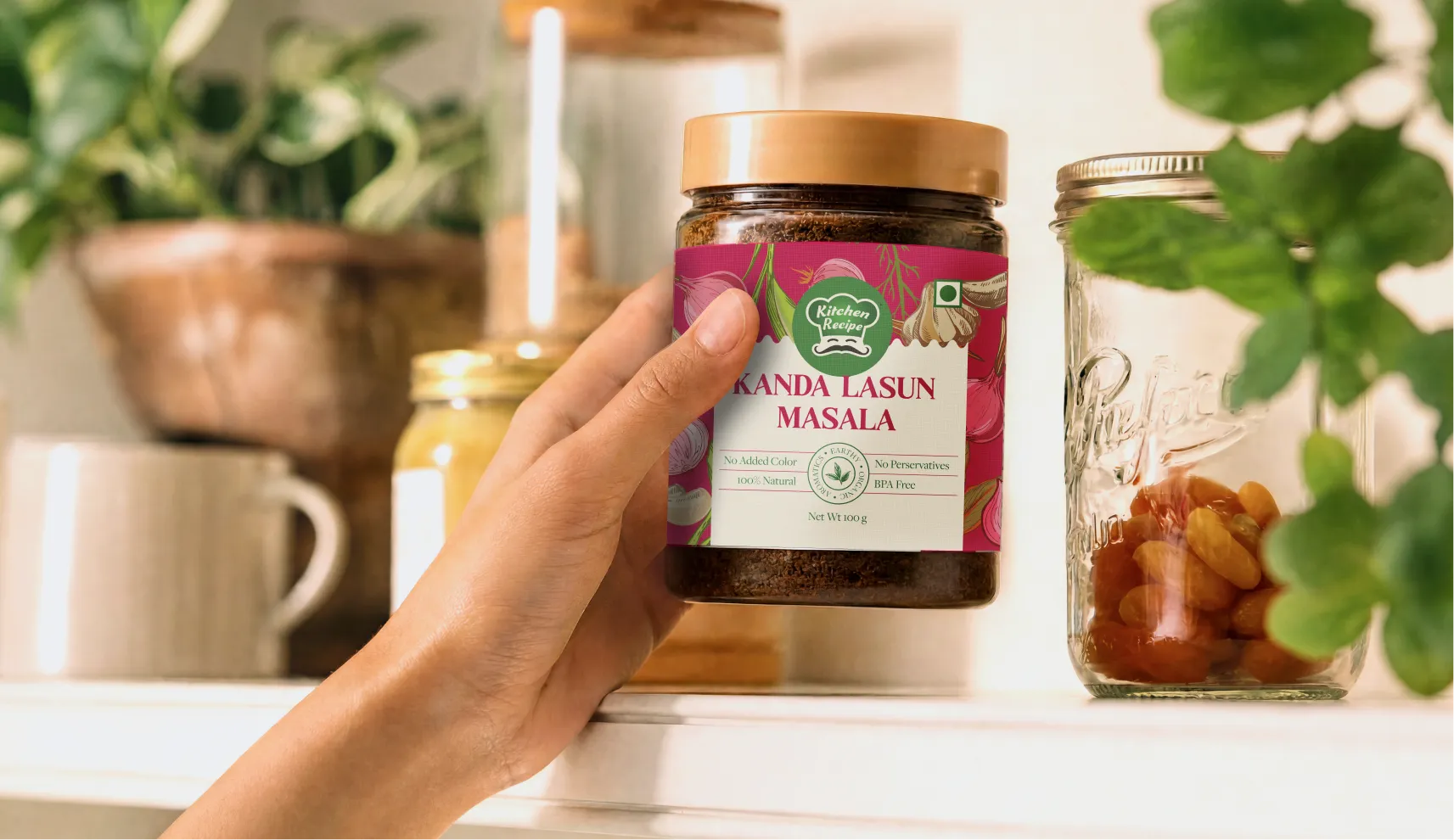
Brand architecture becomes practical when it affects a real product, storefront or customer experience.
Our work across established brands, product portfolios and parent-brand relationships has taught us three lessons that apply directly to UAE family groups.
For Kitchen Recipe, a spice brand founded in 1972, we retained the established logo while updating the packaging, adding Devanagari to the back panels and introducing gold caps to elevate perceived quality.
Lesson: Before renaming a legacy business or removing the family endorsement, understand what customers already recognise and trust.
Our work on ITC's Bingo Chatpat Kairi drinks and ITC's B Natural coconut water required different visual directions suited to their respective products and audiences.
The designs did not need to look alike simply because they belonged to the same parent company.
Family groups face the same decision with homegrown brands.
The parent should establish clear rules for brand relationships, but it should not force every business into one visual identity.
A youth-focused retail concept, a property company and a premium food brand may need very different customer-facing identities.
Our work across Cookwell and NutriPro involved developing distinct brand identities and flexible systems for their respective product ranges.
This illustrates why the relationship between a parent and a new brand needs to be decided deliberately, rather than left to naming or design conventions.
A system that depends on one family member's relationships will not survive the transition to the next generation.
The architecture has to be documented, governed, and transferable.
This is why the Family Charter is so important. It provides the governance layer that the brand architecture sits inside.
We would begin by mapping every business, consumer brand, franchise, licence and trademark.
Each would be classified as Name, Own or Host, followed by a decision on the family name's visibility and the degree of independence each brand needs.
Next, we would align the relevant family decision-makers and business leaders before developing naming rules, identity relationships and governance guidelines.
Finally, we would plan the rollout around new launches, packaging reprints and other natural business milestones to manage cost and disruption.
The goal is to make the relationships between them clear, protect the family's reputation and give the portfolio a structure that can grow across generations.
Al-Futtaim and Majid Al Futtaim offer two useful examples of how UAE family groups organise corporate reputation, owned businesses and international brands.
Al-Futtaim Group operates across automotive, retail, real estate, finance, healthcare and education.
Its portfolio includes international brands such as Toyota, IKEA and Marks & Spencer, alongside businesses of its own.
Customers generally encounter these brands through their own identities, while the Al-Futtaim name represents the wider group to partners, employees and investors.
This is a model where the corporate brand builds trust while hosted brands lead the customer relationship.
Majid Al Futtaim combines major retail partnerships with businesses it owns and operates.
Carrefour is a prominent franchise, while VOX Cinemas, Magic Planet and Ski Dubai are examples of its own consumer-facing businesses.
The portfolio combines international brand partnerships with businesses that build equity under the group's own ownership.
The lesson for other family groups is not to copy either model. It is to recognise that the balance between name, own, and host is a strategic choice, not an accident.
A group that has drifted into one role without deciding to is a group that has not made the choice and the architecture will reflect that absence.
Make the portfolio's relationships deliberate, protect the family name and give each business the identity its market requires.

Brand architecture only lasts when the rules behind it survive changes in ownership, leadership and family relationships.
For UAE family groups, this means connecting brand decisions to the wider family governance framework.
The UAE's Federal Decree-Law No. 37 of 2022, provides a framework for family business ownership and governance. It allows families to adopt a Family Charter covering matters such as ownership, family values, share transfers and family-related disputes.
For brand architecture, the charter is a useful place to establish principles for using the family name and approving new ventures.
Document the decisions that would otherwise be reopened with every new business:
The rules do not need to be complicated. They need to be clear, agreed and consistently applied.
New ventures should have a defined approval process rather than negotiating the family's name from scratch.
Allow standalone brands by default, permit group endorsement when the business meets agreed criteria, and require family-level approval for direct use of the family name.
The Family Charter establishes the decision-making principles.
A group-level brand architecture guide translates them into practice through naming rules, approved identity relationships, templates and market-specific guidance.
Each business should know whether it is classified as Name, Own or Host, how it relates to the group and which decisions it can make independently.
UAE family groups often expand into Saudi Arabia, Qatar, Oman and other markets.
Their brand architecture needs to preserve the family's reputation while adapting to local customers, languages and commercial requirements.
A family name may be well recognised in the UAE but less familiar to customers in Riyadh or Doha.
Instead of rebuilding your architecture for each market, decide where the family name leads, where it endorses a business and where an independent consumer brand is more effective.
Keep the core consistent: the meaning of the family name, the relationship between the group and its businesses, and the rules governing brand ownership.
Adapt the expression where needed, including language, local messaging, visual details and market-specific endorsements.
For a bilingual group, Arabic and English both need deliberate design, with consistent visual quality across corporate identities, owned brands and relevant franchise communications.
Set rules for Arabic and English wordmarks, language hierarchy, typography and layouts across signage, packaging, websites and corporate materials.
Where a hosted brand has its own approved Arabic identity, the group must accommodate it without disrupting its own architecture.
A name that works in one country may conflict with an existing trade name or trademark in another. Screen proposed names in Arabic and English, check pronunciation and local associations, and verify availability in each target market before investing in design.
Maintain a central register of family names, group brands, trademarks and licensed relationships.
This helps new ventures avoid conflicts and gives each market a clear view of which names it can use.
Clear ownership, bilingual rules and controlled local adaptation allow the group to enter new markets while protecting the recognition built over generations.
Most UAE family groups do not need to rename every business.
They need to understand how their brands relate, which decisions lack clear rules and where inconsistent naming is creating confusion for customers, partners and the next generation.
A review is particularly useful before a generational handover, acquisition, new franchise agreement, GCC expansion or investor presentation.
Another warning sign is repeated internal debate over whether a new venture should carry the family name. If every launch starts that conversation again, the group needs rules, not another naming exercise.
List every business, consumer brand, franchise, licence and trademark.
Classify each as Name, Own or Host, then record its legal entity, customer-facing name and relationship to the family brand.
Review how these relationships appear across corporate websites, investor materials, signage, recruitment pages and packaging.
Look for inconsistent use of the family name, overlapping identities and cases where a franchise appears to be owned by the group.
The audit should distinguish between relationships that are commercially useful and inconsistencies that have emerged simply because the portfolio grew over time.
A family group brand architecture brief should cover the portfolio, the intended role of the family name, naming rules, decision rights, target markets and Arabic-English requirements.
Include the family charter or relevant governance documents, along with any restrictions imposed by franchise agreements or regulated businesses.
Identify the people who must approve the outcome. A technically sound architecture will not last if the family and business leaders have not agreed to use it.
Look for experience in multi-brand portfolios, bilingual identity systems and complex stakeholder environments.
Ask how the partner will resolve disagreements, document naming decisions and create rules that remain usable after leadership changes.
At Confetti, we treat family group architecture as the link between family governance and customer-facing brands.
The work includes defining the relationships between businesses, documenting naming and endorsement rules, and designing a system that can accommodate future ventures.
The result should make the portfolio easier to understand today and easier to expand tomorrow.
Reviewing your group's architecture? Let’s talk about our portfolio and help you write the rule before the next generation inherits the question.
What is brand architecture for a family group?
Brand architecture for a family group is the structure that decides how the family or group name relates to the businesses it owns, the brands it creates and the international brands it distributes or franchises. It sets which names lead, which carry an endorsement, which stand alone, and who approves new names, so the portfolio stays clear as the group grows.
Should a family business use the family name as its brand?
Use the family name where it carries trust with the audience, such as investors, partners, government and B2B clients, and where the businesses share standards. Keep it off consumer brands in distant categories or higher-risk ventures, because a problem in one business then reaches the whole family. Many groups use the name as a corporate endorsement rather than on every product.
When should a UAE family group review its brand architecture?
Common triggers include a generational handover, a new business line or acquisition, entry into another GCC market, confusion between similar names, or preparing for investors or a listing. The UAE's Federal Decree-Law No. 37 of 2022 on family businesses, in force since January 2023, also prompts many groups to formalise governance, which is a natural point to review the brand.
How do you restructure a family group's brands without disruption?
Start with an audit of every entity, brand and licence the group holds, then agree the role of the family name and the rules for new brands before any design. Involve the family council or a named decision group, document the reasoning, and roll out changes at natural moments such as new launches or reprints, rather than all at once.
Want strategic branding and packaging like this for your business?