%201.webp)
02
AI Snaps
.svg)
.svg)
01
Our Work
03
About Us
04
Brand Audit
05
Contact Us
06
Client Success
12
07
Blogs
08
Careers
Book A Call
.svg)



.svg)
Need Help In Building Your Brand?
Click the button below & book a call with our founder directly.

Rishabh Jain
Managing Director
Brand strategy vs brand identity is a comparison founders get wrong often. Brand strategy defines what a brand stands for, brand identity defines what it looks like once that thinking gets designed.
This blog compares them side by side on cost, timeline, and ownership, and clears up how brand identity differs from brand strategy. This helps you to understand which one you need to focus on first.
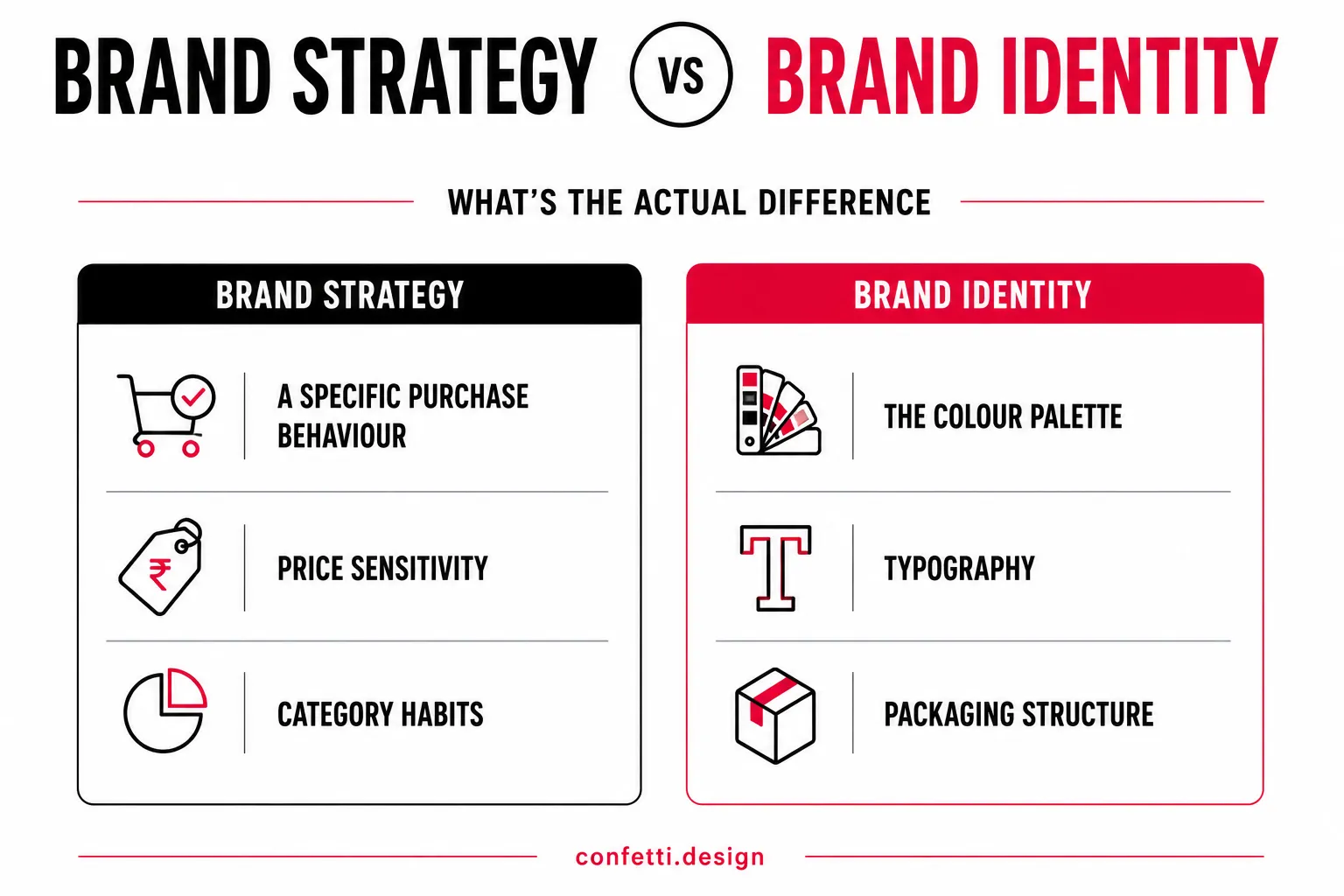
Brand strategy is the set of decisions that determine how your brand competes and who it's for.
It covers positioning. Where you are against competitors, and why that gap is important to a buyer.
It covers audience definition:
It covers messaging architecture too. What you say first, what you say next, and what you never say because it belongs to a competitor.
A strategy engagement produces a document. Sometimes 15–30 pages, sometimes a tighter one-page framework. Either way, it answers one question: what does this brand do better than the next five options, and who is actually going to notice.
For example, a D2C snack brand entering a crowded category has to decide whether it's competing on health, indulgence, or price. That decision has to happen before a single packaging mockup exists.
If you skip this step, your design team starts guessing. That guessing shows up later as inconsistent campaigns and packaging that reads as generic.
Confetti's brand strategy focuses on positioning, audience definition, and messaging direction before moving into any visual design.
📌Strategy is the reference point every design decision gets checked against.
Brand identity is the visual and verbal system that expresses the strategy.
It's the logo, colour palette, typography, packaging structure, photography style and the guidelines that keep all of it consistent once it leaves the design studio and hits a hundred different touchpoints.
Identity work is where strategy becomes something you can actually see.
A brand position like "approachable" only becomes meaningful when it's reflected in colours, typography, and other visual elements. That's the designer's role, always anchored to the strategy.
The deliverable is concrete
📌 Confetti's brand identity design work covers this full execution layer, logo through packaging system, for FMCG and D2C brands entering retail and quick commerce.
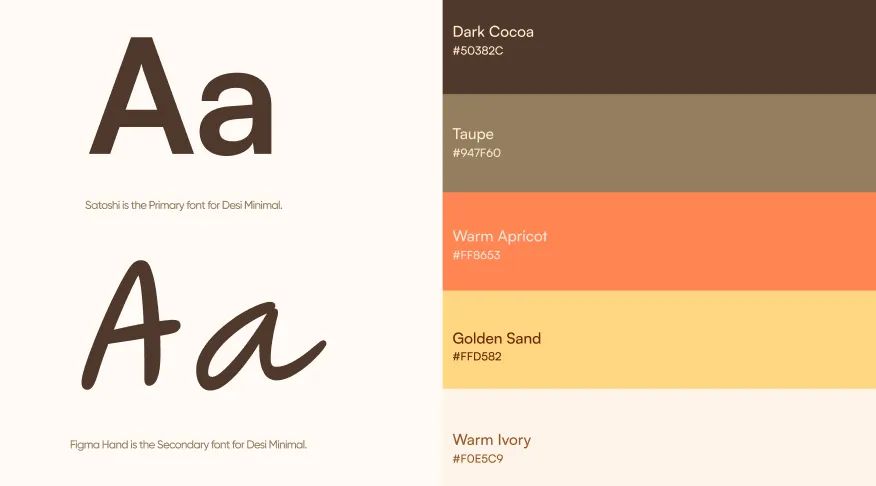
Here's where the two stand against each other on the factors that actually decide what to brief and when.
Brand Strategy answers a question: Why should this brand exist, and why should this customer pick it over the next five options in the category.
It's a business question before it's a creative one. If you get it wrong, good design won't fix it. The design would just be executing the wrong direction faster.
Brand Identity answers a narrower, more tactical question: What does this brand look, sound, and feel like everywhere a customer runs into it? A shelf. A delivery app thumbnail. A social post. An unboxing moment.
Example:Two protein bar brands use identical ingredients. One is positioned as a high-performance snack for gym-goers, while the other is positioned as a convenient breakfast solution for busy professionals.
Strategy decides that split. Identity then decides whether the performance brand looks bold and high-contrast, or restrained and clinical, based on what strategy has already settled.
Without strategy first, a designer is choosing between those directions on instinct.
📌Purpose is a business call. Everything else in identity is a downstream decision from it.
Brand Strategy hands you words and decisions.
Expect a positioning statement, defined audience segments with real behavioural detail, a messaging hierarchy, and often a brand personality framework like Is this brand playful or serious. Premium or accessible. Expert or peer-to-peer.
Brand Identity hands you assets:
📌You can hand a strategy document to any competent designer and get a coherent identity built from it.
You cannot hand identity files to anyone and reverse-engineer a strategy from them. The information only flows in one direction.
Brand Strategy comes first. Structurally and practically.
A strategy phase runs 2–4 weeks: research, positioning workshops, messaging drafts, and revisions before anything gets signed off.
Brand Identity work follows and usually takes longer, 3–6 weeks.
It involves iterative design rounds, packaging mockups, and testing at the sizes customers will actually see them, including thumbnail scale on quick commerce apps.
Brands that try to run both in parallel, often to save time, end up in a loop. The design team builds a logo direction. The strategy work shifts positioning slightly. Design has to restart.
📌Sequencing them properly, strategy closing before identity begins, is what keeps a six-week identity phase from stretching to more weeks.
Brand Strategy can exist without a finished identity. A founder can walk into a pitch meeting with a clear positioning statement and no logo yet. That's a complete, usable asset on its own.
Brand Identity cannot meaningfully exist without strategy behind it. A logo with no positioning to express is just a decoration.
📌This is why agencies that start with a mood board and a font pairing before locking positioning are skipping a structural step.
A brand identity can look great in isolation, but without strategy, it struggles to guide the many decisions involved in packaging, advertising, and retail communications.
Brand Strategy is with whoever owns the business direction. Usually the founder in an early-stage brand, or a marketing lead once the team grows.
It's a business decision with design consequences. It needs someone who understands the market.
Brand Identity is with a design or brand manager once strategy is locked. Their job is applying it consistently.
Making sure packaging on a new SKU still reads as the same brand as the flagship product. Making sure a festive campaign doesn't quietly drift the colour palette.
📌When a design lead starts making positioning calls without founder input, the brand's direction drifts one design decision at a time.
Brand Strategy is research-heavy. Category analysis, competitor mapping, customer interviews or surveys, and a review of what's already working and failing for comparable brands.
This is where the actual thinking happens, before any design conversation starts.
Brand Identity research is narrower. It's benchmarking.
Mostly visual: what competitors' packaging looks like on shelf and on app thumbnails, what colour and type conventions the category has normalised, and where there's room to look different without looking wrong for the category.
A brand strategy engagement lands as a document.
Sometimes a tight one-pager with positioning and messaging pillars. Sometimes a fuller deck with audience personas and competitive maps.
Either way, it's words and frameworks, built to guide decisions.
A brand identity engagement lands as a working kit. Logo files in every format you'll need for print and digital. A colour and type system. Packaging templates ready for production. A guidelines PDF.
📌These are the assets your team, your printer, and your next hire will actually use day to day.
Brand Strategy has a longer shelf life. Positioning built well doesn't need to change every year, and shouldn't.
Revisit it every 2–3 years or sooner if the market shifts meaningfully: a new competitor redefines the category, or your audience's behaviour changes in a way the original research didn't anticipate.
Brand Identity gets refreshed more often, usually every 12–18 months, through smaller updates. A packaging refresh. A seasonal campaign extension. A logo simplification for digital use.
📌These refinements usually don't touch strategy at all. It's identity evolving within a positioning that's still working.
Brand Strategy success shows up in market-level numbers. Market share movement, unaided brand recall in surveys, and how clearly customers can articulate what makes you different when asked directly.
These are slow-moving, quarter-over-quarter metrics.
Brand Identity success is more immediate and tactical. How fast a customer recognises the brand on a cluttered shelf or a mobile thumbnail.
How consistent the brand looks across a hundred touchpoints. Whether packaging tests well at the sizes customers actually encounter it.
📌Confetti tests identity assets based on the platform. For example at 200x200px thumbnail scale for a quick commerce buyer who sees before deciding whether to tap in.
For a D2C or FMCG brand in India, a standalone brand strategy engagement usually comes in the range ₹1–3 lakh. That range depends on research depth and how many audience segments need mapping.
Brand Identity work runs higher, roughly ₹3–8 lakh, because it scales with SKU count, packaging complexity, and how many formats the final assets need to cover.
Many agencies bundle both into a single project quote. That can make it hard to see where the cost is actually going.
📌Ask for a split, even if you're commissioning both brand strategy and identity together. It shows you how much of the budget is paying for direction versus execution.
If you get the strategy wrong, the brand appeals to no one clearly. Messaging changes with every campaign because there's no fixed positioning to anchor it.
The identity built on top of that shaky foundation usually needs a full rebuild within 12–18 months, once the gaps show up in actual sales data.
If you get identity wrong or skip it while strategy is fine on paper, the brand never actually reaches the customer in a recognisable form.
A clear positioning that never turns into consistent visual execution is invisible on a shelf next to a competitor that looks distinct, even with a weaker strategy underneath.
📌Neither mistake saves money. Both defer the cost to a rebrand cycle later, usually a more expensive one than doing the sequence right the first time.
If you don't have clear answers to who your customer is, what makes you different from the three3 closest competitors, and what your brand should never say or claim, you need strategy first.
Jumping to identity without these answers means your designer is filling strategic gaps with aesthetic guesses. Those guesses don’t survive contact with the market.
If strategy already exists, documented positioning, a defined audience, a messaging framework, and you need it translated into a logo, packaging, and consistent visual system, you're identity-ready.
⛔The most common mistake among founders is commissioning a logo before positioning is settled. A logo feels like tangible progress. Strategy feels abstract.
📌It's an understandable instinct, but an expensive one.
Brands that skip strategy usually rebrand within 12–18 months once real positioning gaps surface. That second identity project costs more than doing strategy properly the first time would have.
Brand identity gets used loosely, often standing in for terms that mean something narrower.
Understanding the difference helps you write clearer briefs, define project scope, and ensure everyone, from stakeholders to designers, is working toward the same objective from the start.
Brand Identity vs Visual Identity
Visual identity is the visual layer (logo, colour, typography).
Brand identity includes visuals, messaging, and the overall expression of a brand across every customer touchpoint.
Brand Identity vs Brand Positioning
Positioning defines a brand's place in the market and what sets it apart.
Brand Identity expresses that position through design, language, and customer experience.
Brand Identity vs Brand Personality
Personality is the brand's character, often described in human traits.
Identity is how that character is consistently brought to life through visuals and communication.
Brand Identity vs Brand Equity
Equity is the value and trust a brand earns over time through consistent delivery. Identity supports equity, but reputation is built through customer experience.
Brand Identity vs Brand Guidelines
Identity is the brand system. Guidelines document how to apply it consistently, helping teams and partners maintain a unified brand.
Corporate Identity vs Brand Identity
Corporate identity represents the company itself, especially in business and investor contexts. Brand identity represents a product, service, or consumer-facing brand.
Brand Identity vs Brand Design
Brand design is the process of creating the system. Brand identity is the final set of visual and verbal assets that process delivers.
Brand Identity vs Brand Image
Identity is what a brand intentionally creates and controls. Image is how customers ultimately perceive the brand based on every interaction and experience.

At Confetti Design Studio, the process moves from positioning through final packaging, with strategy work closing before any visual identity begins.
Each stage is built to feed the next.
Confetti's brand strategy work covers five 5 specific pieces, and each one earns its place before design starts.
🎯Competitor analysis looks past who's visible in a category and studies why so many brands end up looking and sounding alike. It surfaces real gaps for differentiation, before anyone touches a mood board.
🎯User personas push a brand to choose a specific audience instead of trying to please everyone. Real behaviours and motivations.
🎯Brand positioning and storyline decide what a brand wants to be known for, and just as importantly, what it's willing to leave behind.
This is especially deliberate in crowded categories like beauty and skincare, where narrative is often the only real point of difference.
🎯Brand archetypes, drawn from Carl Jung's twelve-archetype framework, shape how a brand feels rather than how it looks. In categories where products are functionally similar, archetype work is often what gives a brand a recognisable personality at all.
🎯Brand naming and tagline work treats naming as a strategic decision, not just a creative one. A name is usually the first thing a customer encounters, and one of the hardest choices to undo later.
Confetti's brand identity design work is where strategy starts to take visual form, built across 5 sub-services.
🎯Mood board design is the first step, bringing together colour, texture, imagery, and type to explore the feeling a brand should evoke before any final design decisions get locked.
🎯Colour palette and fonts come next. These are the building blocks that make a brand instantly recognisable, setting the tone before a single word gets read, and staying consistent across packaging, social, and advertising.
🎯Logo design turns those choices into a symbol built to work across packaging, apps, and social media, reflecting the brand's personality rather than existing as a standalone piece of art.
🎯Brand guidelines document all of it into a rulebook: logo usage, colour, typography, imagery, and tone, so a brand can scale without losing consistency as more people touch it.
🎯Mascot design, where relevant, turns brand personality into a character customers can recognise and connect with, built strategically rather than as decoration.
A brand identity extends beyond the logo and brand guidelines. It needs to translate effectively onto physical products, and packaging design is what makes that possible.
Confetti treats packaging as the point where identity gets tested for real: does the colour system still work at shelf scale, does the logo hold up on a 100g pouch as well as a 1kg jar, does the tone of voice translate into copy a customer actually reads while deciding whether to buy.
Packaging built for a retail shelf gets evaluated on shelf appeal and standout next to competitors.
Packaging built for e-commerce or quick commerce gets tested at thumbnail size, since a product on Blinkit or Amazon is encountered as a small compressed tile.
📌Confetti's identity work has picked up recognition beyond client results too, including a World Brand Design Society Award in 2025 for ITC Bingo Chatpat Kairi.
What is the difference between brand strategy and brand identity?
Brand strategy is the thinking behind a brand: who it's for, what it stands for, and how it's different. Brand identity is the visual and verbal expression of that thinking: logo, color, typography, tone of voice. Strategy defines the decisions; identity communicates them.
Which comes first, brand strategy or brand identity?
Brand strategy should come first. Identity built without a strategic foundation tends to be visually appealing but strategically directionless. Which usually leads to inconsistent messaging and a redesign within a couple of years once the gaps become obvious.
Is brand identity the same as a logo?
No. A logo is one component of brand identity, alongside color palette, typography, packaging system, imagery style, and tone of voice. Brand identity is the complete visual and verbal system; the logo is just its most visible single piece.
What is the difference between brand identity and brand image?
Brand identity is what a company deliberately creates and controls. Brand image is what actually forms in the customer's mind, shaped by identity but also by product quality, pricing, and word of mouth.
A brand can have a strong identity and still have a muddled image if the two aren't reinforcing each other.
Can a business have brand identity without brand strategy?
Yes, but it tends to underperform. Without strategy, identity decisions are based on aesthetic preference rather than audience and positioning data, which usually shows up as inconsistent messaging across touchpoints even when the visuals look polished.
Why do brand strategy and brand identity get confused so often?
Because identity is visible and strategy isn't. Most people experience a brand through its logo, packaging, or website, so the invisible strategic decisions behind those choices get overlooked, and the two terms get used interchangeably.
How much of a rebrand budget should go toward strategy vs identity?
There's no universal ratio, but skipping or rushing strategy to protect budget for design work is the most common costly mistake.
A strategy phase that's too thin to answer basic positioning questions will surface as inconsistency in the identity work regardless of how much is spent on it.
Want strategic branding and packaging like this for your business?





.webp)
.webp)

.webp)
.webp)
.webp)
.webp)
.webp)







.svg)
.webp)