%201.webp)
02
AI Snaps
.svg)
.svg)
01
Our Work
03
About Us
04
Brand Audit
05
Contact Us
06
Client Success
12
07
Blogs
08
Careers
Book A Call
.svg)



.svg)
Need Help In Building Your Brand?
Click the button below & book a call with our founder directly.

Rishabh Jain
Managing Director
Two quotes, one costs $5000, the other three times that. The deliverables look similar: logo work, packaging design across your SKUs, brand guidelines. And now you're left wondering whether the expensive one is really worth it.
As a branding and packaging design agency we often get asked why we charge what we do. Here we break down what separates genuinely premium branding work from expensive but hollow work, when the premium is justified, and how to know if you're paying for strategic value.
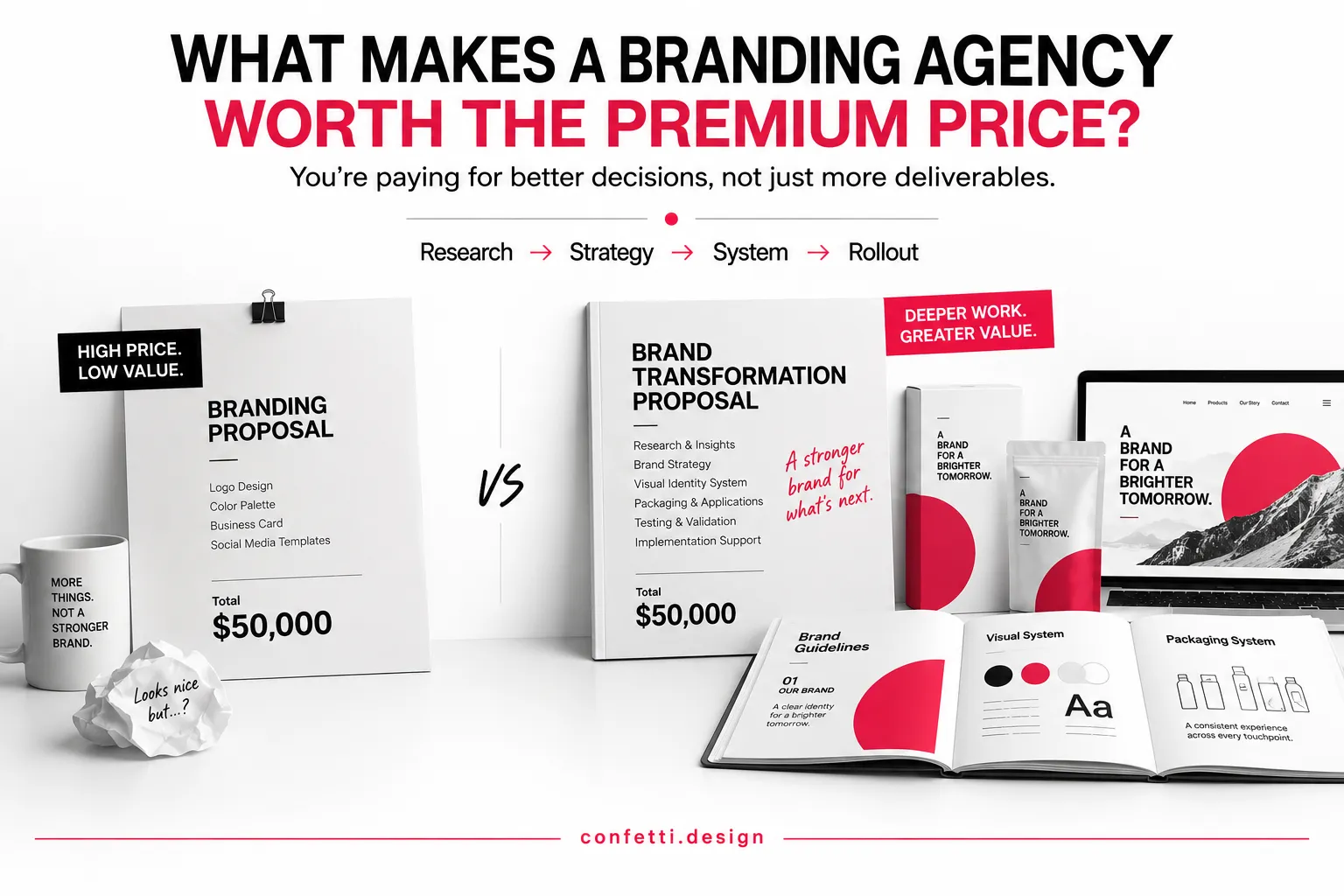
Branding pricing splits into three rough bands:
💲DIY tools and freelancers usually cost you under $5,000. You get a logo and maybe a basic style sheet. There’s no category research and no system thinking.
💲💲Boutique agencies can be anywhere between $10,000–$50,000. You get real strategy, a proper identity, and guidelines, sized for a smaller team and a narrower scope.
💲💲💲Full-service, premium agencies can range between $50,000 and $200,000+ . This should include deep category research, senior talent, and a system built to hold up across SKUs, channels, and markets.
The gap between the three tiers accounts for how much risk gets caught before you go to print.
At the lower end, the project is often centred on execution. The business already knows what it wants and needs a designer to turn that direction into a usable identity.
A mid-range engagement usually adds strategy and research. The agency may assess competitors, define positioning, develop the visual identity and create guidelines for consistent use.
At the higher end, the agency may be solving a much larger business problem. That can involve customer research, brand architecture, naming, multiple markets, stakeholder alignment, packaging systems or a large-scale rollout.
For a packaged food brand, for example, an agency may need to consider shelf differentiation, SKU hierarchy, pack formats, print limitations and mandatory regulatory information before approving the visual direction. For a digital-first business, the identity may need to work across websites, ecommerce thumbnails, apps and social platforms.
When reviewing branding agency costs, ask what each proposal includes:
A $5,000 project and a $10,000 project can both be reasonable quotes when their scopes are different. The useful comparison is what decisions, risks and deliverables that fee covers.
Remove the language out of any premium proposal, and the following things should be visible inside it:
1. Research depth
A premium engagement should spend meaningful time understanding your category, competitors, customers, positioning, and business constraints before design begins.
For a packaging project, that can include reviewing the competitive shelf, understanding SKU requirements, and considering production realities such as pack formats, print processes, and mandatory label information.
👉Ask: What research is included, and how will it influence the design direction?
2. Scope completeness
What's actually included? A basic identity package usually includes a logo, colour palette, and typography. A comprehensive system includes brand strategy, verbal identity, visual identity, packaging, guidelines, and implementation support.
Research from the Nielsen Norman Group on brand system quality found that scope completeness, specifically primary research depth and system documentation thoroughness, predicts whether brands maintain consistency two years after an agency engagement closes.
The cheap quote often omits the elements that make the work last.
3. Cross-functional team composition
Premium fees often cover a team of strategists, researchers, copywriters, designers, and project managers rather than a single designer.
Each role adds cost and also adds quality and accountability. A solo designer or small freelancer team can't match that depth of expertise, regardless of talent.
👉Ask who will actually develop the strategy and concepts, and how involved will senior team members be?
4. Testing and revision structure
A strong process gives the work opportunities to be challenged before it is finalised. That may involve internal creative reviews, structured client feedback, or, where appropriate, customer or retailer input.
For packaging, this can catch problems such as poor shelf visibility or weak information hierarchy before artwork goes to production.
5. System depth, not a single deliverable
A premium identity should account for how the brand will grow.
If you have four SKUs today and expect ten later, the agency should consider how colour, typography, hierarchy, imagery, and layout rules will extend across the range.
The same applies to identities used across websites, ecommerce, retail, social media, and physical materials. A system reduces the need to make foundational design decisions from scratch every time a new application is added.
6. Scope and implementation
The quote also changes with the number and complexity of deliverables. Packaging adaptations, websites, motion, social templates, print collateral, production artwork, printer coordination, and rollout support all add work.
👉Before comparing branding agency pricing, separate the proposal into three questions:
That makes it much easier to see whether a higher quote represents deeper work or simply a higher agency fee.
7. Production and implementation requirements
Premium quotes often include production oversight, printer coordination, material sampling, and quality control.
These aren't design services, they're implementation services. They prevent the gap between what you designed and what actually reaches your customer.
A high branding agency fee does not automatically mean better work. The useful question is what the additional budget actually pays for.
Watch for these signals before signing anything:
A credible agency should be able to explain how its process reduces uncertainty before the final identity is approved.
Look for evidence that:
A simple proposal audit: Compare two hypothetical line items
The second proposal gives you something concrete to evaluate. You can question the scope, ask who is involved, and decide whether those activities are relevant to your business.
A useful test is to ask the agency to explain its fee as you would explain a major expense to your CFO. A strong proposal should be able to show where the budget goes through scope, seniority, research, review rounds, deliverables, and implementation.
At Confett, we structure proposals so clients can see what each stage covers and where the budget is allocated. The point is to make the scope easier to assess, whether or not the client chooses to work with us.
There’s no denying the fact that “branding builds trust”, but it is not enough to justify a branding budget.
Here’s where premium branding can pay back:
Retail buyer confidence
Packaging is part of the sales pitch when a new product is being evaluated for retail. A clearer, more differentiated pack can help a buyer understand the proposition quickly and assess where the product fits within the category.
It cannot guarantee distribution, but weak presentation can create an avoidable barrier.
Shelf and thumbnail differentiation
In crowded categories such as food, beverages, and personal care, packaging needs to remain recognisable among competing products.
That applies to physical shelves as well as ecommerce and quick-commerce grids, where products may be viewed as small thumbnails.
Reduced redesign costs
A well-built identity or packaging system can establish rules for adding future SKUs, formats, or campaigns. That can reduce the need to redesign the brand every time the business expands.
Operational efficiency
Clear brand guidelines give internal teams and suppliers defined rules for using typography, colour, imagery, layouts, and other assets. This can reduce repeated design decisions and inconsistent execution.
Fundraising and M&A readiness
A coherent brand does not determine valuation, but a poorly managed identity can create questions around positioning, product architecture, or operational maturity. A structured brand system gives founders a stronger foundation when presenting the business to investors, partners, or potential acquirers.
Let’s take a FMCG brand selling four snack SKUs through modern retail and quick-commerce platforms.
Before the redesign, the packs use similar colours to several competitors. The product name is small, the key benefit is difficult to find, and each SKU looks slightly different. The business has a good product but limited shelf visibility.
The agency's first job is to audit competing products, review the brand's positioning, and identify what needs to be understood within a few seconds.
The new system gives the brand a consistent visual structure: a distinctive brand block, clearer product hierarchy, stronger SKU differentiation, and layouts designed to remain legible in ecommerce thumbnails.
Suppose the retailer subsequently gives the range better shelf placement and the brand sees higher sales. That improvement cannot automatically be attributed to packaging alone. Pricing, distribution, promotions, product quality, and retailer decisions also influence sales.
The commercial case is therefore better framed as a set of measurable questions:
That is the level at which branding ROI should be assessed. A premium agency cannot responsibly promise a fixed revenue increase before seeing the business data. It can, however, build a process designed to address specific commercial problems and define what should be measured after launch.
Premium branding is not automatically the right investment. The right agency depends on where your business is, what problem you are solving, and how much is at stake if the branding gets the job wrong.
A premium agency may be unnecessary when:
When paying more can make sense
The case for a premium branding agency becomes stronger when the cost of getting the decision wrong is high.
For example:
Consider two founders spending the same amount. One is pre-product-market fit and still changing the product. The other is preparing to launch across several retail stores with a multi-SKU range.
The first may be paying for complexity they do not yet need. The second has more at stake if the positioning, packaging system, or rollout fails.
Choose the level of agency that matches the risk
Before requesting proposals, define define three things:
what needs to change, how many touchpoints are involved, and what happens if the work is wrong.
If the answer is one asset, a freelancer or small studio may be sufficient. If the answer involves a growing brand system across products, channels, or markets, a boutique or premium agency is a choice worth considering.
At Confetti, we build brands that are strategic, thoughtful, and commercially meaningful.
We have worked with 100+ brands, ranging from food and beverage, fashion, beauty and personal care, health and wellness, and D2C brands on branding, packaging design, and identity projects across retail, ecommerce, and quick commerce.
Our approach is particularly suited to projects where the brand needs to do more than look different. That includes new retail launches, growing SKU ranges, repositioning projects, and brands entering new channels or markets.
We move through three connected stages:
The work is not limited to creating individual assets. We build a system that can extend as the brand adds products, enters new channels, or scales into new markets.
Is Confetti the right fit for your project?
Confetti is likely to be a stronger fit if you are:
If you need a single asset or a straightforward refresh, a smaller studio or specialist freelancer may be the more sensible choice. We are comfortable saying that when it applies.
The right branding partner should match the scope, risk, and stage of your business, rather than selling you more work than you need.
Before choosing a branding agency, compare proposals against the same criteria.
A longer deliverables list does not always mean a better engagement. What you need to check is what sits behind those deliverables.
✅Five questions to ask every agency
Ask what research, workshops, interviews, competitor analysis, or category work are included, and how much time is allocated.
Find out who is hands-on during strategy and concept development. A senior creative director listed on the proposal means little if they only appear for the final presentation.
Ask how many concept and refinement rounds are included, who makes approval decisions, and what happens if the initial direction does not work.
For packaging, check whether the agency has considered pack formats, print processes, materials, mandatory information, regulatory requirements, and supplier limitations.
If you expect more SKUs, markets, or channels, ask the agency to explain how the proposed identity will accommodate them without requiring a redesign each time.
✅Then audit the proposal line by line
Use your original brief as the benchmark. Mark each item as included, excluded, unclear, or additional.
Pay particular attention to:
This makes agency proposals easier to compare because you are assessing scope and process rather than presentation quality.
✅A final agency-selection test
Ask each shortlisted agency the same question:
“If you had to reduce this proposal by 20%, what would you remove and why?”
The answer can reveal how the agency prioritises the work. A thoughtful agency should be able to distinguish between essential strategic work, useful applications, and optional additions.
You can also ask for one relevant case study and have the agency explain the business problem, the decision it made, and what changed as a result. Finished visuals alone tell you very little about how the agency works.
The strongest proposal is where you can clearly see what you are buying, who is responsible for delivering it, what is excluded, and why that scope fits your business problem.
How do I know if a branding agency's premium price is justified for my project?
Ask what discovery specifically includes, who's hands-on versus reviewing, how many revision rounds are built in, and whether the design accounts for your production constraints. Specific, verifiable answers to all four matter more than a polished portfolio or a well-known client list.
Can our in-house marketing team handle this instead of hiring an agency?
For a single SKU update with no channel transition ahead, often yes. For a multi-SKU system, a retail or export launch, or production constraints your team hasn't navigated before, specialist support tends to reduce the risk of expensive rework later.
Will a new packaging design actually work in real production?
Only if the process accounted for your specific pack format, print vendor capabilities, and label or regulatory requirements from the start. Ask any agency this directly before signing — skipping the production conversation is how good-looking concepts become expensive last-minute fixes.
Can a packaging system scale as we add more SKUs?
Only if it's designed as a system from the outset, with defined rules for color, hierarchy, and layout, not as a single standalone pack. Ask the agency to walk through how it would apply to your next two or three planned products before assuming it will.
What happens after we bring a design partner in, how much do we have to manage ourselves?
That depends on the agency's process, but a well-structured engagement should define your inputs upfront: brand history, existing customer research, production contacts and run discovery, concepting, and testing with defined checkpoints, not open-ended back-and-forth that pulls your team in constantly.
Want strategic branding and packaging like this for your business?





.webp)
.webp)

.webp)
.webp)
.webp)
.webp)
.webp)






.svg)
.webp)