%201.webp)
02
AI Snaps
.svg)
.svg)
01
Our Work
03
About Us
04
Brand Audit
05
Contact Us
06
Client Success
12
07
Blogs
08
Careers
Book A Call
.svg)



.svg)
Need Help In Building Your Brand?
Click the button below & book a call with our founder directly.

Rishabh Jain
Managing Director
You are briefing a nutraceutical packaging project with the design direction mapped out: positioning decided, maybe a few concept routes in hand and an awareness that supplement labeling in India has rules attached that differ from a standard FMCG product.
This guide provides you that checklist. We cover what actually has to be on the pack, what's specific to nutraceuticals and how to sequence compliance review so it doesn't turn into a reprint after the design is already finalized.
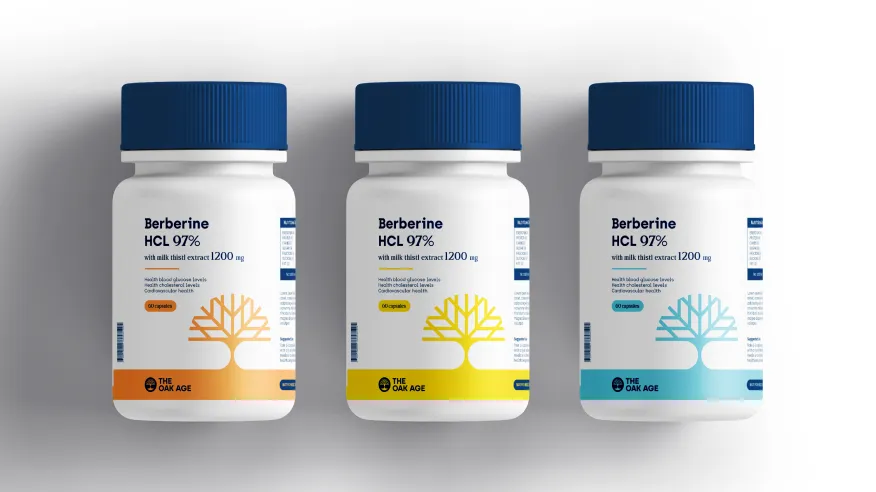
In nutraceutical packaging, regulatory requirements directly influence what can be said, how much space it occupies and how the customer reads the pack. That makes compliance part of the design brief, not a separate step after it.
Three factors make compliance a design problem rather than a legal one:
Mandatory information affects the layout
Nutraceutical packaging has to accommodate information such as the applicable product category name, common or descriptive name, the amount of nutrients or substances with nutritional or physiological effect, recommended usage and relevant warnings.
Depending on the category, this can also include statements such as “NOT FOR MEDICINAL USE,” daily usage warnings, storage instructions and information about not using the product as a substitute for a varied diet.
On a small bottle, sachet or blister pack, that information competes directly with the brand name, product descriptor, claims and imagery. The design task is to make all required information legible, correctly prioritised and easy to navigate within a limited physical area.
Claims can constrain the creative direction
Nutraceutical brands often rely on benefit-led messaging, but FSSAI restricts claims suggesting that a product prevents, treats or cures disease unless specifically permitted.
Structure, function and general well-being claims also need scientific support, while certain health or nutritional claims fall under the separate Claims and Advertisements framework.
That means copy should be reviewed before the front panel is designed around it. If a headline claim later has to be removed or rewritten, the entire hierarchy may need to change.
Small packs need special attention
Information that works comfortably on a large carton may become difficult to read on a small bottle or sachet.
FSSAI's packaging design requirements include category-specific labelling, warnings and nutrient declarations, so the available surface area should be considered before choosing the pack format and visual hierarchy.
Nutraceutical packaging has to satisfy two layers of FSSAI requirements: the category-specific Food Safety and Standards (Health Supplements, Nutraceuticals, Food for Special Dietary Use, Food for Special Medical Purpose, Functional Food and Novel Food) Regulations, 2016, and the general Labelling and Display Regulations, 2020, including subsequent amendments.
FSSAI's current standards page continues to list the 2016 regulations as the governing framework for health supplements and nutraceuticals.
The category declaration is part of the regulatory information, not optional marketing copy. For a nutraceutical, the label must carry “NUTRACEUTICAL” in capital and bold letters in the required location. Health supplements carry the corresponding “HEALTH SUPPLEMENT” declaration.
The product also needs the relevant common name or description and quantitative information for nutrients or substances with a nutritional or physiological effect. Where applicable, nutrient quantities must be expressed against the relevant Recommended Dietary Allowance (RDA.
These category-specific declarations sit alongside the general food-labelling requirements. Depending on the product and package, the label may need to accommodate:
The general Labelling and Display Regulations prescribe requirements for net quantity, batch identification and date marking, with additional requirements depending on the product and packaging format.
Nutraceutical and health-supplement labels have additional warnings that do not typically appear on ordinary FMCG packaging. These can include “NOT FOR MEDICINAL USE,” recommended usage level, duration of use where applicable, warnings about exceeding the recommended daily usage, excessive consumption, relevant precautions and known interactions, along with the requirement to keep the product out of reach of children.
The information needs to be organised so that mandatory statements remain prominent and readable rather than being pushed into a cramped secondary area.
Claims are one of the biggest sources of regulatory risk. The nutraceutical framework does not allow disease prevention, treatment or cure claims unless specifically permitted. FSSAI also requires the scientific and technical basis for ingredient combinations and relevant claims to be available when called for.
That means the claim set should be reviewed before the front panel is designed around it.
FSSAI's First Amendment to the Labelling and Display Regulations, 2026 was notified on 24 March 2026 and comes into force on 1 July 2027. Among its changes, certain notified logos may be omitted from packages with a surface area of 100 sq cm or less, with the information provided on the corresponding multi-unit package.
👉For nutraceuticals, compliance is part of the information architecture. The creative work has to be built around the regulatory content, not the other way around.

Talk to our team about designing compliance into your pack.
Book A Call
The regulatory requirements are driven by the product category, but the packaging format determines how comfortably that information can be presented.
A bottle, sachet, blister strip and multi-unit carton create very different layout problems.
These formats have the least available surface area. Category declarations, product identity, usage information and warnings compete directly with branding.
The solution is not to shrink everything until it technically fits. The hierarchy has to be planned around the final print area, with the required information remaining readable and appropriately prominent.
FSSAI's 2026 amendment also changes the treatment of certain notified logos for packs of 100 sq cm or less from 1 July 2027.
Wraparound labels provide more room, but the usable area is divided across the front, sides and back. The information that needs to be seen during normal display should be positioned accordingly.
Curved surfaces also create production constraints. Text placed too close to a seam, shoulder or label edge can become difficult to read once the label is applied to the actual container.
Blister and strip formats are more restrictive because the individual unit may have very little printable space. The artwork brief should establish whether the product is sold as an individual strip or inside an outer carton.
That distinction matters because the outer retail package may carry information that cannot reasonably fit on the individual unit. The final retail configuration should therefore be known before artwork is approved.
Powders often need more usage information than a capsule product. Serving size, preparation instructions, recommended usage and storage information all have to coexist with the standard declarations.
For a flavour-based range, the same information hierarchy should carry across every SKU. A change in serving size or dosage should reflect an actual formulation difference, not an artwork inconsistency.
Liquid supplements introduce additional considerations around net volume, closure performance and contrast. A transparent or dark bottle can reduce the readability of small regulatory text, making label substrate and background treatment part of the design decision.
The artwork should also allow for batch and date information without interfering with mandatory copy.
When several units are sold together, the outer package becomes an important part of the information architecture. FSSAI's labelling rules contain specific provisions for multi-unit packages, including situations where the outer package provides access to the required information on the individual packs.
For a growing range, consistency matters across formats as well as SKUs. The same warning, dosage statement or category declaration should not shift dramatically from one product to another without a reason.
👉A compliance statement can be technically present and still create a problem if it becomes difficult to find or read on the finished pack.
That is why format, regulatory content and information hierarchy need to be resolved together. The final artwork should be reviewed on the actual bottle, sachet, strip or carton at its intended production size, not only as a flat digital file.
This checklist is designed to be used before the artwork is finalised. Every item on this list should be resolved during the design process, with the regulatory reviewer involved at the appropriate stage.
☐ Product category is confirmed: nutraceutical, health supplement, FSDU, FSMP, or another applicable category
☐ Applicable FSSAI regulations and category-specific requirements have been identified
☐ Product formulation has been checked against the permitted ingredients, usage levels and applicable schedules
☐ Appropriate FSSAI licence has been obtained for the business activity
☐ Central FSSAI licence is in place for food or health supplements and nutraceuticals, as required under the current FoSCoS eligibility framework
☐ If the product is manufactured through a third party, the brand owner has the appropriate Relabeller licence
☐ Applicable product specifications, ingredient information and supporting documents have been submitted through the relevant FoSCoS/licensing process; do not treat this as a separate universal "product registration" requirement
FSSAI's current FoSCoS system lists food or health supplements and nutraceuticals under Central License eligibility, with separate licensing provisions for relabellers and other food-business activities.
☐ “NUTRACEUTICAL” or “HEALTH SUPPLEMENT” appears as the applicable category declaration
☐ Category declaration is presented in the required capital and prominent format
☐ Common name or description clearly communicates the true nature of the product
☐ Amount of each relevant nutrient or nutraceutical ingredient is declared in the required numerical form
☐ Nutrient quantities are expressed against the applicable ICMR Recommended Daily Allowance where required
☐ The “Not to exceed the recommended daily usage” warning is included where applicable
☐ Ingredient list is complete and presented in the required order
☐ Required nutritional information is included, with applicable exemptions checked rather than assumed
☐ Recommended usage or daily dosage is stated
☐ Duration of use is stated where applicable
☐ Net quantity is declared in the prescribed unit and format
☐ Retail sale price and consumer-care information meet applicable Legal Metrology requirements
☐ Batch, lot or code identification is present
☐ Date of manufacture or packaging and Expiry/Use By information are correctly declared; Best Before is used only where applicable
☐ FSSAI logo and licence number are correctly displayed as required
☐ Brand owner, manufacturer, packer, marketer or bottler details are correctly identified according to the actual business arrangement
☐ Consumer-care contact information is complete
☐ Importer name and address are included where the product is imported
☐ Country-of-origin declaration is included where applicable to imported food
☐ Vegetarian/non-vegetarian symbol is present in the prescribed format and location where applicable
☐ Food allergen declarations are included where applicable
☐ Food additive declarations are included where applicable
☐ Instructions for use are included wherever required for safe or appropriate use
FSSAI's general labelling rules cover identity, ingredients, nutrition information, veg/non-veg declaration, business details, FSSAI licensing information, net quantity, batch identification and date marking, with additional requirements depending on the product.
☐ “NOT FOR MEDICINAL USE” is prominently displayed for the applicable category
☐ Recommended usage statement is clearly stated
☐ Maximum recommended daily usage is not obscured or contradicted elsewhere on pack
☐ Warning about excessive consumption is included where a relevant danger exists
☐ Relevant precautions for consumption are included
☐ Known side effects are declared where applicable
☐ Relevant contraindications are declared where applicable
☐ Relevant product-drug interactions are declared where applicable
☐ Product is clearly stated to be stored out of reach of children
☐ Health-supplement products carry the applicable statement that they should not be used as a substitute for a varied diet
☐ Any age-group or target-consumer restriction applicable to the product is correctly communicated
The 2016 category-specific regulations expressly require the relevant category name, quantity information, recommended usage, “NOT FOR MEDICINAL USE,” applicable safety warnings and storage-out-of-reach-of-children information. Health supplements also carry the varied-diet statement under the current 2016 provisions.
☐ Every claim appearing on the pack has been reviewed before artwork approval
☐ No claim states or implies that the product can prevent, treat, cure or mitigate a disease, disorder or medical condition unless specifically permitted
☐ Structure/function or general-wellbeing claims have appropriate scientific support where required
☐ Nutritional and health claims comply with the applicable FSSAI Advertising and Claims Regulations
☐ Any claim requiring prior approval has received that approval before the claim is released
☐ Ingredient combinations have documented scientific or technical rationale where required
☐ Product name, tagline, icons, illustrations and imagery do not create an unintended medical claim
☐ Claims used across the front panel, side panels, website, marketplace listing and promotional material are consistent
FSSAI requires food claims to be truthful and non-misleading, and the nutraceutical framework restricts disease-related claims while allowing certain structure/function or wellbeing statements when appropriately supported.
☐ Mandatory text is legible at the actual finished print size
☐ Letter and numeral dimensions comply with the applicable FSSAI requirements
☐ Letter or numeral width is not less than one-third of its height, subject to the stated exceptions
☐ Required declarations are not compressed simply to make the design fit
☐ Text has sufficient contrast against the background
☐ Mandatory information remains readable on the actual packaging material, not only on a digital mock-up
☐ FSSAI logo and licence number have the required contrast
☐ Veg/non-veg symbol, where required, meets the prescribed size and placement requirements
☐ Mandatory information remains readable under the expected print, finish and lighting conditions
☐ Final artwork has been checked after translation or language adaptation so that no regulatory text becomes smaller or less prominent
FSSAI sets specific requirements for declaration size, including the rule that letter or numeral width generally cannot be less than one-third of its height. The veg/non-veg symbol also has prescribed size and placement requirements.
☐ Principal display panel has enough space for required front-of-pack information
☐ Category declaration and product identity are positioned where required
☐ Required warnings are not buried in decorative copy
☐ No mandatory declaration sits across a fold, seam, seal, closure or other obstructed area
☐ Printer-approved dieline and safe zones are being used
☐ Label dimensions match the actual container
☐ Curved surfaces, shoulders and label seams have been considered
☐ Variable information such as batch and expiry can be printed without covering mandatory content
☐ Small-pack exemptions have been checked specifically for the final package size and configuration
☐ Multi-unit packaging has been reviewed to determine which information appears on the individual unit and which appears on the outer pack
☐ If an accompanying leaflet is being relied upon for permitted information, that approach has been confirmed against the applicable regulation
☐ Packaging material is food grade and suitable for the intended use
☐ Packaging material does not compromise the safety or suitability of the product under the specified storage and use conditions
☐ Applicable BIS or other prescribed food-contact packaging requirements have been verified
☐ Plastic packaging, where used, has been checked for applicable overall and specific migration requirements
☐ Colourants and other packaging components meet applicable food-contact requirements
☐ Packaging protects the product from contamination and damage
☐ Material compatibility with the formulation has been reviewed
☐ Closure and sealing system are suitable for the product and intended shelf life
☐ Storage and transport conditions have been considered in packaging selection
☐ Any tamper-evident feature used has been specified and production-tested where required for the product or deliberately included as a safety feature
FSSAI's Packaging Regulations require food-grade packaging and set specific food-contact requirements, including migration limits for applicable plastic materials. The packaging must also protect the food from contamination and damage.
Sachets and stick packs
☐ Mandatory declarations remain readable at the actual small-format size
☐ Dosage, serving size and usage instructions are not lost in the visual hierarchy
☐ Sealing areas do not obstruct required information
Blister and strip packs
☐ Final retail configuration is confirmed: individual strip, blister, carton or combination
☐ Information appearing on the outer carton has been checked against what is required on the individual unit
☐ Small printable areas have been reviewed at production size
Capsules and tablets in bottles
☐ Wraparound label panels have been assigned clearly for identity, ingredients, usage, warnings and supporting information
☐ Curvature and label overlap do not compromise legibility
Powders and granules
☐ Serving size is clearly defined
☐ Preparation instructions are complete where the product requires mixing or reconstitution
☐ Scoop or serving-measure information matches the approved formulation
Liquids
☐ Net volume is correctly declared
☐ Closure and container compatibility have been verified
☐ Transparent or dark packaging does not reduce regulatory-text contrast
☐ Variable batch and date coding has a defined, practical application area
FSSAI permits nutraceuticals in formats including granules, powder, tablet, capsule, liquid, jelly, gel and semi-solids, including measured-unit formats such as sachets and bottles. The design still needs to accommodate the applicable category-specific and general labelling requirements for the final pack configuration.
☐ Every SKU uses the same approved regulatory information hierarchy
☐ Ingredient and dosage differences between variants are accurately reflected
☐ Flavour, strength and serving-size changes are consistent with the approved formulation
☐ Warnings and usage statements have not been accidentally removed during variant adaptation
☐ Different pack sizes use the correct net quantity, dosage and other variable information
☐ Arabic, regional-language or other translations, where used, have been checked for consistency with the approved master copy
☐ Master artwork contains clearly identified variable fields for future SKUs
☐ No SKU-specific change has been introduced without regulatory review
☐ Final artwork is built on the verified production dieline
☐ All regulatory copy has been checked against the latest approved master text
☐ Claims have been signed off before final artwork approval
☐ Ingredient, dosage and nutritional data have been checked against the approved formulation
☐ FSSAI licence and business details have been cross-checked against current records
☐ Print files have been checked for resolution, colour mode, bleed and linked assets
☐ Fonts and licensing are cleared for production use
☐ Final proof or pre-production sample has been physically checked
☐ Variable coding areas have been tested with the printer or production team
☐ Final PDF and editable source files have been archived as the approved master
☐ Future SKU adaptation rules have been documented where the range will expand
☐ Ownership and permitted use of final design deliverables are documented contractually
☐ Regulatory reviewer has completed the required review
☐ Brand/marketing owner has approved the final artwork
☐ Manufacturer/printer has approved the production file and dieline
☐ All open comments have been closed
☐ Final approved artwork is clearly version-controlled
☐ No artwork changes will be made after sign-off without a documented recheck
Use this as the final design-gate before printing. Any item marked “where applicable” should be resolved against the specific formulation, category, claims, package format and sales configuration rather than automatically marked complete. Where regulations change, the artwork should be reviewed against the version in force on the date of manufacture or import.
At Confetti, we believe that most compliance failures are design failures that surface late. Our work in this category spans both the strategic and compliance-adjacent layers of nutraceutical packaging.
Our process treats regulatory requirements as design inputs, not post-design checks.
Our approach starts with classification
Before any visual work begins, we confirm the product category under the FSSAI framework: nutraceutical, health supplement, food for special dietary use, or another category and the corresponding mandatory declaration list. The category determines the label. The label determines the layout. The layout determines the design.
From there, the process runs across three connected steps
Brand strategy, logo and identity design, and packaging design. The strategy phase defines positioning, category frame, and price architecture. The identity phase translates those decisions into a visual system designed with packaging formats in mind. The packaging phase applies the system across products and SKUs with compliance requirements integrated from the start.
We treat compliance as a structural layer, not a finishing step
The mandatory declarations are mapped to the dieline before the artwork is designed. The panel hierarchy is determined by the regulatory prominence requirements and the brand hierarchy simultaneously. The font sizes are checked against the prescribed dimensions at final print size. The claim wording is reviewed against the substantiation file before it is finalised.
For multi-SKU engagements
The deliverables include a master template with variant layers and an adaptation guide that lets the internal team produce a new SKU without rebuilding the master artwork. The compliance content is built into the shared layers, so a new product inherits the mandatory declarations without redoing the regulatory mapping.
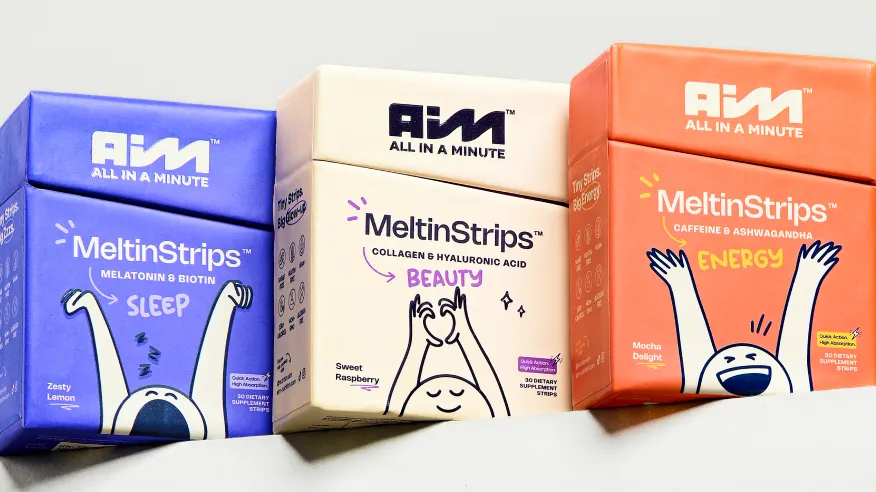
The AIM project is a useful reference for how format constraints and brand positioning intersect in this category, a strip-format wellness product built around convenience ("just a minute a day") still has to carry every mandatory declaration this category requires, on a format with limited space to work with, which means the compliance requirements were a real constraint on the layout from the earliest design decisions rather than an afterthought.
What labeling is mandatory on nutraceutical packaging in India?
Beyond standard food-labeling basics (product name, net quantity, ingredients, dates, FSSAI license number), nutraceuticals specifically require the word "NUTRACEUTICAL" as a product designation, quantitative declaration of nutraceutical ingredients, nutrient percentages expressed against ICMR's Recommended Daily Allowance, a "NOT FOR MEDICINAL USE" disclaimer, and a recommended-usage statement.
Can a supplement claim be classified as a drug claim in India?
Yes. Nutraceuticals are prohibited from claiming to prevent, cure, or treat a human disease under the 2016 regulation governing this category. Structure-function claims are allowed but need scientific evidence behind them, a claim written too close to therapeutic language risks reclassification.
Do gummy and powder supplements have different packaging compliance requirements?
The core mandatory declarations apply across formats, but each format has its own practical considerations, child-safety framing for gummies, and consistent serving-size/dosage clarity for powders where scoop sizes can vary by SKU.
How do I keep packaging consistent across multiple supplement flavors or dosages?
Check declarations across the full range side by side, not SKU by SKU in isolation. Inconsistent placement or formatting of the same required information across variants is a common gap that individual SKU reviews miss.
Should compliance review happen before or after packaging design?
Before the creative concept is finalized. Claims language and mandatory declaration space should be settled in the brief, since resolving them after a design is locked typically costs a reprint rather than a quick revision.
Is FSSAI the only regulator for nutraceutical packaging in India?
FSSAI, through the 2016 Health Supplements and Nutraceuticals Regulations, is the primary governing body for this category's labeling requirements. Confirm current guidance directly with FSSAI or a regulatory consultant before finalizing claims language, since enforcement and interpretation in this space continues to evolve.
Want strategic branding and packaging like this for your business?





.webp)
.webp)

.webp)
.webp)
.webp)
.webp)
.webp)







.svg)
.webp)