%201.webp)
02
AI Snaps
.svg)
.svg)
01
Our Work
03
About Us
04
Brand Audit
05
Contact Us
06
Client Success
12
07
Blogs
08
Careers
Book A Call
.svg)



.svg)
Need Help In Building Your Brand?
Click the button below & book a call with our founder directly.

Rishabh Jain
Managing Director
Brand equity for FMCG is the value your brand carries beyond what the product itself.
This guide is for brands that want to understand the core elements and the process of building brand equity for FMCG brands. We also break down the best examples of brand equity and what exactly worked for them.
Brand equity is the value a brand creates beyond its product. It’s why consumers choose one brand over another, pay a premium, and trust it when it launches new products.
In FMCG, where products are similar and purchase decisions are quick, strong brand equity is a major competitive advantage.
Unlike high-consideration purchases, FMCG buying is fast and habitual. Shoppers rarely compare ingredients or specifications, they recognize familiar packaging, recall positive experiences, and make quick decisions.
That instant trust is built through consistent branding, product quality, and customer experience over time.
Strong brand equity delivers measurable business benefits including:
Also, consumers are more willing to try new products from brands they already trust.
That's why brands like Dove have expanded beyond soap into skincare and personal care, while Amul has successfully entered categories ranging from cheese to beverages. Existing trust lowers the perceived risk of trying something new.
"Equity in FMCG isn't built in a campaign, it's built pack by pack, A brand can run a brilliant ad and lose more equity than it gained if the next three SKUs on shelf don't look like they belong to the same family."
- Rishabh Jain, Founder at Confetti Design Studio
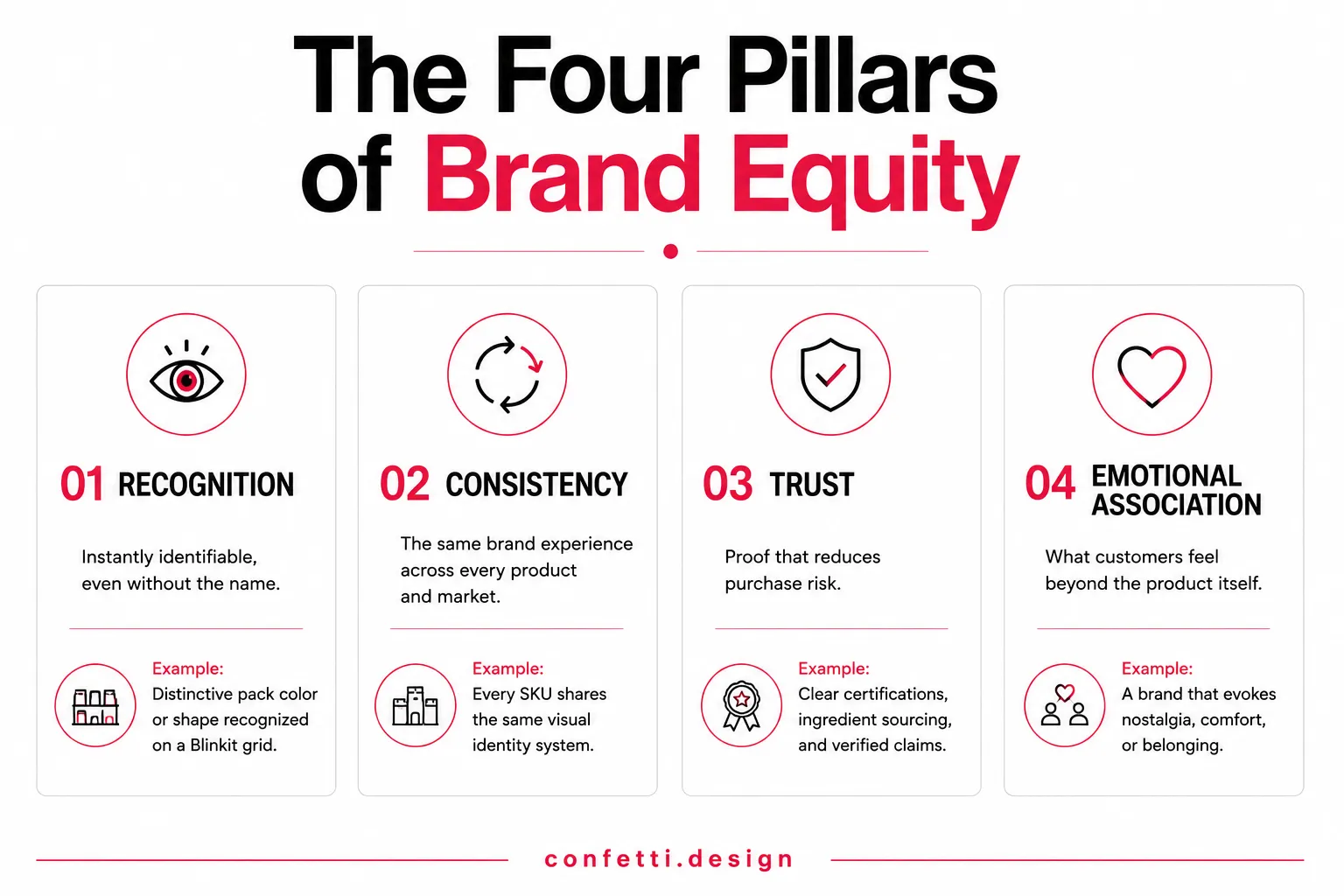
Brand equity is built through a series of consistent experiences that shape how consumers recognise, trust, and value a brand over time.
For FMCG businesses, these ideas can be translated into four practical pillars that brand teams can actively manage every day:
Recognition is a consumer’s ability to identify your brand instantly, whether on a supermarket shelf, a quick commerce app, or a neighbourhood kirana store.
In crowded FMCG categories, brands have only seconds to stand out. Recognition comes from consistent visual assets such as colours, typography, packaging, imagery, icons, and graphic style, not just a logo.
Brands like Coca-Cola, Cadbury Dairy Milk, and Fevicol are often recognised before their names are read because of their distinctive identities.
📝A simple test for new brands: can consumers identify your product from a distance or as a small thumbnail without reading the label?
Recognition only creates long-term value when it is reinforced consistently.
Every new SKU, packaging update, campaign, or retail touchpoint should strengthen existing memory rather than forcing consumers to learn the brand again.
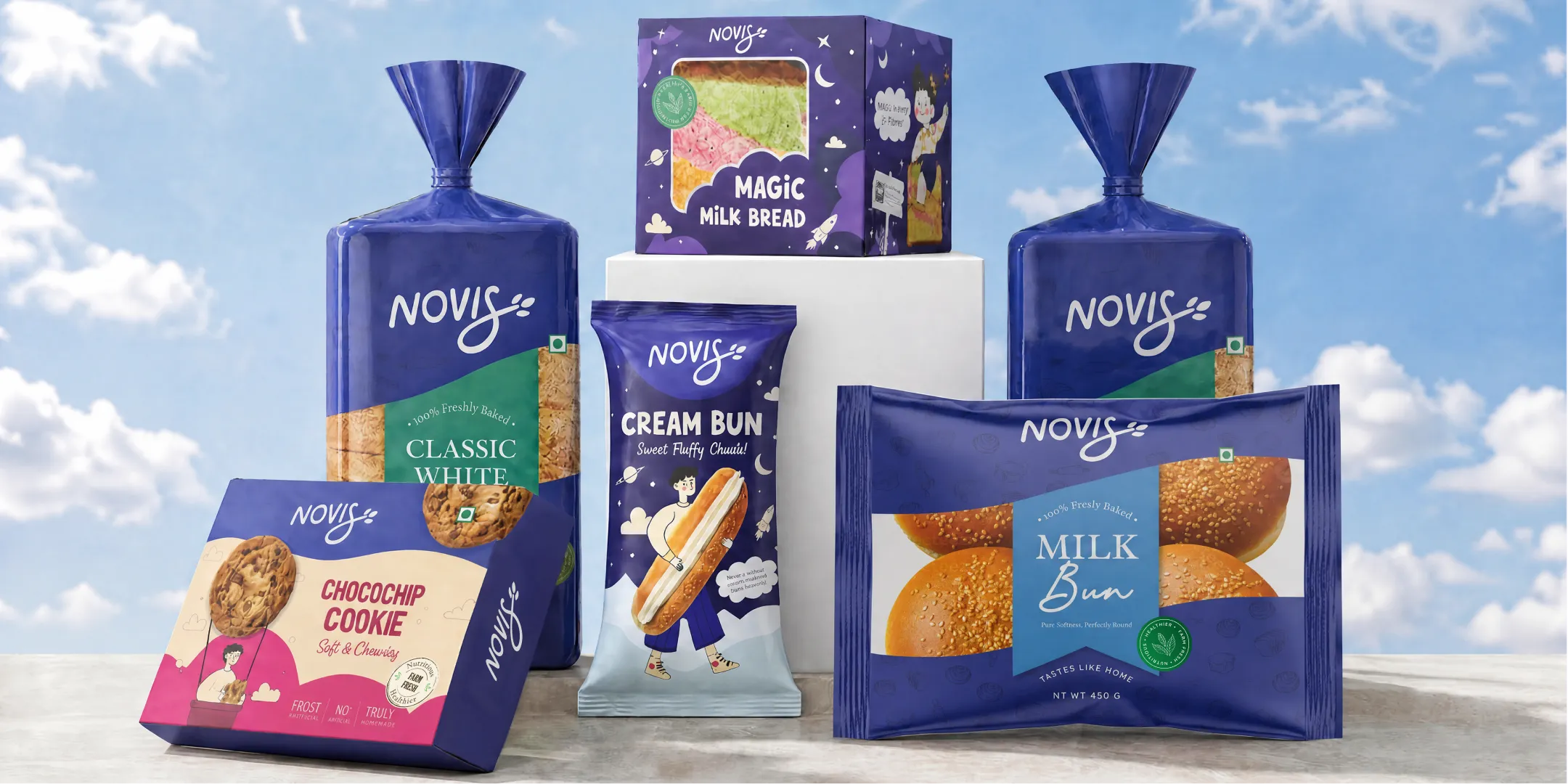
Brand consistency does not mean every product looks identical. It means every product clearly belongs to the same family. Colour hierarchy, typography, illustration style, messaging, and packaging architecture should work together to create a cohesive brand system across every channel.
This becomes even more important as brands expand across modern retail, e-commerce, and quick commerce, where consumers often encounter products in very different contexts.
Without consistency, even significant marketing investments lose effectiveness because every redesign resets consumer memory instead of strengthening it.
Trust is one of the strongest drivers of repeat purchase, particularly in food, beverages, health, beauty, and personal care categories.
Consumers look for signals that reduce uncertainty before making a purchase:
Certifications such as FSSAI in India, or cruelty-free labels can significantly influence purchase decisions when used credibly.
Brands such as The Whole Truth have built strong equity by making transparency central to their identity rather than treating it as a marketing claim.
Functional benefits attract first-time buyers. Emotional associations create loyal customers.
Emotional association is what consumers think and feel when they encounter a brand beyond its product features. It may represent nostalgia, comfort, aspiration, family, wellness, authenticity, sustainability, or belonging.
Some of the world's strongest FMCG brands have spent decades building these emotional connections. Coca-Cola represents shared moments and optimism. Dove has become closely associated with real beauty and self-confidence.
These associations are built through consistent storytelling, product experience, packaging design, and customer interactions over many years. They are also among the hardest competitive advantages to copy and create true brand differentiation.
👉These pillars work together, not separately. Recognition drives trial, consistency builds memory, trust encourages repeat purchases, and emotional connection creates loyalty.
Weakness in one pillar reduces the impact of the others. A recognisable brand without trust loses customers. Inconsistent packaging hurts recognition. Quality without emotional relevance often leads to price competition.
For FMCG brands, success comes from strengthening all four pillars together. Packaging design is central to this, reinforcing recognition, trust, quality, and brand personality at the point of purchase. Done consistently, it becomes a powerful driver of long-term brand equity.
Building brand equity in FMCG is a systematic process that requires discipline, consistency, and a clear understanding of what drives value at every stage of the consumer journey.
Here is a step-by-step framework that works:
Awareness is not equity. A brand may enjoy high recall because of heavy advertising, but that does not necessarily mean consumers prefer it, trust it, or are willing to pay more for it.
Start by evaluating your brand across the key drivers of equity:
Alongside consumer research, analyse sales trends, repeat purchase rates, reviews, retailer feedback, and social listening. These insights reveal where equity is strong and where it is breaking down.
Strong brand equity starts with a clear strategic foundation. Before investing in packaging, advertising, or digital campaigns, define what your brand stands for and why consumers should choose it.
This includes:
The strongest FMCG brands rarely try to own multiple ideas. Dove owns real beauty. Paper Boat owns nostalgia. Fevicol owns unmatched strength. Their clarity makes every marketing decision easier.
Consumers rarely read every package before making a purchase. Instead, they recognise colours, shapes, typography, illustrations, and packaging architecture.
Rather than designing individual products independently, create a visual system that works across your entire portfolio.
A strong packaging design system should include:
This allows recognition to compound over time instead of resetting every time a new product launches.
Brands such as Cadbury, Coca-Cola, and Apple demonstrate how consistent visual systems make products instantly recognisable across hundreds of SKUs.
Brand equity grows when every interaction reinforces the same memory.
Consumers may discover your brand through Instagram, buy it from Blinkit, see it later in a supermarket, and finally purchase it from a local kirana store. Although the buying environments differ, the brand should always feel familiar.
Consistency should extend across:
Frequent redesigns, inconsistent regional packaging, or disconnected digital assets weaken recognition and reduce the effectiveness of previous marketing investments.
Trust cannot be created through advertising alone. It must be supported by tangible proof. For FMCG brands, trust signals include:
Consumers increasingly verify claims before purchasing, particularly in food, health, beauty, and personal care categories.
Consumers cannot buy products they cannot find.
Research consistently shows that strong distribution improves both perceived quality and brand awareness. Widely available brands often appear more trustworthy because consumers encounter them repeatedly across multiple retail environments.
For FMCG businesses, equity grows when awareness and availability develop together across:
Even the strongest branding cannot compensate for poor availability.
Functional benefits may generate trial, but emotional relevance creates loyalty.
Consumers remember stories more easily than product specifications. The brands that endure are those that consistently communicate a meaningful idea through packaging, campaigns, product innovation, and customer experience.
For example:
These emotional associations become difficult for competitors to replicate because they are built over years of consistent execution.
Brand equity is a long-term business asset that should be monitored just like revenue or market share.
Track both perception and commercial performance using metrics such as:
Regular measurement helps identify whether new campaigns, packaging updates, or product launches are strengthening or diluting the brand.
Once consumers trust a brand, extending into adjacent categories becomes easier. However, successful brand extensions build upon existing equity rather than abandoning it.
Brands such as TATA and Samsung have successfully entered multiple categories because every extension reinforces the core brand promise while remaining visually recognisable.
Before launching a new SKU or repositioning an existing product, ask:
Protecting existing equity is often more valuable than chasing short-term novelty.
Most brand equity content reaches for the same global examples, Coca-Cola, Nike, Apple, without ever showing what accumulated equity looks like for a brand actually navigating Indian retail complexity.
Coca-Cola is the world's most valuable non-alcoholic drinks brand, with a brand value of USD 46.3 billion and the highest Brand Strength Index (93.4/100).
Its competitive advantage lies in emotional connection and cultural relevance rather than product features or price.
The brand has achieved 17 consecutive quarters of global value share growth by maintaining a "challenger brand" mindset that drives continuous innovation.
In India, the "Share a Coke" campaign, featuring personalized bottles in 11 regional languages, demonstrated how Coca-Cola successfully adapts its global brand identity to local culture, strengthening consumer engagement and loyalty.
✅Source of equity: Emotional connection, cultural embeddedness, and consistent global presence layered with local activation.
Nestlé remains the world's most valuable food brand for the tenth consecutive year, with a brand.
Nestlé's brand equity is built on decades of consumer trust, which allows the brand to command premium pricing in categories where others struggle. The company's global-local strategy: combining global R&D with India-focused flavours like Maggi Masala noodles, has been a winning formula.
Nestlé scores high on consumer familiarity (9.7), understanding (7.6), and credibility (7.4), though it faces challenges on engagement and price acceptance.
✅Source of equity: Category leadership, deep consumer trust, and the ability to balance global consistency with local adaptation.
Swiss chocolatier Lindt is a 'brand to watch,' with brand value up 14% to USD 4.9 billion. What makes Lindt's equity remarkable is its pricing power. Research reveals that Lindt achieves a perfect 10 out of 10 score for price acceptance in core markets including Germany, France, Spain, the UK, and Switzerland.
Sixty-three percent of UK consumers and 56% of Swiss consumers view Lindt as "expensive but worth the price," the highest percentages among chocolate brands in both markets.
✅Source of equity: Perceived quality that justifies premium pricing, reinforced by consistent product experience and brand positioning.
Amul has been ranked the third most valued brand in India, making it the only FMCG brand in the top three.
Amul's equity is built on a foundation that no competitor can replicate: the cooperative model. The brand is not a corporate entity. It is owned by millions of dairy farmers. This structural authenticity gives Amul a credibility that purely commercial brands cannot claim.
Amul recently revamped a 75-year-old legacy supply chain model to ensure all 650 SKUs are available across the country via a hub-and-spoke model.
✅Source of equity: Structural authenticity (the cooperative model), deep rural penetration, and a brand voice that is unmistakably Indian.
Almarai is the world's largest vertically integrated dairy company and the leading food and beverage producer in the Middle East, serving over 42 million consumers across the Gulf, Egypt, and Jordan.
Headquartered in Riyadh, it ranked as the world's fourth most valuable dairy brand in 2025, with a brand value of US$4.68 billion and an AAA brand strength rating. Almarai also leads Saudi Arabia's food and beverage sector and remains the Kingdom's top FMCG brand.
Its success is driven by a fully integrated farm-to-shelf model, ensuring consistent quality across its dairy portfolio while supporting innovation, sustainability, and growth under its promise of "Quality You Can Trust.
✅Source of equity: Vertical integration that ensures quality control, deep consumer trust built over decades, category leadership across dairy and beverages, and a brand value growth rate that outpaces global competitors.
Building brand equity across markets is a balancing act: how do you scale globally without losing local relevance?
The answer is glocalisation: combining a consistent global brand with local adaptation.
Global consistency builds recognition and trust. The strongest brands keep these elements constant:
Local relevance builds preference. Consumers expect brands to reflect their language, culture, and buying habits while remaining recognizably the same brand.
Successful adaptations include:
IKEA illustrates the broader principle.
In Australia, where it's an established brand, the challenge is staying relevant. In New Zealand, where it launched in 2025, the focus is building awareness. The Swedish identity stays the same; the brand's role changes.
Local brands now hold nearly 79% of FMCG value share in Asia, up from 74% a decade ago. Their advantage comes from local insight, faster innovation, cultural relevance, digital agility, and balancing data with intuition.
The implication is global brands don't win by being bigger, they win by being more relevant.
The best global brands combine consistency with flexibility by:
Brands like Indomie and Nongshim adapt flavors, formats, and messaging by market while preserving their core identity.
In India, equity must stay consistent across kirana, modern trade, quick commerce, and D2C. A pack that works on shelf can lose recognition in a small digital thumbnail, so brands must design for the most restrictive format. Equity compounds when all channels feel like one connected system.
In the UAE and GCC, brands must also build trust across bilingual audiences, with signals like halal certification acting as equity drivers when integrated thoughtfully.
In Western Europe, equity is built through consistency across fragmented retail ecosystems, from supermarkets to discounters, e-commerce, and specialist channels. Brands must balance heritage and distinctiveness with growing expectations around sustainability, transparency, and responsible sourcing.
In Australia, equity depends on maintaining relevance across a highly concentrated retail landscape and digital channels. Brands need to combine strong recognition with authenticity, local relevance, and clear value cues to stand out in a competitive market.
At Confetti Design Studio, we believe brand equity is not a short-term campaign outcome, it is a long-term commercial advantage. It is built deliberately, strengthened through every consumer interaction, and embedded into the brand from day one.
✅We begin with positioning, not packaging.
Great brands win by owning a distinct space in the consumer’s mind.
We analyse competitors, consumer motivations, and market opportunities to define a unique brand position. From there, we align packaging, communication, and retail presence around one powerful idea: driving recognition, relevance, and trust.
✅ We bring category expertise to every project.
Packaging success requires more than good design, it requires an understanding of category behaviour, consumer expectations, and retail dynamics.
Our teams are structured around category expertise, enabling designers to understand what works, what differentiates, and what builds credibility. This approach has helped us deliver 200+ brand projects, including FMCG and retail work for brands trusted by organisations such as ITC and Dabur.
✅ We create scalable brand systems, not standalone designs
A successful brand cannot depend on a single hero pack. We design complete packaging ecosystems that work across product portfolios, formats, and future growth opportunities.
Every decision is shaped by the brand strategy, consumer, category context, and retail environment, creating brand consistency while allowing the brand to evolve.
✅ We design for today’s retail reality: online and offline.
Modern consumers often encounter a brand digitally before they ever see it on a shelf. That is why we design packaging specifically for digital commerce environments, where visibility, clarity, and differentiation influence purchase decisions.
We ensure your packaging performs wherever consumers discover and buy.
✅ We build equity that grows over time
Brand equity compounds when every touchpoint tells the same story. When positioning, packaging, communication, pricing, and retail presence work together, brands become easier to recognise, trust, and choose.
But when these elements are disconnected, even strong brands risk losing relevance and consumer confidence.
At Confetti, we don’t just create packaging. We build brands designed to be remembered, trusted, and chosen. Let’s build yours.
What is brand equity?
Brand equity is the commercial value a brand carries beyond its product's functional performance, reflected in a customer's willingness to pay more, choose the brand without comparison, or trust a new product from the same name. It's built through consistent recognition, trust, and positive association accumulated over time.
What are the sources of brand equity?
The most established framework, Aaker's model, identifies five sources: brand loyalty, brand awareness, perceived quality, brand associations, and proprietary assets like trademarks and patents. For FMCG specifically, these translate practically into shelf recognition, packaging consistency, provable trust signals, and emotional association built over repeated positive purchases.
How is brand equity different from brand awareness?
Awareness measures whether people know your brand exists. Equity measures whether that awareness translates into preference, price tolerance, and loyalty. A brand can have very high awareness and still carry weak equity if recognition never converts into a customer actually choosing it over a competitor.
What is customer-based brand equity (CBBE)?
Customer-based brand equity, most closely associated with Kevin Lane Keller's model, measures brand value entirely through how customers think, feel, and respond to the brand, visualized as a pyramid moving from basic awareness (salience) up to deep emotional loyalty (resonance) at the top.
How long does it take to build brand equity for an FMCG brand?
There's no fixed timeline, but equity compounds rather than appearing suddenly. Consistent execution across every SKU and touchpoint over multiple years typically builds more durable equity than any single campaign, because repeat exposure and repeat positive experience are what the underlying models actually measure.
Can brand equity be measured?
Yes, through a combination of awareness tracking, price premium analysis (how much more customers will pay versus an unbranded or generic alternative), brand association surveys, and repeat purchase or loyalty metrics. Most FMCG brands combine several of these rather than relying on a single number.
How does packaging consistency affect brand equity?
Packaging consistency is one of the most direct, controllable levers a physical product brand has over its own equity. Every SKU that stays visually consistent with the rest of the brand family reinforces the same recognition pattern; every inconsistent one introduces a small amount of doubt that, accumulated across a portfolio, measurably erodes the recognition equity depends on.
Want strategic branding and packaging like this for your business?





.webp)
.webp)

.webp)
.webp)
.webp)
.webp)
.webp)







.svg)
.webp)