%201.webp)
02
AI Snaps
.svg)
.svg)
01
Our Work
03
About Us
04
Brand Audit
05
Contact Us
06
Client Success
12
07
Blogs
08
Careers
Book A Call
.svg)



.svg)
Need Help In Building Your Brand?
Click the button below & book a call with our founder directly.

Rishabh Jain
Managing Director
FSSAI compliant packaging is essential for any food business in India. Non-compliance can lead to penalties, recalls or license issues. It ensures food safety, transparency and builds consumer trust.
Balancing compliance with strong design can be challenging, which is why many brands work with Confetti Design Studio to create packaging that is both compliant and shelf-ready.
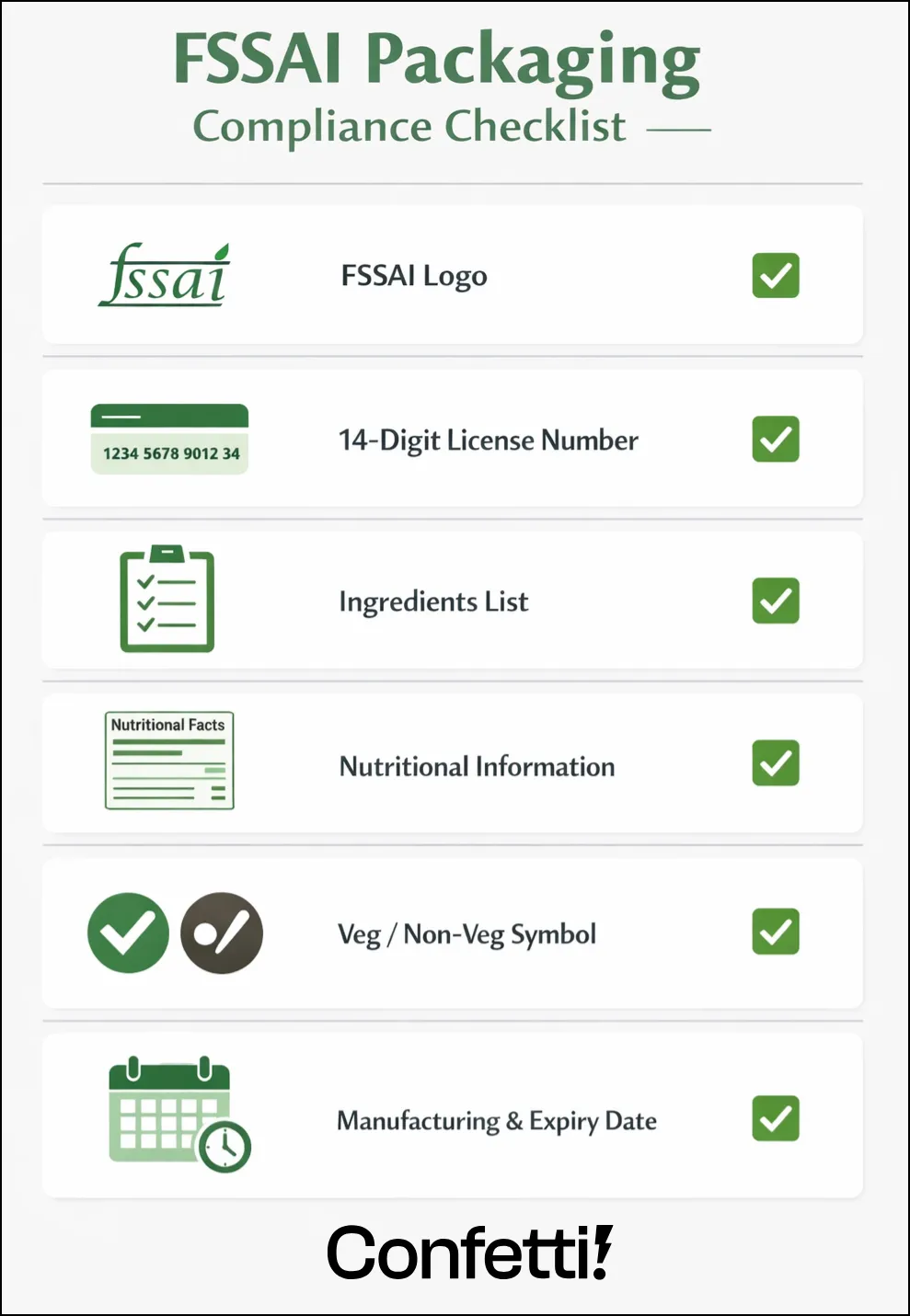
Food packaging plays a major role in ensuring food safety and consumer awareness.
In India, food packaging must follow strict rules defined by the Food Safety and Standards Authority of India (FSSAI).
These rules regulate both packaging materials and labeling information used on packaged food products.
FSSAI compliant packaging design means that food products are packaged in safe materials and include all mandatory information required under Indian food safety laws.
This helps consumers understand exactly what they are buying and ensures food businesses operate within legal guidelines.
FSSAI compliant packaging refers to packaging that follows the requirements defined under the Food Safety and Standards Act, 2006 and related packaging regulations.
These regulations apply to both the physical packaging materials and the information displayed on food labels.
The objective is to ensure that packaging does not contaminate food and that consumers receive accurate product information.
For example, labels must clearly display the product name, ingredients, nutritional information, manufacturer details, and shelf life.
The regulations also control how packaging materials interact with food to prevent chemical contamination.
Food packaging regulations are designed to protect public health.
Without proper labeling, consumers would not know what ingredients are present in a product or whether it contains allergens.
Clear packaging information allows people to make informed decisions about the food they consume.
Compliance also improves food traceability.
If a food safety issue occurs, regulators can identify the manufacturer and production batch quickly using the information printed on the package.
For food businesses, following FSSAI packaging rules helps avoid legal risks while strengthening brand reputation in the market.
FSSAI packaging regulations apply to almost every business involved in selling packaged food in India.
These businesses are known as Food Business Operators (FBOs) under the Food Safety and Standards Act.
Any organization that manufactures, processes, distributes, or sells packaged food must follow these regulations.
Food manufacturers producing packaged items such as snacks, beverages, dairy products, and ready-to-eat meals must comply with FSSAI packaging rules.
Before selling their products, they must ensure that packaging materials and labeling information meet regulatory standards.
Food processing companies that package sauces, spices, frozen foods, or processed meals must also comply with labeling and packaging regulations.
These businesses must include complete ingredient lists and nutritional information on their packaging.
Imported food products must meet Indian FSSAI labeling requirements before entering the market.
Often, imported products require additional labels containing mandatory FSSAI information.
Importers must also obtain FSSAI approval through the official FSSAI licensing portal.
Restaurants and cloud kitchens that sell packaged food products must also comply with packaging rules.
For example, if a restaurant sells bottled sauces, packaged snacks, or ready-to-eat meals, the packaging must include all mandatory labeling details required by FSSAI.
India’s food safety framework includes detailed rules governing how food should be packaged and labeled.
These regulations ensure that packaged foods remain safe during storage, transportation, and sale.
The Food Safety and Standards Authority of India publishes and updates these regulations regularly to address new food safety challenges.
Food businesses must stay updated with these regulations to maintain compliance.
The Food Safety and Standards (Packaging and Labelling) Regulations define how packaged food products should be labeled and packaged in India.
These rules were introduced under the Food Safety and Standards Act, 2006 and later updated to improve consumer protection.
In recent years, FSSAI has introduced additional guidelines to strengthen labeling transparency and reduce misleading food claims.
Businesses must carefully follow these guidelines when designing product packaging.
The full regulatory framework is available through the official FSSAI regulations portal.
FSSAI packaging rules focus on improving both food safety and consumer awareness.
The main objective is to ensure that food products are packaged in materials that do not contaminate food and that consumers receive clear product information.
These regulations help maintain quality standards across the food industry.
Key objectives include:
These standards create a more transparent food supply chain and help consumers make informed choices.
Food safety regulation in India involves several government authorities working together.
The primary authority responsible for food safety is the Food Safety and Standards Authority of India (FSSAI).
FSSAI develops food safety regulations, approves standards, and monitors compliance across the country.
State food safety departments also play an important role.
They conduct inspections, monitor food businesses, and enforce compliance with packaging and labeling rules at the regional level.
The Ministry of Health and Family Welfare oversees FSSAI and ensures that national food safety policies are implemented effectively.
Every packaged food product in India must display certain mandatory information on its label.
These labeling requirements ensure transparency and allow consumers to understand what they are purchasing.
Missing or incorrect information on food packaging can lead to regulatory penalties, product recalls, or legal action against the food business.
For this reason, businesses must carefully design their packaging to include all required details.
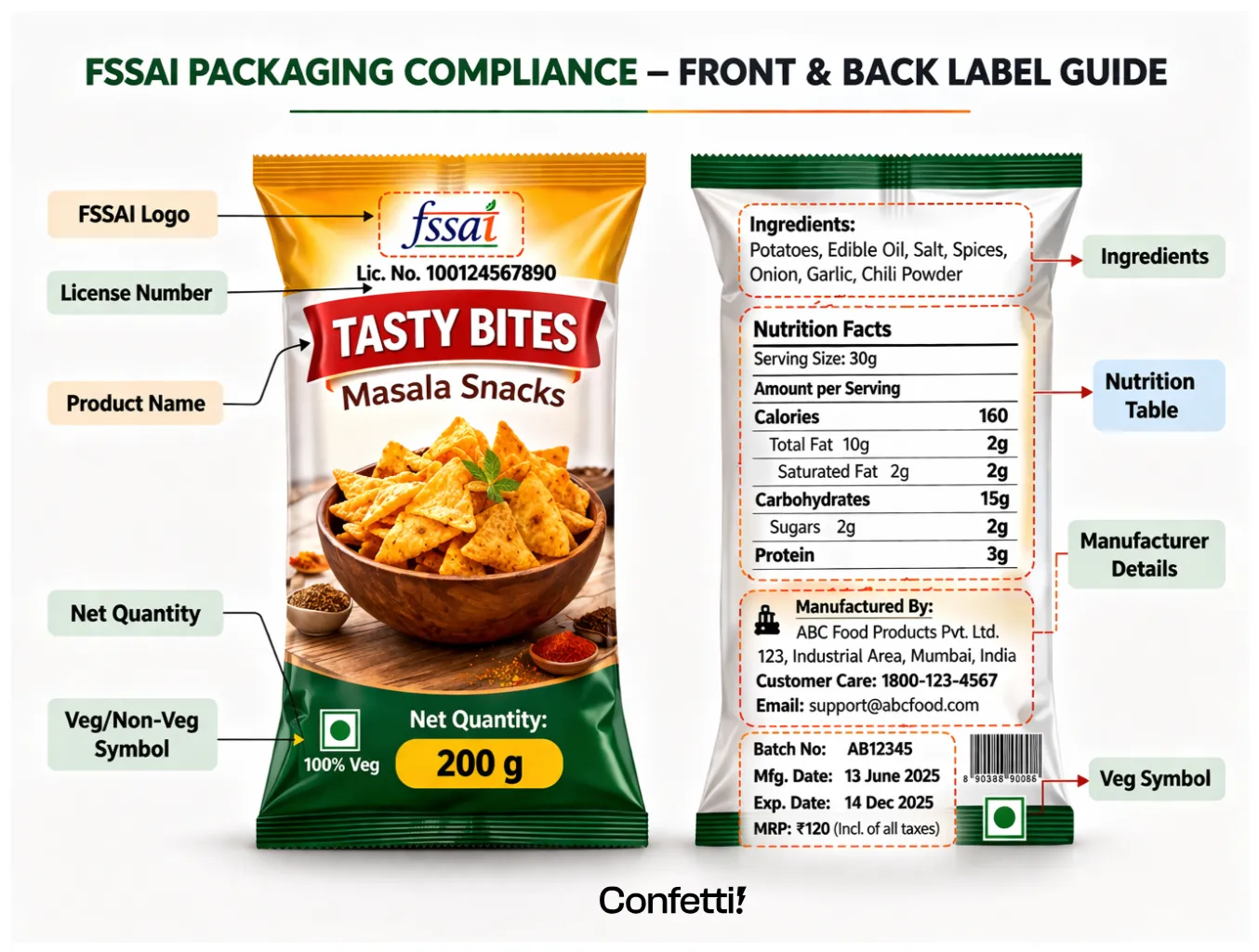
One of the most important requirements for packaged food is the FSSAI logo and license number.
The license number is issued when a food business registers with FSSAI and obtains approval to operate.
This number is usually a 14-digit registration or license number that identifies the food business operator.
Displaying this number on packaging helps consumers verify that the product comes from a legally registered food business.
The FSSAI logo must be clearly visible and printed in a way that consumers can easily read it.
Every food package must clearly display the name of the food product.
The name should accurately describe the product and must not mislead consumers.
For example, a beverage cannot be labeled as “fruit juice” unless it meets the regulatory definition of fruit juice.
This rule prevents deceptive marketing practices in the food industry.
The packaging label must include a complete list of ingredients used in the product. Ingredients must be listed in descending order based on their weight or quantity.
This means the ingredient present in the largest amount appears first on the list.
Certain ingredients such as milk, peanuts, soy, wheat, and tree nuts must be clearly declared because they are common allergens.
Clear allergen labeling helps protect consumers who have food allergies.
Most packaged foods must display a nutrition information panel that shows the nutritional value of the product.
This panel allows consumers to compare food products and understand their dietary impact.
Typical nutrition labels include the following information.
Some products may also include additional information such as fiber, sodium, vitamins, or minerals.
The packaging must include the name and address of the manufacturer, packer, or importer.
This information allows regulators and consumers to trace the source of the product.
Many food companies also include customer care contact details to address consumer complaints or feedback.
Food packaging must clearly state the net quantity of the product.
This is usually displayed in units such as grams, kilograms, milliliters, or liters.
The declared quantity must represent the actual amount of food inside the package excluding the weight of packaging materials.
Each packaged food product must include a batch number or lot number.
This identifier helps track the production batch in which the food product was manufactured.
If a food safety issue occurs, regulators can quickly identify the affected batch and remove those products from the market.
Food labels must clearly display the date of manufacture and either the expiry date or best-before date.
This information helps consumers determine whether the product is still safe to consume.
Expired food products cannot legally be sold in the market.
India has a unique food labeling system that identifies whether food products are vegetarian or non-vegetarian.
Vegetarian products must display a green dot inside a green square. Non-vegetarian products must display a brown dot inside a brown square.
These symbols help consumers quickly identify products based on dietary preferences, religious practices, or cultural habits.
While these elements seem simple, fitting them correctly into limited packaging space requires careful planning. Many brands rely on teams at Confetti Design Studio to ensure accuracy without compromising design.
In addition to labeling requirements, FSSAI also regulates the materials used to package food.
Packaging materials must be safe and must not contaminate the food product.
Food businesses must ensure that packaging materials meet food-grade safety standards before using them.
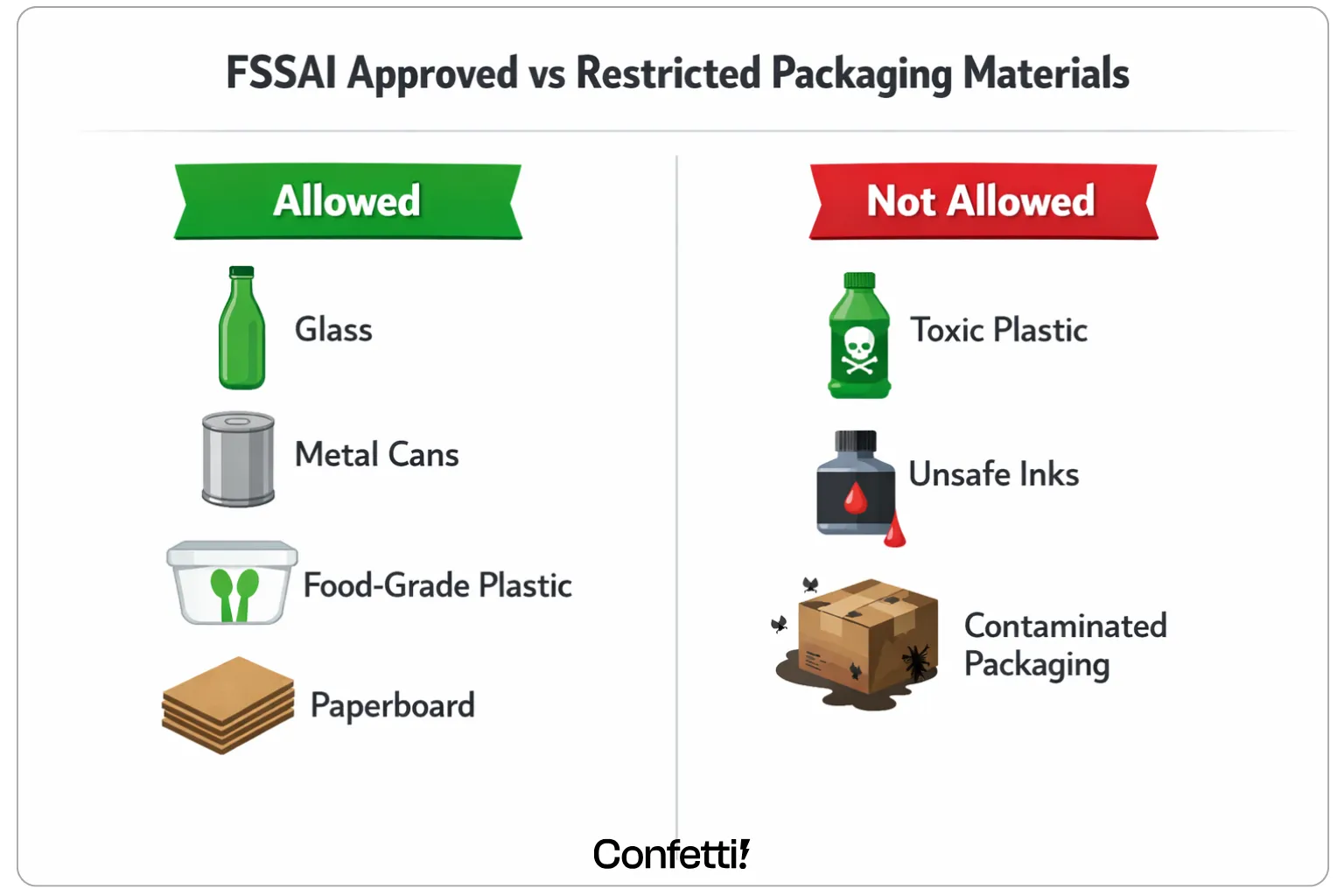
Several packaging materials are widely used in the food industry because they are safe and stable for food contact.
Common approved materials include:
These materials protect food products from contamination while maintaining product freshness during storage and transportation.
Certain packaging materials are restricted under FSSAI regulations because they may pose health risks.
Materials containing toxic substances or chemicals that can migrate into food are not permitted.
For example, some forms of recycled plastic are restricted for direct food contact unless they meet strict safety standards.
Printing inks and adhesives used on food packaging must also be non-toxic and safe.
Chemical migration occurs when substances from packaging materials transfer into the food product.
FSSAI regulations set limits on how much chemical migration is allowed.
Packaging manufacturers must test materials to ensure they meet these safety limits.
Laboratories often conduct migration testing to verify that packaging materials are safe for food contact.
This helps prevent contamination and ensures consumer safety.
Designing a label is not just about putting information on a package.
FSSAI has specific design and formatting rules to ensure that all information is easy to read and clearly visible to consumers.
If your label is hard to read or poorly designed, it can still be considered non-compliant, even if all information is present.
Let’s break down the most important FSSAI label design guidelines you must follow.
FSSAI mandates that all mandatory information on packaging must follow minimum font size rules.
The font size depends on the size of the packaging. Smaller packages can use smaller fonts, but they must still be readable.
Here’s a simplified reference:
The goal is simple.
Consumers should be able to read all information without difficulty.
If the text is too small, it violates FSSAI labeling rules.
All mandatory information must be placed in a prominent and visible area on the package.
This is often called the Principal Display Panel (PDP). The PDP is the part of the packaging that consumers see first.
Important details like:
must be displayed clearly on this panel.
Other details like ingredients and nutritional information can be placed on secondary panels but must still be easy to find.
FSSAI requires labels to have clear contrast between text and background.
For example, light text on a white background is not acceptable.
The label must be designed so that consumers can easily read all information.
Avoid:
Simple and clean design improves both compliance and user experience.
Food labels in India must be written in English or Hindi. Businesses can also include additional regional languages if needed.
However, mandatory information must always be available in at least one of these two languages.
This ensures that a wide range of consumers can understand the product details.
Some types of food products require additional labeling rules under FSSAI.
These rules ensure that consumers receive more specific information based on the type of product they are buying.
Organic food products must comply with both FSSAI regulations and organic certification standards.
They must display certification logos such as:
The product must not make false claims about being organic without proper certification.
Health supplements must include specific warnings and usage instructions. Labels must clearly state that the product is not a substitute for a balanced diet.
They must also include recommended dosage and caution statements. This prevents misuse and protects consumer health.
Infant food products are subject to strict labeling rules. Labels must include important statements such as:
“Mother’s milk is best for infants”
These products cannot include misleading claims or promotional content that discourages breastfeeding.
Imported food products must meet Indian labeling requirements before being sold.
If the original packaging does not comply, additional labels must be added.
These labels must include:
This ensures that imported products meet the same safety standards as domestic products.
Many food businesses fail to comply with FSSAI regulations due to simple mistakes.
These mistakes can lead to penalties or product recalls. Understanding these common errors can help you avoid compliance issues.
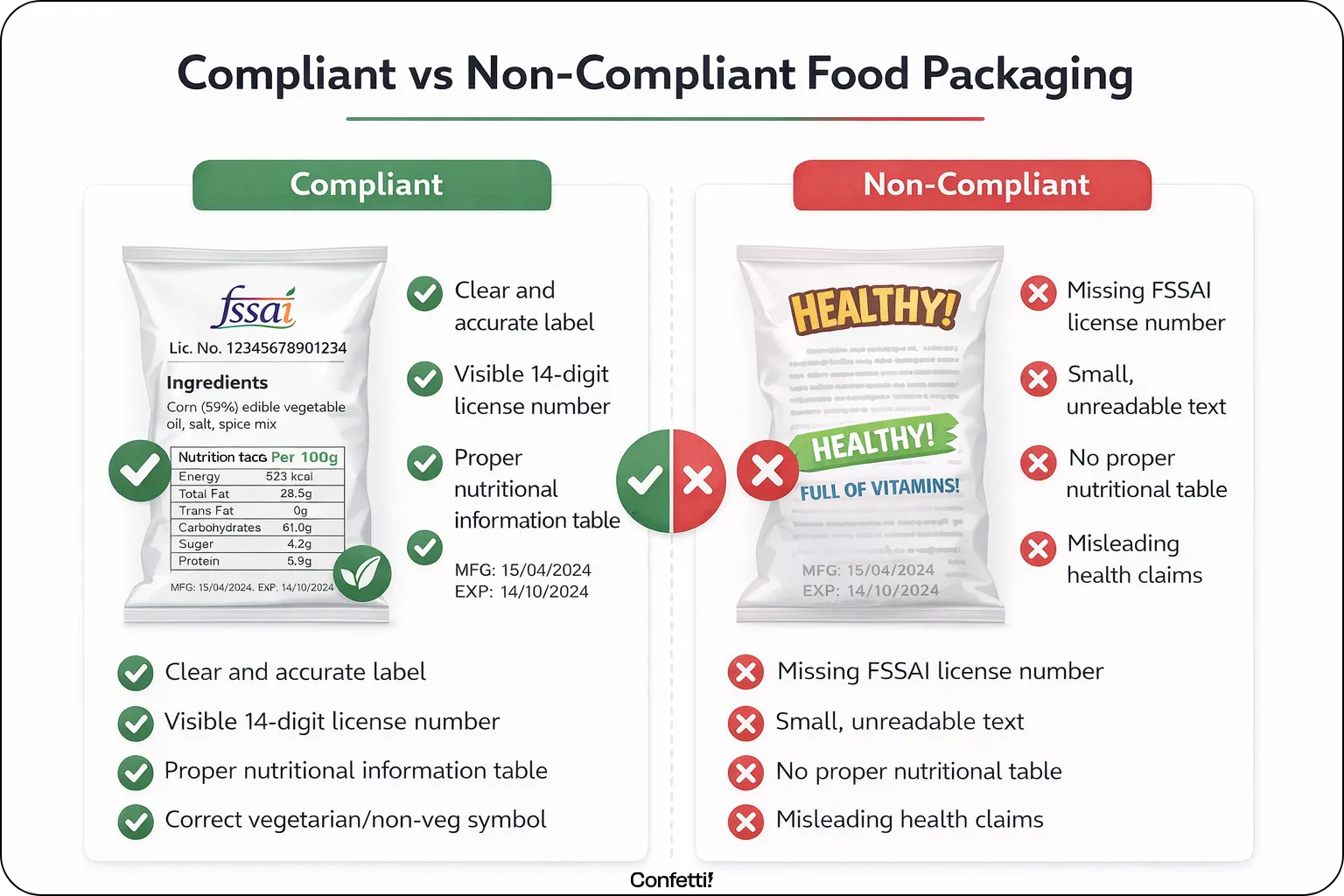
One of the most common mistakes is failing to include the FSSAI license number on packaging.
Without this, the product is considered non-compliant.
Using the wrong symbol or placing it incorrectly can lead to violations.
The symbol must be clearly visible and follow FSSAI specifications.
Many brands use terms like:
If these claims are not supported by regulations, they are considered misleading and illegal.
Incorrect or incomplete nutritional information is another common issue.
All required values must be displayed accurately.
Even if all information is present, using small or unclear fonts can result in non-compliance.
Labels must always be easy to read.
Failing to follow FSSAI packaging regulations can result in serious consequences.
These penalties are designed to ensure that food businesses take compliance seriously.
Food businesses may face fines for non-compliant packaging.
The penalty amount depends on the severity of the violation.
Authorities may order a product recall if packaging does not meet safety standards.
This can result in major financial losses for the business.
In serious cases, FSSAI may suspend or cancel the business license.
Without a valid license, the business cannot legally operate.
Non-compliance can damage consumer trust.
Once customers lose confidence in a brand, it becomes difficult to recover.
Creating compliant packaging may seem complex, but it can be simplified into a step-by-step process.
Following this process will help ensure your packaging meets all regulatory requirements.
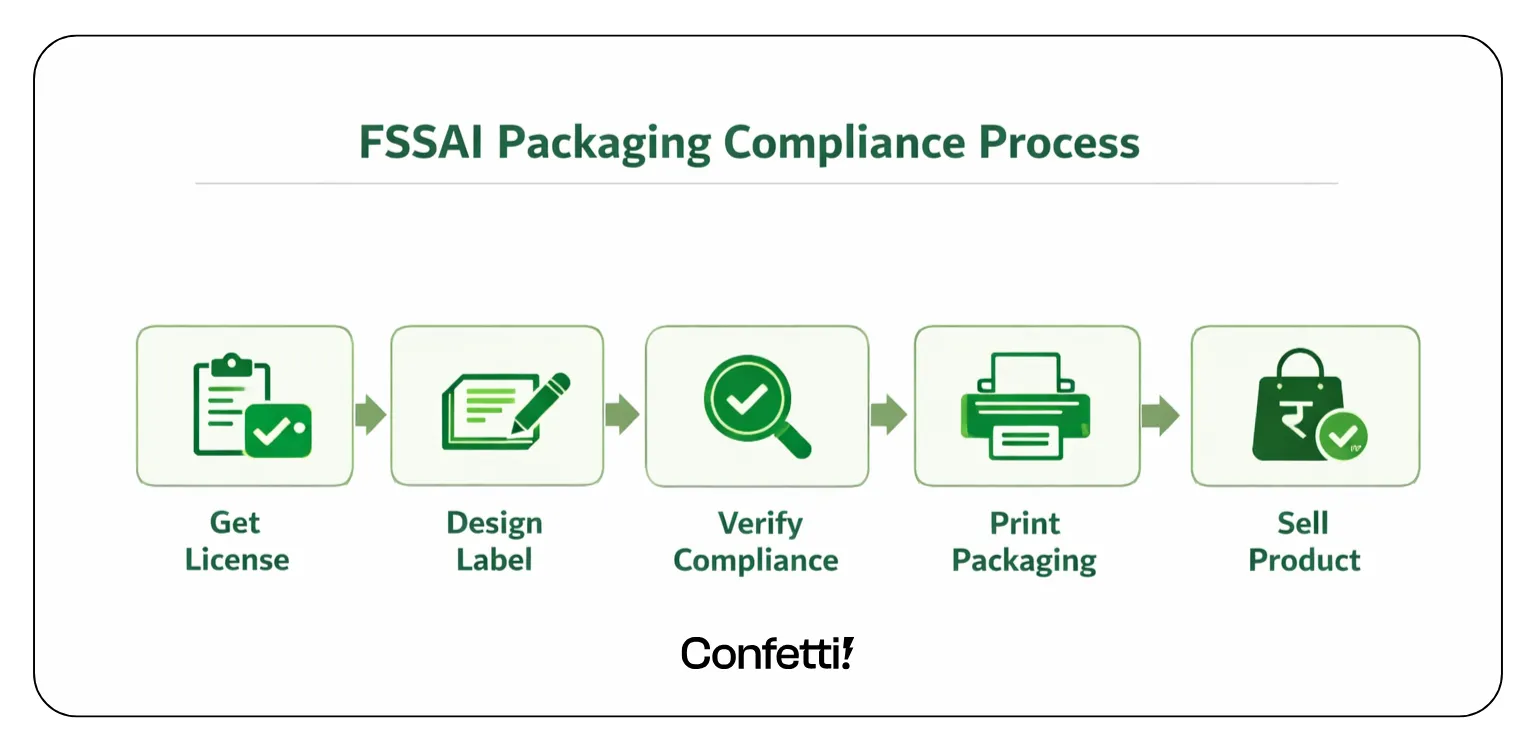
The first step begins with securing a valid FSSAI license, which is the legal foundation of your entire packaging process.
Without this license, no packaged food product can be sold in India, regardless of how well the packaging is designed.
During this stage, it is equally important to correctly define your product category under FSSAI regulations.
This is where many businesses make mistakes.
Different categories such as snacks, dairy products, health supplements, or organic foods are governed by different rules.
If your product is incorrectly classified, your label may miss critical information or include incorrect declarations, making it non-compliant from the start.
Establishing the correct license and category ensures that everything that follows is aligned with the law.
Once the legal foundation is in place, the next step is to prepare the content that will appear on your packaging.
This is not just informational content but legally required data that must be accurate and properly structured.
The product name must clearly reflect what the food actually is, without exaggeration or misleading wording.
The ingredient list must follow a strict order based on quantity, starting with the ingredient used in the highest amount.
This requirement ensures transparency and helps consumers understand what they are consuming.
Allergens must be clearly declared, as this directly impacts consumer safety.
Nutritional information must be calculated carefully, either through lab testing or reliable data sources, because incorrect values can lead to regulatory issues.
Another important aspect is the use of correct terminology.
Ingredients and additives must be listed using standardized names rather than marketing language.
This step requires precision, because even small inaccuracies can result in compliance failures.
After finalizing the label content, attention must shift to the physical packaging material.
FSSAI regulations require that packaging materials must be safe for food contact and must not affect the quality or safety of the food.
The choice of material depends heavily on the type of food product.
For example, products with high oil content, moisture, or acidity require packaging that can prevent chemical reactions or contamination.
Selecting the wrong material can compromise food safety even if the labeling is perfect.
Businesses must work with reliable suppliers who can provide proper certifications for food-grade materials.
Once both content and materials are ready, the next step is to design the packaging layout.
This is where compliance and visual design must work together.
The most important information must be placed on the front-facing panel, where it is easily visible to consumers.
Other details should be organized in a structured and logical way so that they can be easily read and understood.
Font size must follow FSSAI guidelines based on the size of the packaging, and all text must be clearly legible.
The design should use proper contrast between text and background to avoid readability issues.
At the same time, marketing claims on the packaging must be carefully reviewed.
Any claim such as “healthy,” “natural,” or “low fat” must meet FSSAI criteria and should not mislead consumers.
This step requires balancing regulatory compliance with effective product presentation.
The final step involves validating the packaging before and after production.
Before printing, a thorough compliance review must be carried out to ensure that all required elements are present, accurate, and correctly placed.
This review acts as a safeguard against costly mistakes, such as missing information or incorrect formatting.
Once the design is approved, the packaging is printed and tested under real-world conditions.
This includes checking whether the text remains clear after printing, whether the material holds up during storage and transportation, and whether the label remains readable in different environments.
Testing is essential because packaging that looks correct on screen may behave differently in actual use.
Even after the product is launched, businesses must continue to monitor compliance and update packaging if regulations change.
This ensures that the product remains legally compliant throughout its lifecycle.
At this stage, the challenge is balancing compliance with visual appeal. We at Confetti Design Studio help turn regulatory requirements into clean, effective packaging that works in real retail settings.
What does FSSAI compliant packaging design mean?
It means packaging that follows FSSAI regulations for both labeling and material safety, ensuring food products are safe and properly described.
Is the FSSAI logo mandatory on packaging?
Yes.
All packaged food products must display the FSSAI logo and license number.
What font size is required for FSSAI labels?
Font size depends on packaging size but must always be clear and readable as per FSSAI guidelines.
What materials are allowed for food packaging in India?
Approved materials include glass, metal, food-grade plastic, and paperboard.
These materials must not contaminate food.
Can imported food be sold without FSSAI labeling?
No. Imported food must comply with Indian FSSAI labeling requirements before being sold.
What happens if packaging does not follow FSSAI rules?
Non-compliance can result in fines, product recalls, or license cancellation.
Want strategic branding and packaging like this for your business?





.webp)
.webp)


.webp)
.webp)
.webp)
.webp)
.webp)







.svg)
.webp)