%201.webp)
02
AI Snaps
.svg)
.svg)
01
Our Work
03
About Us
04
Brand Audit
05
Contact Us
06
Client Success
12
07
Blogs
08
Careers
Book A Call
.svg)



.svg)
Need Help In Building Your Brand?
Click the button below & book a call with our founder directly.

Rishabh Jain
Managing Director
Finding the right packaging design agency is essential to maximise your ROI. However, with so many choices, finding the best experts gets tricky.
Our Confetti guide is here to help. We take you through the step by step process of finding the best packaging design agency your brand needs. Right from evaluating portfolios to questions you need to ask, we cover it all.
A packaging design agency is a specialised service provider that helps brands create packaging that works.. The goal is to get the product retail-ready, production-ready, and consumer-ready.
Packaging design agencies combine brand strategy, structural engineering, and graphic design knowledge to make packaging that performs in be it visually, structurally, and commercially.
For FMCG, D2C, beauty, food, or retail, packaging directly affects conversion, perceived value, and repeat purchase.
Most people think of graphic design when considering packaging. They take into account colours, the logo, the typography, the imagery, and a couple of other elements.
That’s just half the story. The other half is Structural design.
Also called industrial or 3D packaging design, this is the physical architecture of the pack. That means: shape of a box, the way a lid closes, the ergonomics of a bottle.
This design decides how a pack is formed, how it protects the product inside, and how efficiently it ships.
Here’s a simple comparison between the two:
If your product uses a standard format, graphic design may be enough.
But, if you’re creating a new format, entering D2C, or scaling distribution, you will need structural expertise.
1. Brand Strategy and Packaging Positioning
Agencies define how your product should stand out on the shelf and what value it signals to shoppers.
They analyze competitors, audience behavior, and build a clear positioning before any design begins.
2. Structural Packaging Design (Form, Function, Materials)
They design the physical form of the package to ensure it protects the product, ships efficiently, and is easy to use.
This includes materials, formats, and engineering decisions that impact cost and durability.
3. Visual Design and Communication
This layer focuses on how the packaging looks and communicates key information within seconds.
It includes typography, colors, layout, and messaging that work across shelf, hand, and digital views.
4. Regulatory Compliance and Content Structuring
Agencies ensure all legal and mandatory information is correctly included and formatted.
This prevents compliance issues like recalls, penalties, or costly relabelling.
5. Prototyping and Testing
Designs are physically tested to validate durability, usability, and shelf performance before production.
Small adjustments here can save large operational costs later.
6. Print Production and Pre-Press Management
They prepare files and manage printing to ensure the final output matches the intended design.
This step avoids common issues like color mismatch or material-related print failures.
7. E-commerce and Digital Shelf Optimisation
Packaging is optimized to look clear and attractive in small digital formats like thumbnails.
This ensures visibility and conversion in online and quick-commerce environments.
8. Sustainability and Cost Engineering
They balance eco-friendly materials with cost efficiency and scalability.
Even small material or size changes can significantly reduce expenses and environmental impact.
9. Portfolio Rollouts and SKU Systems
Agencies create consistent systems for multiple product variants and SKUs.
This helps brands scale efficiently while maintaining a cohesive identity across ranges.
Packaging design agencies can fall into three levels based on the level of expertise and services they provide:
Freelance packaging designers can be a great option for early-stage brands with a limited budget and a simple brief.
Advantage: They're fast, lean, and highly skilled at visual design.
Disadvantage: Most freelancers have limited knowledge of print production, material specifications, or structural constraints. You may get great-looking artwork but it could cause expensive packaging design problems.
Best for: Startups, single-SKU products, basic label or pouch design.
A boutique agency is a small team of 3–10. They have strong category expertise, and a hands-on approach.
These studios often specialise in a specific area such as food and beverage, beauty, wellness and know that world inside out.
Advantage: They're collaborative, responsive, and tend to care deeply about the work.
Disadvantage: They may not be able to handle large multi-SKU rollouts or very tight turnaround times.
Best for: Growing brands, category-specific packaging challenges, brand-led redesigns.
These are full-service agencies like Confetti Design Studio. They handle everything from brand strategy and structural design through to production management and print-ready artwork delivery.
Advantage: They have dedicated teams for research, concept, design, and production. They are equipped to manage complex projects across multiple markets, formats, and SKUs simultaneously.
Disadvantage: This level of service comes with a higher price tag and longer timelines.
Best for: Scaling or enterprise brands, complex multi-format launches, international rollouts.

Before you even begin researching the best agency for packaging design, you must have absolute clarity on your own objectives.
A vague "we need a new look" will lead to a vague outcome.
Treat this like any other business initiative. This means having specific and measurable goals.
All packaging projects are not the same. It will change with the nature and scope of design needed.
Here are some common scenarios:
New Product Launch: You have a product ready to go and need packaging built from scratch. This will need a comprehensive packaging brief.
It covers brand positioning work, structural decisions, graphic design, and print-ready artwork. You should get an agency with end-to-end experience.
Brand Refresh or Redesign: In this situation, your product is already on shelf, but you need a packaging redesign because it isn't working hard enough, or no longer reflects where your brand is.
This is a refinement project, but still quite comprehensive. A packaging redesign if not done properly can damage brand equity that took years to build.
Range Extension: You're adding new SKUs flavours, or formats to an existing range.
This is another extensive exercise that requires careful design thinking to maintain consistency while still differentiating within the range. A fresh pair of eyes matters here.
Sustainability-Driven Redesign: You need to move to more eco-friendly packaging materials. Reasons could be consumer demand, regulatory pressure, or your own brand values.
This requires an agency with genuine sustainability expertise, not just good intentions.
E-Commerce Packaging Design; Your product ships direct to consumer, and the packaging needs to survive a courier network, make an impact when it lands on a doorstep, and create a great unboxing experience.
This is a different brief to retail shelf packaging and not all agencies understand the difference.
💡 Before you approach any agency: Create a packaging brief that covers:
This brief will become the foundation for all your agency conversations and ensures you’re comparing them properly. .
Many brands get this part wrong. They usually underestimate, or in some cases overestimate the packaging design budget.
The costs can vary depending on the scope of your project, the size and experience of the agency, and how many SKUs are involved.
Some points to remember:
But remember - Invest in the right agency. It pays back.
Packaging design takes time because even with the best of agencies - good design requires thought, iteration, and careful technical preparation.
A realistic timeline for a standard packaging design project can take anywhere between 10–20 weeks. Sometimes more for complex, multi-SKU projects.
If you're working to a hard deadline like a trade show, a retail buyer meeting, a product launch date, work backwards from that date before you approach agencies.
The best agencies will be honest with you if the timeline isn't feasible.
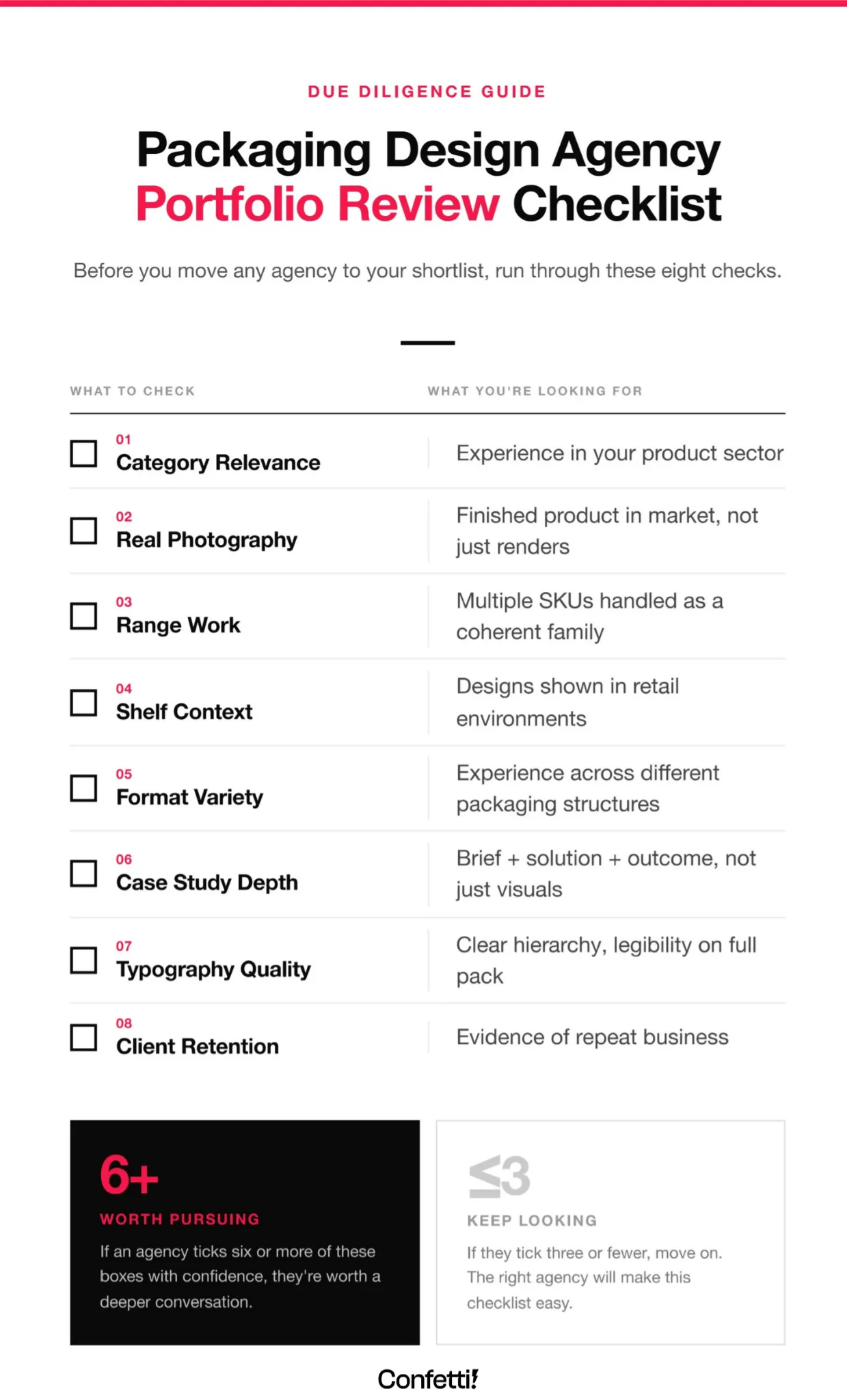
You have narrowed down a few agencies and now what?
A portfolio full of stunning visuals doesn't mean the work actually performed.
Evaluating a packaging design portfolio properly is a skill and many brands miss what they should be paying attention to.
Here's how to do it right.
The first filter is category experience.
Packaging design is context-specific. The ideation and design for skincare will not work for grocery. And what works in D2C can fail in modern retail.
Check for:
✅Work in your category or closely related sectors
✅Familiarity with your price tier (mass, premium, luxury)
✅Evidence of retail environments similar to yours
Category knowledge reduces trial-and-error. It means the agency already understands shelf behaviour, retailer constraints, and shopper expectations.
A render shows intention. A photograph shows delivery.
Many designs fail during print or production. Real images prove the agency can execute, not just visualise.
Look for:
✅Actual product photography (on shelf, in-hand, in use)
✅Print finishes captured realistically (not simulated)
✅Packaging in retail or distribution environments
Watch out for portfolios made entirely of 3D mockups or stock templates.
Designing one SKU is easy. Designing a scalable system is not. Most brands scale.
If the system breaks at 5 SKUs, it will fail at 20.
Check:
✅Multi-SKU ranges (flavours, sizes, formats)
✅Consistent brand identity across variants
✅Clear differentiation at a glance
Anyone can make one hero SKU look great. Making twelve SKUs work as a cohesive family on shelf, at a glance, in different sizes and formats, is a different challenge entirely.
Packaging does not compete in isolation. A pack that looks beautiful in isolation may be invisible on a real shelf.
If the portfolio never shows context, the agency may not design for it.
Look for:
✅Shelf simulations or real retail images
✅Competitor comparisons
✅Designs shown in crowded environments
Packaging is format-driven. Each format has different design rules, print constraints, and material behaviours.
A strong portfolio includes:
✅Folding cartons, rigid boxes, flexible packs, labels
✅Bottles, jars, pouches, sleeves
✅Different materials (paperboard, plastic, glass, sustainable options)
An agency that's only ever worked in one format will struggle when your brief needs something different.
This is where weak agencies get exposed.
It's easy to make a front-of-pack look good. The real test is whether the back panel is legible, legally compliant, and still on-brand.
Zoom into back panels and dense content areas.
Evaluate:
✅Legibility of small text
✅Structure of information (what comes first, second, third)
✅Handling of legal and regulatory content
✅Alignment with brand tone even in technical sections
Packaging must balance marketing and compliance. Poor hierarchy reduces trust and usability.
A portfolio image is not enough. You need narrative which is why evaluating case studies is very crucial.
The best agencies show you in depth case studies of their work with proper context.
Each case study should answer:
Look for the outcome. You won’t always get exact numbers. You should still see signals of performance.
Look for:
If an agency's case studies are all process-focused ("we ran three rounds of concepting and refined the typography") but outcome-free, you need to do more digging.
Now that you've shortlisted two or three agencies.Their portfolios are strong. Their credentials check out.
The next step is having a conversation that decides it all.
Here's what to ask. The answers to these will get you to the best design agency for your needs:
Choose an agency that can articulate a clear, repeatable, client-friendly process that reliably gets to great outcomes.
1. "How do you run your discovery and briefing phase?"
A strong agency should have a structured process to understand your brand before creating concepts, covering your audience, retail context, competitors, values, and business goals.
If they just say, “we’ll have a call and get started,” consider it a red flag.
2. "How many design concepts will you present, and at what stage?"
There’s no single right number of concepts. Some agencies show two, others four.
What matters is having a clear rationale. Too many scattered options suggest weak strategy; only one limits choice.
3. "How many rounds of revisions are included and what counts as a revision?"
Revisions can mean anything from a minor colour tweak to a full concept rethink.
Get clarity upfront: how many rounds are included in the quoted fee? What happens if you need more? What's the process for giving feedback: a document, a call, a shared platform?
4. "Do you manage print production, or do you hand over files at the end?"
Many agencies deliver final artwork and step away, which works if you have a strong in-house team.
If not, look for one that manages production too: coordinating with printers, checking proofs, approving colour, and ensuring the final output matches what you saw on screen.
1. "Have you worked with brands in our product category?"
You want a confident yes, backed by a real example.
Category experience matters because each sector has its own unwritten rules. A generalist can learn, but that learning curve costs you time and money.
2. "What printing techniques and substrates are your designers familiar with?"
A strong answer will include specific techniques like offset litho, flexography, digital print, screen printing, hot foil stamping, embossing, soft-touch lamination, spot UV.
If the answer is vague or they immediately defer to "the printer will handle that," be cautious.
3. "Can you share a case study for a project similar to ours?"
If they can't point to something in your category or adjacent to it, ask how they'd approach the knowledge gap.
The best agencies will have a clear answer: specific research, consultation with material suppliers, retailer visits.
4. "Do you have experience with sustainable packaging materials and design?"
Even if eco-friendly packaging isn't your immediate priority, the answer tells you a lot about how current and forward-thinking the agency is.
If they can only talk about it in vague terms, their knowledge probably hasn't kept pace with the industry.
1. "What exactly will I receive at the end of the project?"
A complete delivery package should include: final artwork files in all required formats (AI, PDF, EPS), print-ready files with correct colour profiles, dieline templates, brand guidelines for packaging (if applicable), and any structural design files.
2. "Who owns the design rights?"
In most agency engagements, intellectual property transfers to the client on full payment. But this isn't universal, and the specifics matter.
Do you own the design outright, or do you have a licence to use it?
Can the agency use the work in their portfolio? What happens if you want to make changes to the design in future, do you need to come back to them, or can you work with another supplier?
3. "What does a realistic timeline look like for a project like ours?"
Any agency can quote you an optimistic timeline. What you want is an honest one.
Push them: what are the factors most likely to cause delays? What do they need from you, and by when, to keep the project on track?
A good agency will have a clear project management approach and won't be afraid to tell you if your launch date is tighter than they'd recommend.
1. "What's a project that didn't go the way you planned and what did you do about it?"
Every agency has had projects go sideways. What matters is how they handled it.
The best agencies answer honestly, sharing a specific example, what went wrong, and what they learned. That kind of transparency shows how they operate under pressure.
They’re not claiming perfection, they’re proving reliability. That’s the kind of agency you want on your side.
Confetti treats packaging as a brand's silent salesman. That framing is deliberate.
A product package has seven seconds or even less to make a shopper pause and reach for the product. Every design decision has to earn its place.
That's why Confetti's process starts with brand strategy, not mood boards. Before a concept is sketched, the team works to understand the brand's positioning, target consumer, retail environment, and competitive landscape.
Design decisions are never arbitrary, they're tied to a clear strategic rationale every time.
One of Confetti's most distinctive tools is the Packaging Resonance Score: a proprietary framework that evaluates designs across five dimensions: visual appeal, brand alignment, emotional impact, functionality, and shelf presence.
Most agency reviews are subjective.
The Packaging Resonance Score introduces an objective layer: a structured way to measure whether a design will actually perform before it goes anywhere near a printer.
It forces the right conversations early, when changes are cheap. Not after launch, when they're expensive.
Confetti manages the full journey, from concept and structural design through to production-ready artwork, so brands don't have to coordinate between designers and printers themselves.
Every layout is built with logos, product names, barcodes, and legal information organised for both brand impact and functional clarity.
Confetti has worked with over 100 brands from Fortune 500 companies to independent founders across FMCG, food and beverage, beauty, wellness, and e-commerce.
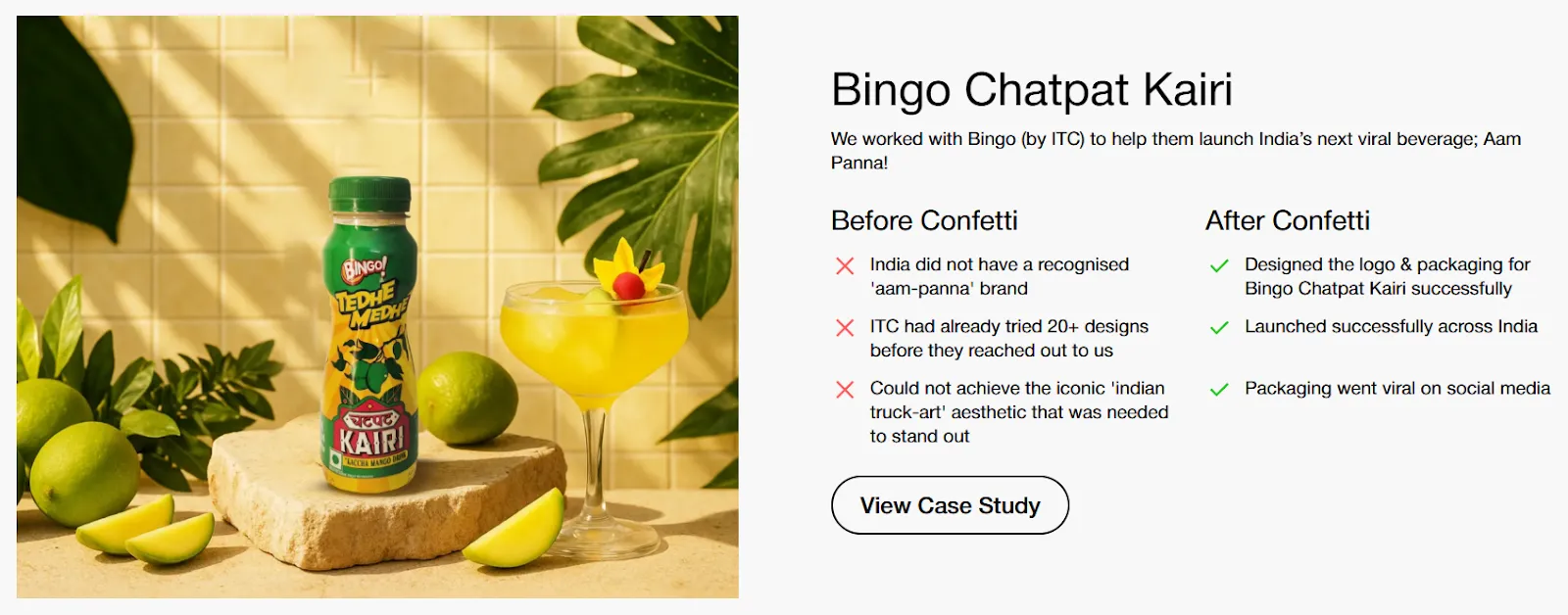
Our recent work includes packaging redesigns for ITC Bingo, ITC BNatural, and ITC Aashirvaad.
In 2025, Confetti won a commended World Brand Design Society Award for the ITC Bingo: Chatpat Kairi packaging.
You’ve done the work, set your goals, reviewed portfolios, asked tough questions, and are left with a few strong options.
The decision still feels hard. To make it easier, here’s the framework:
The best way to choose between shortlisted agencies is to give them a real task, paid, not a free pitch.
Share a short brief outlining your project, brand, and core packaging challenge. Offer a modest fee to show you value their time and thinking.
You’re not looking for finished designs, you’re evaluating how they think.
Did they ask smart questions? Approach the problem strategically, or jump to visuals? Does their response feel tailored or templated?
Early-stage thinking is the strongest indicator of how they’ll perform throughout the project.
The relationship with your packaging agency matters more than most brands expect.
You’ll give unclear feedback, change your mind, and hit a point, often around the second revision, where things feel harder than they should. How the agency handles that moment is critical.
Chemistry isn’t about liking them; it’s about trust, respect, and honest communication under pressure.
The key signal: do they push back?
An agency that agrees with everything is a vendor, not a partner. The best ones challenge weak briefs, question ineffective directions, and flag unrealistic timelines.
That kind of honesty only exists when there’s real trust—and you can usually sense it early.
That means being open with commercial context, what the product needs to achieve, what the retail buyer feedback has been, what the previous packaging got wrong.
It means making decision-makers available when sign-off is needed. It means giving feedback that's specific and actionable, not just "we don't love it."
It also means setting up the working relationship properly from day one.
Before the project kicks off, align on these basics:
Get in touch with our experts and discuss your project
How do I know if a packaging design agency is right for my brand?
Look for relevant industry experience, a portfolio with real (not just rendered) work, a structured creative process, and transparent pricing. Ask for client references and, if possible, a brief paid pitch.
What's the difference between a packaging design agency and a branding agency?
A branding agency defines your brand identity (logo, colours, tone of voice). A packaging design agency applies that identity, and often creates the structural and print-ready design, specifically for physical packaging. Some agencies do both.
How long does packaging design take?
A typical packaging design project takes 6–12 weeks from brief to production-ready artwork. Complex structural design or multi-SKU rollouts can take 3–6 months.
Do I need an agency with experience in my specific product category?
It's strongly recommended. A food packaging agency understands labelling regulations, shelf adjacencies, and retail buyer expectations in a way a generalist agency won't. Category experience reduces mistakes and speeds up execution.
Should I choose a local packaging design agency or work remotely?
Location matters less than it used to. Remote working is now standard. What matters more is communication style, time zone alignment, and their ability to understand your market.
Want strategic branding and packaging like this for your business?





.webp)
.webp)

.webp)
.webp)
.webp)
.webp)
.webp)






.svg)
.webp)