%201.webp)
02
AI Snaps
.svg)
.svg)
01
Our Work
03
About Us
04
Brand Audit
05
Contact Us
06
Client Success
12
07
Blogs
08
Careers
Book A Call
.svg)



.svg)
Need Help In Building Your Brand?
Click the button below & book a call with our founder directly.

Rishabh Jain
Managing Director
A packaging redesign is needed when your packaging no longer reflects your brand, fails to compete on shelf, or is costing you sales, customers, or compliance.
In this blog, we explore some of the most common triggers for packaging redesign including competitor pressure, rebrand, product formula changes, and more.
.webp)
A packaging redesign is a tactical change to a product's visual and/or structural packaging.
It is different from a rebrand, which is a broader change to a company's identity. It is also not the same as a packaging refresh, which is a minor visual update.
Packaging redesigns are undertaken to better meet current business, consumer, and market needs.
It can be anything from small label updates to full structural and design overhauls across an entire product range, including:
Your core brand identity. Your name, positioning, and brand meaning remain intact.
Before diving in, let’s get to know the spectrum of packaging changes.
Not every packaging change is a full redesign. Understanding where you lie on this spectrum helps frame your timeline, budget, and risk level.
A packaging redesign process must understand how big a change is needed. It can mean:
Evolution is the safer option. You keep what people already recognise: colours, logo, layout, and just improve what isn’t working. It’s low risk, but the results are usually gradual.
Revolution is a bold move. You rethink everything, design, materials, structure, to signal real change. It can bring big rewards, but it also carries more risk, so testing is essential.
The best choice depends on how strong your brand already is, how far behind competitors you are, and what you want to achieve.
That’s why good packaging redesign agencies like Confetti, start with a clear strategy that is aligned with the brand goals
A packaging redesign is needed for multiple reasons: when sales decline, your packaging looks outdated, your brand or product has changed, you’re entering new markets, etc.
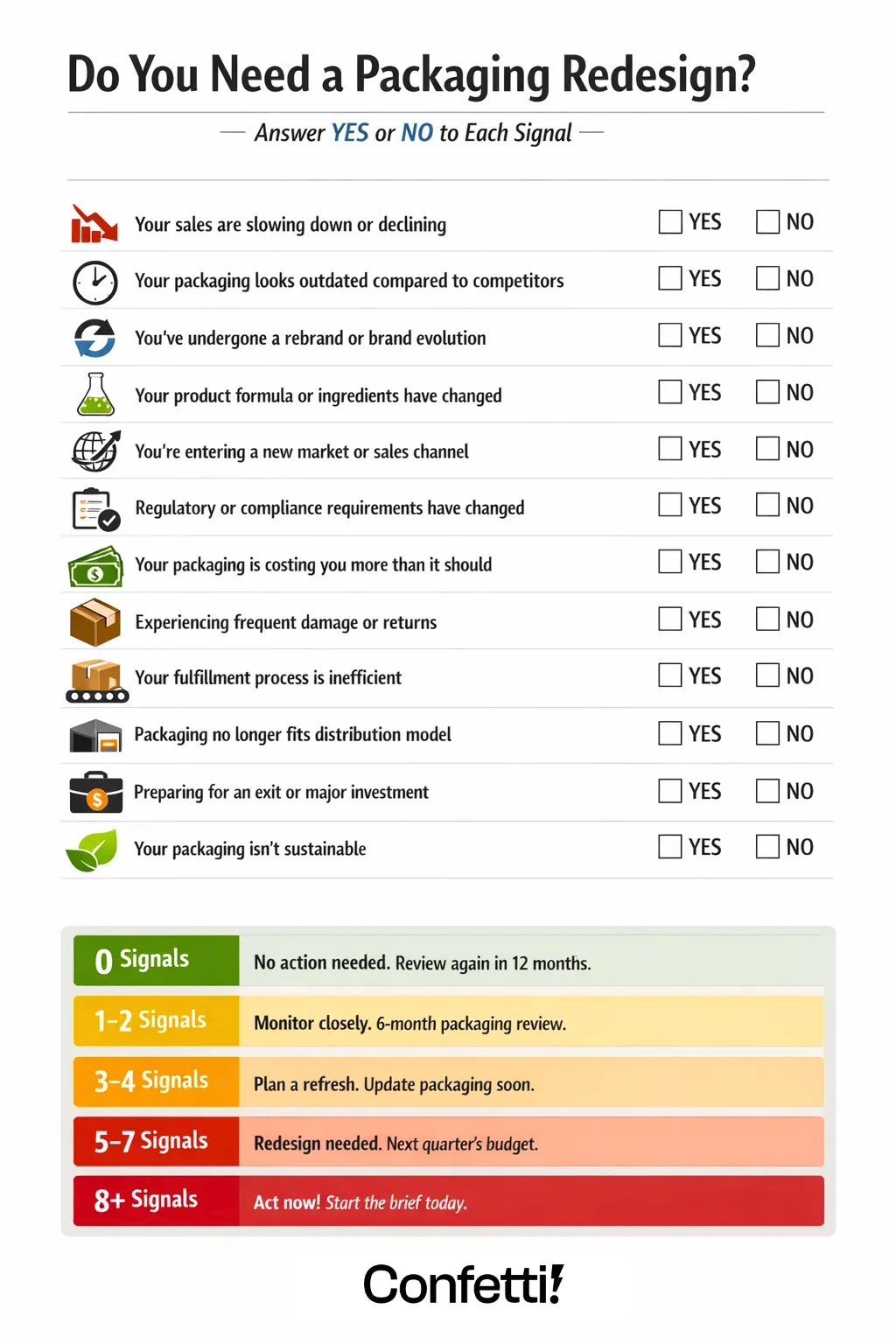
Let’s delve into these early signals that tell you it’s time to redesign:
When sales drop without clear reasons like pricing or distribution, packaging is often the hidden factor.
Packaging drives first impressions and final purchase decisions.
In a physical retail environment, a shopper makes that decision in under 7 seconds. Online, they're scrolling past hundreds of thumbnails. If your pack doesn't stop them: visually, emotionally, or informationally: someone else's will.
Real-world example: In 2022, Liquid Death, a canned water brand, outpaced established players not because their water was better, but because their packaging was dramatically different.
Designed to look like a beer can, it cut through the shelf clutter of pastel wellness brands entirely. Sales went from a standing start to over $130 million in revenue within three years.
Lesson: packaging that earns attention earns sales. If your sales are flat or falling, run a packaging audit before you assume the problem is price, distribution, or the product itself.
Packaging design evolves every 3–5 years.
Pull your product off the shelf, physically or digitally, and place it next to your three closest competitors.
If competitors look cleaner, more premium, or more relevant, your product is clearly signalling “old”.
Your customers may not be able to explain it right away, but they’ll notice and feel it soon.
Example: A heritage hot sauce brand kept its 1990s label while competitors modernized. A redesign, retaining the mascot but updating layout, adding a neck label, and using lighter glass, restored shelf appeal and won back lost distribution.
Benchmark test: If three or more of your direct competitors have updated their visual identity or packaging design in the past two years, you are behind.
.webp)
You've updated the logo. Refreshed the brand colours. Even repositioned with a new tagline or tone of voice. The website is live and socials look great.
But the packaging still carries the old identity.
You may not consider it urgent but that old packaging is actively undermining the new brand story you're trying to tell.
A brand update without packaging alignment creates confusion.
For trust to build, customers expect consistency across all touchpoints.
Real-world example: When Innocent Drinks modernised its identity, it updated all packaging at once, creating a cohesive shelf presence that helped defend against new challenger brands.
Rule: If your brand has evolved in any meaningful way in the past 18 months, your packaging needs to follow. Now!
This one rarely makes it onto lists of packaging redesign triggers.
If packing takes too long or requires workarounds, your packaging is costing you operationally.
Warning signs:
Packaging should simplify fulfilment: easy-to-assemble, correctly sized, and efficiently designed structures cut labour, errors, and boost throughput, especially during peak periods.
Example: A fast-growing DTC supplement brand cut pack-out time by 40% and freed up one full-time role by switching to a tray-and-lid design with pre-set product placement, replacing a three-person assembly process.
Insight: Talk to your warehouse or fulfilment team before your next packaging review. They'll tell you exactly what the current pack is costing operationally.
.webp)
Packaging does not transfer seamlessly across channels.
Every sales channel has its own physical environment, shopper behaviour, and commercial requirements. Ignoring this can be a costly packaging mistake brands make.
Each environment has different demands:
Real-world example: When Gymshark expanded globally, it adapted packaging market by market, adjusting claims, regulatory info, and formats to local rules, helping avoid confusion, compliance issues, and poor shelf navigation.
Key insight: New channel = new packaging brief.
Packaging regulations evolve constantly.
This can include ingredient labeling, allergen declarations, recycling symbols or sustainability claims
Any of these can render existing packaging non-compliant, sometimes overnight. The risk of non-compliance is severe ranging from product recalls to legal penalties.
Real-world example: When the UK’s front-of-pack traffic-light nutritional labelling became standard, FMCG brands had to redesign packaging at scale. Those with ongoing review processes adapted smoothly, while others faced rushed, inconsistent, and costly updates.
Best approach: Treat compliance updates as a strategic redesign opportunity.
Packaging directly impacts margins. And most brands don't review it often enough.
Common inefficiencies include:
All of these are margin drains hiding in plain sight.
A structural packaging redesign, even one with no visible change to the consumer. can reduce material costs by 10–25%.
Real-world example: ASOS has repeatedly redesigned its mailing bags, cutting plastic use and shipping costs through smarter materials and structure, improving margins without changing the customer experience.
Action point: Review packaging cost efficiency every 18–24 months.
.webp)
If products arrive damaged, packaging has failed its core function.
This is particularly acute in e-commerce, where products face far more handling touchpoints than in traditional retail: fulfillment centres, sortation machines, courier networks, front door drops.
Example: A premium candle brand reduced damage rates from over 1% to near zero with structural redesign and better internal support. The redesign paid for itself within the first quarter, all without changing what the customer saw on the outside.
Insight: Fixing packaging is always cheaper than replacing products.
Changes inside the product must be reflected outside. This is both a compliance requirement and a marketing opportunity.
Consumers are actively reading labels today in a way they weren't a decade ago. They're looking for cleaner ingredient lists, recognisable names, reduced sugar, added protein, or ethical sourcing signals.
Real-world example: When Halo Top launched, it made one bold packaging choice—putting total calories per pint front and center. That clarity made its benefit instantly obvious, helping it grow to $300M+ in annual sales by 2017.
Lesson: New formula? New ingredient story? Your packaging should be shouting about it.
Retailers and trade partners have requirements -
Shelf dimensions, planogram structures, barcode placement, case configuration, secondary packaging specifications, and sustainability commitments.
All these vary by retailer and all are subject to revision.
If your packaging doesn't meet current trade partner requirements, it can lead to delisting, reduced shelf space or additional costs.
Real-world example: Many UK retailers are phasing out hard-to-recycle packaging. Brands that redesigned with recyclable materials and clear sustainability messaging are gaining a competitive edge, while those that lag face buyer warnings and lost opportunities.
Insight: If you haven’t checked your packaging against your main trade partners’ current requirements in the past year, make that review a priority now.

This one’s for the founders and CFOs.
When an investor, acquirer, or PE firm evaluates a consumer brand, packaging can play an important role in signalling brand maturity, operational rigour, and commercial readiness.
Outdated, inconsistent, or structurally inefficient packaging suggests risk. Strong packaging signals readiness and increases perceived value.
You don’t need a full brand overhaul before every investor meeting, but updating visibly underperforming packaging before a strategic process is usually worth the investment.
Example: A startup founder redesigns their "DIY" packaging into a professional, cohesive brand system just months before pitching to a private equity firm to justify a higher valuation.
Sustainability is now a purchase driver, regulatory requirement, and brand expectation.
Research by NielsenIQ consistently shows that products with sustainability claims on pack tend to grow faster than those without, on average, across many FMCG categories.
This isn’t just a growth issue, it’s a risk.
Today’s consumers notice excess plastic, missing recycling symbols, or when packaging doesn’t match a brand’s sustainability claims and they share their reactions online, in reviews, and through returns.
Example:
A brand that moved to recyclable packaging and communicated it clearly improved both perception and retail positioning.
Real-world example: Graze revamped its packaging to be fully recyclable by 2025, highlighting this clearly on-pack. The update strengthened its sustainability story, boosted retailer scorecard ratings, and secured a stronger shelf position.
Most brands don’t intentionally delay a redesign, they just never start.
And that gap between knowing the pack is underperforming and actually doing something about it, is where the real cost lives.
Some of these include:
Lost sales:
Every month your packaging underperforms, market share quietly shifts to faster-moving competitors. Lost shoppers, downgraded shelf space, and damaged orders may not appear on the P&L but they create a hard-to-reverse downward trend.
Lost trial:
A new shopper who doesn't pick your product up never gets to experience what's inside.
Competitive lock-out:
Once a rival owns the visual language of your category, dislodging them costs far more than a redesign would have.
Retailer confidence:
Buyers notice when a brand's packaging looks tired. It affects ranging decisions, promotional access, and shelf position, long before any formal review.
Investor and acquirer perception:
Outdated packaging signals a brand that hasn't been actively managed. That gets priced into valuations.
Designalytics’ 2024 research tracked brands before and after packaging redesigns. The finding was consistent.
Those that redesigned proactively, often before performance had visibly declined, saw sales uplifts of up to 30% in the year following launch, with many winners in the 20–30% range.
Brands that delayed until sales were already eroding faced a tougher climb; by then, competitors had captured shelf space, retail relationships, and consumer habits.
The redesign cost was broadly similar either way, the timing and messaging were what made the outcome so different.
Many brands tend to delay packaging to a later time. However, the “later” choice can become more expensive. Here’s a look:
A successful packaging redesign process needs to well planned and implemented.
Here’s we approach it at Confetti:
Start with a side-by-side competitor audit. Walk the shelf, physically or digitally, and document how your packaging compares on visibility, hierarchy, material quality, and messaging.
Pair this with consumer perception research: what do current customers think your packaging says about your brand?
Then interview internal stakeholders across sales, operations, and marketing. They may have unique insights from the teams handling returns, fulfillment, and retailer pushback.
Decide whether you need an *evolution*- preserving brand equity or a *revolution*, a full overhaul.
Evolution is lower risk and faster; revolution requires more change management but can reposition a brand entirely.
Set measurable KPIs upfront which can include shelf pick‑up rate, conversion lift, trial rate, or cost‑per‑unit reduction.
When researching consumers, go beyond just age and gender. Understand the emotional and functional job your packaging must perform.
Does it need to convey safety, indulgence, convenience, or sustainability? Use shopper psychology to guide your color choices, information hierarchy, and tactile cues.
Test early concepts with real shoppers through online card sorts, focus groups, or shelf tests, before you commit to final change.
Develop 2–3 distinct design directions. Create physical prototypes and put them on a real shelf for testing.
Eye‑tracking studies or heat maps can reveal where shoppers look first and what they miss.
Skipping this step can leave you in a dicey spot. Brands that fail to test are three times more likely to experience a failed redesign.
Another advantage you’ll have with prototyping is that it will uncover any structural or manufacturing issues early.
Coordinate the launch with production cycles to minimize obsolete inventory.
If you have a large portfolio, phase the rollout. Lead with hero SKUs, then cascade to slower movers.
Communicate the change to trade partners, retailers, and consumers before the new packaging hits shelves. Also make sure to update every digital asset simultaneously: website, Amazon listings, social media, and digital ads.
A mismatch only creates confusion and erodes trust.
A packaging redesign is a huge decision that touches multiple aspects of your business.
It involves
Handing this to a generalist design studio means you’ll be coordinating those threads yourself. And most brand teams don't have the bandwidth, or the specialist knowledge, to do that well under pressure.
Confetti Design Studio was built specifically for this intersection.
Our team brings brand strategy, structural packaging design, and shopper research together, so every redesign decision is grounded in both creative ambition and commercial evidence.
Every redesign engagement starts with a shelf audit.
Before any design work begins, our team benchmarks the brand's current packaging against direct competitors, category trends, and retailer requirements. This tells us not just what looks dated, but why it's underperforming and where the opportunity is.
Next is : Consumer perception. We understand how your customers actually behave at the shelf. What they notice first, what draws them in, what they reach for and why.
The design work begins after this.
Confetti works across the full arc of a packaging redesign, from the initial audit and strategic brief through to production-ready artwork and rollout planning.
For brands at an early stage, that might mean a packaging audit and a design direction, giving internal teams a clear brief to work from.
For brands scaling through new channels or markets, it might mean a full structural and visual redesign, developed alongside trade partner requirements and tested with real shoppers before production commences.
For brands preparing for investment or acquisition, it means building the kind of brand coherence and packaging equity that holds up to scrutiny and supports a premium valuation.
The scope changes. The rigour doesn't.
Confetti's work spans challenger FMCG brands entering major grocery retail for the first time, established brands refreshing packaging to defend category leadership, and growth-stage businesses using packaging redesign to prepare for a funding round or exit.
What they have in common is that they've outgrown packaging decisions made earlier in their journey, and they need a partner who can help them make the next set of decisions with confidence.
Not guesswork. Not trend-chasing. Decisions rooted in brand strategy, consumer behaviour, and commercial reality.
.webp)
How do I know if my packaging needs a redesign?
Key signs include declining sales, outdated visual design, a recent rebrand, product formula changes, retailer pushback, new sales channels, sustainability concerns, or rising packaging costs. If two or more of these apply, a packaging redesign is likely needed.
How often should packaging be redesigned?
Most brand experts recommend reviewing packaging every 3–5 years, even if no major changes are needed. High-growth categories (beauty, food & beverage, wellness) may require more frequent updates, every 2–3 years, to stay competitive.
What's the difference between a packaging redesign and a packaging refresh?
A packaging refresh is a minor visual update like adjusting colours, fonts, or imagery while keeping the overall structure intact. A packaging redesign is a more significant overhaul that may include structural changes, new materials, and a new visual identity. A full packaging overhaul covers an entire product portfolio.
Can a packaging redesign hurt sales?
Yes, if done poorly. Shoppers rely on familiar packaging cues to find products on shelf. A dramatic redesign without adequate consumer testing risks causing shoppers to miss the product entirely. This is why phased rollouts, consumer testing, and clear shelf communication are essential parts of any packaging redesign strategy.
Should I do a packaging redesign in-house or work with an agency?
Both have merits. In-house teams bring deep brand knowledge but may lack specialist packaging expertise. Agencies (particularly packaging-specialist studios) bring category benchmarking, structural design capability, and production experience. For significant redesigns involving new structures, materials, or regulatory compliance, working with a specialist partner is strongly recommended.
Want strategic branding and packaging like this for your business?





.webp)
.webp)

.webp)
.webp)
.webp)
.webp)
.webp)







.svg)
.webp)