02
AI Snaps


01
Our Work
03
About Us
04
Brand Audit
05
Contact Us
06
Client Success
12
07
Blogs
08
Careers
Book A Call




Need Help In Building Your Brand?
Click the button below & book a call with our founder directly.

Rishabh Jain
Managing Director
Luxury skincare branding is what turns a $10 moisturizer into a $100 product customers believe is worth the price. Beyond formulations and active ingredients, it relies on positioning, credible claims, distinctive packaging, retail experience, and consistent brand communication.
For founders launching premium lines, established brands moving upmarket, and businesses expanding globally, every touchpoint must justify the price.
This Confetti guide explores what it requires and where premium brands risk losing their right to charge more.
Luxury in skincare is not a price point. Every part of the brand must justify that price, from the formula and evidence behind it to the packaging, shopping experience and distribution.
If one touchpoint feels ordinary or unreliable, it can weaken the entire premium perception.
A masstige brand offers an affordable step up from mass-market products. A premium brand competes through visible quality and efficacy. A luxury brand adds a distinctive point of view, origin or ritual, supported by strong product credentials and carefully controlled pricing, distribution and service.
The problem begins when a brand adopts luxury aesthetics without delivering the substance buyers expect.
Strong luxury skincare brands build recognition around a distinct idea. Augustinus Bader has its TFC8 technology and scientific founder. La Mer is known for its Miracle Broth, while SK-II builds its story around Pitera and its fermentation origins. Dr. Barbara Sturm centres its positioning on doctor-led skincare and inflammation research.
Own one credible idea and communicate it consistently. Broad claims such as “advanced,” “clean” or “premium” are easy for competitors to copy.
A recognisable hero product gives customers a clear entry point and makes the brand easier to remember.
Augustinus Bader’s The Cream and SkinCeuticals’ C E Ferulic illustrate how a flagship formula can anchor a broader range.
Launching too many products without a clear lead can dilute the story and make the range harder to navigate.
Luxury skincare must build trust before customers can judge results for themselves.
Relevant clinical evidence, clear ingredient information and substantiated efficacy claims help reduce purchase risk. Present this information precisely, without exaggerated promises.
This is where luxury skincare separates itself from premium-positioned skincare.
Forest Essentials combines Ayurvedic heritage with tactile materials, considered detailing and a ceremonial unboxing experience.
The materials, finish and product information should feel as deliberate as the formula.
Distribution and service also shape perceived value. Permanent discounts and indiscriminate distribution can undermine a luxury position, even when the product and packaging are strong.
Buyers also splurge selectively. McKinsey’s State of Beauty 2025 report notes that consumers are more willing to spend on products such as facial serums than on everyday essentials like cleansers. Range planning should therefore identify which products can credibly command luxury prices.
👉Check: Can your formula, proof, packaging, service and distribution all defend the same price? Luxury branding works when they reinforce one another, not when expensive-looking design has to carry the promise alone.
Luxury skincare brands earn premium prices in different ways.
You must choose one primary positioning route and build the product, proof, packaging and customer experience around it.
Combining too many routes without a clear hierarchy can make the brand difficult to understand.
Augustinus Bader, SkinCeuticals and Dr. Barbara Sturm show us how scientific expertise can support premium positioning.
A founder’s credentials can strengthen this route when they are relevant and stated accurately. However, expertise alone cannot prove efficacy.
The brand needs evidence that supports its product claims and a visual identity that communicates precision without appearing cold or overly clinical.
La Mer built its identity around Miracle Broth, connecting the formula to a distinctive origin story. This route requires more than a rare-sounding ingredient.
Sourcing, formulation and origin claims must be credible, while packaging should make the product feel considered and valuable.
Ayurveda, regional botanicals and established care rituals can provide a strong foundation for luxury positioning when the story is specific and authentic.
For Forest Essentials, we at Confetti worked on limited-edition packaging for an exclusive collection created for the Jaipur Royal family. The process included researching Rajasthani heritage, building an SKU database and content inventory, and developing eight concepts before narrowing them to three for review.
The design needed to express heritage through considered details rather than superficial cultural motifs.
Brands such as Tatcha and 111SKIN show how distinctive packaging and a contemporary point of view can support premium positioning. Some brands use restrained typography and minimal layouts; others rely on rich materials, gold detailing and elaborate finishes.
Neither approach is more luxurious by itself. The visual direction must fit the product promise and remain recognisable across packaging, digital channels and retail.
For brands entering the UAE or wider Gulf, local relevance can be a stronger differentiator than copying international luxury codes.
Regional botanicals, credible local expertise or a well-researched ritual can give the brand a story competitors cannot easily replicate.
👉Choose the route your product can genuinely support, then make every touchpoint reinforce it.
Luxury skincare today has a visual language problem: the minimal layouts, muted colours, clean typography, and ingredient-led communication, are now industry standard.
Minimalist packaging signals restraint, but not identity, it scales sameness.
Do not reject the category code, but decide which codes to keep so the brand reads as skincare, and which one or two to break so it reads as your skincare.
✨Start with the trust architecture
Skincare identity must work across more contexts than almost any other category: a 120-pixel e-commerce thumbnail, a packaging label, a social grid, an unboxing insert, a retail shelf, and a founder’s LinkedIn post.
✨Build one distinctive asset
The brands that hold premium prices tend to own one visual or verbal asset completely: a bottle silhouette, a cap form, a colour, a typographic treatment, a ritual phrase.
The asset must survive at thumbnail size and in the hand.
✨Make the verbal identity as specific as the visual
Luxury skincare copy often collapses into generic efficacy language.
Confetti’s work with House of Anasha, a luxury botanical skincare brand, built a verbal identity that balanced sincerity, excitement, and glamour, conversational but expert-led, so the brand could communicate skincare expertise without sounding clinical or overpromising.
The visual identity paired a calm blue with Cormorant typography to signal serenity and premium positioning, and the packaging carried that system into the unboxing experience.
Design the identity for digital and physical simultaneously. A luxury brand that looks expensive on a shelf but indistinguishable in a search result is a brand that loses the discovery moment.
The identity must be tested in the channels where the customer actually meets it.
✨Avoid the premium paradox
A luxury identity that looks premium but communicates nothing specific is expensive decoration.
The customer may admire it and still choose the brand with a clearer reason to exist. Distinctiveness is not the same as decoration.
How you structure and price a skincare range shapes how customers perceive its value. A deliberate range gives shoppers a clear entry point, a reason to upgrade and a reason to return.
✨Build an entry–hero–halo structure
A considered range can have three levels:
The hero does need to be your bestseller. It has to be the product that best expresses the brand’s promise.
For a new launch, one hero and a small number of supporting products are easier to explain and position than a large catalogue.
✨Organise products around a routine
Luxury skincare sells a regimen, not simply a list of products.
Build a clear sequence, such as cleanse, treat, moisturise and protect, with each product serving a distinct purpose. Avoid adding products without a clear role in the routine.
A short size ladder can also support trial and travel without lowering the full-size product’s perceived value. Each size should have a clear use case rather than becoming another promotional option.
✨Make refills part of the experience
Refillable packaging can encourage repeat purchases while reducing packaging material, depending on the design and refill system.
Clarins’ Total Eye Lift and Chanel’s N°1 de Chanel range illustrate how refills can become part of a product’s packaging strategy.
For luxury brands, the refill should remain easy to use and feel consistent with the original product. Substantiate environmental claims with evidence, and make sure the refill format does not compromise the quality of the experience.
✨Use gifting without relying on discounts
Seasonal gift sets can create value through curated products and elevated presentation.
Ramadan and Eid in the Gulf, Diwali in India and the year-end holiday season offer relevant gifting occasions. Limited editions should have a genuine reason to exist and clear limits on availability.
Protect the published price by rewarding loyalty through samples, early access, replenishment benefits or gifts with purchase rather than constant discount codes.
👉Every price and product format should have a clear role. If customers need frequent discounts to justify a purchase, revisit the value proposition and range architecture before lowering the price.
Luxury skincare packaging is a connected sensory system. Customers experience it through weight, texture, opening mechanisms and the unboxing sequence.
Every detail should reinforce the brand’s positioning and justify the price.
✨Design for the positioning
The primary pack sets the first physical impression. Glass weight, cap fit, pump action and surface finish can signal quality, but they must work together.
A heavy jar with a flimsy cap or a premium finish paired with crowded typography sends mixed signals.
The format should also match the product. A heritage-led brand may favour tactile materials and a more ceremonial experience, while a science-led brand may benefit from precise dispensing and restrained design.
Airless packaging can help protect suitable formulas from exposure, but the choice should be based on the formula, usability and positioning, not appearance alone.
The outer carton should carry the same visual language through colour, typography and material quality. Consider recycled content, responsibly sourced paper and reduced packaging where feasible, while ensuring the pack still protects the product.
✨Create recognition across the range
Luxury packaging needs to feel consistent without making every product look identical.
A brand might use the same bottle shape with different colours, or maintain a shared design while varying one element to distinguish product types.
Establish this system before expanding the range. It helps customers recognise the brand across shelves, e-commerce listings, gift sets and future launches.
✨Treat unboxing as part of the product
For D2C brands, packaging replaces much of the experience customers might have at a retail counter. The opening sequence should feel considered without adding unnecessary layers.
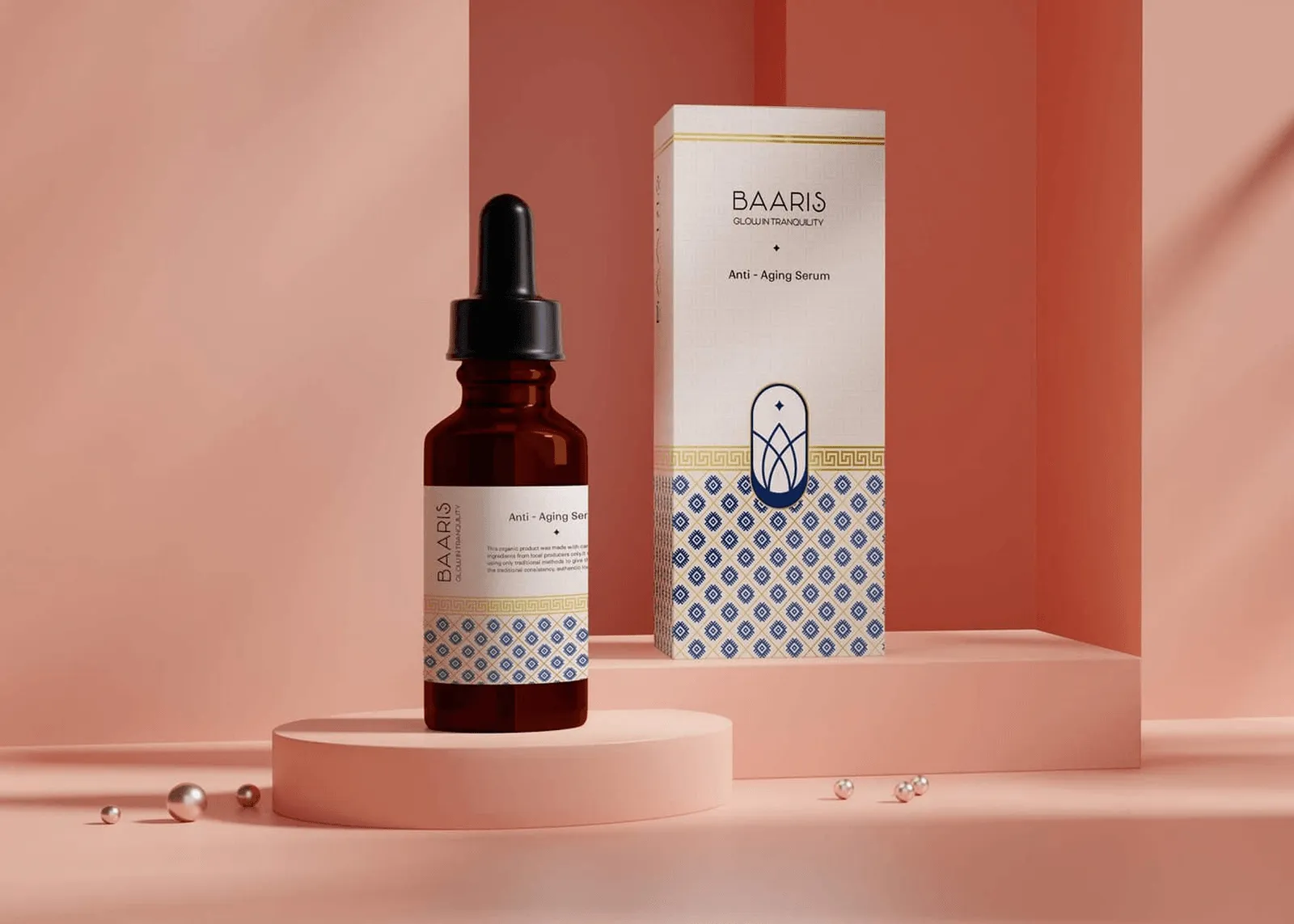
Confetti developed the brand identity for Baaris, a luxury skincare brand built around Turkish remedies. Thoughtful packaging design elevated the unboxing experience, turning each product reveal into a luxurious, sensory extension of the brand.
✨Design bilingual packaging from the start
For brands entering the UAE and wider Gulf, plan Arabic and English information together.
Allow enough space for both languages, establish a clear hierarchy and check how product names and brand elements appear in Arabic. Adding translated copy at the end often compromises readability and visual balance.
👉Check: Does every component feel like part of the same brand, from the bottle in the customer’s hand to the carton they open at home? Luxury packaging earns its place when material, function and presentation all support the product’s value.
Luxury skincare claims must withstand scrutiny from customers, retailers and regulators. Vague promises can weaken trust, while unsupported claims create legal and commercial trouble for your brand.
Every claim should have a clear purpose and evidence to support it.
✨Understand the requirements in each market
The EU benchmark
Commission Regulation (EU) No 655/2013 sets six criteria for cosmetic claims: legal compliance, truthfulness, evidential support, honesty, fairness and informed decision-making.
Claims must be accurate, supported by adequate and verifiable evidence, and consistent with what the evidence actually demonstrates.
Environmental claims also need careful review
Since 27 September 2026, the EU Empowering Consumers for the Green Transition Directive has applied.
This restricts generic environmental claims such as “eco-friendly” or “sustainable” when they lack qualifying substantiation. Terms such as “clean beauty” should not be used as vague environmental promises without appropriate support.
The UAE and Gulf markets
GSO 2528:2024 sets criteria for cosmetic and personal-care product claims across the Gulf standards framework. Claims must be truthful, supported and compliant with applicable requirements.
In Dubai, products making health or therapeutic-type claims may require review or approval by the relevant Dubai Municipality authority before being placed on the market. Confirm the applicable registration and claim-approval route for the specific product category and market.
✨Use fewer but stronger claims
A specific, substantiated benefit is more persuasive than a list of adjectives.
Claims such as “clinically proven” need relevant evidence; study details should be shared accurately when used to support the promise.
For a luxury brand, proof should reinforce confidence without overwhelming the design. Clear ingredient information, credible testing and carefully worded benefits are stronger foundations than exaggerated promises.
✨Build a claims matrix before designing the pack
Create one approved record for every product claim, covering:
👉Keep all channels consistent, including paid promotions and influencer content. A creator who exaggerates a product benefit can undermine the trust the brand has worked to establish.
Luxury skincare is discovered online and often validated through physical experience. Your website, retail environment, packaging and product information must work as one system.
A premium impression at one touchpoint cannot compensate for a poor experience at another.
✨Make the digital shelf work
At thumbnail size, packaging becomes a colour block, silhouette and product name. Fine typography and subtle finishes may disappear, so build recognition around at least one clear visual feature.
The product page must then answer the questions that packaging alone cannot.
Explain the product’s purpose, ingredients, substantiated benefits, texture and place in a skincare routine. Use clear product photography and straightforward navigation to make the buying decision easier.
For Celesti, Confetti designed a website that combines a dreamy, celestial visual direction with structured product grids and clear navigation.
The experience preserves the brand’s mood without making products difficult to explore.
✨Build trust before the purchase
Luxury prices can make customers more careful about what they buy.
Product pages should provide useful information, credible evidence and clear purchasing details rather than relying on atmosphere alone.
✨Make the physical experience match
In retail, customers can handle the pack, test the product and speak to an adviser. Bottle weight, closure quality, testers and consultation all contribute to perceived value.
Choose retail partners whose service and surroundings support your positioning. Consultation-led retail can help customers understand a product’s benefits and use, while authorised stockists give buyers greater confidence in authenticity.
✨Treat gifting and marketplaces carefully
Luxury gift sets, travel-retail exclusives and seasonal editions should feel like considered collections, not discounted bundles. Maintain the core brand’s visual codes while adapting the presentation for gifting.
If you sell through marketplaces, manage authorised distribution, pricing and product listings carefully.
Identify approved sellers on your own website and keep product information consistent across channels.
👉Whether customers discover the brand on a screen, encounter it in a store or receive it as a gift, the experience should reinforce the same promise of quality, efficacy and care.
The first question we ask a luxury skincare founder is not about the bottle. It is about the claim they are willing to defend.
The evidence behind the hero product, the target price and the markets where your brand will sell shape every design decision.
We first work and agree on positioning, substantiated claims and verbal identity. Then we plan the product range and price architecture before developing the visual identity, packaging, unboxing experience and digital touchpoints.
For existing brands, we begin by auditing what already works and where the system falls short.
Our projects reflect different approaches to luxury.
The design must fit the brand’s evidence and ambitions. Strong product proof can support a restrained identity; a brand still building credibility needs a clear, defensible story before investing heavily in packaging.
Building or repositioning a luxury skincare brand? Schedule a consultation with Confetti to define your positioning, claims and design direction before committing to production.
What is luxury skincare branding?
Luxury skincare branding is the work of making every part of a skincare brand consistent with a high price: the positioning, the claims and the evidence behind them, the range and price ladder, the packaging and unboxing, the retail and online presentation, and the way the brand handles discounts and service. If one touchpoint looks or behaves cheaper than the price, buyers notice the gap.
How do you make a skincare brand look luxury?
Start with a specific position and proof, not with gold foil and serif logos. Then make the physical product match the price: weight, closure, dispensing and finish. Keep the palette and typography restrained and consistent across the range, write specific claims you can support, and avoid constant discounting. Customers read a brand as luxury when every touchpoint agrees with the price.
What is the difference between luxury, premium and masstige skincare?
The difference is in what the price is asked to justify. Masstige brands sell an affordable step up from mass products. Premium brands compete on visible quality and efficacy at a higher price. Luxury brands sell a point of view, an origin or a ritual, with pricing, distribution and service controlled tightly. Each tier needs different packaging, claims and channels.
Should a luxury skincare brand offer discounts?
Rarely, and never as a habit. Frequent codes and countdown timers teach customers to wait for the next sale and undercut the price the brand is asking. Luxury brands tend to use gifts with purchase, sample sets, early access or replenishment benefits instead, which reward loyal buyers without publicly lowering the price.
Want strategic branding and packaging like this for your business?