%201.webp)
02
AI Snaps
.svg)
.svg)
01
Our Work
03
About Us
04
Brand Audit
05
Contact Us
06
Client Success
12
07
Blogs
08
Careers
Book A Call
.svg)



.svg)
Need Help In Building Your Brand?
Click the button below & book a call with our founder directly.

Rishabh Jain
Managing Director
Packaging design compliance issues can shut down your product overnight if you ignore them.
If your packaging does not follow Indian laws, your product can be fined, seized or banned from sale.
How packaging design compliance issues work and how to avoid costly mistakes. We are at Confetti to help brands design legally compliant packaging in India.
Packaging design compliance issues refer to legal problems caused when product packaging does not follow Indian regulations.
These regulations control labeling, safety warnings, recycling symbols and mandatory declarations.
If your packaging misses even one required detail, it becomes non-compliant.
Many brands focus only on aesthetics and forget legal packaging compliance.
That mistake can be expensive.
For brands working with Confetti Design Studio, compliance is the part of the packaging design process from day one.
India has strict packaging and labeling laws. Authorities regularly inspect retail shelves and warehouses.
If your product violates packaging regulations, it can be seized immediately.
Ignoring these authorities increases legal risk.
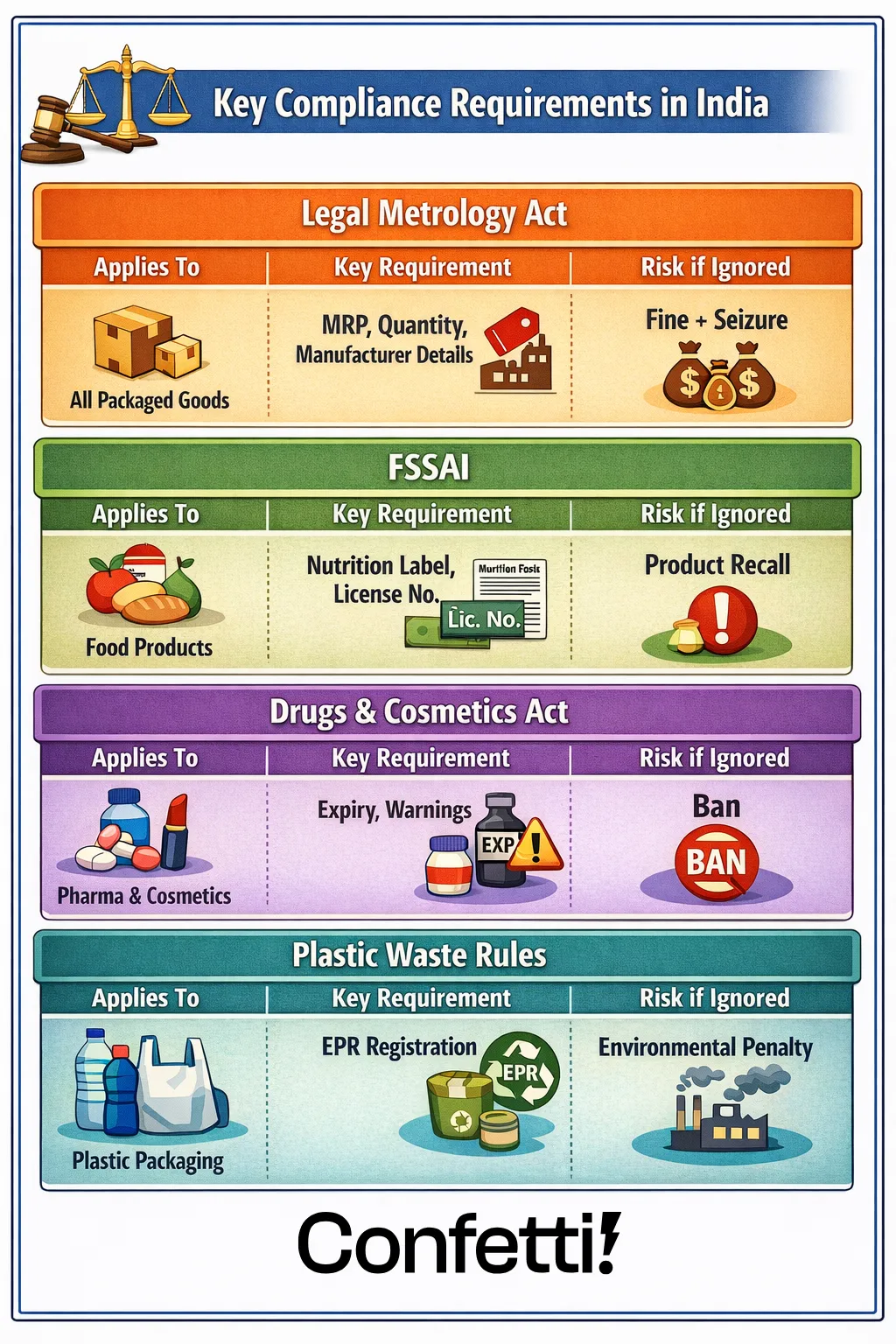
The Legal Metrology Act, 2009 controls packaged commodities in India.
It ensures consumers are not misled by packaging claims.
Your packaging must include:
If any of these are missing, it creates packaging design compliance issues.
Font size for MRP and quantity must follow prescribed guidelines.
Each industry operates under its own regulatory framework, labeling standards, and inspection norms.
What is compliant for one category may be illegal for another.
FMCG products are subject to frequent inspections due to high retail turnover and mass distribution.
Compliance errors in FMCG packaging are among the most commonly penalized violations in India.
Common FMCG Packaging Compliance Issues
Failure to maintain legibility and accuracy can result in fines, product seizure, or mandatory relabeling.
Professional service providers like Confetti Design Studio integrate compliance checks directly into artwork development to minimize regulatory risk before printing.
If your product falls under the food category, it must comply with regulations issued by the Food Safety and Standards Authority of India (FSSAI).
Food labeling laws in India are strict and highly detailed. Any error in packaging design can lead to penalties, product recall, or legal notices.
Mandatory Labeling Requirements Under FSSAI in Food packaging include:
Incorrect size, color, or placement of the green or brown symbol is a serious compliance violation.
Additionally, misleading claims such as “100% Natural” or “Sugar-Free” without substantiation can invite regulatory action.
If your product is a cosmetic or personal care item, it must comply with the Drugs and Cosmetics Act 1940 and related rules governing labeling and safety disclosures.
Cosmetic packaging errors can result in product seizure, sales bans or regulatory notices.
Cosmetic packaging must include:
Claims such as “Chemical-Free,” “Dermatologist Approved,” or “Clinically Proven” without proper substantiation can lead to legal complications.
If your product is a pharmaceutical drug or medicinal formulation, it must strictly comply with the Drugs and Cosmetics Act 1940 and associated labeling rules.
Pharma packaging is highly regulated, and even minor deviations can result in product recall or complete sales prohibition.
Pharmaceutical packaging must include:
Improper warning placement or missing red box warnings for prescription drugs is a serious offense.
Read more about Nutraceutical Packaging Design: Guide for DTC Supplement Brands + Examples
If your product uses plastic packaging, it must comply with the Plastic Waste Management Rules 2016 and Extended Producer Responsibility (EPR) requirements issued by the Central Pollution Control Board.
Non-compliance can lead to environmental penalties and restrictions on sale.
Plastic packaging must ensure:
Brands without valid EPR registration risk monetary penalties and operational restrictions.
Sustainable packaging is growing rapidly, but environmental claims are now under strict regulatory scrutiny.
If your product uses eco-friendly, compostable, or biodegradable packaging, it must comply with the Plastic Waste Management Rules 2016 and certification norms issued by the Central Pollution Control Board.
Many brands promote packaging as “eco-friendly” or “100% biodegradable.” However, making such claims without valid certification creates serious legal exposure.
Greenwashing is increasingly becoming a regulatory focus area in India.
False or exaggerated environmental claims can result in penalties, product scrutiny, and brand reputation damage.
To avoid sustainable packaging compliance issues:
False sustainability claims can trigger consumer complaints, regulatory investigation, and enforcement action.
Proper verification at the design stage ensures your sustainable packaging is legally defensible — not just visually appealing.
We started Confetti because we saw too many great products fail—not because they lacked design, but because they missed compliance. For us, packaging isn’t just about how it looks, it’s about whether it can legally survive in the market.
Every time we design a label, we ask ourselves one question: will this pass an inspection tomorrow? That mindset is what drives everything we do at Confetti—from the first layout to the final print.
— Rishabh Jain, Founder, Confetti Design Studio
These are the packaging errors that most often lead to inspection failures, penalties, and brand damage:
Law Applied: Legal Metrology Act 2009
Issue: MRP not printed, overwritten with a sticker, or shown in wrong format (e.g., missing “Inclusive of all taxes”).
Example Scenario: Retail inspectors routinely seize products where MRP is covered with a secondary sticker. Several FMCG brands have faced fines during state-level inspection drives for this exact issue.
Issue: Net quantity, MRP and manufacturer details printed too small to meet prescribed height requirements.
Example: A small D2C spice brand had to reprint 20,000 pouches because the net weight font size did not meet Legal Metrology specifications.
Issue: Only city name mentioned instead of full postal address.
Example: Imported cosmetic kits were stopped at customs due to incomplete importer address details.
Authority: Food Safety and Standards Authority of India
Issue: Expired license number or incorrect formatting.
Case Pattern: Food businesses have received show-cause notices when the FSSAI number on packaging did not match the registered entity.
Issue: Incorrect color shade, wrong size or poor visibility.
Common Rejection Scenario: During supermarket audits, products are removed if the green/brown dot is not compliant.
Issue: “Contains peanuts” or “Contains milk solids” not declared clearly.
Risk: Consumer complaint leading to regulatory scrutiny.
Issue: “100% Natural,” “Zero Side Effects,” “Clinically Proven” without evidence.
Regulatory Focus: Environmental and health claims are increasingly monitored by consumer authorities.
Scenario: A herbal tea brand was forced to withdraw “Boosts Immunity” claim due to lack of scientific backing.
Law Applied: Drugs and Cosmetics Act 1940
Issue: Smudged expiry, incorrect format or missing batch number.
Pharma Scenario: Entire batch recall due to unreadable batch number during audit.
Issue: Writing “500gms” instead of “500 g” or wrong rounding format.
Common in: Small FMCG startups using outdated templates.
Issue: Mandatory for imported goods and e-commerce.
Scenario: Products delisted from marketplaces until compliant stickers were applied.
Regulation: Plastic Waste Management Rules 2016
Issue: No valid EPR registration number linked to packaging.
Real Pattern: Brands have received environmental compensation notices for non-compliance.
Issue: Using “Organic,” “ISI,” or Compostable logos without approval.
Example: Small food brands often misuse organic-style icons without certification.
Issue: Ink fading, peeling labels, or smudging.
Retail Rejection Scenario: Products rejected by modern trade stores because mandatory details became unreadable.
Issue: Shelf-life printed without stability testing.
Food Audit Scenario: Product withdrawn after lab testing showed mismatch.
Issue: Different ingredient lists across sizes of the same product.
Risk: Consumer confusion and compliance questioning.
Issue: Imported products covered with local stickers that hide original declarations.
E-commerce Risk: Account suspension until corrected.
Regulation: Consumer Protection E-Commerce Rules 2020
Issue: Missing customer care contact details.
Issue: Imported product repackaged locally but labeled incorrectly.
Issue: Barcode scans different product than printed description.
Retail Impact: Inventory rejection by large retail chains.
Issue: No “Store in a cool & dry place” or temperature warning.
Risk: Product degradation + liability exposure.
Issue: “Extra 20% Free” sticker hiding mandatory declarations.
Inspection Reality: Products seized during festive audit drives.
Why Should Brands Worry About Packaging Design Compliance IssuesMost packaging compliance failures happen because compliance is treated as an afterthought, not as part of the design process.
In reality, issues arise when:
The result? Costly reprints, inspection penalties, marketplace delisting, and reputational damage.
That’s exactly why compliance-integrated packaging design is a risk management necessity.
A design that cannot survive regulatory scrutiny is a business risk, not an asset.
Packaging is not just a branding surface it is a legal document.
Design teams typically focus on aesthetics, hierarchy, typography, and shelf impact.
Regulations, however, focus on statutory declarations, font size rules, placement requirements, contrast ratios, mandatory symbols, and disclosure formats.
When compliance is treated as an afterthought, problems begin:
The result is not just “bad design.”
It leads to reprinting costs, delayed product launches, unsellable inventory, distributor rejection, and in some cases, regulatory penalties.
Effective packaging design integrates compliance at the concept stage — not after artwork is finalized.
When design and compliance work together from day one, brands avoid costly revisions and build packaging that is both visually compelling and legally secure.
Compliance is not a final-stage correction — it is a structured process. A disciplined workflow prevents costly redesigns and regulatory exposure.
When compliance is embedded early into layout planning, the risk of fines, recalls and reprinting drops significantly.
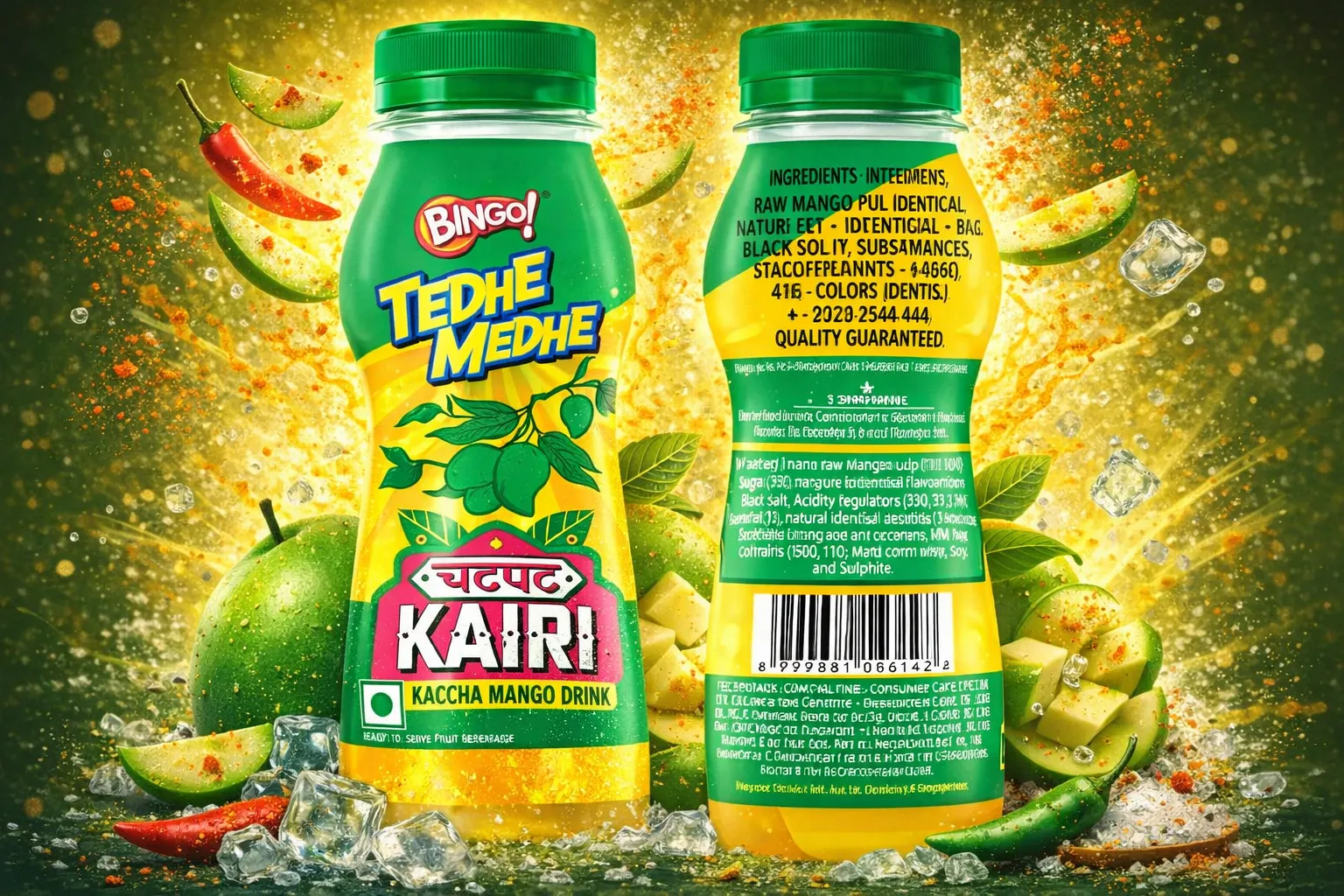
This layout demonstrates structured placement of statutory declarations within predefined compliance zones, not leftover spaces.
Typography hierarchy, minimum font size requirements and contrast standards are maintained to ensure readability under regulatory inspection.
When labels are overcrowded or declarations are compressed to accommodate marketing elements, the risk shifts from design compromise to legal exposure.
Startups move fast, regulators do not.
Early-stage brands prioritize speed to market, investor pressure, and rapid SKU launches. In that urgency, packaging often gets finalized before regulatory validation.
Compliance becomes a correction stage instead of a planning stage — and that’s where problems begin.
When compliance is treated as an afterthought, packaging design compliance issues surface quickly — often after the product is already in distribution.
1. Misleading Claims in Food & FMCG
Several startups in the D2C space have received notices from the Food Safety and Standards Authority of India (FSSAI) for using terms like “100% Natural” or “Immunity Booster” without sufficient scientific backing.
In some cases, brands were required to modify packaging and marketing communication.
2. Country of Origin & E-commerce Violations
After regulatory scrutiny increased in 2020–2021, many online sellers were penalized for missing “Country of Origin” declarations under the Legal Metrology Act 2009 and Consumer Protection E-Commerce Rules 2020.
Several listings on platforms like Amazon India were temporarily removed.
3. EPR Non-Compliance in Plastic Packaging
Multiple emerging FMCG brands faced operational restrictions for not obtaining proper EPR registration under the Plastic Waste Management Rules 2016 before distributing plastic-packaged products.
Startups don’t fail because they lack creativity.
They struggle because compliance structure is missing during early growth.
Investing in structured packaging design and compliance planning at the beginning prevents reprints, penalties, marketplace delisting, and launch delays — protecting both capital and credibility.
At Confetti Design Studio, we work with emerging brands to embed compliance intelligence directly into the packaging development process.
Instead of correcting errors after printing, we structure layouts, claims, and statutory zones from the concept stage itself — allowing startups to scale faster without regulatory friction.
Ignoring packaging design compliance is not a minor oversight — it is a commercial risk.
In India, regulatory authorities conduct routine inspections across retail shelves, warehouses, and distribution channels.
Non-compliant packaging can trigger immediate enforcement action, disrupting sales and damaging brand credibility.
Potential Consequences of Non-Compliance
Beyond fines, the larger cost is operational disruption — halted distribution, strained retailer relationships, and loss of consumer trust.
Compliance is not just about avoiding penalties. It is about ensuring uninterrupted market access.
Non-compliant packaging does not result in a single uniform penalty — consequences vary based on the nature and severity of the violation.
Even small errors like incorrect font size can trigger action.
That is why packaging design and compliance must work together from the start.
For brands working with Confetti Design Studio, compliance checks can be integrated during the artwork phase to reduce these risks.
Packaging design compliance is not a creative afterthought — it is a pre-print control system.
Use this structured checklist before approving any artwork for production.
Environmental enforcement in India is tightening every year. Non-compliance can result in operational restrictions, not just fines.
If anything appears ambiguous, compressed, or overstated — correct it before dispatch.
At Confetti Design Studio, compliance mapping is integrated into the layout planning stage — ensuring packaging is structured, legally defensible, and production-ready without clutter.
Packaging compliance in India is no longer static — regulations are evolving rapidly with technology, environmental priorities, and stricter enforcement mechanisms.
Indian packaging laws are becoming more data-driven, traceable, and enforcement-focused.
Brands that fail to anticipate these changes may face operational disruption.
Key emerging trends include:
Regulatory bodies such as the Food Safety and Standards Authority of India and other enforcement authorities are increasingly adopting digital monitoring mechanisms.
Brands that adapt early — by integrating compliance into their packaging design workflow — avoid last-minute redesigns, penalties, and market disruptions.
Proactive compliance is becoming a competitive advantage, not just a legal necessity.
Here’s a refined, professional, and authoritative version for your website:
What is mandatory on product packaging in India?
Manufacturer details, MRP, net quantity, date (MFG/EXP), batch number, and customer care info are required.
Food products must also include FSSAI license, nutrition table, ingredients, allergens, and veg/non-veg symbol.
Is Hindi labeling compulsory in India?
English is mandatory in most cases. Hindi may be required for certain categories or states—bilingual labeling is safer for nationwide sales.
What happens if packaging is non-compliant in India?
Fines, product seizure, recalls, delisting, or even license suspension in serious cases.
Do startups need packaging compliance in India?
Yes. No exemptions—startups and small businesses must comply just like large brands.
What are EPR rules in India?
EPR requires brands to manage plastic waste from packaging. Non-compliance can lead to penalties and operational restrictions.
Want strategic branding and packaging like this for your business?





.webp)
.webp)

.webp)
.webp)
.webp)
.webp)
.webp)







.svg)
.webp)