%201.webp)
02
AI Snaps
.svg)
.svg)
01
Our Work
03
About Us
04
Brand Audit
05
Contact Us
06
Client Success
12
07
Blogs
08
Careers
Book A Call
.svg)



.svg)
Need Help In Building Your Brand?
Click the button below & book a call with our founder directly.

Rishabh Jain
Managing Director
Packaging design delayed product launch is a problem you only truly notice when everything else is ready and your product still cannot ship.
The team is excited, aligned your marketing, locked your launch date and briefed your sales teams. Then the packaging stalls.
Suddenly, your entire go to market plan is pushed back by something that should have been predictable.
We at Confetti Design Studio help you understand why packaging design becomes a hidden bottleneck, what causes these delays.
And how you can build a process that keeps your launch on track.
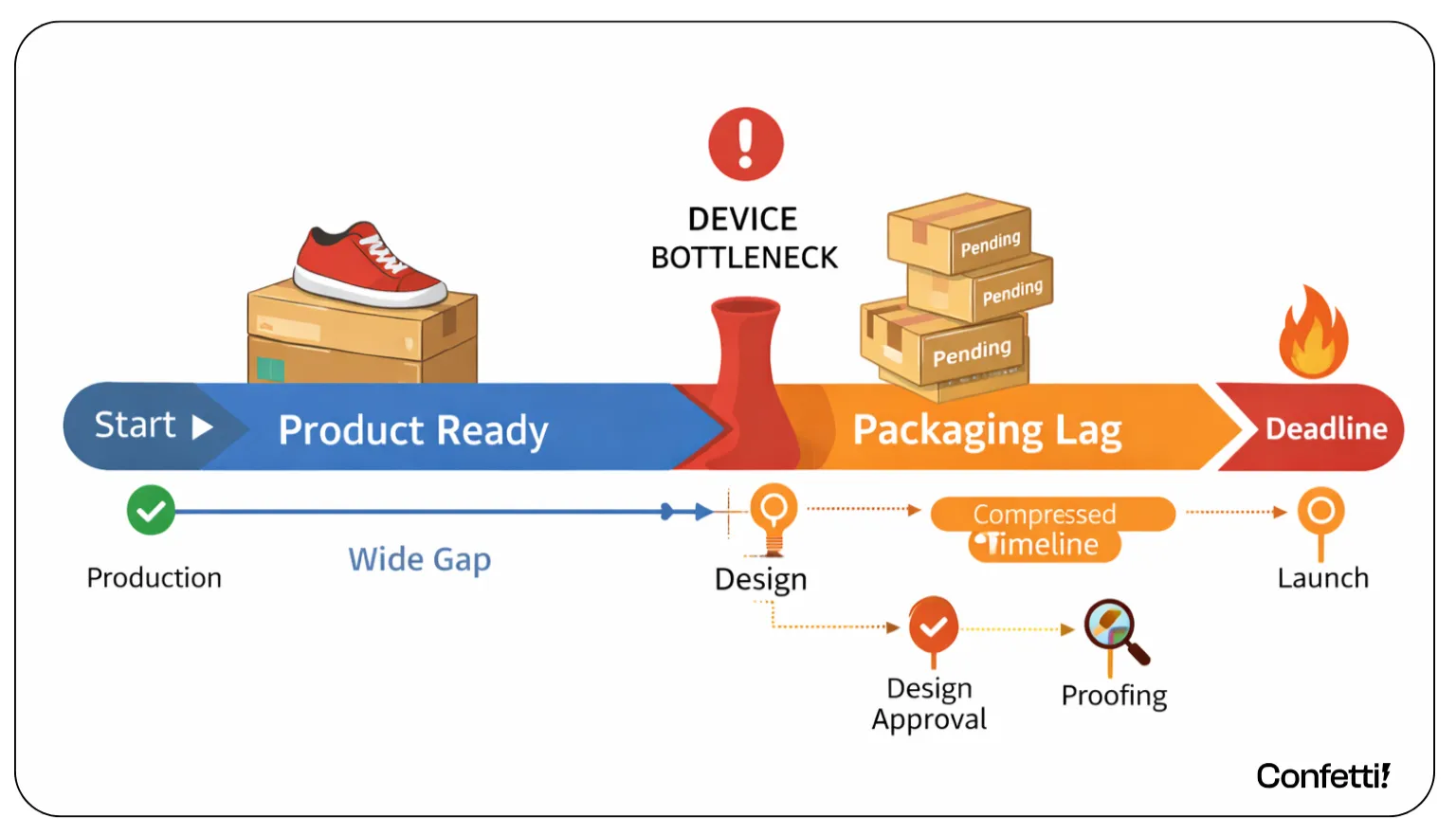
You might assume that production or logistics are the biggest risks to your launch timeline. In reality, most delays begin much earlier, during design and approval stages.
Most packaging delays happen upstream, not on the factory floor. When you treat packaging design as the final step after product development, you compress multiple complex stages into a very short window.
Design, approvals, regulatory checks, supplier coordination and print production all get stacked at the end.
This creates a domino effect. Late artwork handoffs delay printer scheduling. Missed proofing windows push production slots.
Retail deadlines are lost not because manufacturing failed, but because packaging was not ready in time.
The real issue is structural. Packaging is often seen as a creative output, not a technical and operational workflow. In reality, it sits on the critical path of your entire launch.
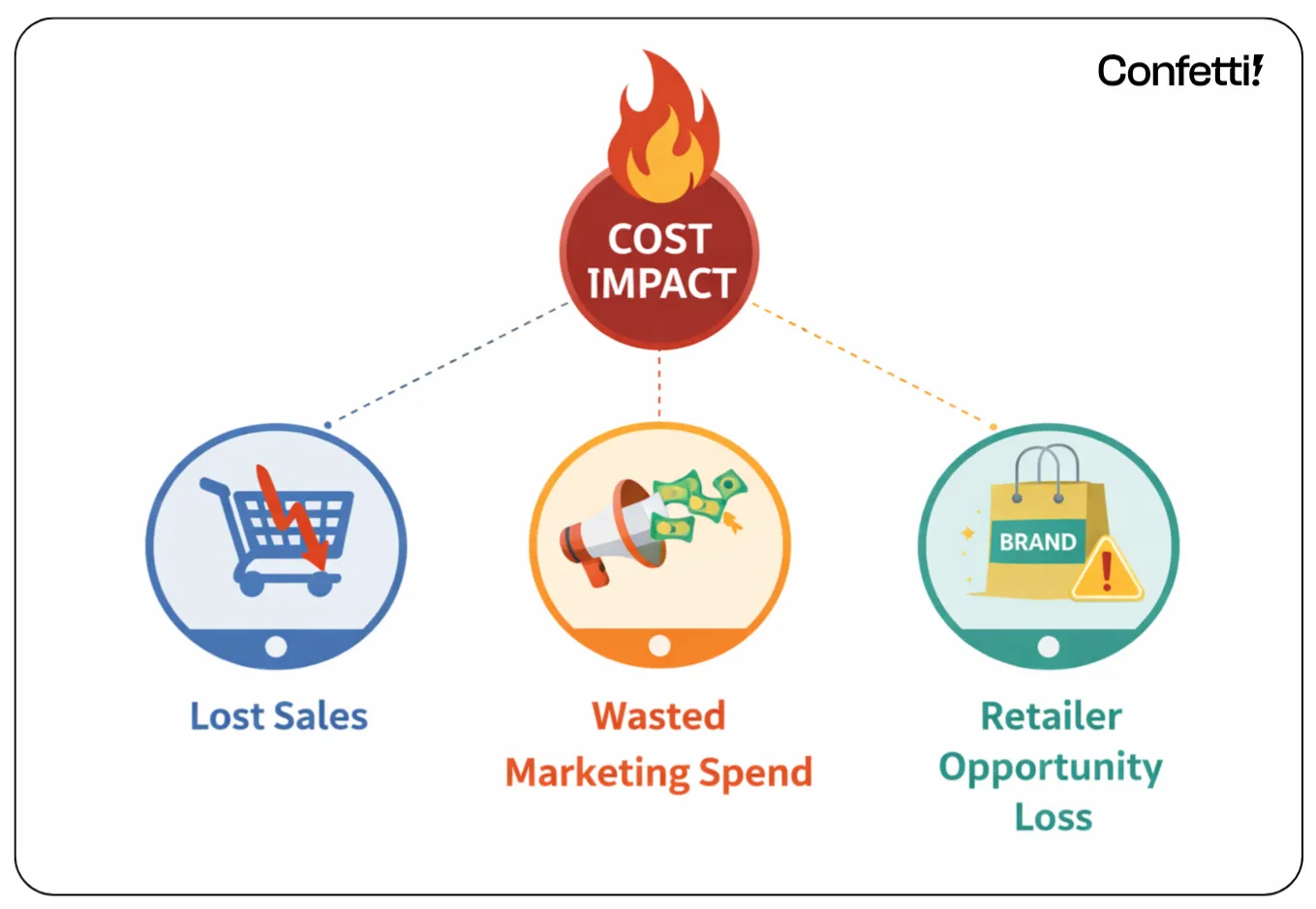
When packaging delays your launch, the impact goes far beyond a missed date.
You lose revenue when seasonal windows are missed. A festive or promotional launch that arrives late is often irrelevant by the time it hits shelves.
Retailers may allocate your shelf space to competitors if you cannot deliver on time. Marketing campaigns go live without product availability, wasting budget and weakening impact.
There is also a longer-term cost. Buyers remember missed commitments. Your brand begins to look unreliable, even if the issue was internal.
Understanding the causes of delay is the first step to preventing them.
Most delays are not caused by one major issue, but by small gaps across design, approvals and production that build up over time.
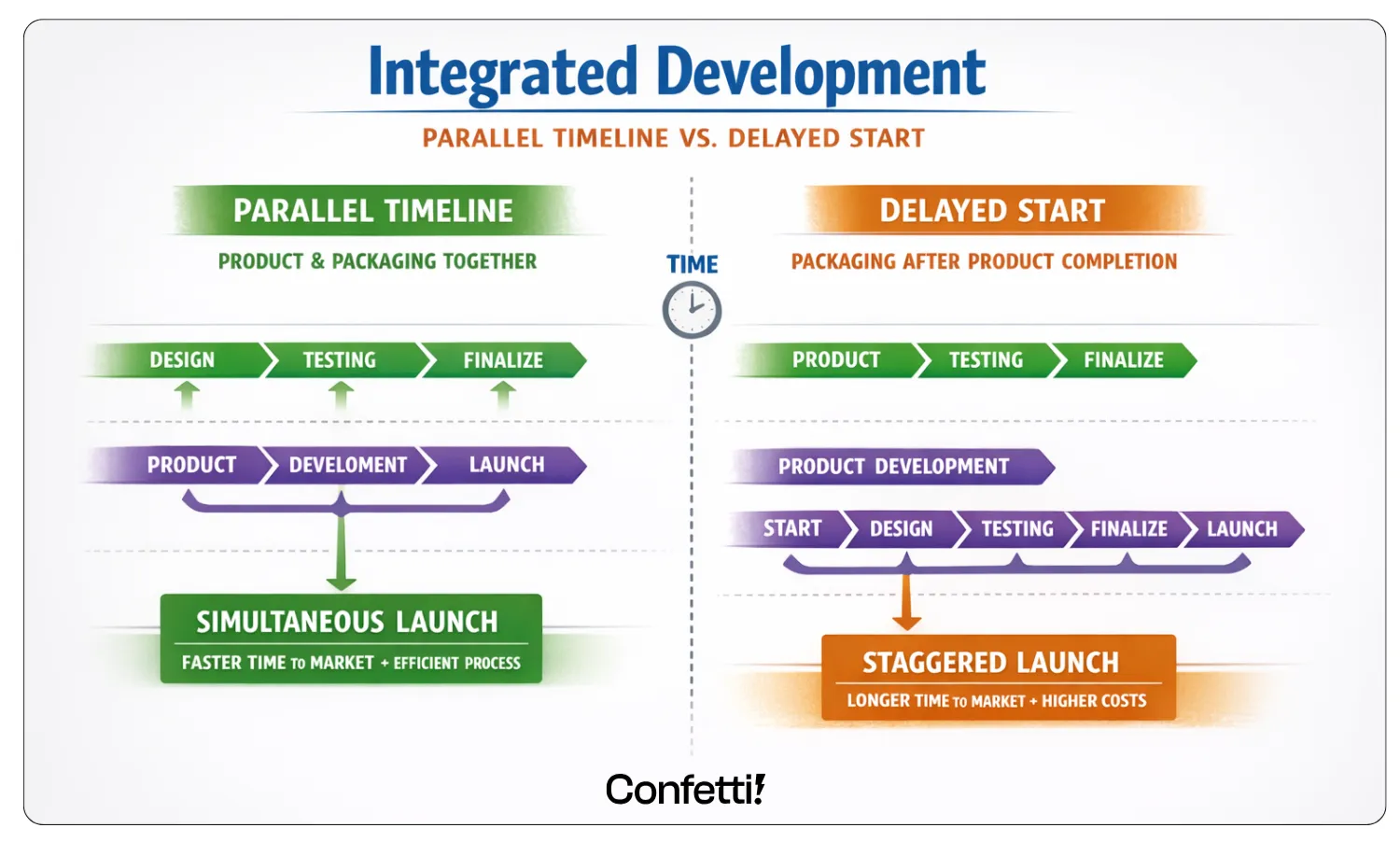
One of the most common and costly mistakes you can make is starting packaging only after your product is fully developed.
On paper, this may seem efficient. In reality, it compresses a complex, multi stage process into a very short window.
Packaging design is not just about visuals. It involves structural decisions, material selection, regulatory content, print specifications, and supplier alignment.
When all of this begins late, every stage becomes time sensitive. Design concepts are rushed, approvals are delayed, and production timelines become unrealistic.
The smarter approach is to treat packaging as a parallel workstream. When you start early, even with rough concepts, you create alignment across teams.
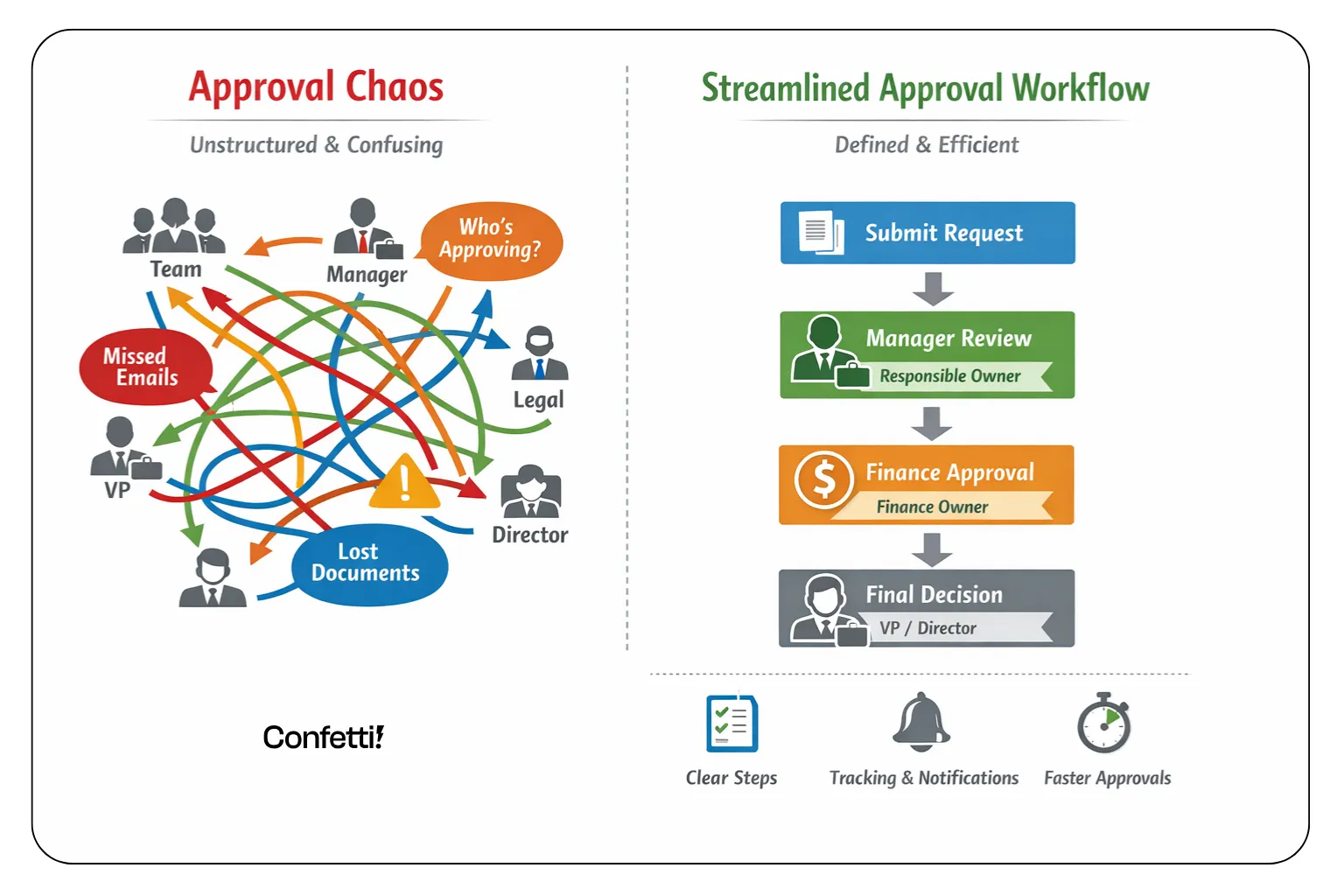
Approval delays are one of the most underestimated causes of packaging bottlenecks.
In many organisations, packaging files move across multiple stakeholders including brand, marketing, legal, regulatory, and supply chain.
Without a clear structure, this process becomes chaotic.
You may find yourself dealing with overlapping feedback, conflicting inputs and repeated revision cycles.
One stakeholder approves a version while another raises new concerns. Feedback comes in at different times, often without context.
As a result, the design team keeps reworking files instead of moving forward.
To fix this, you need a structured approval workflow. Every stage should have a clear owner who is responsible for sign off.
Feedback should be consolidated rather than scattered. Timelines should be defined so that reviews happen within a set window, not indefinitely.
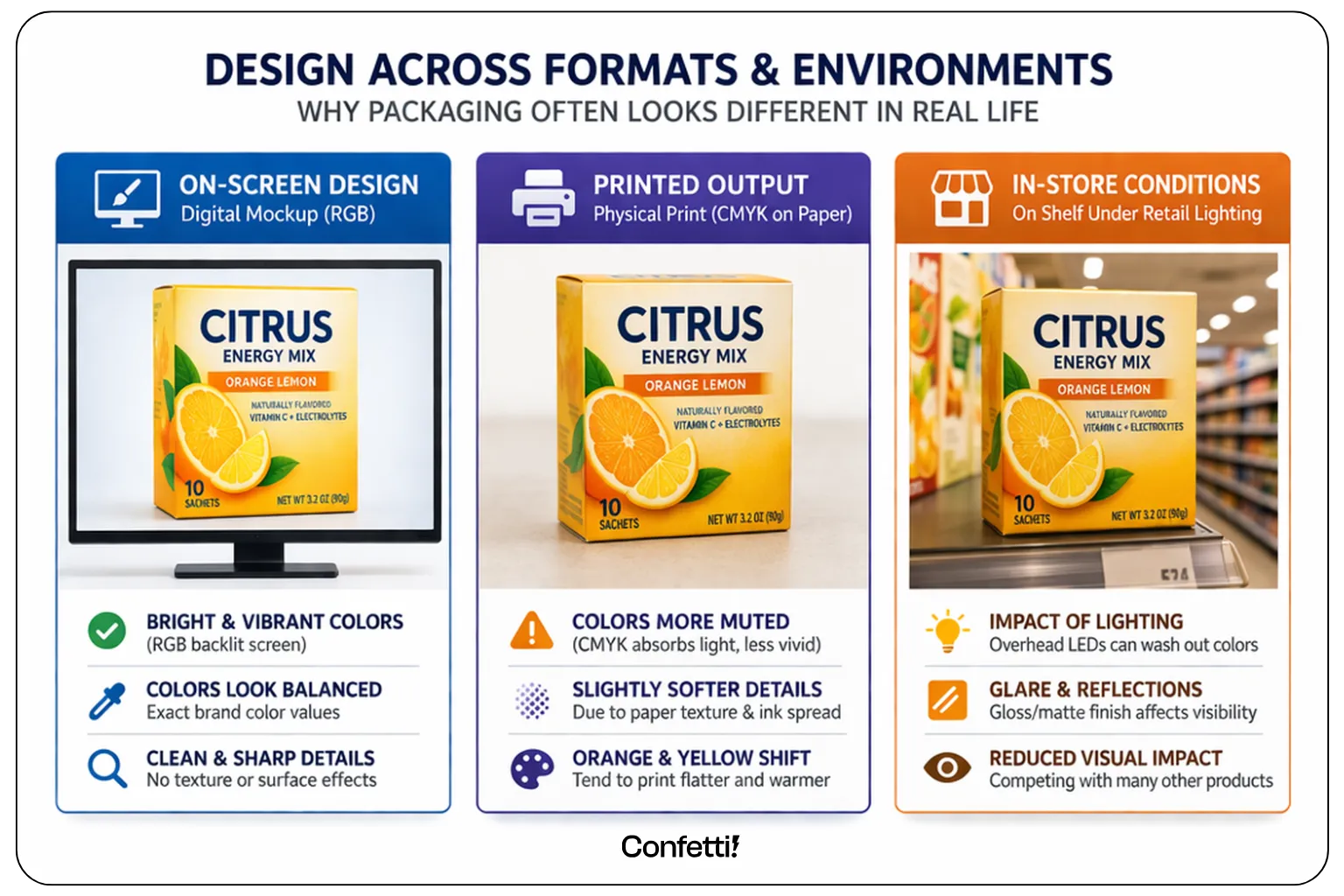
Packaging often looks perfect on screen but fails to deliver in print. This is because digital design and physical production operate under very different conditions.
Colours that appear vibrant on your monitor may shift when printed due to ink limitations, substrate differences and lighting conditions in retail environments.
Finishes such as matte, gloss or metallic behave differently depending on the material used. Small variations in print settings can significantly impact the final output.
When these issues are discovered late, they are expensive and time consuming to fix. You may need multiple rounds of proofing, or in some cases, a complete reprint.
The key is to address colour and print considerations early in the process. Establishing colour standards at the beginning ensures consistency across batches.
Using pre production proofing methods allows you to simulate how the packaging will look in real world conditions before you commit to production.
Packaging is deeply dependent on external partners. Printers, material suppliers and packaging manufacturers all operate on their own schedules and these schedules are often longer than expected.
Lead times can vary based on material availability, machine capacity, and order volumes. Special finishes, custom structures or imported materials can further extend timelines.
If suppliers are brought in late, you may find that your preferred production slot is no longer available.
The solution is early engagement. When you involve suppliers at the design stage, you gain visibility into realistic timelines and constraints.
Packaging is not just design. It is also data. Product information, regulatory text, barcodes, SKU details, and legal requirements all need to be accurate and consistent.
When this information is managed across multiple documents or teams, errors become inevitable.
You may end up with outdated copy, incorrect claims, or missing details. These issues are often discovered during final checks, when timelines are already tight.
At this stage, even small corrections can cause major delays. Artwork needs to be revised, approvals need to be repeated and production schedules may be pushed back.
A centralised content management approach helps prevent this. When all packaging data is stored and managed in one place, you reduce the risk of inconsistencies.
Teams work from a single source of truth, and updates are reflected across all assets.
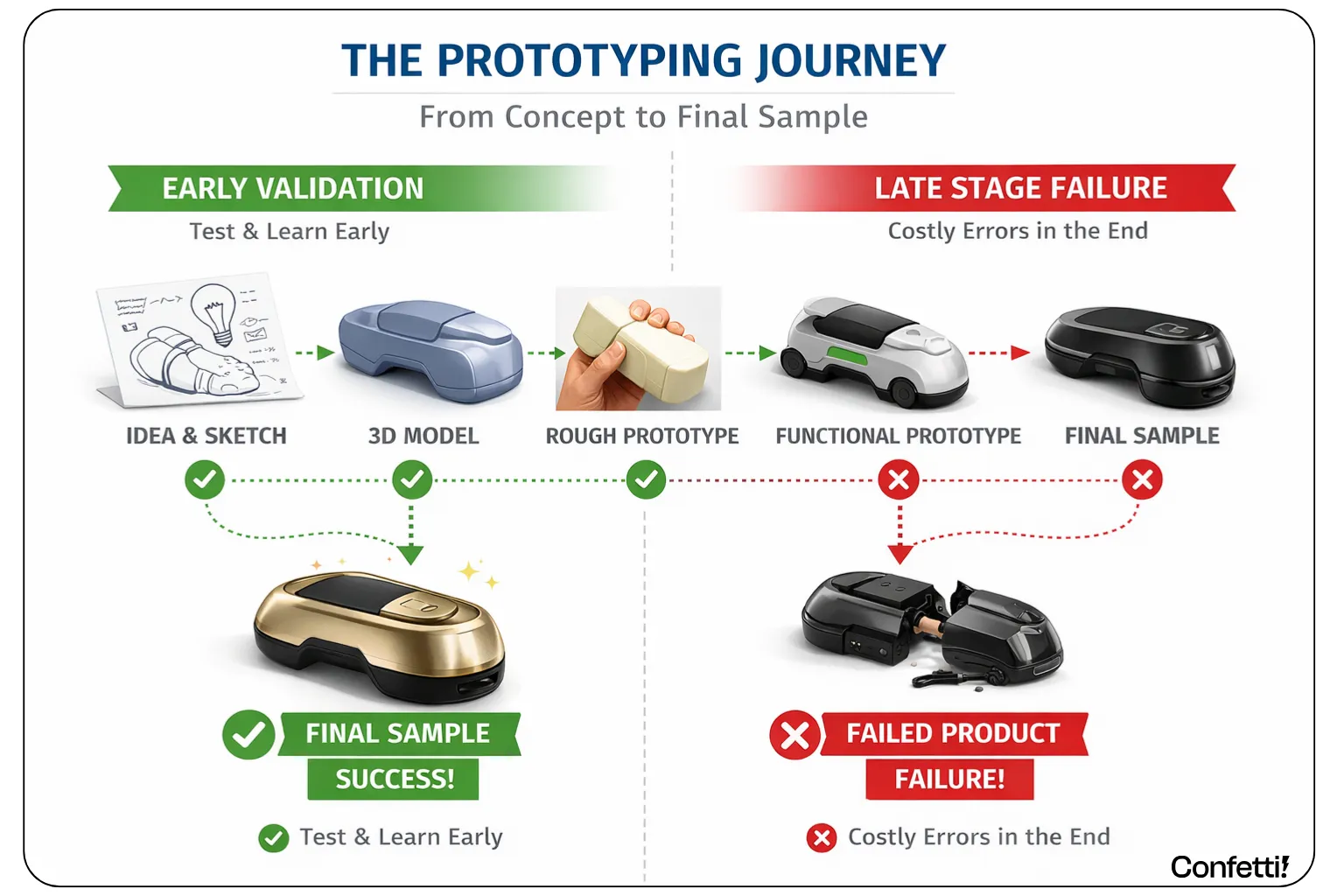
Prototyping is where your packaging moves from concept to reality. It is your opportunity to test structure, usability, durability, and visual appeal before committing to production.
When prototyping is delayed, problems surface too late. You may discover that the structure is not practical, the material does not perform as expected.
The design does not translate well physically. Fixing these issues at the final stage is both costly and time consuming.
The better approach is to integrate prototyping earlier in your timeline. Early samples allow you to validate assumptions, test performance and refine details without pressure.
A structured timeline is your strongest defence against delays because it brings clarity, accountability, and predictability to every stage of your packaging process.
When you define each milestone in advance and work backwards from your launch date, you remove guesswork and ensure that design, approvals and production are aligned from the beginning.
This allows you to identify risks early, allocate realistic time to each stage, and avoid last minute bottlenecks that can push your launch off track.
You should always start with a fixed launch date and work backwards through every packaging milestone. This ensures that each stage has enough time and that dependencies are clear.
You need to identify where delays are most likely to occur. Approval gates, supplier dependencies, and quality checks are common risk points.
Adding buffer time for regulatory changes and assigning clear ownership to each milestone ensures accountability.
Packaging should move alongside product development, not after it. Cross functional alignment between marketing, supply chain, regulatory, and design teams is essential.
Regular check-ins help ensure that packaging stays on track as product decisions evolve.
You might have the right team, a strong brief and a clear launch date, yet packaging still slows you down.
This usually happens because small execution gaps appear between design, approvals and production, and they add up quickly.
At Confetti Design Studio, you are not just getting design. You are getting a process built around your launch timeline. From the start, the focus is on creating print ready artwork, not just something that looks good on screen.
This means what you approve is what actually gets produced, without last minute surprises.
You also benefit from structured workflows that reduce back and forth and keep everyone aligned.
of endless revisions, you move forward with clarity at each stage. With experience across retail, DTC, and ecommerce, your packaging is designed with real world constraints in mind, including supplier timelines and production realities.
You can significantly reduce delays by following a few disciplined practices:
If your packaging is already causing delays, the priority is to act quickly and make focused decisions instead of trying to fix everything at once. The goal is not perfection at this stage, but getting your product to market without damaging relationships or timelines further.
You first need to identify exactly where the delay is happening.
You should look closely at whether the issue is in approvals, supplier timelines, print errors, or missing content. Each of these requires a different solution.
Without this clarity, you risk spending time fixing the wrong problem while the actual bottleneck remains.
A quick internal audit with all stakeholders aligned on the current status helps you pinpoint the exact stage where things are stuck and what is needed to move forward.
Once you know the problem, you should shift to practical solutions that help you recover time. Fast turn digital printing can act as a short term fix to get initial stock ready.
If timelines are tight, you can simplify your packaging by launching with a hero SKU instead of the full range.
In some cases, temporary solutions like labels or overlays on existing packaging can help you enter the market while final packaging is being completed.
These approaches are not ideal for the long term, but they allow you to avoid missing your launch window entirely.
You should not wait for the delay to become visible externally. Inform your retail and distribution partners early and clearly.
When you communicate a revised timeline along with a recovery plan, you maintain trust and show control over the situation.
Silence creates uncertainty, but proactive communication positions you as reliable even when things do not go exactly as planned.
Q1: How long does packaging design take for a product launch?
A: It typically takes 12 to 20 weeks from brief to print ready artwork, depending on complexity, SKUs, and approvals. Starting early improves your chances of hitting launch timelines.
Q2: What is the most common reason packaging delays a product launch?
A: Treating packaging as a final step. This compresses design, approvals, and production into a short window, making delays likely.
Q3: How can I speed up my packaging design process?
A: Start earlier and run packaging alongside product development. Use clear approval ownership and align print specs with suppliers upfront.
Q4: Can poor packaging design affect product launch revenue?
A: Yes. Missing a launch window or shelf space can lead to lost sales and weaker retailer relationships.
Q5: What is packaging postponement and is it a good strategy?
A: It means delaying final packaging to the last stage. It can add flexibility, but only works with strong planning and reliable suppliers.
Q6: How do I brief a packaging designer to avoid delays?
A: Include audience, messaging, brand guidelines, technical specs, regulatory needs, launch date, and SKUs. A clear brief reduces revisions and saves time.
Want strategic branding and packaging like this for your business?





.webp)
.webp)

.webp)
.webp)
.webp)
.webp)
.webp)







.svg)
.webp)