%201.webp)
02
AI Snaps
.svg)
.svg)
01
Our Work
03
About Us
04
Brand Audit
05
Contact Us
06
Client Success
12
07
Blogs
08
Careers
Book A Call
.svg)



.svg)
Need Help In Building Your Brand?
Click the button below & book a call with our founder directly.

Rishabh Jain
Managing Director
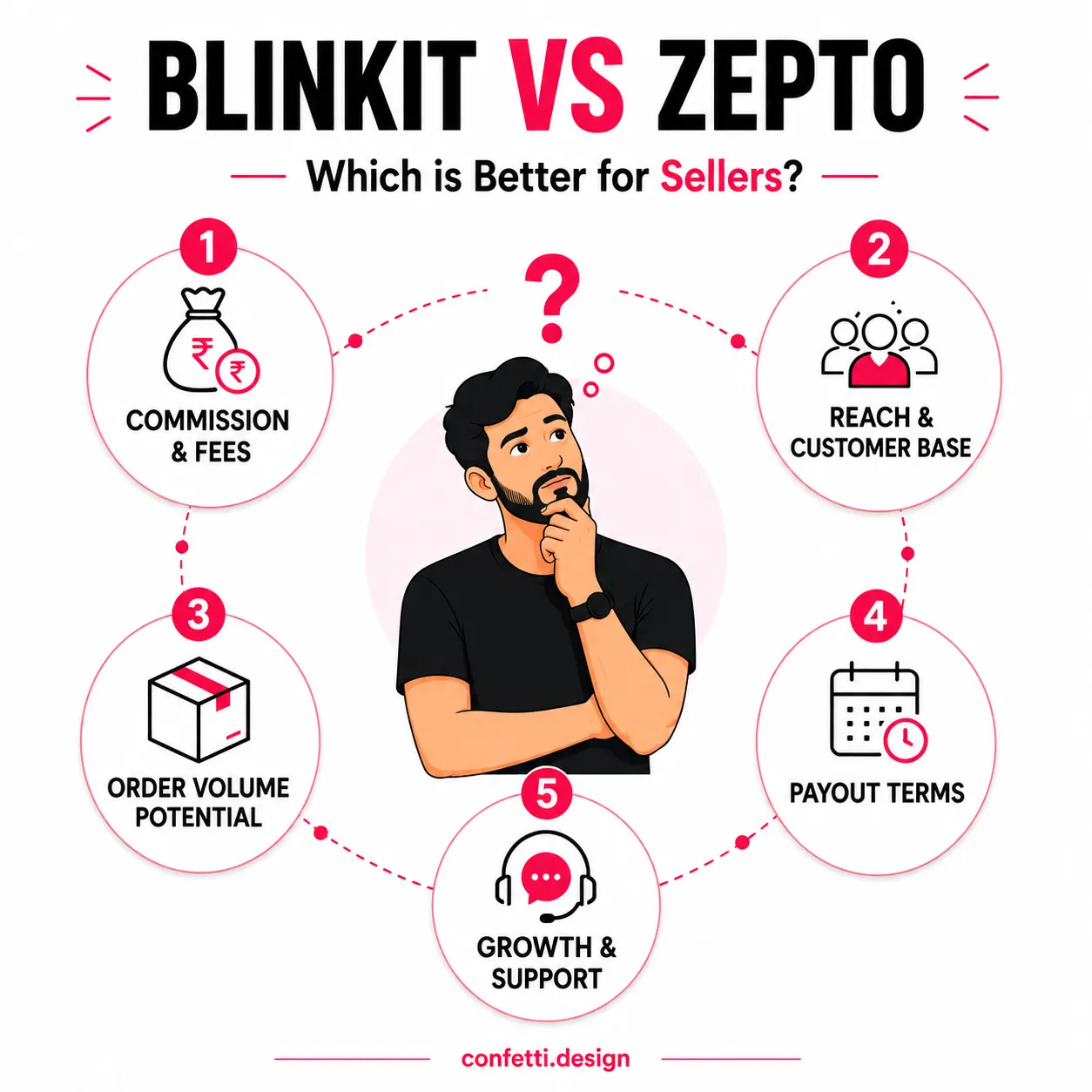
Blinkit Vs Zepto can be a tough choice for sellers wanting to explore quick commerce for the very first time.
For sellers, the question is which one to prioritise, what it will actually cost, and whether your brand is structurally ready for the channel before you spend on listing fees.
This guide covers all of it, so you can make that decision by choosing the correct quick commerce platform i.e. Zepto or Blinkit for your brand.
Quick commerce now accounts for over two-thirds of all e-grocery orders in India, a number that was effectively zero five years ago.
This structural shift in how urban India shops for daily essentials has permanently changed the calculus for any FMCG or D2C brand thinking about distribution.
Here’s why:
✔️Blinkit holds 45% of India's quick-commerce market and Zepto holds 29%. For a brand entering q-commerce today, Blinkit and Zepto are the two most compelling platforms.
✔️By FY25, both Blinkit and Zepto crossed ₹1,000 crore in ad revenue. For sellers, visibility now depends as much on ad spend as commissions.
Add storage, warehousing, and delivery fees, and these platforms retain nearly 30–35% of the selling price, a number worth considering before you list.
Unless your pricing already accounts for q-commerce costs. Brands that treat Blinkit or Zepto like a normal sales channel, without reworking pricing, pack sizes, or margins, often end up moving volume without making money.
✔️The infrastructure gap matters too. Blinkit currently operates around 2,100+ dark stores, while Zepto and Instamart each have approximately 1,100+.
📌None of this means you shouldn't be on both platforms. But listing on all quick commerce platforms by default, before understanding the cost structure of each, is one of the most expensive mistakes a brand can make in quick commerce right now.
Here's where both the platforms stand on the parameters that are most important to sellers. Use this as a starting reference.
The right platform for your brand depends on your category, margin structure, and where your target customer actually shops.

Talk to Confetti experts about creating high-converting assets for Zepto and Blinkit.
!
Book A Call
A platform with a larger share has more active buyers, more dark stores fulfilling orders, and more opportunities for your SKU to convert.
Blinkit currently holds around 45% of India's quick commerce market.
Blinkit's lead is structural, it comes from having the densest dark store network in high-order-frequency metros, deep integration with Zomato's existing user base, and a head start on operational efficiency.
Zepto's 29% share understates its actual competitive strength in specific cities and demographics.
In Mumbai, Bengaluru, and Hyderabad, Zepto's dark store concentration in younger, urban micro-markets gives it a disproportionate presence among the 22–32 age group.
📌On Blinkit, that geographic coverage advantage is real and consistent across Tier 1 metros. Zepto's coverage is strong in its priority cities but thinner in secondary markets.
For sellers, it determines stock proximity to buyers, SLA reliability, and how many pin codes your product can actually reach on any given day.
A brand listed on a platform with thin dark store coverage in its target city is effectively unlisted for a large portion of that city's buyers.
Blinkit currently operates approximately 2,100 dark stores across India, with plans to add another 900 stores by March 2027.
That network is the densest in the quick commerce space and concentrated. Delhi-NCR, Bengaluru, Mumbai, Hyderabad, and Pune account for a significant share of those locations.
In high-density metros, Blinkit can place multiple dark stores within the same neighbourhood, reducing delivery radius per store and improving both delivery speed and in-stock reliability per pin code.
Zepto operates approximately 1,100–1,200 dark stores. Zepto's network is strategically concentrated in Tier 1 cities with high youth demographic density.
The coverage gap is most visible in Tier 2 cities and newer metro markets, where Blinkit's expansion has moved faster than Zepto's.
If you're launching a product targeting broad household penetration across metro India, Blinkit's network depth gives you more addressable pin codes.
If you're targeting a younger urban buyer in specific cities, say, Koramangala in Bengaluru or Bandra in Mumbai, Zepto's concentrated presence in those micro-markets can be equally effective despite the smaller overall footprint.
📌Before finalising platform priority, check actual coverage in your specific target pin codes, both platforms provide this during the onboarding conversation.
Commission structure on Blinkit and Zepto are different in how the rate is determined, how predictable it is, and how much leverage you have over it as a seller.
Blinkit charges commissions usually in the range of 2–18% based on the price-band, depending on the category.
This means, if your product priced below ₹500 attracts a lower commission rate. The same product in the same category, priced above ₹1,200, attracts a meaningfully higher one up to 18% for FMCG and up to 25% or beyond for premium, gourmet, or lifestyle categories.
For example, if you sell a water bottle on Blinkit, priced 249 rupees, then it charges around 80 rupees.
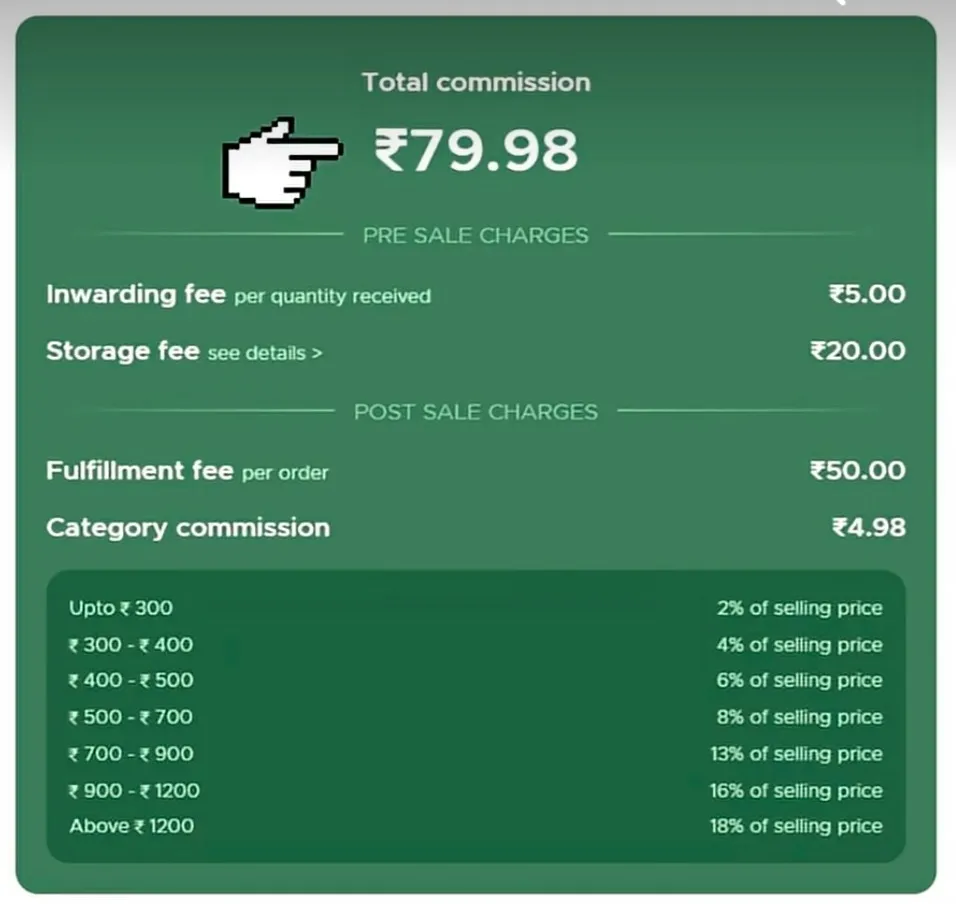
Warehousing, and last-mile delivery charges are layered on top, pushing the total platform revenue share to 30–35% of the selling price for most sellers.
In addition, there will be return handling fees, damage and shrinkage fees, storage or holding fees.
Zepto does not operate a public rate card. Your commission is negotiated directly with the Category Manager assigned to your product vertical.
The rate you land on depends heavily on your brand's offline revenue, category competitiveness, and how much Zepto wants your product on the platform at that moment.
The working range is from 10% to 25%. Brands with ₹5 crore or more in monthly offline demand have genuine negotiating room. Smaller D2C brands generally take the standard rate and revisit terms once they've built platform volume.
📌Blinkit's model is more transparent and independently verifiable. Zepto's is more negotiable but less predictable. For a brand with strong offline credentials and negotiating leverage, Zepto's flexibility can produce better effective rates.
Quick Commerce Setup and listing fees are where sellers most commonly miscalculate their actual entry cost.
Blinkit charges ₹25,000 per SKU per state as a mandatory listing fee. This applies to every product you list, in every state you want to sell in.
The fee is returned as advertising wallet credits but with a 12-month expiry and restricted to spend within Blinkit's own ad platform.
Zepto's fee structure has a comparable commitment. Rather than per-SKU charges, Zepto bundles onboarding costs into a package, usually around ₹5–6 lakh.
The advantage is cost predictability. You know your entry spend before you sign. The downside is no guarantee of return.
Placement is allocated, but performance depends on category competitiveness, audience fit, and how well your packaging converts at thumbnail scale.
📌Neither platform is cheap to enter. Blinkit's itemised structure makes costs visible and scalable; you control how many SKUs and states you start with. Zepto's bundled model is more predictable upfront but less flexible.
Blinkit's advertising operates on an auction model. Search placement, category page visibility, and homepage banners are all bid-based.
The brand willing to pay the most per click or impression wins the position.
For a new D2C brand with a ₹2–3 lakh monthly ad budget competing against a national player spending ₹20–30 lakh in the same category, the auction dynamic is unfavourable.
The one genuine advantage of Blinkit's ad model is attribution or analytics. Seller Hub reports campaign performance at SKU level, by city, in near real-time.
You can see exactly which placement is driving conversion, which dark store is responding to a specific campaign, and where to pull spend that isn't working. For a data-driven brand with the bandwidth to act on daily reporting, this transparency is genuinely valuable.
Zepto's ad model is structurally different. Rather than an open auction, ad placement is bundled into the onboarding package. Your ₹5–6 lakh entry cost includes allocated visibility slots, influencer integration, and category placement for an agreed initial period.
The Swap & Save format, which shows your product to a buyer the moment they add a competitor's product to their cart, is included within this framework and represents Zepto's most distinctive ad mechanic.
On Zepto, the Atom analytics subscription is ₹30,000 per month for real-time competitor tracking and category-level performance data, sits outside the bundle. For brands that need granular data to optimise spend, this is effectively a mandatory additional cost, pushing Zepto's total setup investment meaningfully beyond the headline package price.
📌If you reduce ad spend on either platform, visibility drops within days. This is reflects the reality that both platforms have designed their discovery architecture around paid placement.
Organic ranking exists, but it is driven primarily by sales velocity and SLA compliance, both of which require ad-supported visibility to build in the first place.
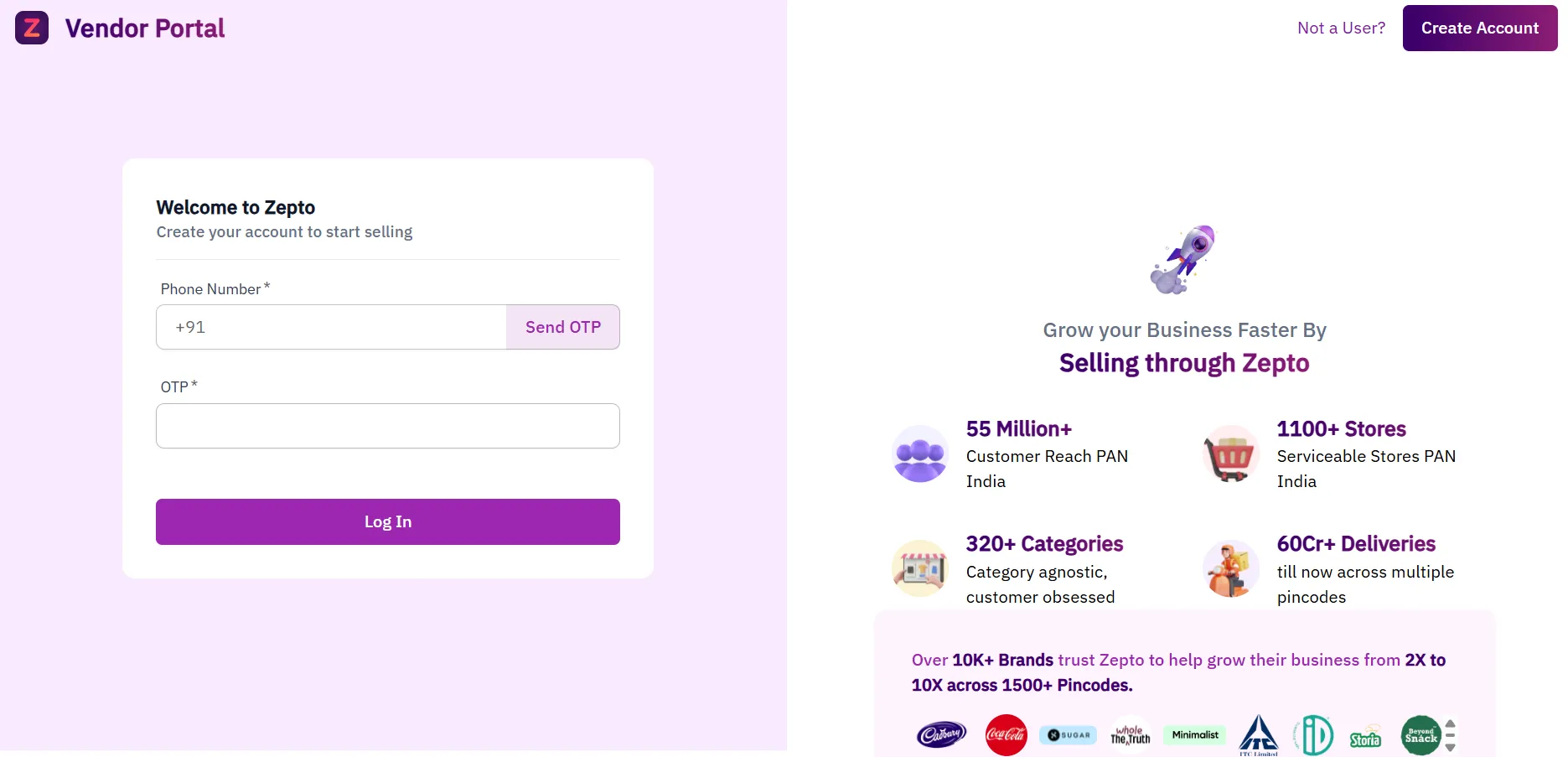
Blinkit's seller registration is self-initiated, you can apply on their official website. The Partner Portal accepts direct sign-ups, and the blinkit document checklist is straightforward: GSTIN, PAN, address proof, and FSSAI licence if you're listing food or beverage products.
But open registration doesn't mean easy onboarding. You should be ready to go through the onboarding process step by step.
After document verification, Blinkit conducts a physical stock and operational review before your products go live. This is where many first-time sellers face their first issue because their products aren't shelf-ready for a dark store environment.
Dark store staff pick orders at speed, under volume pressure. Your packaging needs to
SLA compliance starts immediately. Stockouts and order fulfilment failures are tracked algorithmically.
If you miss your fill rate targets within the first 48–72 hours of a live listing and your ranking takes a hit that can take weeks to recover from. For a new brand with limited SKU depth and a small initial inventory push, this is a real operational risk.
It takes 4-8 weeks in this onboarding process.
On Zepto also from application to live listing, expect 4–8 weeks. The timeline tends to stretch when category managers are managing multiple new onboardings simultaneously which is common in high-growth quarters.
Every brand that enters Zepto does so through a category manager, who controls:
The documentation requirements are similar to Blinkit. After submitting your documents, commercial terms: commission rate, shelf placement, promotional commitments are negotiated directly with the category manager assigned to your product vertical.
And this is where brand size becomes a real variable. Brands with ₹5–7 crore or more in monthly offline demand have leverage in that room. They can push back on rate, negotiate better placement, or structure a deal that includes co-marketing support.
A D2C brand doing ₹30–50 lakh a month offline usually cannot. You take the standard rate, agree to the bundled package, and work within those terms until you've built enough volume on the platform to renegotiate.
📌On both the platforms the onboarding timelines are almost the same. The brand that goes live on time is almost always the one that prepared for the process before initiating it.
On Blinkit, support runs through a ticket-based system and resolves problems. For operational queries: a settlement discrepancy, a packaging rejection, a dark store stock transfer issue: this process works, but slowly.
In addition, Blinkiit has its own knowledge centre where they have covered almost all the aspects related to onboarding process and documents.
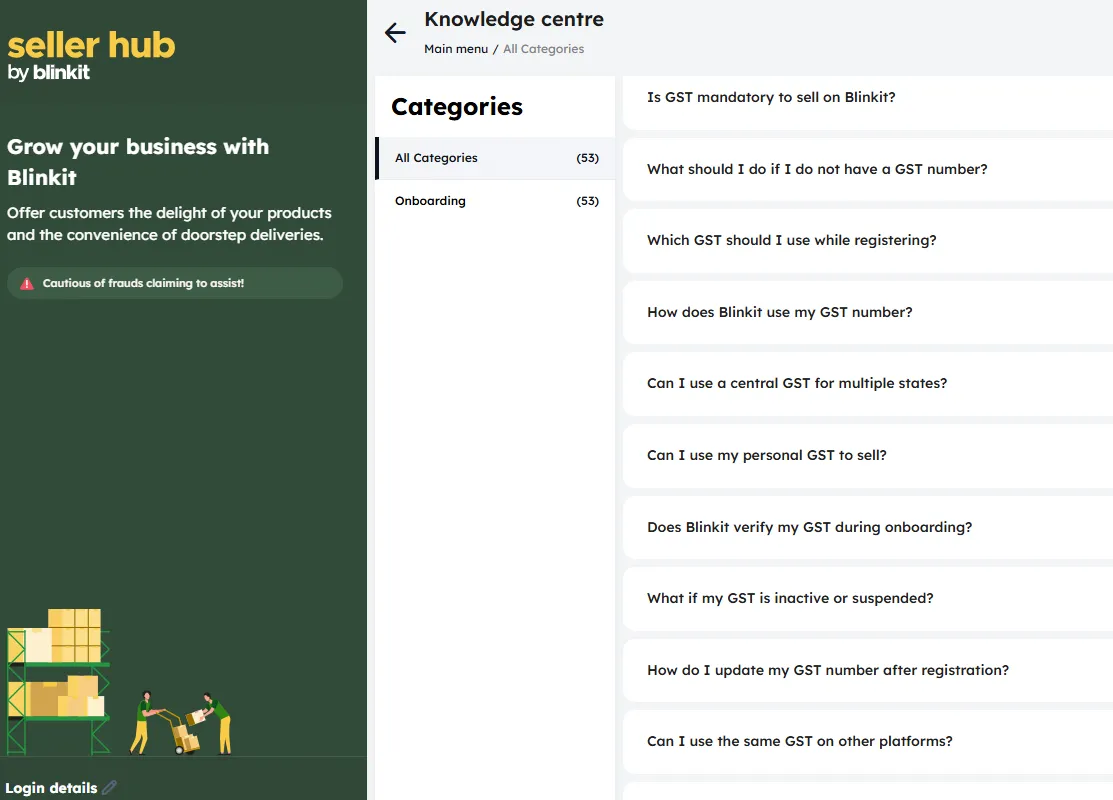
Once you get onboarded and listed your products, Blinkit’s Seller Hub gives you real-time SKU-level performance by city, campaign attribution, and inventory tracking.
For a brand with the internal capability to interpret and act on that data, the platform effectively substitutes information for human support. You don't need someone to tell you your Bengaluru listing is underperforming if you can see it directly in the dashboard and adjust accordingly.
Zepto's Category Manager model provides a named contact who is accountable for your brand's performance on the platform. In the first 30–60 days post-launch, this matters more than most sellers expect.
Your Category Manager can advise on initial inventory positioning, flag underperforming placements before they damage your ranking, and intervene when operational issues arise at the dark store level.
They also facilitate access to Zepto's influencer and content marketing infrastructure: part of the bundled onboarding package, which gives new brands a visibility mechanism beyond pure paid placement.
📌Both Blinkit and Zepto assume a baseline level of Q-commerce onboarding readiness that many new brands simply don't have.
Neither will tell you that your packaging will fail a dark store SLA check before it does. Neither will flag that your MRP is positioned incorrectly for the category's price band. Neither will advise you that your product photography won't convert at thumbnail scale on a mobile grid.
Blinkit's user base skews toward established metro households: dual-income families, working professionals in the 28–45 age range, and buyers with a high repeat purchase frequency on daily essentials.
These are consumers who have integrated Blinkit into their regular grocery and household replenishment routine. They know what they want, they search for it directly, and they convert quickly on familiar categories and brands.
For FMCG brands, daily essentials, packaged food, personal care staples, and gifting SKUs, this audience profile is highly favourable.
These are habitual, high-frequency buyers whose cart behaviour is driven by need and convenience, exactly the conditions where strong packaging, clear product communication, and consistent in-stock availability drive compounding returns.
Zepto's audience skews younger, urban consumers in the 18–32 age range, with a strong Gen-Z core in metro markets.
These buyers are more trend-responsive, more influenced by social proof and influencer recommendations, and more open to trying brands they haven't purchased before. Discovery is a genuine part of how they use the platform, not just a side effect of scrolling.
This has concrete implications for specific categories.
Functional snacks, premium beverages, clean beauty, Korean-inspired food products, nutraceuticals, and lifestyle personal care brands consistently find higher first-trial conversion rates on Zepto than on Blinkit.
📌Before choosing a platform, answer one question honestly: who is the person most likely to buy your product in the next 30 days, and where do they shop?
A 35-year-old in Gurugram restocking household staples shops on Blinkit. A 24-year-old in Koramangala trying a new oat milk brand shops on Zepto. The platform decision should follow that buyer.
Blinkit operates on a weekly payment cycle for most sellers. Revenue from orders fulfilled in a given week settles into your registered bank account within 7 days, subject to deductions for returns, damage claims, and platform fees.
Zepto's standard payment cycle runs twice monthly, with settlement timelines varying by contract, some sellers report a 15-day lag, others 20 days from the close of the billing period.
For a brand doing ₹20–30 lakh monthly GMV on Zepto, a 20-day lag means carrying 20 days of revenue as a receivable at any given point. At thin margins and high platform cost, that working capital requirement is material.
The variability in payment terms is a known issue in seller communities. Unlike Blinkit's relatively standardised weekly cycle, Zepto's settlement schedule depends on what was agreed during the Category Manager negotiation.
📌Neither platform currently offers real-time payment tracking visible to sellers outside of their respective dashboards.
These deductions work almost in the same way on Blinkit and Zepto.
When a customer reports a damaged product, raises a return request, or when a dark store flags a pick error resulting in a damaged unit, the cost is passed back to the seller.
Deductions are applied to the settlement for the period in which the incident is recorded, not necessarily the period in which the order was placed, which can create timing mismatches in your reconciliation.
Neither platform absorbs damage that occurs during dark store picking or last-mile delivery as a default.
📌The burden of proof sits with the seller to demonstrate that damage occurred after the product left their custody in acceptable condition.
Most sellers don't have the documentation to make that case consistently, and the deduction stands.
On Blinkit, inventory management is your responsibility. The platform provides the data; the execution is on you. This model gives you control but demands operational bandwidth.
You monitor stock levels across dark stores through Seller Hub, raise replenishment orders when levels drop below threshold, and coordinate inbound logistics to the relevant fulfilment points.
Monitoring stock across multiple dark stores in multiple cities, each with different velocity profiles for your SKU, requires either a dedicated person or a reliable system.
Zepto's inventory model differs structurally. Your stock is held in Zepto's warehouse facilities and managed within their fulfilment system rather than being seller-tracked through a self-serve dashboard.
This removes some of the day-to-day replenishment monitoring burden, Zepto's operations team manages pick and pack, but introduces a different set of constraints.
The most documented of these is inventory exit. Sellers who want to discontinue a SKU, reduce their platform presence, or exit Zepto entirely consistently report significant friction in retrieving unsold inventory.
The process involves raising warehouse return tickets, waiting on confirmation across timelines that can stretch several weeks, and navigating return logistics terms that aren't always clearly defined in the original contract.
📌Read the inventory exit and return clauses in your Blinkit and Zepto contract before you sign.
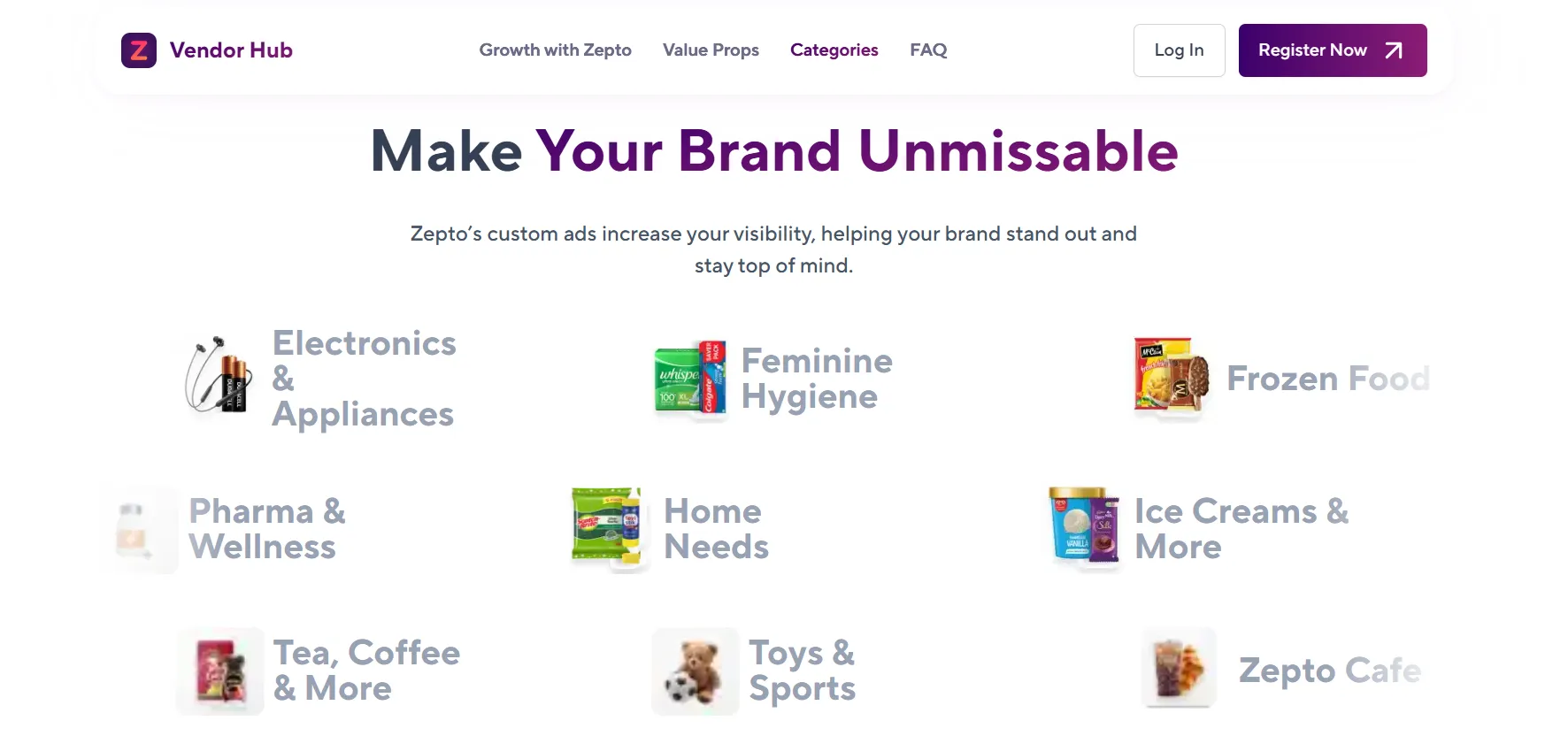
A brand winning on Blinkit in Delhi-NCR can underperform badly on the same platform in Pune, while Zepto's concentrated dark store presence in certain micro-markets gives it outsized strength in cities where Blinkit's network is thinner.
Platform choice is as much a city-level decision as it is a category-level one.
That said, audience skew and platform mechanics do create genuine category-level patterns. Here's where the data and seller experience points:
🔷Functional snacks and premium beverages are where Zepto's Swap & Save format earns its keep most clearly.
If your product competes directly with a national brand, say, a craft energy drink going up against Red Bull, or a millet snack bar against an established FMCG player, the ability to intercept that competitor's cart moment is a meaningful acquisition lever. You're not waiting for a search; you're appearing at the point of commitment.
🔷Clean beauty and personal care brands consistently find Zepto's audience more responsive, particularly for products with a sustainability, ingredient-transparency, or "clean label" positioning.
The platform's influencer integration, bundled into its onboarding package, creates awareness that pure search placement on Blinkit cannot replicate for a brand the target buyer hasn't heard of yet.
🔷Gifting and impulse SKUs benefit from Blinkit's attribution strength. Gifting on q-commerce is heavily seasonal and campaign-dependent: Diwali, Valentine's Day, Holi, rakhi windows drive disproportionate volumes.
Blinkit's Seller Hub lets you see in near real-time which dark stores are converting on a gifting SKU during a campaign window, allowing you to reallocate ad spend and inventory mid-campaign.
On Zepto's slower reporting cycle, you're often reacting to data that's already 48–72 hours stale.
🔷New brands entering q-commerce for the first time should almost always start with Blinkit.
Not because Blinkit is cheaper, but because the registration model and Seller Hub data give you the cleanest environment to test whether your unit economics actually work before committing to Zepto's upfront bundle.
Validate your margin stack, your conversion rate by city, and your SLA compliance on Blinkit first. Then take that data into a Zepto category manager negotiation with actual numbers behind you.
🔷One rule that overrides the table above: Check dark store density in your specific target city before you finalise platform priority.
A category that skews Blinkit nationally may have a weaker Blinkit presence in Ahmedabad or Kochi than Zepto does. Your platform decision should be built on your city cluster, not the national headline.
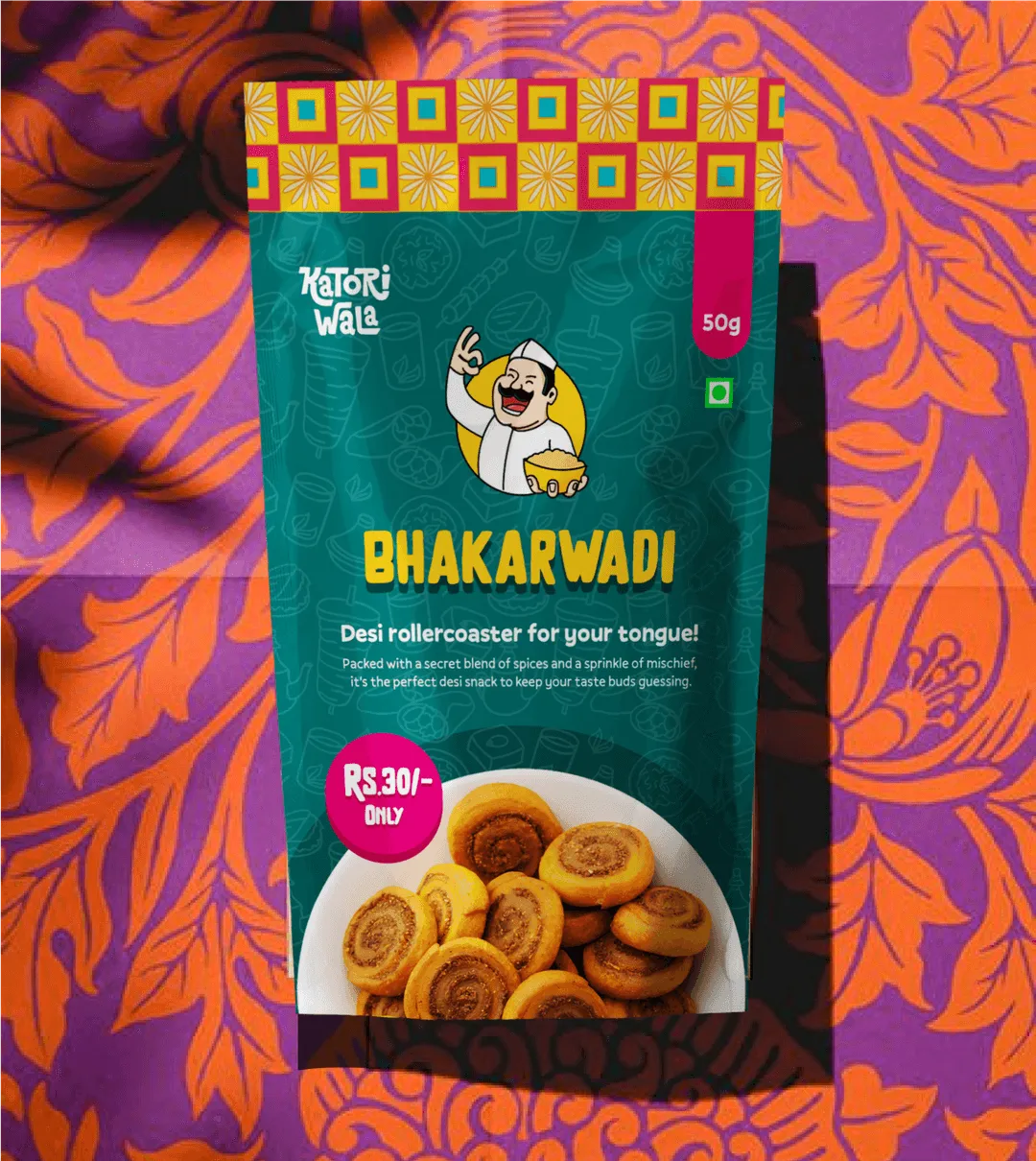
Both Blinkit and Zepto as quick commerce platforms have packaging and labelling standards that go beyond standard retail requirements and both will penalise non-compliance, though in different ways.
Blinkit's packaging guidelines are among the most detailed in Indian quick commerce.
It publishes explicit requirements covering barcode placement, label specifications, packaging structural standards, and regulatory compliance markers.
Stock that fails a dark store compliance check at the point of inbound is rejected before it goes live, which means your listing fee is spent and your inventory is sitting in a return queue before you've made a single sale.
Blinkit's compliance checks happen at the inbound stage, before stock is shelved. This is the most transparent point of failure, you know immediately whether your packaging passed.
The cost of failure, however, is already sunk: listing fee paid, inventory shipped, launch timeline disrupted.
Zepto's packaging compliance approach differs.
Rather than a hard inbound rejection gate, Zepto's standards are enforced through operational performance metrics, SLA scores, pick error rates, and damage claim rates.
Non-compliant packaging doesn't necessarily get rejected at the warehouse door. It gets listed, generates fulfilment problems, and those problems accumulate against your seller account metrics over time.
This means the consequences of non-compliant packaging on Zepto are slower to appear and harder to attribute.
Sellers often spend weeks trying to diagnose a ranking decline before identifying the packaging root cause.
Zepto's Category Manager may flag obvious compliance issues during the onboarding review, but this depends heavily on how thorough that review is and how experienced your assigned manager is with your product category.
At Confetti, we help D2C and FMCG brands get listed and succeed on quick commerce platforms including Blinkit and Zepto.
We specialises in getting brands q-commerce ready through a three‑step approach that works across both Zepto and Blinkit.
✅ We focus on onboarding preparation, building a brand’s digital footprint and packaging to increase the likelihood of being accepted by major apps.
✅ We handle listing and pricing consultation, studying category‑specific pricing on each platform and creating the product photography and creative assets that customers see on‑screen.
✅We optimise ongoing performance through listing improvements and in‑app ads, helping brands adapt to changing market trends and seasonality.
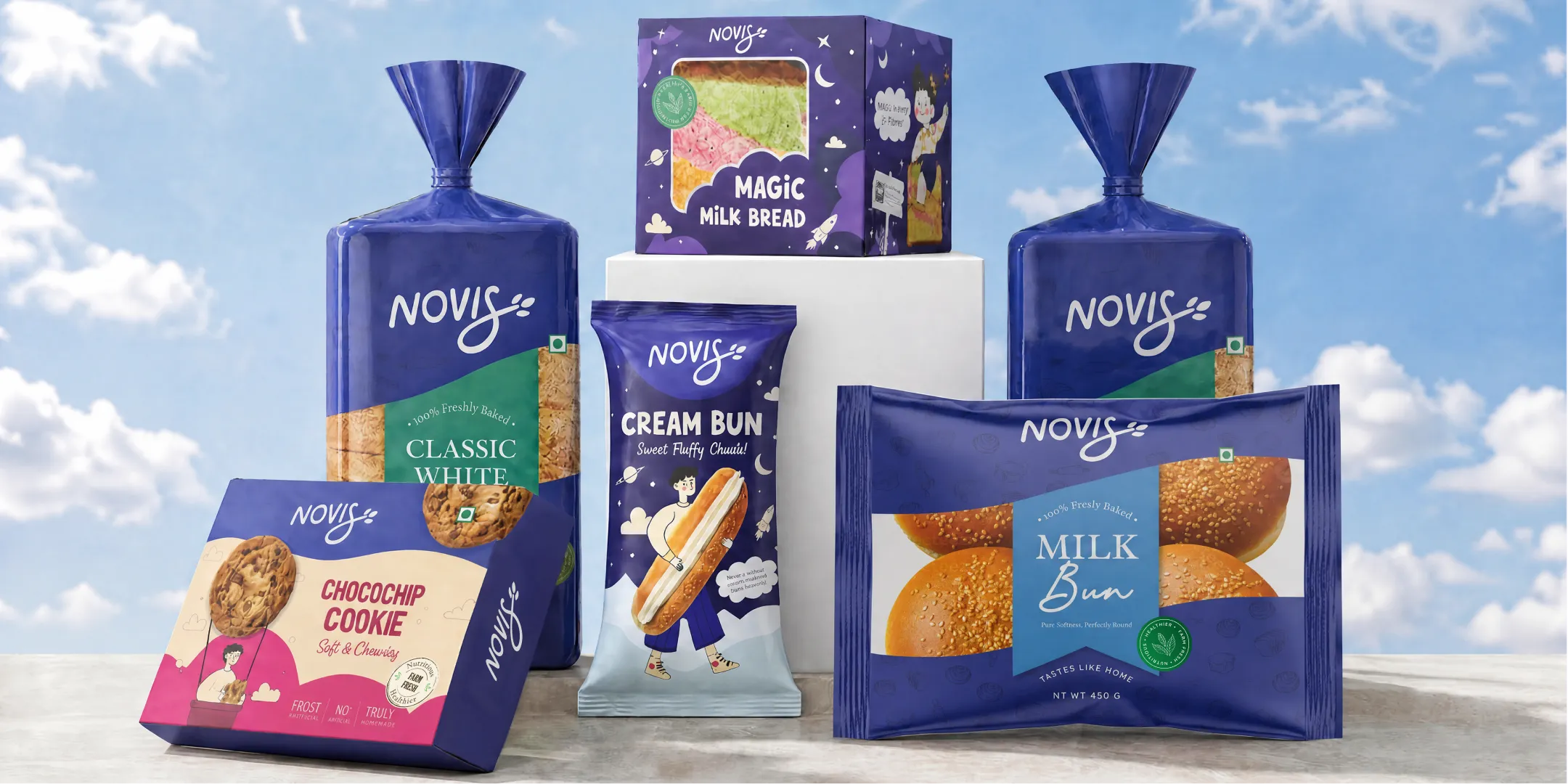
We also design packaging specifically for the quick commerce environment.
On Zepto and Blinkit, customers scroll fast and products compete in compressed grids, so a product has roughly a second to register before a scroll moves on.
Confetti approaches packaging not as a scaled‑down version of offline designs, but as a system tested for digital retail behaviour, ensuring that visual hierarchy, contrast and immediate category signalling are all optimised for a mobile screen.
Whether you choose Zepto or Blinkit, being q‑commerce ready means your brand can compete effectively from day one.
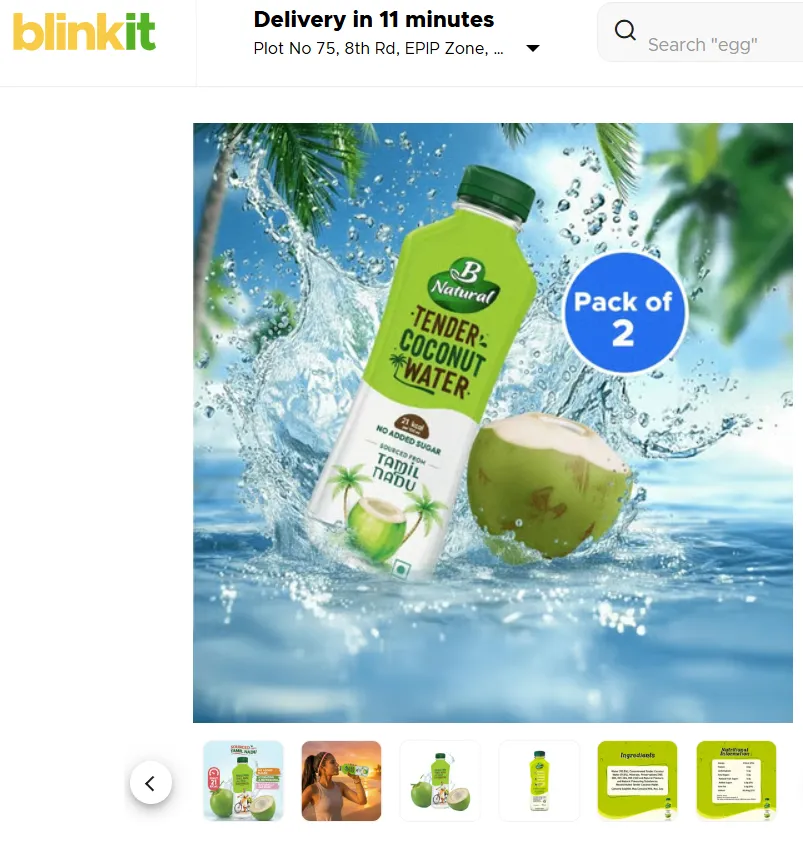
📌We have worked with various brands like B-Natural and have designed a unique packaging for coconut water, which is listed on all quick commerce platforms.
The honest answer to "Blinkit or Zepto?" is: it depends on where your brand is right now, not where you want it to be.
The framework below is built on that premise, match your current situation to the right starting point, validate, then scale.
Each of these mistakes is documented in seller forums, visible in platform settlement data, and in most cases entirely avoidable with upfront planning.
1. Treating listing fees as a sunk cost instead of a media investment
Both platforms return fees as ad credits. If you don't have a plan to use those credits strategically, you're funding the platform's ad business, not your own.
2. Ignoring packaging readiness before onboarding
Dark store picking is not a warehouse operation. Packaging that isn't barcode-compliant, structurally durable, or SKU-label clear generates SLA violations that hurt ranking before you've built any sales velocity.
3. Going live on both platforms simultaneously without validating margins on one
Splitting the budget across two platforms before you have attribution data from either is not a multi-platform strategy. It's two simultaneous experiments with no control group.
4. Underestimating total cost of channel
Base commission is 15–25%. Add warehousing, handling, payment gateway, mandatory ad spend, and discount participation. Effective cost is 30–35% of selling price on both platforms. Model this before signing.
5. Choosing platform by market share instead of audience fit
Blinkit is larger. That is not a reason to list there if your product's buyer is a 22-year-old urban Gen-Z consumer who shops Zepto. Market share is the platform's metric. Audience fit is yours.
How much does Blinkit charge sellers?
Blinkit charges ₹25,000 per SKU per state as a mandatory listing fee, returned as ad wallet credits with a 12-month expiry. Commission ranging from 2%-18% depending on category.
How much commission does Zepto take from a seller?
Zepto's base commission ranges from 10–25% depending on category, with standard FMCG at 15–20%.
When warehousing fees, handling charges, payment gateway costs, and mandatory advertising are included, the effective total cost of selling on Zepto typically reaches 30–35% of the selling price.
Is Blinkit cheaper than Zepto for sellers?
Blinkit's base commission has historically been lower than Zepto's for standard FMCG. However, Blinkit's minimum ad spend (₹2–3 lakh/month) versus Zepto's bundled model (₹5–6 lakh upfront) means total effective costs are comparable at scale.
Blinkit is more flexible for small initial budgets; Zepto's bundling is more predictable for larger, established brands.
Is it easy to sell on Blinkit?
The process includes document verification, physical stock verification, and strict compliance with SLAs and packaging guidelines.
Stockouts reduce ranking within 48–72 hours. It is easy to start but not easy to sustain without strong operational discipline.
Who is more profitable: Blinkit or Zepto?
For sellers, neither platform is reliably profitable below 60% gross margins and ₹25–30 lakh monthly GMV on the channel. ROAS rarely exceeds 1.2–1.5x for small D2C brands.
Which platform is better for D2C brands?
Blinkit holds the largest D2C brand mix and offers superior real-time attribution through Seller Hub. Zepto's audience skews younger and is better for Gen-Z categories like functional snacks and clean beauty.
For data-driven first-time q-commerce entrants, Blinkit is the more transparent starting point. For trend-forward D2C targeting urban youth, Zepto is the stronger fit.
Can a small brand afford to sell on Blinkit or Zepto?
The economics are difficult for most self-funded small brands. Between listing fees, mandatory ad spend, commission, and operational costs, platforms usually consume 30–35% of revenue.
Quick commerce works best for brands with gross margins above 65% and proven product-market fit established through offline or D2C channels first.
Want strategic branding and packaging like this for your business?





.webp)
.webp)

.webp)
.webp)
.webp)
.webp)
.webp)







.svg)
.webp)