%201.webp)
02
AI Snaps
.svg)
.svg)
01
Our Work
03
About Us
04
Brand Audit
05
Contact Us
06
Client Success
12
07
Blogs
08
Careers
Book A Call
.svg)



.svg)
Need Help In Building Your Brand?
Click the button below & book a call with our founder directly.

Rishabh Jain
Managing Director
Packaging labeling requirements in India are governed by multiple laws. Getting them wrong can mean fines, product seizure, or delisting from major marketplaces.
Our Confetti guide covers mandatory declarations for all packaged products, category-by-category requirements for food, cosmetics, and electronics, rules for imported goods, and the latest 2026 updates on nutrition labeling and plastic packaging.
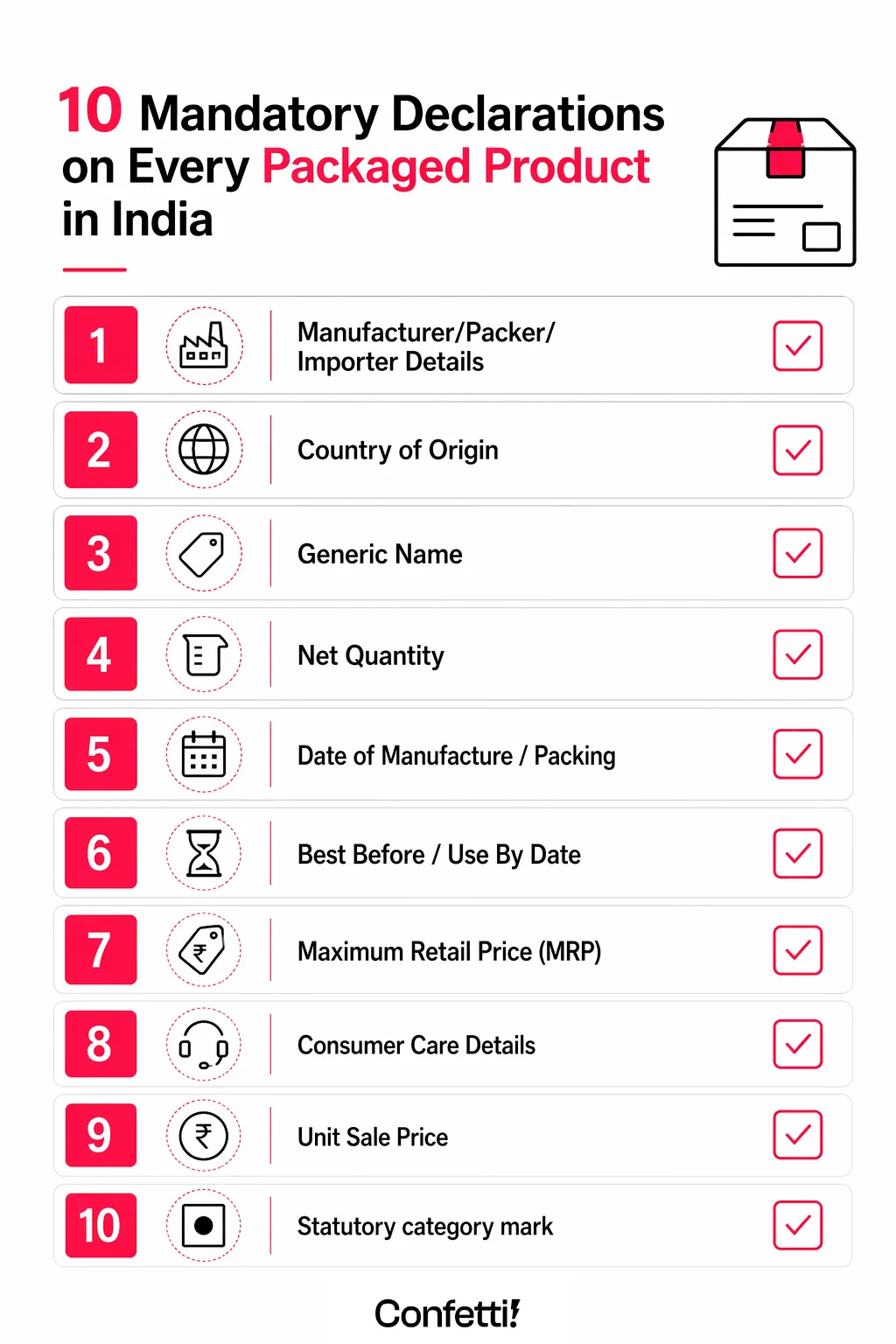
The regulatory enforcement in India has become aggressive and systematic. The Department of Consumer Affairs conducts regular nationwide raids targeting warehouses, retail stores, and e-commerce fulfillment centers.
In one notable case, authorities seized non-compliant packages from a single Amazon seller, resulting in fines exceeding ₹1 lakh.
👎Financial penalties are only the beginning.
👎Customs can detain imported shipments at port for label non-compliance, storage fees accrue daily while you scramble to apply corrected labels.
👎E-commerce platforms like Amazon and Flipkart have delisted brands for repeated violations under their seller compliance policies. Your competitors won’t wait while you sort out legal notices.
👎Plus, for consumer goods companies, the reputational damage often costs far more than the penalty itself.
Here's the regulatory map you need to know:
Most products fall under Legal Metrology + at least one category regulator. You need to comply with both simultaneously.
India’s product compliance acts as a two-layer system.
Here's a breakdown:
The Legal Metrology (Packaged Commodities) Rules, 2011 apply to every packaged product sold at retail in India. It applies to everything, from a bar of soap to a box of screws. No exceptions for small businesses or D2C brands.
Your label must include these eight declarations, typically in English or Hindi, on a Principal Display Panel (PDP) with clear, legible fonts
Font size rules: Mandatory declarations should be legible and displayed in the prescribed format and size on the package. For e-commerce listings, the mandatory declarations must also be shown digitally on the product page.
Once your base is solid, you need to layer on the rules specific to your product. Here's a quick look at the major ones:
🏷️Food & Beverages:
Regulated by FSSAI (Food Safety and Standards Authority of India), you'll need an FSSAI license number and logo, nutritional information (per serve contribution to RDA), a veg/non-veg symbol, and allergen declarations. The FSSAI's 2020 regulations are designed to reconcile with Legal Metrology rules, reducing legal ambiguity.
🏷️Electronics & Appliances:
Dual-compliance category. You need a BIS (Bureau of Indian Standards) registration number and the Standard Mark, and for many appliances (like ACs, fridges, TVs), a mandatory BEE (Bureau of Energy Efficiency) star rating label. For recent updates, the BEE is also making star ratings mandatory for LPG stoves and cooling towers.
🏷️Cosmetics & Personal Care:
Governed by the Drugs and Cosmetics Act, 1940. Your label needs the manufacturing license number, a complete list of ingredients (INCI names), and specific warnings for products like soaps.
🏷️Medical Devices:
A recent 2025 amendment to the Legal Metrology rules now fully aligns packaged medical devices with the specialized Medical Devices Rules, 2017. This eliminates confusion by establishing a single set of labeling standards.
🏷️Plastic Packaging:
Under the Plastic Waste Management Rules, you are now required to print a specific QR code on plastic packaging. This links to a portal with details on the product's environmental impact and disposal instructions, making your "sustainability claims" directly verifiable.
If you're currently reviewing your packaging or planning a new launch, an excellent first step is a compliance audit of your existing or proposed labels against this two-layer framework. We’d be happy to discuss how to make this process seamless for your brand.
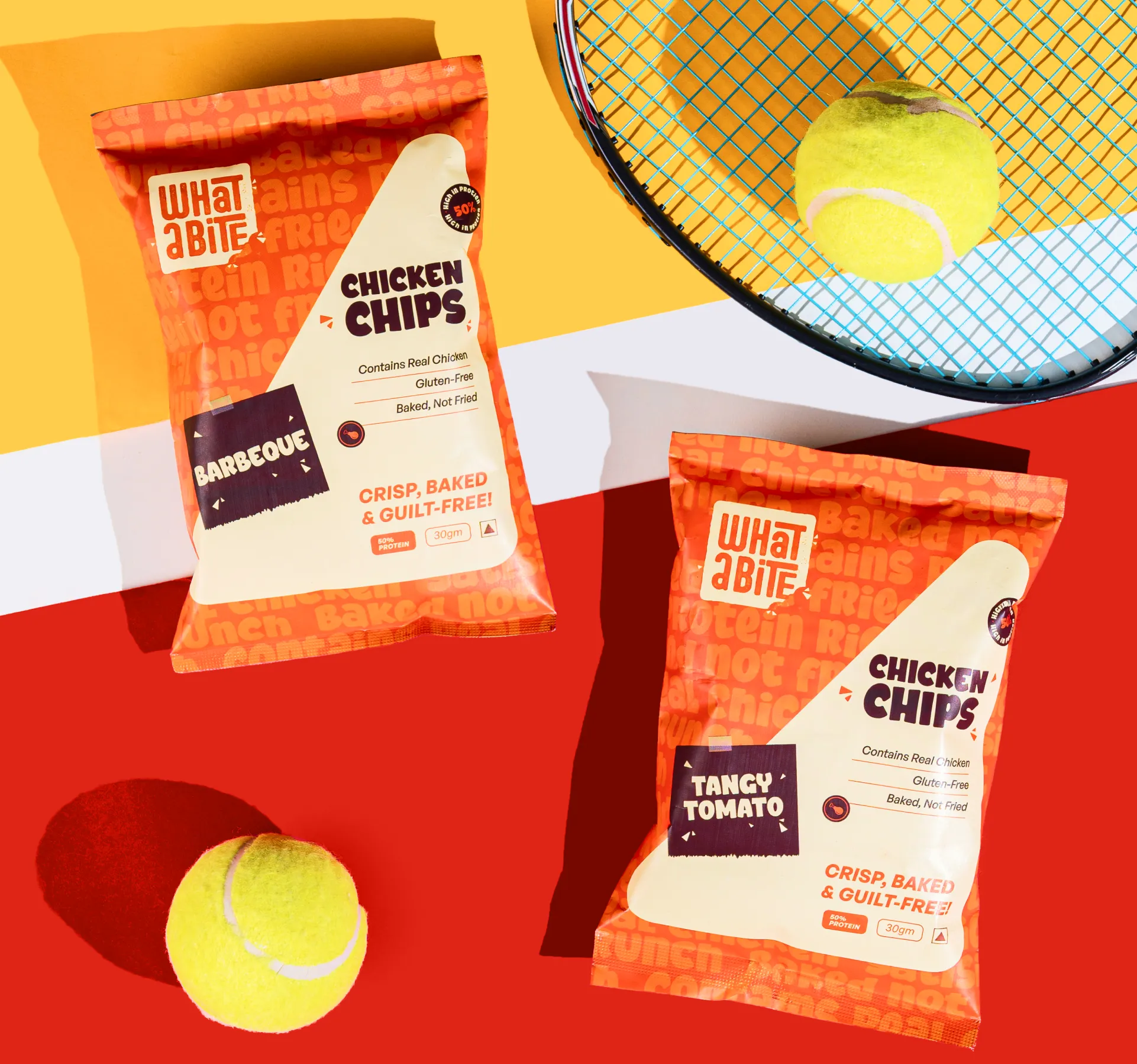
FSSAI labeling is the primary way Indian consumers judge your product’s safety and quality.
FSSAI has consolidated its rules under the Food Safety and Standards (Labelling and Display) Regulations, 2020, which are being actively reinforced with multiple 2025 amendments.
Miss a single requirement, and your product gets pulled from shelves. Here’s what your food and beverage label absolutely must include:
FSSAI has proposed and, in some cases, already notified updates to the Food Safety and Standards (Labelling and Display) Regulations, 2020.
Main updates :
✔️Bolder, Larger Fonts for Critical Nutrients: The % RDA contribution for added sugar, saturated fat, and sodium must be displayed in bold letters with a relatively increased font size. This is designed to make unhealthy elements impossible for shoppers to miss.
✔️Special Rules for Specific Products:
✔️Mandatory QR Code: A QR code on the label linking directly to a live Certificate of Analysis will become mandatory for many food categories. This aims to provide complete transparency on a product’s nutritional facts.
✔️Stricter Front-of-Pack (FOP) Rules: Expect mandatory FOP nutritional warning labels for products high in fat, salt, or sugar (HFSS), similar to the ‘red label’ systems seen in other countries.
✔️Enhanced Allergen Declaration: The rules are becoming stricter on how allergens must be highlighted, with a strong push for them to be in a separate, bold “Contains” statement, not buried in the ingredient list.
✔️BPA-Free Packaging Requirement: FSSAI has proposed restrictions on BPA in food-contact materials, including packaging made from polycarbonate and epoxy resins.
If your packaging design for food and beverages isn’t flexible enough to absorb these changes without a complete redesign, you’re taking a big risk.
📍IMPORTANT: Many D2C food brands on marketplaces are getting flagged for oversized health claims ("boosts immunity," "100% natural") without supporting certification. This is a growing area of enforcement.

Cosmetics sold in India are regulated by the Drugs and Cosmetics Act, 1940 and its rules, enforced by the Central Drugs Standard Control Organisation (CDSCO).
The regulatory framework for cosmetics was updated under the Cosmetics Rules, 2020.
However, the moment your product makes a therapeutic claim, the "cosmetic" label disappears and stricter drug regulations apply.
Misclassification penalties include product seizure, license cancellation, and imprisonment up to one year.
Here's the test:
Does your product clean, perfume, or change appearance? Or does it treat, prevent, or cure a condition? If you're selling a fairness cream that claims to "reduce melanin production," you've crossed into drug territory.
The same applies to anti-dandruff shampoos, anti-acne creams, fluoride toothpastes, and sunscreens. These require drug manufacturing licenses and drug-compliant labeling.
Every cosmetic product label must include:
Ingredient Labeling
India requires cosmetic ingredients to be declared using INCI names on the label.
Placement And Format
Ingredient information should be shown clearly and legibly on the label panel prescribed by the applicable cosmetic labeling rules.
Font size and legibility is important. The label must remain readable and must comply with the applicable cosmetic labeling and package-declaration requirements.
Special Declarations And Warnings
Certain cosmetics require additional mandatory warnings.
Hair dyes must carry the prescribed cautionary statements, including patch-test advice and directions to keep the product away from children.
Soaps or other products containing restricted ingredients may also need specific cautionary declarations.
Where synthetic colours or other regulated substances are used, the relevant permitted declarations and compliance conditions must be followed.
Cruelty-Free and Vegan Claims
India has no mandatory certification body for "cruelty-free" or "vegan" cosmetic claims.
Brands can use these claims, but increasing consumer awareness and growing scrutiny from consumer courts mean that unsubstantiated claims carry reputational risk.
Third-party certifications (such as Leaping Bunny or PETA certification) are best practice even where not legally required.
False Or Misleading Claims
Cosmetic labels and advertisements must not make false, deceptive, or misleading statements about a product’s nature, quality, safety, performance, or origin.
Claims suggesting therapeutic effects should be avoided unless the product is actually regulated for that purpose.
Penalties And Enforcement
Misbranded or spurious cosmetics can be seized. You can also face prosecution, fines, and imprisonment under the Drugs and Cosmetics framework. T
he severity depends on the violation and whether it concerns manufacture, sale, or import.
The Drugs and Cosmetics Act also prohibits certain statements on labels:


Electronics in India need to be checked with two separate agencies: the Bureau of Indian Standards (BIS) and the Bureau of Energy Efficiency (BEE) .
BIS is for safety and quality. BEE suggests energy efficiency. Neither is optional if your product falls under its scope.
BIS operates two main schemes:
Under CRS, you cannot manufacture, import, sell, or distribute any notified electronic product in India without valid BIS registration and the Standard Mark bearing its unique R-number.
Products currently covered under CRS:
The Bureau of Energy Efficiency (BEE) operates India's Standards & Labeling (S&L) program.
If your product category is under mandatory star labeling, you cannot sell a single unit without the star label affixed.
Includes:
The BEE label must display the star rating (1–5 stars), annual energy consumption in kWh, and the model details.
Star ratings are reviewed and recalibrated periodically, a label that was accurate two years ago may no longer reflect current standards.
Under the E-Waste Management Rules, 2022, all electronic and electrical equipment must carry:

This is the fastest-moving area of India's packaging compliance.
Brands that haven't updated their plastic packaging artwork recently may already be out of compliance.
Under the Plastic Waste Management Rules (Amendment 2022), plastic packaging must carry:
From 1 July 2025, notified plastic packaging in India must carry prescribed traceability information.
This may be provided through a barcode or QR code, a product information brochure, or a unique number, depending on the applicable rule.
Producers, importers, and brand owners covered by the plastic-waste framework must also register under the CPCB EPR system and comply with the portal-based reporting and recycling obligations.
Every brand that uses plastic packaging must register on the CPCB's (Central Pollution Control Board) EPR portal.
Your EPR registration number must appear on the packaging. This applies to brands of all sizes, including D2C startups. Failure to register is treated as a serious violation under solid waste and plastic management rules.
If you import products into India, your label compliance has an additional set of requirements.
Some important ones are:
Country of origin: must be declared on every imported product. "Made in [country]" or "Product of [country]" are both acceptable formats under Legal Metrology rules.
MRP must be declared in India: even if the foreign label shows a foreign price. The Indian MRP must be printed or stickered in Indian Rupees, inclusive of all applicable taxes, before the product is offered for retail sale.
Importer's details are mandatory: The Indian importer's name, address, and contact information must appear on the label. The foreign manufacturer's address alone is insufficient.
FSSAI import registration number: must appear on all imported food and beverage products. This is a separate registration from domestic FSSAI licensing and is processed by FSSAI's regional offices for import.
Language requirements: All mandatory declarations must be in English or Hindi. Regional languages are permitted in addition to these. Importing a product with a label entirely in a foreign language is not compliant for Indian retail.
Language and legibility: Mandatory declarations must be in English or Hindi, clearly visible, indelible, and legible; labels only in a foreign language are not acceptable for retail sale.
No misleading claims: Labels must not be false, misleading, or deceptive.
Special-category disclosures: Some products need extra markings, such as irradiated food details, colouring material disclosures, and the vegetarian/non-vegetarian symbol where applicable.
Here are the most common labeling violations that lead to penalties, seizures, and product delisting in India:
🚨 Skipping Design Compliance Until the End
Many companies design packaging for maximum “shelf appeal” first and try to squeeze in the mandatory declarations later. This is a critical error.
A compliance-first approach, the one we adopt at Confetti, bakes legal requirements into the design process, is much more efficient.
🏷️ Missing the Mandatory MRP Declaration
It seems basic, but the omission happens frequently. The MRP must be printed on every pre-packaged item.
Forgetting it or getting the price wrong is a direct violation of the Legal Metrology Act.
📏 Font Size and Legibility Failures on the Declaration Block
The size of the text for mandatory declarations is not a suggestion. Under Legal Metrology rules, the minimum font size is based on the area of the packaging.
On smaller packs, text is often too small, and on larger packs, consumer helpline numbers or net quantity text is too small. Even if the sticker or text is present, an inspector can deem the whole package non-compliant.
🌐 Incorrect or Missing 'Country of Origin' on Imports
With the rise of 'Made in India' mandates, this has become a high-risk area. Simply adding a generic 'Made in' statement is insufficient.
For imported goods, the country of origin must be explicitly declared. E-commerce platforms like Amazon and Flipkart now require this for product listings and will delist items with incorrect or missing origin details.
🌿 Misleading or Unsubstantiated Product Claims
Calling a product "natural", "herbal", "ayurvedic", or "zero chemicals" without proof is considered misbranding.
For food, this can attract an FSSAI penalty of up to ₹3 Lakhs. For cosmetics, the CDSCO can cancel your license for making claims that shift the product into "drug" territory.
🔢 Incompatible BIS Registration Numbers
For electronics manufacturers, the error often lies not in the logo but in the number.
Printing the BIS registration number (R-number) in the wrong font, at the wrong size, or simply mismatching it between the box, the invoice, and the product itself is a primary reason goods are seized at customs.
⚡ Forged, Oversized, or Outdated Star Ratings (BEE)
With BEE's latest 2026 regulations, the star rating label is now a tightly controlled asset.
Slapping on an old label format or a fake star saves costs now but invites huge problems later. BEE is conducting active market surveillance, and any detected deviations will lead to penalties, model suspension, and legal proceedings.
🍱 'Mix-and-Match' Errors on the Nutritional Table
For F&B companies, one careless copy-paste error in the nutrition table is a common but catastrophic error.
Using the nutritional data from a different product's formula or calculating the %RDA contribution per serving incorrectly can lead to misbranding penalties and forcing a recall of the entire batch.
🍽️ Forgetting the Veg/Non-Veg Symbol (or Using Wrong Colors)
A straightforward rule, but surprisingly often forgotten. A product that is 100% vegetarian but missing the green dot, or one that contains egg but shows a green dot, is a severe misbranding violation.
The symbol must be prominently displayed near the product name in the specified colours and dimensions.
🚫 Missing consumer helpline number
The 2022 Legal Metrology amendment made this mandatory. Thousands of labels printed before 2022 still circulate without this. If your label predates 2022, this is worth checking.
🚫 E-waste symbol missing on electronics
The crossed-out wheelie bin is mandatory for all electrical and electronic equipment.
Smaller electronic accessories, cables, adapters, chargers, are frequently non-compliant on this point.
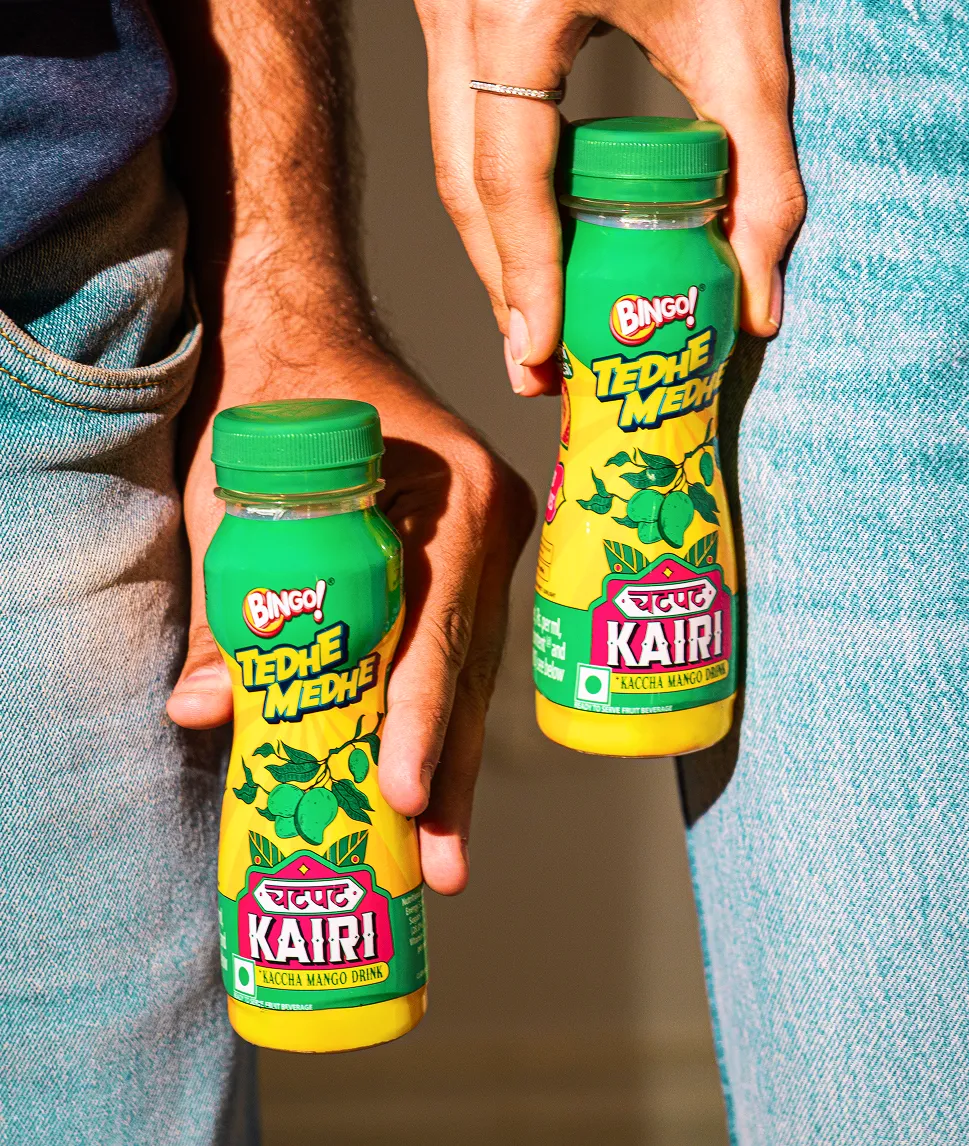
At Confetti, compliance is where our design process starts.
Before we place a single design element, we map every mandatory declaration required for the product category:
Our packaging design process integrates the compliance audit into the initial brief.
You don’t have to choose between a beautiful shelf presence and regulatory safety. We treat packaging as the brand's "silent salesman". It must be visually arresting, structurally sound, and legally defensible.
Consider these examples from our client success work:
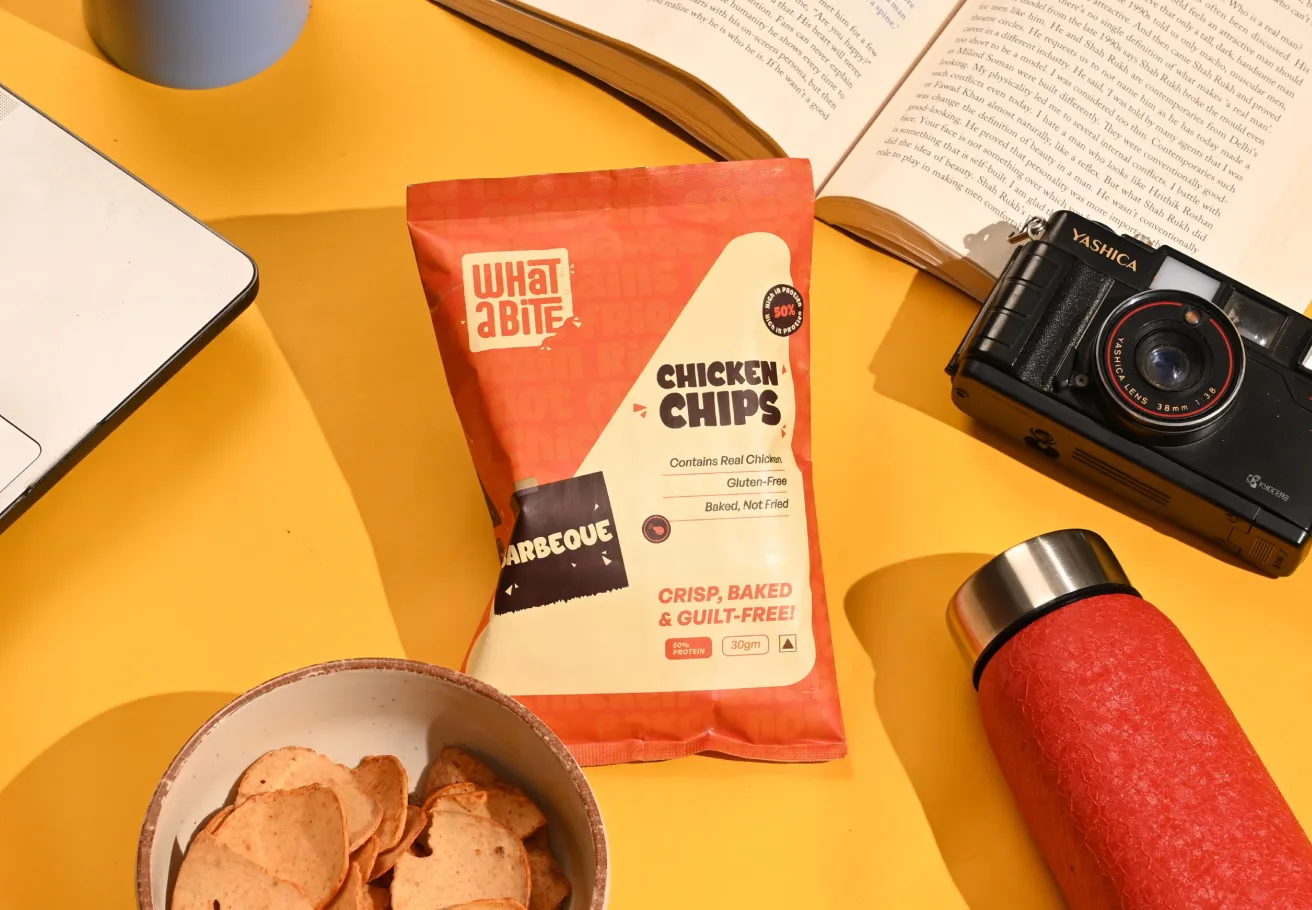
Navigating a Product Launch with High Scrutiny: ITC had already tried over twenty designs for their 'Aam Panna' beverage before they reached us. We launched the product as a viral success across India.
But behind the "Indian truck-art" aesthetic, we were quietly ensuring that every label detail met Legal Metrology standards for a beverage launch: dates, MRP, nutritional claims, and FSSAI licensing, all integrated into a design that flew off shelves and gained massive social media recall.
A US health brand needed a melt strip product to launch in a competitive market. We designed a specific unboxing experience that mimicked a Zippo lighter mechanism while engineering the label design to respect the strict labeling guidelines for health supplements, ensuring the launch was seamless and ready for regulations in both the US and India.
At Confetti, we design packaging that marries bold, iconic design with bulletproof compliance. We create systems, not stickers.
We build brands that can survive a sudden inspection and thrive in the hands of a delighted customer.
What are the mandatory declarations on packaged products in India?
Under the Legal Metrology (Packaged Commodities) Rules, 2011, every packaged product must display: name and address of manufacturer/packer/importer, product name, net quantity, MRP (inclusive of taxes), manufacturing date, best before date (if applicable), consumer helpline number, country of origin for imports, and any statutory certification mark required by category-specific law.
Is it mandatory to print MRP on all products sold in India?
Yes. All pre-packaged goods sold in India must display the Maximum Retail Price inclusive of all applicable taxes. The MRP must be printed in a specified minimum font size depending on the package size. Selling above MRP is a cognizable offence under the Legal Metrology Act, 2009.
What labeling is required for food products under FSSAI?
FSSAI mandates that all pre-packaged food products display: product name, ingredient list (descending order of weight), nutritional information per 100g/ml and per serving, veg/non-veg symbol, allergen declaration, FSSAI license number, manufacturer details, net quantity, best before/use by date, and batch number.
Do imported products need a separate Indian label?
Yes. Imported products must carry a label with all mandatory declarations in English or Hindi, even if the original foreign label is present. This includes the Indian importer's name and address, MRP, FSSAI import registration number (for food), and country of origin. The foreign label alone is not sufficient for sale in India.
What is the penalty for non-compliance with packaging labeling laws in India?
Under the Legal Metrology Act, 2009, penalties for non-compliance include fines up to ₹25,000 for a first offence and up to ₹1 lakh for repeat violations. Products can also be seized. FSSAI violations carry additional penalties under the Food Safety and Standards Act, 2006, including suspension or cancellation of FSSAI license.
Can I use "natural" or "organic" claims on my product label in India?
The word "organic" requires certification from an accredited body (such as NPOP for domestic products or APEDA-recognized certification for exports). "Natural" is less regulated but is under increasing scrutiny from FSSAI and consumer courts. Using these terms without substantiation can lead to penalties for misleading labeling under the Consumer Protection Act, 2019.
Want strategic branding and packaging like this for your business?





.webp)
.webp)

.webp)
.webp)
.webp)
.webp)
.webp)







.svg)
.webp)


