%201.webp)
02
AI Snaps
.svg)
.svg)
01
Our Work
03
About Us
04
Brand Audit
05
Contact Us
06
Client Success
12
07
Blogs
08
Careers
Book A Call
.svg)



.svg)
Need Help In Building Your Brand?
Click the button below & book a call with our founder directly.

Rishabh Jain
Managing Director
Rebranding strategy only works when it's built on a real business reason. Most brands do it out of competitor pressure or logo fatigue.
This guide shows you when rebranding is necessary, how to test if the timing is right, and what actually happened with big brands when rebranding went wrong.
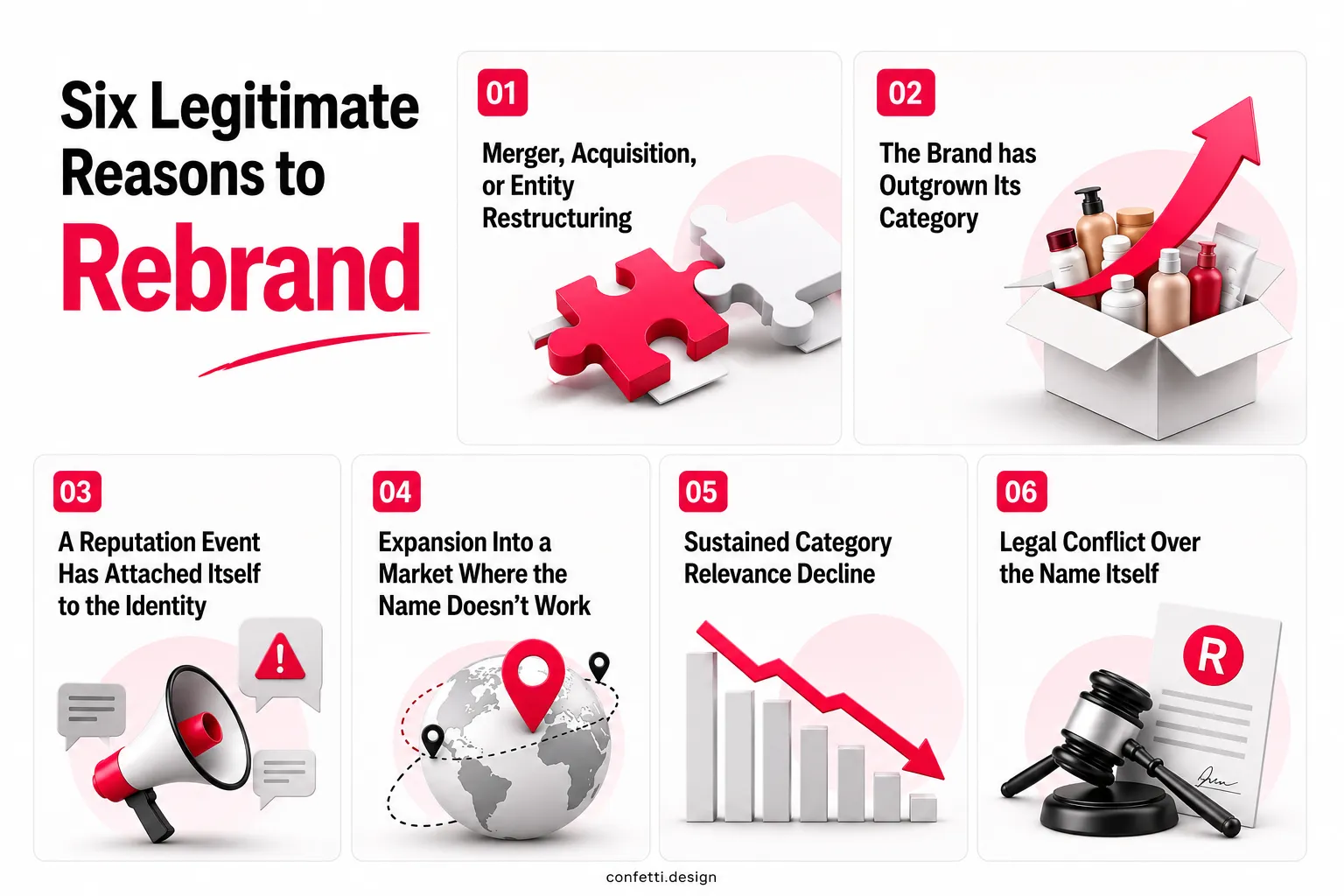
Here is a quick look at the triggers that actually justify a rebrand:
1. Merger, Acquisition, or Entity Restructuring
When two companies combine, or one is absorbed into another, the old identity often can't survive the legal and operational reality. So, rebranding is necessary.
Example: Tata's consolidation of multiple FMCG entities under Tata Consumer Products is a case of the corporate structure forcing the brand architecture to catch up, not the other way round.
2. The Brand has Outgrown Its Category
If you launched as a protein bar company and now sell breakfast cereals, snacks, and beverages, a name and identity built for "protein bars" works against you.
Every new product launch has to fight the old positioning instead of building on it. Rebranding helps in this case.
3. A Reputation Event Has Attached Itself to the Identity
A specific public event, a recall, a lawsuit, a founder controversy, that's now inseparable from the name in search results and customer memory. When the association is that direct, a refresh won't dilute it.
Only a genuine identity change, backed by real operational fixes, has a chance of resetting the narrative.
4. Expansion Into a Market Where the Name Doesn't Work
This shows up as:
Both are binary problems. You either have rights to operate under that name or you don't. No amount of brand affection changes that.
5. Sustained Category Relevance Decline
It means the language, cues, and positioning that won you customers at launch no longer match how the category is actually discussed by customers, by retailers, by category heads deciding shelf and platform placement.
You can usually see this in falling organic search share for your original positioning terms. Rebranding helps in fixing this.
6. Legal Conflict Over the Name Itself
A trademark dispute, a cease-and-desist, or a naming collision discovered during due diligence for funding or a platform listing.
Here the decision isn't really yours, legal risk forces the timeline regardless of how attached you are to the current name.
Before committing budget, timeline, and internal capital to a rebrand, plot your situation against two variables:
❓How strong your business case is
❓How much you stand to lose if the execution goes wrong
Business Case Strength
How clear and urgent the trigger is, drawn from the six legitimate reasons above.
A merger forcing a name change is at the strong end. "The team is tired of the logo" is at the weak end, because it isn't a business case at all.
Execution Risk
How much existing brand equity, customer recognition, and market trust is on the line if the change misfires.
A two-year-old D2C brand with modest awareness has low execution risk.
A 15-year-old FMCG brand with strong shelf recognition and repeat purchase behaviour has high execution risk. Customers have to unlearn something before they can relearn it.
Plot the two against each other and you get 4 positions:
"Rebrand" covers 3 distinct scopes of change, and picking the wrong one wastes either money (over-scoping) or the opportunity itself (under-scoping).
🟤Visual Refresh
The name, positioning, and core brand story stay the same.
What changes is execution, updated colour palette, refined logo, modernised packaging design, tightened visual system.
This suits brands where the idea of the brand still holds but the expression has aged. A refresh is faster, cheaper, and lower-risk, because customer recognition of the name and core proposition carries through unbroken.
🟤Partial Rebrand
Positioning shifts, and some combination of name, visual identity, and messaging changes.
This is common when a brand is expanding into a new category or geography and needs room to grow without discarding equity built in its original space.
A sub-brand or an updated tagline alongside a retained core name often does this work without the risk of a full identity break.
🟤Full Repositioning
Name, identity, and market position all change together.
This is warranted only by the highest-stakes triggers, mergers, reputation events tied directly to the name, or category outgrowth so complete that the original name actively misrepresents the business.
It's also the most expensive and highest-risk option, because it asks customers to unlearn and relearn everything at once.
Where your brand is on this spectrum depends on specifics:
We've built a structured Rebrand Scope Selector as part of our full rebranding checklist.
It walks you through the same trigger and risk questions from the Go/No-Go Matrix above, but scoped specifically to answer how much should change. See the Rebrand Scope Selector in our rebranding checklist.

A rebrand gets approved because a board, a co-founder, or an investor can see three things clearly:
Build the case on five components, in this order:
🟣 Problem: Tied to a Specific Trigger
State which of the six legitimate triggers applies, and be specific.
For example, "our current name and packaging were built for the protein-snacks category; 40% of our revenue now comes from categories the name doesn't represent, and that mismatch is showing up in quick commerce category mis-tagging and search discoverability."
🟣Cost of Inaction: Quantified Wherever You Can Get a Number
This is the part of the business case that actually convinces people. Ask yourself: what is not rebranding currently costing the business?
Look for:
If you have any brand tracking data of your own, use it that's the strongest evidence.
🟣Proposed Scope: Referencing Where You Land on The Go/No-Go Matrix
Don't just ask for "a rebrand." That sounds vague, and vague asks make stakeholders nervous. Instead, connect your ask directly back to the Go/No-Go Matrix from earlier.
Say something like: "We're in the strong-case, high-risk quadrant. So we're proposing a phased rollout."
This one sentence does two jobs for you:
Always pair your ask with the reasoning behind the scope of the rebrand.
🟣Success Metrics: Defined Before Launch
If you can't name what success looks like before you start, you can't prove the rebrand worked when you're done, and you'll spend the next board meeting defending a decision with no evidence either way.
Define 3–5 metrics tied to the original problem: category-correct search ranking, quick commerce listing approval or ranking within a defined window, brand recall in customer surveys, category mis-association rate, or revenue mix shift toward the categories the rebrand is meant to support.
🟣Risk Mitigation: How the Chosen Scope Limits Downside
If you've proposed a phased approach, say what the phase gates are and what happens if early data is weak. A founder who says "if quick-commerce SKU performance doesn't hold in the first 90 days, we pause wider rollout" is asking for a controlled bet.
And that's a much easier "yes."
A structured approach is essential for a smooth transition during rebranding. Following a clear plan helps manage complexity and ensures that no critical step is missed.
This is how to rebrand without losing customers and momentum:
Step 1: Research and Define Your Strategy
Before you change anything, you need to understand where you stand. Conduct thorough market research, analyze your competitors, and survey your target audience.
Define clear, measurable goals for the rebrand. For example, are you trying to increase market share by 15%? Attract a younger demographic? Clearly defining success will guide every subsequent decision.
Step 2: Revisit Your Core Identity
This is the soul-searching phase. Re-articulate your company's mission (why you exist), vision (where you're going), and values (what you believe in).
These statements will serve as your constitution for the rebrand, ensuring every new element is aligned with your fundamental purpose.
📌At Confetti, we run the Competitor Swap Test on your positioning. If your statement still sounds true for your closest competitor, it goes back. We don't move to design until the Angle passes.
Step 3: Develop the New Brand Elements
With your strategy and core identity as your guide, you can now work on the creative components.
This includes your brand name (if changing), logo, color palette, typography, brand voice, and messaging. Each element should tell a piece of your brand's story and work together to form a cohesive system.
Everything must tie back to a research finding. If a design decision can't be traced to a strategic insight, it's merely decoration.
Step 4: Plan Your Launch
How you introduce your new brand is just as important as the brand itself. Develop a comprehensive launch plan that covers both internal and external communication.
Your employees are your first brand ambassadors. If they don't understand the "why," your external audience won't either.
For customers, create a narrative that explains the "why" behind the rebrand and highlights the benefits for them.
Step 5: Execute the Rollout
This is where the new brand comes to life. Update all your brand assets consistently across every touchpoint.
This includes your website, social media profiles, product packaging, email signatures, and physical store signage. A staggered or inconsistent rollout can create confusion and undermine the rebrand's impact.
Step 6: Measure and Gather Feedback
After the launch, monitor your key performance indicators (KPIs) to see if you are meeting the goals you set in the first step.
Pay close attention to customer feedback, both positive and negative. Listen, iterate, and stay responsive as your new brand settles into the market.
Be prepared to listen and make small adjustments as your new brand settles into the market.
These cases are among the most documented rebrands in modern retail:
⚠️Tropicana (2009): A Refresh With No Customer Testing
In January 2009, PepsiCo replaced Tropicana Pure Premium's familiar orange-with-a-straw carton with a minimalist image of a glass of juice. There was no name change and no repositioning, this was a visual refresh. The lightest form of change on the spectrum.
Within two months, sales had dropped by around 20%. By late February, Tropicana announced it would return to the original packaging, and the old design was back on shelves within months.
On the Go/No-Go Matrix, this is a weak case, high risk rebrand that should have been validated first: a small-market test would have surfaced the recognition problem.
⚠️Gap (2010): No Business Case, No Validation, Rushed Execution
Gap replaced its 20-year-old blue box logo with a plain Helvetica wordmark, launched quietly on its website with no announcement or campaign.
Within less than a week, Gap reverted to the original 1990 logo, with a spokesperson acknowledging the backlash had made clear how much attachment existed to the old identity. Internally, the change was reportedly driven by a sense that after 20 years, "something" needed to change.
This is the clearest weak case, high risk example in modern branding history: an established, globally recognised identity changed for internal reasons rather than a documented business problem, with zero customer validation before launch.
⚠️Weight Watchers → WW (2018): A Real Trigger, Undermined by Abrupt Execution
Weight Watchers rebranded as WW in September 2018, adopting the tagline "Wellness that Works" to reposition away from diet culture and toward broader wellness, as consumer sentiment around dieting shifted and the "diet brand" label became a genuine liability.
The underlying trigger was legitimate, sustained category perception decline.
Where it differs is execution. The name change was abrupt, and the initials "WW" didn't clearly communicate what the company had become. Critics pointed out that removing the word "weight" didn't stop anyone from recognising it was still Weight Watchers.
The unfocused campaign, combined with the sudden name change and a simultaneous shift in positioning and purpose, diluted decades of accumulated brand equity among existing customers.
And the rebrand alienated loyal customers who'd used the brand for weight loss without giving the new "wellness" positioning a compelling enough reason to land with the new audience it was chasing. The result showed up directly on the balance sheet.
WW is in a harder-to-diagnose spot : a real business case, but executed as if it were lower-risk than it actually was.
A trigger tells you a rebrand is justified but it doesn't tell you now is the right moment to run it. These are two separate decisions, and conflating them is how well-reasoned rebrands still go wrong.
Three factors decide whether now is actually the right window:
🟣Operational Bandwidth
A rebrand, even a phased one, pulls attention across packaging, marketing, customer service, sales collateral, and platform listings simultaneously. If your team is already stretched on a product launch, a fundraise, or a systems migration, adding a rebrand on top doesn't just slow the rebrand down.
It degrades execution on everything else, because the same small team is now covering all of it at once. Ask honestly: who on the team can actually own this for the next quarter, and what do they stop doing to make room?
🟣Seasonal Exposure
Brands with a strong Diwali, back-to-school, or year-end sales period should treat that window as a hard no for launch, regardless of how ready the creative work is.
If you rebrand during this time and if something does not land well then it will affect your brand and revenue.
🟣What Else is on The Calendar
If you're mid-fundraise, mid-acquisition talks, or negotiating a major retail or platform partnership, a rebrand introduces a variable those conversations don't need.
Investors and partners are evaluating the business as it currently presents. A rebrand launched mid-negotiation forces everyone to evaluate a moving target instead. And if the rollout hits any friction, it becomes a live concern in a conversation where you wanted stability.

When rebranding, we start with answering: is this actually a branding problem, and is now the right time to solve it?
Every rebrand we take on gets run through a version of Go/No-Go thinking before scope is discussed. When the case is real, we help build it into something a founder can confidently bring to a board or co-founder.
Our Rebranding Process
We start with studying the founder's vision, map the competitive landscape, audit every existing brand asset, and identify whitespace the current brand isn't using.
Through deep discussions with leadership, we uncover the brand's equity, what's working, what isn't, and what customers actually value versus what the team assumes they value.
Only once that's clear do we move into strategy: defining positioning, personality, and messaging architecture, which then becomes the creative brief every designer works from.
All design decisions related to rebranding are tested against things that actually matter for your business. Will this stand out in a crowded aisle or on a mobile grid? Can this be printed consistently across packaging, at scale, within budget? Does this trigger the right emotional response at the moment of purchase?
Our focus is on success that can be measured commercially. A beautiful rebrand that doesn't sell is a failure.
We've worked across both ends of the rebrand spectrum. From heritage brands that need to earn their place on digital shelves without losing their soul, to challenger brands that need to punch above their weight against larger, better-funded competitors.
How We Rebranded Kooji
Vedashree, a car and home perfume brand from Kannauj, India's scent capital, had centuries of craft, genuine quality, and a loyal offline base. But on Amazon and Flipkart, they were invisible.
Larger, better-funded brands dominated the digital shelf, and their existing visual identity communicated function, not character.
The strategic shift: Stop communicating what the product smells like. Start showing where it takes you. We renamed the brand Kooji, after Coogee beach in Sydney, carrying memory, movement, and openness.
The logo was drawn from Google Maps screenshots of Indian roads. The packaging system runs across three product lines and twenty-four SKUs, with a consistent structural logic and a changing visual world per scent.
The result: A heritage perfume house now competes on digital shelves, not by shouting louder, but by telling a story no one else can tell.
What is a rebranding strategy?
A rebranding strategy is the set of decisions made before execution begins, whether the reason for rebranding is strong enough to justify the cost, how much should actually change, and what business case supports the investment.
It's distinct from a rebranding checklist, which covers the step-by-step execution once that decision is made.
When should a company rebrand?
A company should rebrand when there's a specific, legitimate trigger, a merger, outgrown positioning, a reputational event, international expansion conflicts, or a genuine shift in category relevance. Competitor activity or internal aesthetic fatigue alone aren't sufficient justification on their own.
What's the difference between a brand refresh and a full rebrand?
A refresh updates visual elements (colors, typography, photography style) while keeping the name, positioning, and messaging intact. A full rebrand can involve renaming, repositioning, or a complete change to what the brand claims to stand for. Confusing the two is a common cause of budget and timeline overruns.
How risky is rebranding for an established brand?
Risk scales with existing brand equity, how recognized and positively associated the current brand already is. A brand with strong recognition and loyal customers faces higher risk from an abrupt full rebrand and often benefits from a phased approach rather than a single-day change.
What's an example of a rebrand that failed?
Tropicana's 2009 packaging redesign is a widely cited example. The new design was reported to have significantly hurt sales within weeks and was reversed shortly after. It illustrates the risk of changing recognizable visual equity without adequate customer testing beforehand.
Do small businesses need a formal rebranding strategy, or just a checklist?
Even a small-scope rebrand benefits from answering the strategy questions first: is the trigger real, how much needs to change, what does success look like, before opening an execution checklist. Skipping straight to execution is how founders end up mid-project without a clear reason for the change.
Want strategic branding and packaging like this for your business?





.webp)
.webp)

.webp)
.webp)
.webp)
.webp)
.webp)







.svg)
.webp)