%201.webp)
02
AI Snaps
.svg)
.svg)
01
Our Work
03
About Us
04
Brand Audit
05
Contact Us
06
Client Success
12
07
Blogs
08
Careers
Book A Call
.svg)



.svg)
Need Help In Building Your Brand?
Click the button below & book a call with our founder directly.

Rishabh Jain
Managing Director
When hiring business branding consultants, many founders are unsure of what to expect and what they actually need.
This post covers what the brand consultant role genuinely involves, what good brand consulting output looks like, and how to decide whether it's the right investment at your stage.
A branding consultant helps a business become legible, distinct, and commercially effective in the minds of their target customers.
A consultant's real work happens before any creative execution begins:
☑️Diagnosis: understanding what is unclear, undifferentiated, or working against you in your current brand
☑️Strategy: deciding what the brand will stand for, who it's for, and how it will compete
☑️Execution: translating brand strategy into identity, messaging, and market touchpoints
A common mistake we see brands make is that they jump straight to execution. You get a logo, packaging, and a website, all well-designed, without a strategic platform underneath.
The creative work looks polished by itself but fails to create category clarity or brand preference.
Many business owners confuse a branding consultant with a branding designer or a marketing consultant, which leads to mismatched expectations.
Here's where the confusion tends to cluster:
As you can see, there is a strong overlap between these roles.
A strong branding agency like Confetti does all of the above under one roof.
A solo brand consultant generally covers strategy but depends on a design partner for execution.
What’s most important is being clear about what you're paying for and ensuring the strategic layer doesn't get skipped because an execution-first vendor is leading the engagement.
💡When founders tell us at Confetti, “our marketing isn’t working,” the real issue is often the brand foundation. Unclear messaging, inconsistent visuals, or undifferentiated positioning make marketing far less effective. Investing in marketing before fixing the brand is like pouring water into a cracked vessel. Fix the brand first, then scale the marketing.
When businesses hire a business branding consultant, they are not buying a logo. They are buying clarity about where to play, how to win, and why customers should care. That clarity compounds across every subsequent marketing penny spent.

The range of services that your branding consultant provides varies by project, but a full brand consulting engagement generally moves through the following phases.
A brand audit is where every serious engagement begins.
The consultant reviews existing brand assets, analyses competitors, interviews key stakeholders, and often conducts customer research.
This phase answers foundational questions:
Example: A mid-size Indian FMCG brand that had been positioning itself around "natural" ingredients for 5 years. A proper category audit would have revealed that three better-funded competitors had already fully occupied that space in the consumer's mind.
The positioning was just occupied. By the time the brand discovered this, 2 crore rupees in advertising had been spent reinforcing a claim that delivered no differentiation.
The audit would have cost a fraction of that.
Our brand audits of Indian D2C brands including deep-dives into how brands like Mamaearth, The Whole Truth, Sleepy Owl, and Paper Boat built their market positions, consistently show that the brands that scale have one thing in common: clear, ownable, research-backed positioning that competitors haven't already claimed.
Brand positioning is the single most valuable output of strategic branding. It defines the unique space a brand owns in the customer's mind.
The messaging hierarchy translates that positioning into a structured system of brand pillars, value propositions, and a distinctive tone of voice.
Good positioning creates instant category clarity. It tells a consumer in say 2 seconds at shelf, or in a half-second scroll, exactly what kind of brand this is and whether it's for them.
A three-part test for positioning quality:
All three must pass.
Example:
A brand that claims "premium quality at an accessible price" usually fails the distinct test.
A brand that claims "made for endurance athletes" may fail the relevant test if it's actually trying to reach casual fitness enthusiasts.
Positioning decisions are difficult because they require making deliberate choices to exclude certain audiences and reject certain claims. Most businesses resist this. Consultants worth hiring help clients make those choices and hold them to it.
Here, the consultant defines what the visual identity must communicate before a designer picks up a brief.
The consultant briefs the design team on the underpinnings of every visual decision. The colour palette chosen to signal specific brand attributes. The typography selected for legibility across packaging, digital, and print.
Confetti's brand identity design framework uses core components like logo, colour palette, typography, brand voice, and imagery style to build recognisable systems that work across every touchpoint.
The result is not a logo file. It is a brand guidelines document that tells everyone how to use the identity consistently.
Portfolio brands face a specific challenge: how do different products or sub-brands relate to each other? This is the domain of brand architecture.
A consultant helps decide whether to use a branded house model (like Virgin), a house of brands model (like Unilever), or a hybrid approach.
Naming follows architecture. A branding consultancy company conducts linguistic checks, trademark searches, and domain availability assessments.
A poorly chosen name creates legal liability and customer confusion. A well-chosen name encodes competitive advantage.
For product-based businesses, packaging is the most critical brand touchpoint.
A branding consultant who understands retail and D2C dynamics knows that packaging must balance shelf impact, regulatory compliance, and structural functionality.
In India, packaging design must also navigate FSSAI compliance, mandatory labelling requirements, and export regulations if the brand distributes internationally.
A consultant with packaging expertise ensures the visual identity translates onto physical packaging without losing fidelity or breaking legal requirements.
And finally, a service often overlooked: implementation support.
A consultant does not simply hand over a PDF and disappear. They provide brand guidelines that document every rule, create asset libraries, and often conduct training sessions with internal teams.
The difference between a brand that succeeds and one that fades is consistency. A brand that is applied differently on Instagram, packaging, and the website is not a brand. It is a collection of disconnected assets.
Not every business needs one. And not every business that needs one is ready for one. Here are the specific conditions where you can benefit from branding consultant services:
1. Launching a new product in a crowded category
If you're entering a category with established players and funded D2C brands already active, you need an expert defined positioning strategy before you need packaging.
Take the nutraceutical or confectionery categories. Without a clear positioning, your product becomes interchangeable.
See how we handled Miduty branding and packaging, building a positioning that earned shelf and digital authority in a saturated space.
2. Rebranding after growth or a market shift
Your brand was built when the business was smaller, younger, or aimed at a different customer. Now the business has outgrown it. The visual identity sends the wrong signals. The messaging no longer matches what you actually deliver.
This is one of the most common situations we see. The brand has genuine equity: real customers, real repeat purchase, but the identity is holding the business back from the next stage.
3. Entering a new channel
A brand that sells on Instagram doesn't automatically work on modern trade shelves. The visual cues, hierarchy, and communication logic are completely different.
Moving from D2C to quick commerce onboarding or general trade is a brand challenge, not just a logistics one and you need experts that can handle these challenges
4. Competing against scaled or funded brands
When your competitive environment becomes more sophisticated: funded competitors, private labels, international entrants: intuition-based branding works no longer.
The bar for visual quality, messaging clarity, and identity coherence rises. A branding consultant helps you compete at that bar without necessarily having the same budget.
5. Preparing for distribution expansion or investment
Distributors and investors read your brand before they read your pitch deck.
A brand that looks like a start-up experiment signals a different level of ambition than one that looks like a market contender.
Brand coherence is treated as a proxy for business maturity.
6. Existing brand feels inconsistent across touchpoints
This is the most common trigger for small and mid-sized businesses. The logo looks one way on the website, another way on Instagram, and a third way on the product box.
The messaging shifts depending on which team member wrote the copy.
Inconsistency erodes trust faster than poor design. A branding consultant diagnoses where the fragmentation exists and builds a unified system.
7. Marketing spend is rising but recall is falling
You are spending more on Meta ads, Google Shopping, or influencer campaigns, but brand recall metrics are flat or declining. Customers do not remember your brand after seeing the ad.
The problem is mostly with the brand foundation. Without distinctive brand assets and a clear messaging hierarchy, marketing creative becomes forgettable. A branding consultancy fixes the root cause so that every marketing dollar works harder.
Branding amplifies what already works. It doesn't create demand where none exists.
If you haven't validated product-market fit, a branding consultant can't save you.
If you don't have clarity on who your primary customer is, any positioning work will be built on unstable ground. If there's no internal owner for brand decisions, the strategy document will sit unused and nothing will change.
Signs you're not ready:
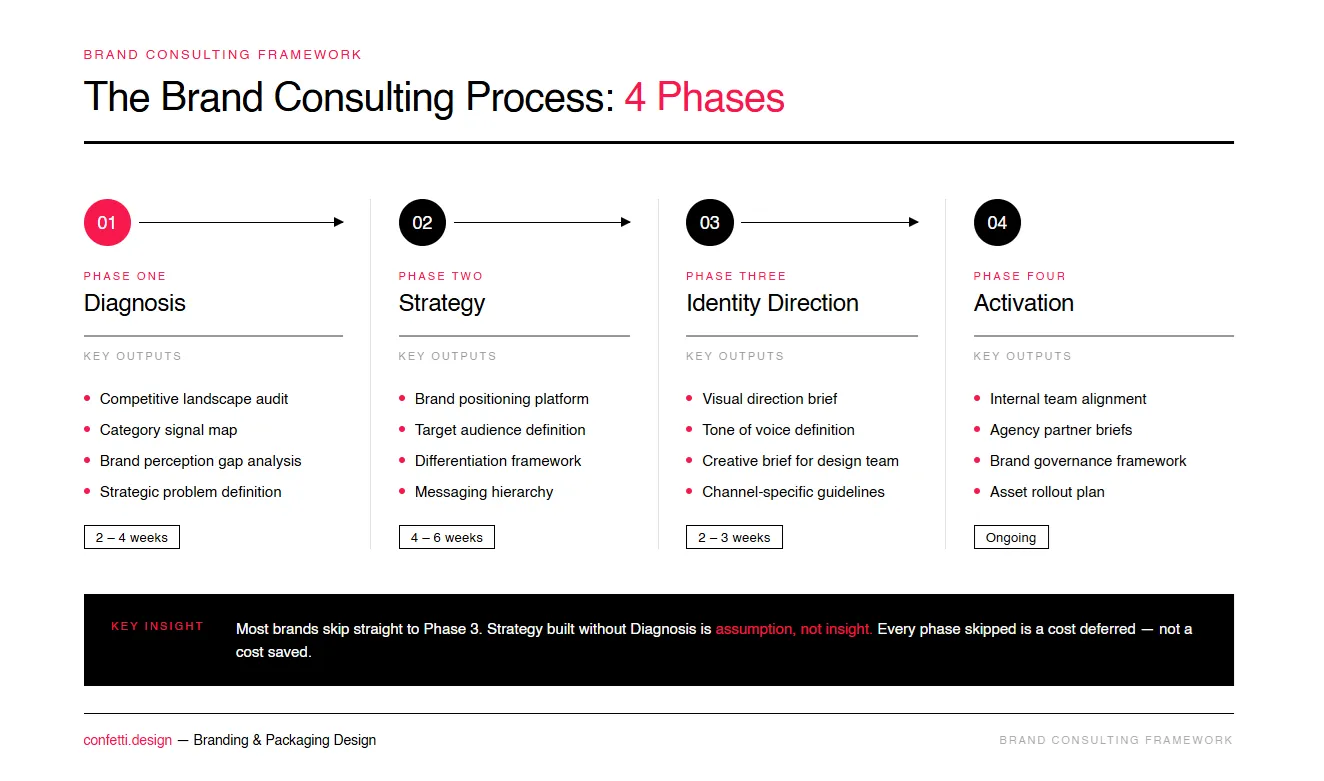
Many business owners hire a branding consultant services provider and receive nothing more than a few meetings and a slide deck. That’s not how it's supposed to happen.
A rigorous branding strategy consultant follows a structured, milestone-driven process. Here is what should actually happen, phase by phase.
❓Answers:
This phase includes competitive landscape analysis, category mapping, consumer research (interviews, surveys, or retail observation depending on budget), audit of current brand assets and messaging, and stakeholder alignment sessions.
The output is a diagnosis document: where the brand stands now, what's working, what's working against it, and what strategic questions must be resolved before direction is set.
At Confetti, we add a layer of forensic audit. For product brands, we examine SKU databases, supply chain constraints, and retail compliance requirements. For D2C brands, we audit every digital touchpoint from homepage to checkout email.
❓Answers:
This phase produces the brand's core positioning platform. The output is a brand strategy document.
Do not accept a positioning that sounds like every other brand. A good brand consultant pushes back on generic claims like "premium quality" or "customer-first approach." Look for specific, defensible positioning.
❓Answers:
The consultant briefs designers on the strategic guardrails like what the brand must communicate, what it must avoid, and where it can flex. Multiple visual directions are explored and presented against the strategy.
Once a direction is approved, the team develops the full visual identity system: logo variations, colour palette, typography, imagery style, iconography, and application mockups. For product brands, this includes packaging mockups across primary, secondary, and tertiary packaging.
Our brand identity design work always begins from this point. The brief is treated as a strategic document, not a formality.
❓Answers:
This phase covers: aligning internal teams on the new brand direction, briefing agency or design partners correctly, building governance around brand decisions, and creating a rollout plan for existing assets.
The Brief → Build → Govern cycle is where most brand projects break down. Companies invest in Brief and Build, then skip Govern, and within 12 months, the brand has drifted back to inconsistency.
❌The consultant promises deliverables before discovery is complete
❌You receive a logo without a positioning document
❌No one interviews your customers or frontline sales team
❌The process has no defined milestone or timeline
❌You are asked to approve visual work without seeing how it applies to packaging or digital

Talk to Confetti experts about branding strategies that help your business connect and grow.
Book a Strategy Call
After 12–18 weeks of strategic work, you should not just receive a folder of logo files.
You should receive a brand system that your entire organisation can use, defend, and extend.
A complete branding engagement produces four distinct layers of output:
📋Strategy Foundation Documents
You should receive a brand positioning document that defines the brand’s owned perceptual space, adjacent competitors, and supporting evidence.
The messaging architecture should outline core messaging pillars, audience-specific value propositions, and tone-of-voice guidelines with clear do’s and don’ts.
At Confetti, we documented exactly this strategic foundation for The Indus Valley before any visual work began. Without this layer, you have decoration, not direction.
📋Visual Identity System
A complete visual identity includes logo variations, a colour palette (CMYK, RGB, and hex codes), typography guidelines, imagery standards, and supporting graphic elements.
Beyond these assets, a strong brand system explains the rationale behind each design choice. Look for guidelines that explain why colours, fonts, and visual elements were selected, not just how to use them.
📋Application Toolkit
The brand must work across real touchpoints.
A good brand consulting firm provides templates for stationery, email signatures, presentation decks, social media graphics, and advertising formats.
📋Governance and Rollout Plan
This is the most frequently omitted deliverable.
You should receive a plan for how to migrate existing assets, who approves new applications, and what metrics track brand consistency. Without governance, your investment erodes within months.
Cost varies significantly based on scope, seniority, and whether you're engaging a solo consultant, a boutique agency, or a full-service firm.
These are just indicative costs. Several factors increase investment beyond baseline estimates:
At Confetti, we custom-scope each engagement based on the complexity of the brand architecture, number of product lines, and whether packaging design is included.
Our process mirrors the arc described in our complete branding timeline guide.
Most consultancies separate strategy from execution.
We built Confetti differently. Our method combines strategic consulting with execution capability under one roof.
This means the same team that defines your brand positioning also designs your packaging, your website, your retail materials, and every touchpoint in between.
We use a four-stage framework — Lock → Flex → Navigate → Scale — to structure brand-building for growing businesses:
This framework prevents the most common failure mode: brands that shift their core positioning every time a new campaign or channel demands something different, and over time lose the coherence that built customer trust in the first place.
Choosing the right branding consultant can create long-term value; the wrong one can waste time and budget.
1. Match the Consultant to Your Needs
Different problems require different consulting models. Diagnose your need first:
2. Evaluate the Process, Not Just the Portfolio
A strong portfolio shows creative ability, but it does not reveal how a consultant works.
Ask candidates to explain their approach to research, strategy development, design, stakeholder feedback, and implementation.
A clear, repeatable process is often a better indicator of success than attractive visuals alone.
3. Verify Category and Channel Experience
Branding challenges vary by category, channel, and market.
A consultant experienced in consumer products, e-commerce, retail, or B2B branding will better understand the specific constraints and opportunities in your sector.
For product-based businesses, packaging and regulatory knowledge should be part of the evaluation.
4. Assess Strategic Thinking
Use interviews to test how candidates think. Ask how they measure success, handle disagreements, validate decisions, and learn from past mistakes.
Strong consultants can explain the reasoning behind their recommendations and connect branding decisions to business outcomes.
5. Check References and Compare Value
Speak with recent clients and ask about results, communication, timelines, and long-term brand performance. Finally, compare proposals based on value delivered rather than cost alone.
A comprehensive engagement that includes strategy, design, guidelines, and implementation support often delivers a stronger return than a lower-cost project with limited scope.
1. Can you show me work in my category, or a closely adjacent one? Evidence of category understanding, not just design quality.
2. What does your research process look like, and how long does it take? A research phase that takes less than 2 weeks is almost certainly surface-level. Push for specifics: what sources, what methods, what outputs.
3. How do you ensure positioning is commercially grounded, not just creatively interesting? Should reference how competitive territory is mapped and how consumer decision-making is incorporated.
4. What exactly will I receive at the end of each phase? Specific deliverables, not vague descriptions like "a brand deck" or "a strategy document."
5. Have you worked with brands at my stage: launching, scaling, or rebranding? Each stage requires a different strategic approach. Experience at one doesn't automatically transfer to another.
6. How do you handle the handoff to design or internal teams? If the answer is "we send you the deck," that's a red flag. The brief is where strategy becomes executable.
7. What does "done" look like in your engagement model? A good consultant is clear about when their role ends and what the client team needs to own after that.
8. Do you have Chosen Location-specific retail or digital commerce experience? Every market has specific dynamics: category competition structures, ecommerce growth, regional consumer preferences, FMCG distribution chains. Consultant needs to understand that.
💡The best branding consultancy company for your business is the one that asks hard questions about your business model, your customers, and your competitive landscape. Look for strategic tension, respectful disagreement that pushes your thinking.
What does a branding consultant do?
A branding consultant helps a business define who they are, what they stand for, and how they should be perceived in the market.
Their work covers brand audit, competitive analysis, positioning, messaging architecture, and visual direction.
What is the difference between a brand consultant and a brand strategist?
A brand strategist focuses primarily on long-term positioning direction and growth frameworks.
A brand consultant tends to have a broader mandate: diagnosing current brand performance, facilitating strategic decisions, and ensuring strategy translates into executable direction for design and messaging teams.
When should a business hire a branding consultant?
Hire one when you're launching in a crowded category, rebranding after significant growth, preparing for a new channel, or facing a visible disconnect between how your business has evolved and how your brand still looks and sounds.
Don't hire one before you have product-market fit or a clear picture of who your primary customer is.
What should a branding consultant deliver?
At minimum: a research-backed positioning statement, a defined target customer profile, a competitive differentiation map, a messaging hierarchy, and a visual direction document.
Measure the quality by specificity and commercial grounding. A positioning statement that doesn't make specific choices is not doing its job.
Can a branding consultant help a D2C or FMCG brand specifically?
Yes and category experience is important here. D2C and FMCG brands face a channel-specific challenge: the brand must perform simultaneously on packaging, product listing pages, social content, and retail shelves.
A consultant with category experience understands the visual constraints, category conventions, and competitive dynamics of each channel. A generalist approach often produces strategy that works in theory but fails in the specific context of Indian retail or quick commerce.
Want strategic branding and packaging like this for your business?





.webp)
.webp)


.webp)
.webp)
.webp)
.webp)
.webp)







.svg)
.webp)