%201.webp)
02
AI Snaps
.svg)
.svg)
01
Our Work
03
About Us
04
Brand Audit
05
Contact Us
06
Client Success
12
07
Blogs
08
Careers
Book A Call
.svg)



.svg)
Need Help In Building Your Brand?
Click the button below & book a call with our founder directly.

Rishabh Jain
Managing Director
Most packaging design agency deliverables list concepts, revisions, and final artwork, but that doesn’t always mean it’s production-ready.
This checklist is actionable. It covers the operational deliverables that should be defined upfront, in the sequence decisions need to happen, to minimise rework, delays, and unexpected costs.
A packaging design proposal that lists "concept development," "revisions," and "final artwork" is only telling you less than half of what you actually need.
The remaining is the production infrastructure that determines whether the design is compatible with the printer, retailer, and regulatory body.
The deliverables should help ensure the approved design can actually be manufactured, printed, adapted across SKUs, and handed over to your team.
A complete packaging engagement covers three connected areas:
A visual preview is not the same as a production-ready file. A 3D render can show the intended look, but it doesn’t confirm the artwork fits the manufacturer’s actual template, dieline, seals, or gussets.
For example, a snack pouch may look correct in a presentation while the actual printer's gusset or seal area differs from the template used by the designer. If important front-of-pack information sits too close to the seal, the printed result can be compromised. That is why structural confirmation and production specifications should be addressed before final artwork is approved.
The same applies when you have multiple SKUs. If every new flavour or variant requires the agency to rebuild the artwork from scratch, the original design has not been developed as a scalable packaging system.
What to check in a proposal
Look beyond terms such as "final artwork" or "print-ready files." Ask:
A strong packaging proposal should make the path from approved concept to manufactured pack clear. If that production layer is missing, the deliverables list may look complete while leaving the most expensive part of the process unresolved.
The dieline is the foundation of packaging production. It defines the physical area in which the artwork has to work, including where the pack will cut, fold, seal, glue, or wrap. A polished design is of little value if it does not fit the actual structure being manufactured.
A credible packaging engagement should therefore address structure before final artwork, especially for custom or technically complex formats.
1. Structural brief
One to two pages documenting the product dimensions, weight, target retail channel, packaging format, material preferences, and production constraints.
This brief should be signed off before any dieline is drawn. It defines the canvas. If the agency doesn't produce a structural brief, the dieline will be built on assumptions.
2. Production-ready dielines
You should receive the correct dieline for every packaging format in scope, whether that is a carton, pouch, label, sleeve, bottle, or secondary pack.
The dieline should show relevant cut and fold lines, glue or seal areas, bleed, safe zones, and other production requirements. It should be supplied at the correct scale in an editable format suitable for the printer or converter.
For standard stock packaging, a bespoke structural drawing may not be necessary. For custom shapes or mechanisms, it becomes much more important.
3. Material and substrate recommendations
The proposal should clarify whether the agency is responsible for recommending or working with the selected material or substrate.
Material affects more than appearance. It can influence structural strength, print methods, cost, finishes, and how the pack performs during storage, retail handling, or delivery.
A pack designed for a retail shelf may have different requirements from one that needs to survive courier handling and doorstep delivery.
4. Physical prototype or structural sample
A physical or digital prototype of the packaging structure, built to the dieline, to test fit, function, and assembly. This is where structural failures surface before a print run commits to thousands of units.
For e-commerce formats, the prototype should be tested for drop and compression resistance. For retail formats, it should be tested for shelf fit and visual hierarchy at distance.
5. 3D structural visualisation
Photorealistic renders of the final pack, built from the artwork and the dieline, showing how the design reads in three dimensions.
These serve three purposes: internal approval, retailer sell-in, and e-commerce listing imagery.
6. Dieline-to-artwork confirmation
The agency should confirm that the final artwork has been mapped correctly to the approved structure.
This includes checking bleed, safe zones, folds, seals, and the placement of critical information such as the brand name, variant, barcode, and regulatory copy.
7. Structural system for future SKUs
If you expect new flavours, sizes, or variants, ask how the structure will scale.
A useful packaging system should make it possible to adapt approved formats without rebuilding the entire design every time.
Check: Who is responsible for confirming that the final artwork fits the actual production structure? If the answer is unclear, the proposal has a gap.
The goal is not to add technical deliverables simply to make a proposal look comprehensive. It is to make sure the approved design can move from screen to sample to production without expensive surprises.
This is where packaging design meets manufacturing. The artwork deliverable is the production file that the printer can run without questions.
1. Layered and editable source files
Ask for the editable master files, like Adobe Illustrator, InDesign, or another agreed production format, alongside the final print files.
Layers should be clearly named and organised so future designers can make SKU changes without rebuilding the artwork. Final production files may have text converted to outlines where required, but editable versions should preserve live text and linked or embedded assets where appropriate.
2. Correct bleed, trim, and safe zones
Artwork should be built against the approved production dieline. The file should account for bleed, trim, folds, seals, glue areas, and safe zones for important information.
The exact bleed requirement depends on the printer, substrate, and format, so the agency should work to the production specifications rather than assume one number applies to every pack.
3. Colour specifications
The artwork should use the colour mode and specifications required for the chosen printing process. This may include CMYK builds, Pantone or other spot-colour references, and specifications for finishes such as foil, embossing, debossing, or spot UV.
Where packaging visuals will also be used online, RGB and HEX equivalents may be useful for ecommerce listings and digital marketing.
4. Preflight and production checks
A proper preflight should check issues such as image resolution, colour mode, fonts, bleed, overprint settings, linked assets, and the printer's specific requirements.
"Print-ready files" should not mean the agency simply exports a PDF and sends it to you. Ask who is responsible for the final production check.
5. Proof and approval
For colour-critical packaging, ask whether the process includes a physical proof or pre-production sample on the intended substrate. A screen cannot reliably show how ink, paper, film, board, or finishing processes will look in production.
The approval process should clearly identify who signs off the final proof before the full run begins.
6. Printer handoff package
The final production package should include the format required by your printer, such as a print-ready PDF/X-4, with the approved dieline, bleed, trim, safe zones, and other production requirements correctly applied.
The printer should not have to guess what the agency intended.
7. Adaptation files for future SKUs
If the packaging is designed as a system, source files should be structured for future variants. Shared layouts, master elements, and variant-specific layers make it easier to introduce a new flavour, size, or product without rebuilding the artwork from scratch.
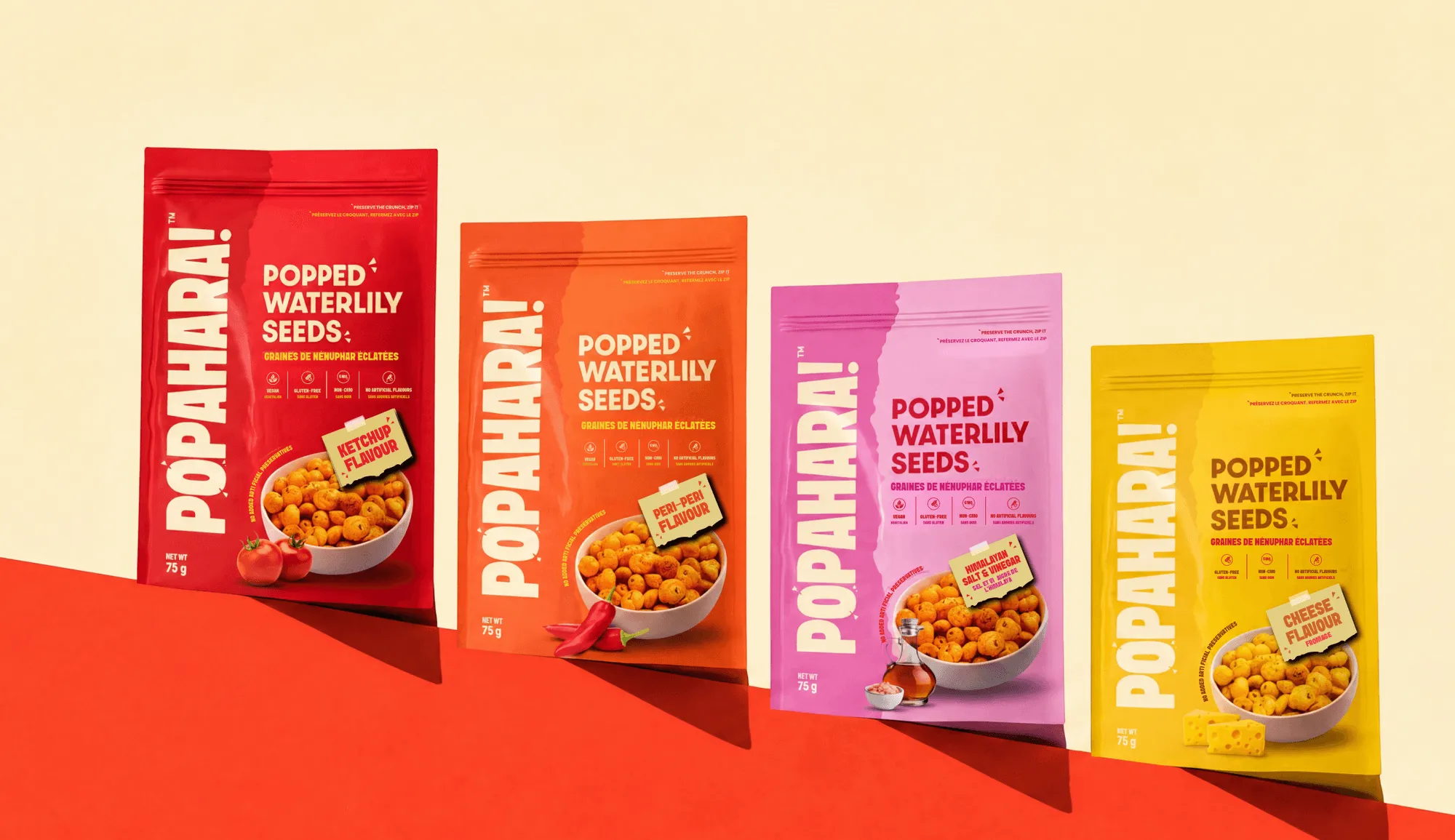
A single-SKU project and a multi-SKU launch are different scopes of work. When you have several flavours, sizes, variants, or pack formats, the deliverable is a system that keeps the range recognisable while making each variant easy to identify.
1. Master artwork templates
The agency should create master files for each packaging format, with shared elements such as the logo, brand name, information hierarchy, and core graphics separated from variant-specific elements such as flavour names, colours, illustrations, or product descriptors.
A new SKU should be an adaptation of the approved system, not a new design project.
2. Variant adaptation rules
The agency should document what changes and what stays fixed across the range. This can include colour rules, variant naming, illustration styles, product hierarchy, and placement of key information.
Check: could an internal designer or production artist create the next SKU without guessing what the original designer intended?
3. Format-specific deliverables
Different packaging formats create different design and production requirements. Make sure the proposal identifies which formats are actually included rather than treating every application as a simple variation.
If several formats are involved, ask whether each requires a separate master artwork file, dieline, adaptation, proof, and production handoff.
4. Portfolio hierarchy
A strong SKU system needs to work both individually and as a family. The deliverables should show which elements remain consistent to build recognition and which change to distinguish variants.
Check this at shelf distance and ecommerce thumbnail size, not only in individual presentation mockups.
5. Range-level mockups
Ask for mockups showing the full range together. These can reveal weak differentiation, inconsistent hierarchy, or one variant overpowering the rest.
6. Barcode, SKU, and version management
For larger portfolios, clarify who handles barcode placement, SKU codes, mandatory variant information, and retailer-specific requirements.
Ask how versions will be named, approved, and updated so operational changes do not create conflicting artwork files.
7. Future and multi-market adaptations
If you expect new SKUs, pack sizes, or markets, ask whether the master system can accommodate them. Market-specific regulatory information, translations, or labels should ideally be handled through a documented adaptation process rather than rebuilding the master artwork.
Compliance is one of the deliverable areas buyers most often assume is included in "artwork". However, in many cases, it may be a separate line item, handled by a regulatory consultant, or left entirely to the client.
Confirm who is responsible before signing the proposal.
This is even more important when packaging will be sold across different markets. A snack exported to the UAE may require mandatory Arabic labelling to meet GCC regulatory compliance requirements. A breakfast cereal entering the United States must display nutrition information using the FDA-approved Nutrition Facts format.
1. Market-specific labelling checklist
For each market in scope, the agency should identify the applicable requirements for items such as:
This should happen early enough to influence the artwork, rather than being discovered during final production.
2. Regulatory copy review
Ask whether mandatory copy is actually checked or simply placed into the design. A proper review should confirm that required information is present, correctly formatted, legible, and positioned away from folds, seals, or other areas that could obscure it.
Design approval and compliance approval are not necessarily the same thing. Your proposal should make clear whether both are included and who provides the final regulatory sign-off.
3. Material and packaging compliance
If the agency is advising on substrates, inks, adhesives, coatings, or finishes, clarify whether relevant compliance documentation is included.
This becomes particularly important for food, cosmetics, pharmaceuticals, and other regulated categories where packaging materials can be subject to specific requirements.
4. Sustainability and environmental claims
If the pack makes claims such as recyclable, compostable, recycled content, or other environmental statements, ask who is responsible for substantiating them.
The agency may help design and phrase the claim, but the business may need evidence or certification from the relevant supplier or authority. Do not assume that including a claim in the artwork makes it legally acceptable.
5. EPR and market-entry guidance
If you are launching in markets with Extended Producer Responsibility requirements or other packaging obligations, clarify whether the agency provides any guidance on how these requirements affect packaging decisions.
This does not necessarily need to be a full regulatory consulting service. Even a market-entry checklist identifying responsibilities, documentation, and decisions that need specialist review can prevent gaps.
Check:
If the answer is "your team" or "a separate consultant," that is perfectly workable, but it should be clear in the proposal. The important thing is knowing whether compliance is included, excluded, or dependent on another party before the artwork reaches production.
Most packaging checklists focus on what gets designed. The commercial terms determine what happens to those assets after the project, who can use them, and what support you receive once the files leave the agency.
Intellectual property and structural file ownership
Payment for design work does not necessarily mean every underlying asset automatically becomes yours. Confirm in writing that the final packaging artwork, dielines, structural drawings, CAD files, 3D models, and other agreed production assets transfer to you on completion and full payment.
This is important if you change printers, launch a new SKU, or work with another agency later. You should not discover that you only have permission to use a flattened file for one production run.
Also clarify what happens to rejected concepts. Agencies may retain rights to unused directions, so the agreement should state whether rejected concepts remain with the agency and whether any portfolio or reuse rights apply.
Revision rounds and change requests
“Revisions included” is too vague. Ask how many concept and refinement rounds are included and what qualifies as a revision.
A colour adjustment within an approved direction is different from reopening a rejected concept. A copy change is different from changing the structure after the dieline has been confirmed. These can require very different amounts of work.
A well-scoped proposal defines the included rounds and explains how additional work is priced.
Vendor coordination and post-launch support
Ask whether the agency coordinates directly with your printer, converter, packaging manufacturer, or other production vendors. Some agencies manage these conversations; others provide the final files and consider the engagement complete. Either model can work, but the difference affects your team's workload.
Also clarify what happens after launch. If you add a flavour, size, seasonal pack, or minor copy update, can the original team handle it as an extension of the existing system, or does every request require a new proposal?
Handover, licensing, and confidentiality
The contract should specify the final handover package, including editable source files, structural files, production assets, and agreed renders or supporting files.
Check licensing for fonts, stock imagery, illustrations, and other third-party assets. Make sure commercial packaging use and any transfer or future modification rights are covered.
Finally, clarify portfolio and confidentiality terms. If the packaging is commercially sensitive, agree when the agency can publish the work and what business information cannot be disclosed.
A checklist is useful for reviewing one proposal. A scoring framework makes it easier to compare several agencies against the same standard.
Set your criteria before reviewing proposals, then weigh them according to what matters most to your business. For a packaging project, a practical scorecard could look like this:Score each criterion from 1 to 5, then calculate the weighted score:
Structural and dieline deliverables: 20%
Dielines, material recommendations, prototypes, structural adaptations, and dieline-to-artwork mapping
Print-ready artwork: 20%
Print-ready PDF/X-4, layered AI or packaged InDesign files, colour specifications, prepress checks, and proofing
SKU and variant system: 15%
Master templates, variant adaptation, hierarchy, and a system that can scale beyond the first launch
Compliance and regulatory scope: 15%
Market-specific labelling checks, compliance responsibilities, and clarity on what the agency does versus what the client must approve
Commercial and ownership terms: 15%
Ownership of artwork and structural files, revision limits, licensing, handover, and exit terms
Production support and handoff: 10%
Printer coordination, proof oversight, production queries, and artwork adaptation
Team and account ownership: 5%
Who actually creates the work, manages production files, and handles the account
Weighted score = (Your score ÷ 5) × Category weight
Imagine you are comparing a packaging agency proposal for a four-SKU food launch. After reviewing the scope, you score the agency as follows:
The agency scores 80/100. That does not automatically make it the right choice. The 3/5 scores reveal where you need to ask questions before signing.
For example, does the agency's compliance scope cover your target markets, and does production support include printer coordination or simply file delivery?
If another agency scores 86/100 but charges significantly more, you can now compare the additional scope against the extra fee rather than choosing based on price alone.
A score below 3 on structural or print-ready deliverables should trigger production questions. A score below 3 on commercial and ownership terms deserves clarification before you proceed.
A design isn’t finished until a printer can run it. That’s why we don’t hand over “final artwork” as an undefined line item.
We deliver print-ready PDF/X-4 files built on verified dielines, layered source files with editable text preserved, Pantone confirmations for every spot colour and finish, and pre-production approval samples checked against the design intent. Each item exists because its absence causes a specific production failure.
For Novis, a bakery brand launching across three product categories and twelve SKUs, the deliverables layer was what made the system work.
The packaging held one logic across every variant: wordmark top left, product name central, a flavour-specific illustrated character, and a colour accent tied to its category.
The master artwork template separated shared layers from variant layers, so a new flavour could be adapted by changing the variant layers without rebuilding the file.
The identity held across twelve SKUs without losing coherence, and the system was structured to absorb new products as the brand grows.
That’s the difference between delivering concepts and delivering a system. The concepts are the visible layer. The system is what allows the brand to scale without redesigning from scratch.
If you’re comparing proposals, ask who builds the dieline, what the prepress checklist covers, and whether a variant adaptation guide is included. Those questions reveal whether you’re buying a design or a production-ready package.
What files should I receive from a packaging design agency?
At minimum: confirmed dieline or structural drawing files, print-ready artwork (typically PDF/X-4), layered editable source files, Pantone or spot color confirmation, and a signed-off pre-production approval sample. A flattened PDF alone isn't sufficient for production or future revisions.
What's the difference between a dieline and a structural drawing?
A dieline is the flat technical layout showing how a package folds and cuts, used for standard formats. A structural drawing goes further, specifying dimensions, tolerances, and material behavior for a custom shape, such as a bespoke box, tray, or closure mechanism.
Do I need a physical pre-production sample before printing?
Yes, for any project where color accuracy or structural fit matters. Screen and digital proofs don't reliably predict how color and structure behave on the actual production substrate, so sign-off should happen on a physical sample run on the real material, not a mockup.
Who owns the dieline and structural files after the project ends?
This should be confirmed explicitly in the contract, not assumed. Structural files are production assets, without them, a reprint or a switch to a new vendor can stall. Confirm that dielines and structural drawings transfer to you, not just the flattened artwork.
Can the same packaging system scale across multiple SKUs and formats?
Yes, if it's designed as a system from the start rather than as a single hero SKU. That means defining what stays fixed (structural format, logo placement, hierarchy) and what varies (flavor or variant cues) as its own deliverable, not something worked out ad hoc as each new SKU is added.
Want strategic branding and packaging like this for your business?





.webp)
.webp)

.webp)
.webp)
.webp)
.webp)
.webp)







.svg)
.webp)