%201.webp)
02
AI Snaps
.svg)
.svg)
01
Our Work
03
About Us
04
Brand Audit
05
Contact Us
06
Client Success
12
07
Blogs
08
Careers
Book A Call
.svg)



.svg)
Need Help In Building Your Brand?
Click the button below & book a call with our founder directly.

Rishabh Jain
Managing Director
The packaging vs labeling difference is not as simple as most brands think, plus the implications of getting it wrong can be damaging.
Packaging is the physical container that holds your product; labeling is the printed information on it.
This Confetti guide covers how the two differ across function, materials, cost, legal compliance, and brand impact, and why designing them as separate decisions is one of the most common and costly mistakes in product launches.
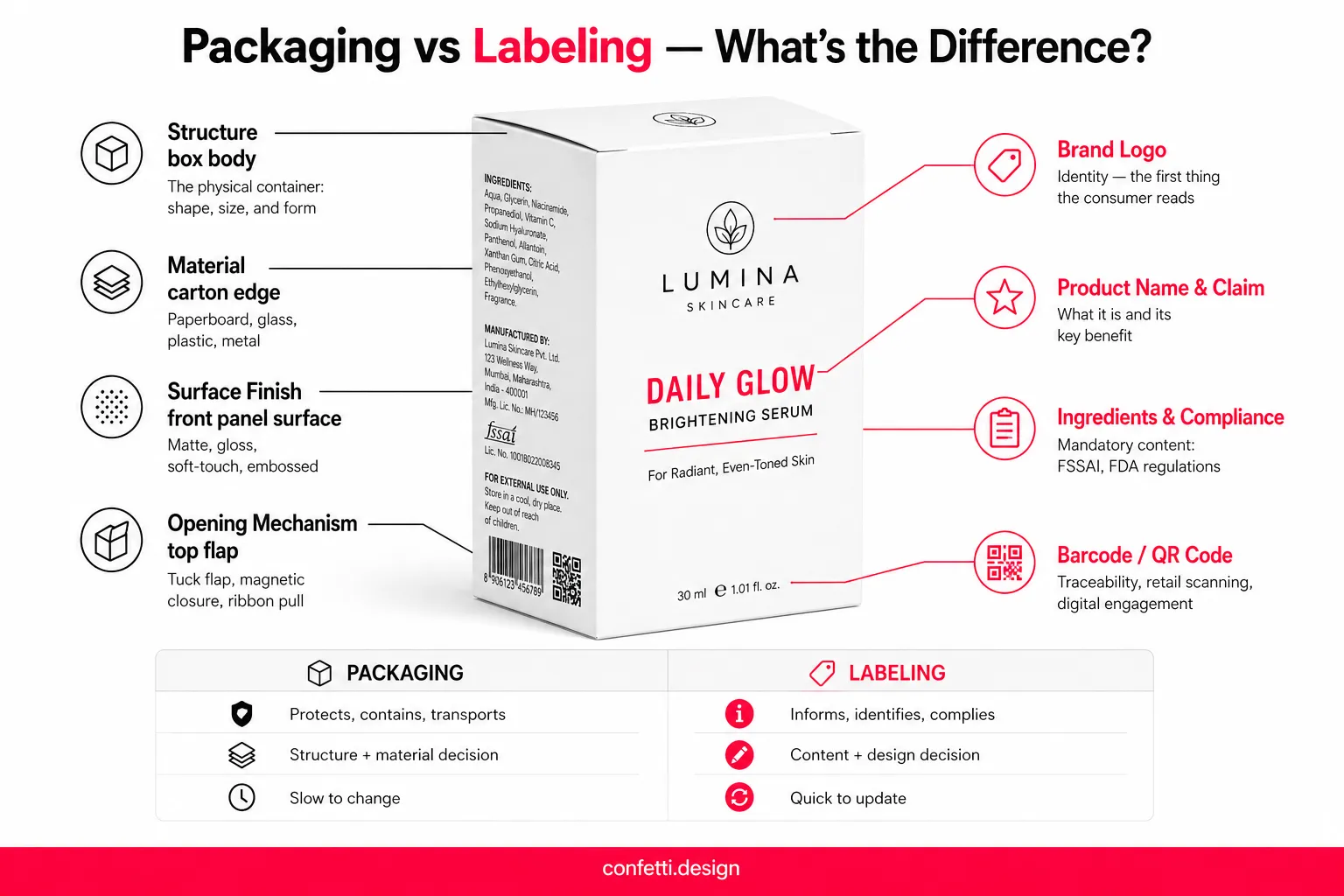
Product packaging is the physical structure used to contain, protect, and transport a product, from the factory floor to the consumer's hands.
It includes the materials, shape, and design of the container itself. A glass bottle, a cardboard box, a resealable pouch, a blister pack, all is packaging.
Packaging serves six non-negotiable functions.
Example: In a cereal box, the cardboard holds the bag, which holds the flakes. That’s containment. The box’s rigid structure stacks on pallets and shelves, that’s logistical protection.
The inner liner keeps cereal crisp: preservation. And the bright graphics scream “buy me” that’s retail display and communication.
Three Levels of Packaging
Packaging is your cheapest form of advertising. Eye-tracking studies suggest that a customer spends 2-6 seconds scanning a shelf. Your package design either earns their attention or loses it to the competitor 3 inches away.
So product packaging is a strategic asset, the first physical point of contact between your brand and a stranger. And you have exactly that glance to make it count.
Labeling is the information layer applied to the package. A label can be a sticker, a printed area directly on the box, a hang tag, or even an embossed logo. Where packaging is the container, labeling is the content written on that container.
It tells the consumer who made this, what's in it, how to use it, and what they need to know before buying. It also tells regulators that the brand has met its legal obligations.
A product label carries two types of content: mandatory and voluntary.
Mandatory content (required by law, varies by category and country):
Voluntary content (brand-controlled):
Brands that treat labeling as a legal checkbox miss the opportunity it represents.
The back panel is real estate. The ingredient list can tell a sourcing story. The certifications can build trust. The QR code can connect the physical product to a digital brand experience.
Four Types of Labels
The best labels designed by branding and packaging design experts like Confetti are designed with the same intentionality as the front panel. They don't just inform, they reinforce why this product is worth buying.
The differences between packaging and labeling is deeper than function.
Understanding each dimension helps you make better decisions, whether you are launching a product, rebranding an existing one, or evaluating a vendor.
📦Packaging's job is physical.
Its job is physical: keep the product inside, safe from impact, light, moisture, and contaminants. Without packaging, a liquid spills, a cookie crumbles, a pill degrades.
🏷️Labeling's job is informational.
Its job is data: tell the customer what the product is, who made it, what’s in it, and how to use it. In regulated categories, it also tells the government that the brand has met its legal obligations.
Neither is optional. A product without adequate packaging gets damaged. A product without compliant labeling gets pulled from shelves.
📦Packaging uses structural materials, chosen for load-bearing capacity, barrier properties, and surface compatibility. These materials must withstand stacking, dropping, and temperature swings:
🏷️Labels use thinner, lighter materials applied to the surface of packaging:
Material choice for both should be decided together. A matte-finish paperboard box with a high-gloss BOPP label creates a tactile contradiction the consumer will feel.
Both face laws, but different ones.
📦Packaging legal requirements vary by category and market. Child-resistant closures are mandatory for pharmaceuticals and some household chemicals in most markets.
Tamper-evident seals are required for OTC drugs and many food products. In the EU, certain packaging materials and ink components are regulated. In India, BIS standards apply to specific packaging categories.
🏷️Labeling requirements are broader and stricter across almost all product categories:
Getting packaging wrong is usually a product damage or aesthetic problem. Getting labeling wrong is a regulatory and liability problem.
📦Packaging communicates identity through form. The shape of a bottle. The weight of a lid.
The texture of an embossed surface. These are brand signals that work before the consumer reads a single word.
🏷️Labeling communicates identity through content. The name, the tone of voice, the claims, the certifications, all of it shapes what the consumer believes about the product.
Together, they create the full brand impression. Separately, they each carry distinct responsibilities.
Packaging is the reason a consumer picks something up. Labeling is the reason they buy it.
In DTC and e-commerce, this dynamic shifts. Packaging becomes the primary brand touchpoint. There is no retail shelf, no face-out display, no store lighting.
The delivery box and the product packaging carry the full weight of first impressions.
Our brand identity work at Confetti treats packaging and labeling as a unified brand system not two separate design briefs. The same visual language, tone, and brand logic must run through both.
📦Packaging customization involves:
These decisions have production minimums and tooling costs attached. Custom packaging structures often require new dies or molds, that investment makes sense at scale, not at 500 units.
🏷️Label customization involves:
Labels are significantly more flexible. You can change the copy, update a certification badge, or localize content for a new market without touching the packaging structure.
That flexibility is why direct-to-consumer brands test label variants constantly.
📦Packaging design combines two specializations: structural engineering and graphic design.
Structural packaging design determines how the package is built: net volumes, load-bearing walls, closure mechanisms, material behavior under different conditions.
This requires CAD tools, dieline expertise, and an understanding of manufacturing constraints.
Surface graphic design determines what the packaging looks like: layout, color, typography, imagery, hierarchy across all panels.
Both must work together. A beautifully designed surface on a poorly engineered structure means the box collapses in transit. A perfectly engineered box with an undifferentiated surface is invisible on the shelf.
🏷️Label design is a sub-discipline of graphic design, with a specific constraint: it must organize mandatory and voluntary content within a defined space while still functioning as a brand communication tool. That constraint is what makes label design genuinely difficult to do well.
It also requires familiarity with regulatory content requirements. A label designer who does not understand FSSAI or FDA rules will produce work that looks great and fails compliance review.
📦Packaging cost drivers:
🏷️Label cost drivers:
A practical benchmark: for a mid-tier consumer goods brand, packaging can account for 10–40% of COGS depending on category. Labels add around 1–5%.
The leverage is different, too. Improving packaging quality tends to drive a significant increase in perceived product value. Improving label quality is important but its cost impact on purchase decisions is less pronounced than packaging structure and finish.
📦Packaging must survive from factory to final use, months or years. It faces pallet stacking, truck vibration, warehouse heat, retail shelf lighting, and consumer handling.
🏷️Labels are generally less durable than the packaging they are applied to. This is especially visible in:
Material choice addresses most durability issues. Waterproof BOPP labels, UV-resistant inks, and in-mold labeling all significantly extend label lifespan.
But they add cost and that tradeoff needs to be built into the brief from the start, not solved after the first batch of peeling labels arrives.
📦Packaging helps:
🏷️Labeling helps:
In pharmaceutical supply chains, labeling traceability is mandatory in the US under the Drug Supply Chain Security Act (DSCSA) and increasingly required in India.
A single missing batch number can trigger a regulatory hold on an entire shipment.
📦Consumers interact with packaging before they interact with a label.
First, they see the packaging: shape, color, finish, size on the shelf. Then they pick it up: feel the weight, the texture, the quality of the material. Only then do they look at the label.
This sequence drives the initial attraction.
🏷️Labeling drives the decision to purchase. In-store
In e-commerce, the dynamic shifts again.
Consumers see product photography first, which should show both packaging and label together. The label content is often replicated in the product description. The physical interaction only happens post-purchase.
That first physical interaction in e-commerce opening the delivery is where unboxing design matters.
The unboxing experience is now a brand moment in its own right: 40% of consumers say they would share a photo of a product on social media if it came in premium packaging
Both packaging and labeling are increasingly being used as technology carriers.
📦Smart packaging technologies:
🏷️Smart labeling technologies:
The technology layer is increasingly important for brand engagement, regulatory compliance, and supply chain visibility.
It is also where packaging and labeling converge: a QR code printed directly on packaging structure serves the same function as one applied via a label.
📦Packaging is difficult to change. It changes slowly and expensively.
Custom structures require new tooling (dies, molds). Even changing a standard box size requires new dielines and generally a minimum order run.
Lead times for custom packaging range from 6 to 16 weeks depending on material and supplier location.
🏷️Labeling is comparatively easy to change.
Digital printing allows short-run reprints with updated content. Changing a claim, updating a certification, adding a language for a new export market. These can be turned around in days, not months.
This is why brands entering new markets often do so with the same packaging structure and localized labels, rather than redesigning packaging for each market. It is faster, cheaper, and logistically simpler.
Both packaging and labeling carry safety responsibilities but they address different types of risk.
📦Packaging safety functions:
🏷️Labeling safety functions:
Packaging provides physical safety. Labeling provides informational safety.
📦Packaging is one of the largest contributors to global solid waste. The environmental considerations for packaging:
🏷️Labeling’s footprint is smaller but non-zero. The environmental considerations for labeling:
The most sustainable packaging systems are designed with end-of-life in mind from the start, choosing materials and label formats that are compatible with local recycling infrastructure.
This is not a downstream decision. It belongs in the brief.
Packaging and labeling are not independent decisions. They share the same surface, the same consumer moment, and the same brand logic.
1. Brand expression
Packaging communicates identity through form: shape, weight, material, structural detail.
Labeling communicates identity through content: name, tone, claims, information hierarchy.
Neither operates in isolation. A brand that invests in premium packaging structure but writes its label copy in a generic, undifferentiated voice creates a disconnect.
Conversely, sharp, compelling label copy on structurally weak or visually undistinguished packaging wastes the work the copy was trying to do.
2. Opening instructions
“Peel here,” “push down and turn,” “tear along perforation.” These can be printed on the label or directly on the package.
Either way, they bridge instruction (labeling) and mechanism (packaging). Get them wrong and customers brute-force your package open, breaking it.
3. Barcodes and identifiers
A UPC code is labeling. But its placement is packaging. If you put a barcode over a curved surface or seam, it won’t scan.
That’s a packaging design decision affecting labeling function.
4. Safety warnings
“Keep out of reach of children” on a label. But child-resistant closure is packaging. Both must work together.
A CRC label without the matching cap is useless. A CRC cap without a visible warning label violates regulations.
5. Sustainability claims
“Recyclable” printed on the label. But the package material determines if that’s true. Misalignment here is greenwashing. Your label claim must match your package reality.
6. Compliance
Packaging must meet standards like tamper seals, child safety, and material safety. Labeling must meet rules on content, font size, and allergen disclosure.
In regulated categories like food, pharma, etc, a change in one affects the other. A new allergen updates the label, which can impact layout and pack design.
Direct-print packaging: aluminum cans, glass bottles with ceramic label printing, paper cartons, carries the brand and product information printed directly onto the packaging surface. There is no separate label. The packaging is the label.
Shrink sleeves wrap the entire container. The sleeve carries all label content: brand identity, ingredients, regulatory information, while also functioning as a tamper-evident seal and a structural layer over the packaging.
In-mold labels (IML) are fused into the packaging during the manufacturing process. The label and the packaging become a single material. This format is increasingly used in premium food and personal care categories for its durability and finish quality.
In these formats, design decisions for packaging and labeling cannot be made separately at all. The briefing process, the design process, and the production process must be unified from day one.
In e-commerce and DTC, the packaging and label experience reaches its peak at the moment of opening.
This is where the outer packaging delivers its structural brand promise: the quality of the box, the way it opens, the interior experience.
And it is where the inner label, on the product itself, delivers the identity and information layer.
These two moments are separated by seconds. The consumer goes from the outer packaging to the inner product in a single interaction.
If the outer box is premium and the inner product label is half heartedly done, that gap is felt by the consumer immediately.
At Confetti, packaging design and label design are developed within the same brand identity framework, because that is the only way to ensure they remain coherent when either one needs to change.
Packaging and labeling do not work the same way across categories. Let’s take a look at the difference in packaging and labeling as per the industry:
Food packaging must: protect perishables, build brand, meet regulations, and in some cases signal sustainability.
Packaging requirements (food & beverage):
Structural performance is critical. Packs must maintain integrity across the cold chain, with strong barriers against oxygen, moisture, and light.
Glass and metal offer high protection for long shelf-life products. Flexible films are lighter and cheaper but harder to recycle.
MAP extends freshness by altering internal gases. Aseptic formats enable long shelf life without refrigeration.
Labeling requirements (food & beverage):
In India, FSSAI requires key details like product name, ingredients, nutrition, allergens, net quantity, manufacturer info, origin, dates, license number, batch, and MRP.
In the US, Food and Drug Administration (21 CFR Part 101) mandates similar disclosures, including standardized nutrition panels and allergen statements.
Brand opportunity:
Food is the most competitive retail category. The shelf is crowded. Differentiation through packaging design is measurably linked to trial and purchase and this is the category where label claims do the most work.
Claims like "cold-pressed," "no added sugar," "100% natural," "non-GMO," and "certified organic" function as decision shortcuts for time-pressured consumers.
But they only work if the packaging design gives them prominence, and if the packaging quality is consistent with the claim's positioning.
Pharmaceuticals are the most regulated packaging environment. Even small details, like adhesives or font size, are often legally defined.
Packaging requirements (pharma):
Child-resistant closures are mandatory for many drugs. In the US, this falls under the Poison Prevention Packaging Act; in India, under the Drugs and Cosmetics Act.
Tamper-evident formats are required for OTC products, commonly using seals, sleeves, or breakable caps.
Sterile products rely on validated barrier systems like vials or foil packs to maintain sterility.
Blister packs dominate for tablets and capsules, improving safety and dose control.
Labeling requirements (pharma):
Highly controlled. In India, the Drugs and Cosmetics Rules mandate details like drug name, strength, dosage, manufacturer, batch, dates, and storage. Prescription drugs require explicit warning statements.
In the US, the Food and Drug Administration defines both professional and consumer labeling formats with strict structure and typography.
Packaging and labeling in Pharma are tightly linked. A label change can impact pack structure, and vice versa. In pharma, all changes go through formal control processes, making late-stage updates costly.
Consumer goods (personal care, wellness, home, supplements, gifting) offer the most room for brand differentiation through packaging and labeling.
Regulations (FSSAI, BIS, state rules) exist but are less restrictive than food/pharma, leaving space for creative decisions that shape perception and pricing.
Where the opportunity lies
Common mistake
Packaging and labeling are designed separately, leading to a disjointed brand system instead of a cohesive experience.
We’re ranked as India’s #1 digital design agency for FMCG brands. That recognition comes from a specific philosophy: packaging and labeling are not separate workstreams.
They’re a single integrated system.
Our process starts with strategy, not sketches
Before we touch a single material or font, we define your brand’s purpose, audience, and competitive positioning.
Our brand strategy work includes competitor analysis to identify white space, user persona development to focus decisions, and brand archetype definition to shape emotional tone.
We design for the real world, not the render
Offline packaging is about being experienced. The way a product feels, moves, and stands on the shelf shapes how customers notice, pick up, and decide to buy it.
We balance visibility, touch, and material quality. For e-commerce and quick commerce, we test packaging in real platform mock-ups alongside competitors to ensure it stands out on Amazon, Flipkart, Nykaa, Myntra, Zepto, or Blinkit.
The unboxing is part of the brand
Unboxing is the moment a brand truly meets its customer. We create memorable experiences using material and shape choices : sturdy glass, sleek boxes, tactile paper wraps. Inserts, stickers, and surprises make the experience shareable and social-media-ready.
Our unboxing experience service turns every opening into a story worth sharing.
ITC Bingo Chatpat Kairi, AIM Nutrition, Miduty, Swizzle, and Pawsible Foods are all featured in ‘Packaging Of The World’ and ‘The Dieline’.
Client results: We helped ITC launch a viral beverage after they’d tried 20+ designs. We launched AIM Nutrition in the competitive US market with a packaging format that drove influencer collaboration. We helped Swizzle move from glass bottles to aluminum cans, enabling quick commerce and vending machine distribution across India.
What we don’t do.
We don’t chase trends that fade in six months. We don’t hand you a PDF and disappear. We don’t treat packaging as decoration. Every decision, from material selection to print finishes to label hierarchy, serves a strategic purpose.
Ready to build packaging that sells?
A majority of consumers say packaging design and materials influence what they buy, often before they’ve used the product.
Packaging drives first attention; labeling supports the final decision. If the pack doesn’t engage, the label never gets read.
Retail Level Decision:
In retail, this decision happens fast. Consumers take about 5–7 seconds to decide whether to engage with a product. In that moment, packaging carries the load.
Color sets expectations and triggers emotion. Shape creates distinction in crowded shelves. Typography scale signals confidence, while finish and texture communicate quality.
These cues are processed almost instantly, often before conscious evaluation.
Once attention is captured, labeling takes over.
Claims like “organic,” “no added sugar,” “cruelty-free,” or “dermatologist tested” can strongly influence choice. But effectiveness depends on credibility.
A premium claim on low-quality packaging creates doubt rather than trust. Packaging and labeling need to reinforce the same message.
Ecommerce Considerations
E-commerce makes this more complex. Consumers rely entirely on images, without physical interaction.
Packaging must translate well visually: clear silhouette, strong contrast, and legible labeling. At the same time, label content is often duplicated in product descriptions, so consistency matters.
After purchase, the delivery experience becomes the first physical interaction, making outer packaging and unboxing important drivers of repeat purchase and sharing.
Packaging also signals price. Consumers often use it as a proxy for product quality. A mismatch, premium pricing with budget packaging, creates dissatisfaction.
Strong packaging, on the other hand, supports higher price points and improves shelf performance.
Packaging and labeling are not separate functions. One attracts, the other converts. Together, they directly influence whether a product gets picked up, trusted, and bought.
What is the difference between packaging and labeling?
Packaging is the physical material that holds and protects a product. Labeling is the printed information on or attached to that packaging, including brand name, ingredients, usage instructions, and compliance data. Packaging protects. Labeling communicates. Both work together to influence how a consumer perceives and chooses a product.
Is labeling part of packaging?
Labeling is applied to packaging but is a distinct discipline. Packaging refers to the structure and material. Labeling refers to the informational content displayed on it. In some cases like direct-print cans or shrink-wrapped products they are physically integrated. But the design and regulatory responsibilities are always separate.
What are the legal requirements for product labeling?
Legal labeling requirements vary by country and product category. In the US, the FDA mandates specific elements for food, drugs, and cosmetics including net weight, ingredient lists, allergen warnings, and nutritional panels. In India, FSSAI governs food labeling. Non-compliance can result in product recalls, fines, or import rejections. Always verify category-specific regulations before finalizing label design.
Can good packaging design replace labeling?
No. Packaging design and labeling serve different purposes and are often both legally required. Packaging creates the visual and structural impression. Labeling delivers the information, some of which is mandatory by law. A beautifully designed package with a non-compliant label is still a legal liability.
How does packaging and labeling affect brand perception?
Both directly influence how consumers evaluate a product before purchasing. When packaging and labeling are designed cohesively: same brand tone, typography, and quality signals, it builds trust and perceived product value. Misalignment between the two is one of the fastest ways to erode that trust.
Want strategic branding and packaging like this for your business?





.webp)
.webp)

.webp)
.webp)
.webp)
.webp)
.webp)






.svg)
.webp)