%201.webp)
02
AI Snaps
.svg)
.svg)
01
Our Work
03
About Us
04
Brand Audit
05
Contact Us
06
Client Success
12
07
Blogs
08
Careers
Book A Call
.svg)



.svg)
Need Help In Building Your Brand?
Click the button below & book a call with our founder directly.

Rishabh Jain
Managing Director
For new brands, Zepto is a boon It but it doesn't work like a traditional marketplace. It runs on dark stores; small warehouses inside cities that exist purely to fulfill orders in 10 minutes.
New brands can get listed, but the process, costs, and what it takes to stay on the platform are nothing like Flipkart or Amazon. This guide covers everything that actually makes a new brand succeed on Zepto.
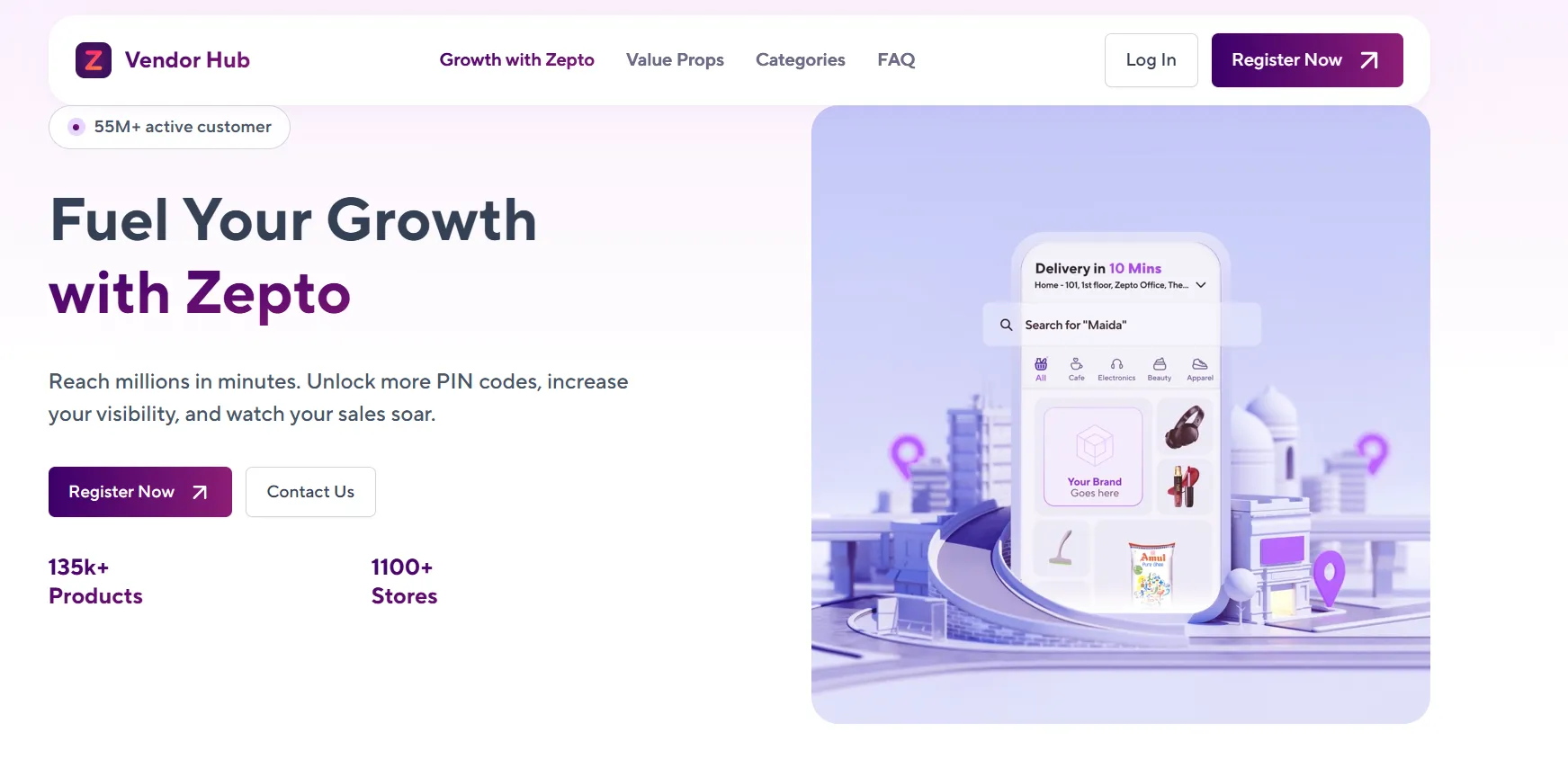
Founded in 2021, Zepto has scaled fast, hitting a reported $1 billion GMV within 2 ½ years of launch.
Zepto delivers to 10 million+ customers across 1,500+ pin codes in India. For FMCG and D2C brands, that's a huge opportunity.
So, how does Zepto work for new brands? You do not ship to the customer. You ship to a dark store located within 1–2 km of your target customer. Zepto then takes over from there.
Zepto doesn't rely on partner kiranas or retail stores. Instead, it operates through dark stores.
These are small, dedicated fulfillment centers usually between 1,000 and 3,000 sq ft, located inside residential neighbourhoods and high-density urban pockets. They are purely stocking stations for pickers.
When a customer taps “Add to cart,” a picker inside a dark store already knows which aisle and shelf your product sits on. Within 90 seconds, it is bagged. Within 10 minutes, a rider is at the customer’s gate.
For a new brand, this changes your logistics math. Zepto requires pre-positioned inventory in multiple dark stores across a city.
If you only stock one dark store in South Delhi, you are invisible to a customer in North Delhi. Coverage equals sales.
Zepto is not an open marketplace. You cannot simply register, upload your catalogue, and go live.
Zepto decides what gets listed. Just like Blinkit evaluates each brand based on demand signals, competitive landscape, price positioning, and how well a SKU is likely to sell in a given city or locality.
The platform's inventory is limited by physical dark store space, so they're selective about what they stock.
Once you're in, you're operating in a less crowded environment than a traditional e-commerce marketplace. But getting in requires a real pitch, not just a filled-out form.
The company has four revenue streams, and three of them directly impact your brand’s profitability.
₹ Commission on sales
Zepto charges commission when you sell, 8% to 25% depending on your category. Grocery staples sit at the low end. Packaged foods and personal care sit higher.
₹ Advertising and sponsored listings
Zepto charges brands to appear at the top of search results or category pages. If you do not bid, your product sits lower. For new brands, this is almost mandatory for the first ninety days.
₹ Private label competition
Zepto sells its own products under the “Zepto Brand” label. In some categories: staples, snacks, cleaning supplies. Here you are competing directly against the platform itself. They own the shelf, the data, and the margin.
₹ Delivery fees from consumers
This one does not touch your margin directly, but it affects customer order value. Higher delivery fees mean customers bundle more items. Bundling benefits staples and everyday essentials more than high-consideration new brands.
📌Your effective margin is not (MRP minus commission).
(MRP - Commission - advertising cost - return rate - dark store stocking penalties = Margin).
Many new brands calculate only the commission and get wiped out by the other three.
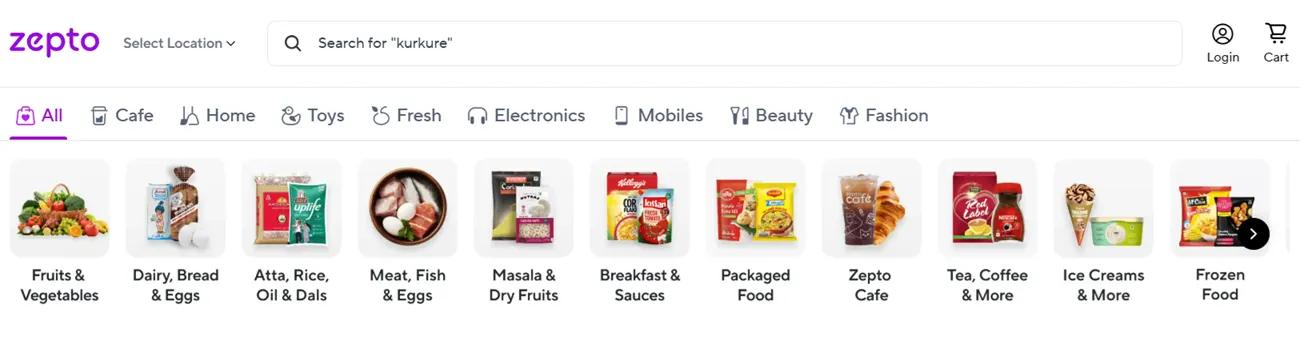
New brands can sell on Zepto but it's worth knowing whether your brand actually qualifies.
Zepto's category managers move fast, but they also filter hard.
Zepto rejects more brands than it accepts. Not because those brands are bad. Because they do not fit the operational model or lack basic compliance documents.
Zepto splits its dark store shelf space across specific categories. As of 2026, the platform has listed over 10,000 brands.
But that number includes everything from massive FMCG players to tiny D2C startups.
Here is where new brands actually have a shot:
🛍️Grocery and staples (rice, dal, atta, oil: high volume, low margin)
🛍️Fresh fruits and vegetables (tight logistics, but possible for regional suppliers)
🛍️Packaged food and snacks (the sweet spot for D2C. Chips, muesli, protein bars, instant noodles)
🛍️Personal care and beauty (shampoo, soap, face wash, moisturizer: high repeat rate)
🛍️Baby care (diapers, wipes, lotions. Parent buyers are loyal and urgent)
🛍️Pet care (the fastest-growing D2C vertical that most founders ignore)
🛍️Home essentials and cleaning (detergent, dish soap, surface cleaner)
🛍️Electronics and accessories (select SKUs only. Phone chargers, earphones, cables. Not laptops or TVs)
🛍️Health, wellness, and nutraceuticals (vitamins, protein powder, OTC products. Requires additional compliance)
Here is what experienced brand managers know that new founders miss:
Zepto is selective with D2C brands, but the selection criteria follow a clear pattern.
Having a proven sell-through rate in another channel like Amazon, your own website, even a physical retail store, dramatically improves your chances.
Zepto wants validation that customers actually buy your product before they dedicate dark store shelf space to it.
Non-grocery categories are not side categories anymore. Zepto is following the same trajectory. Beauty, personal care, and pet care are central to their margin strategy going forward.
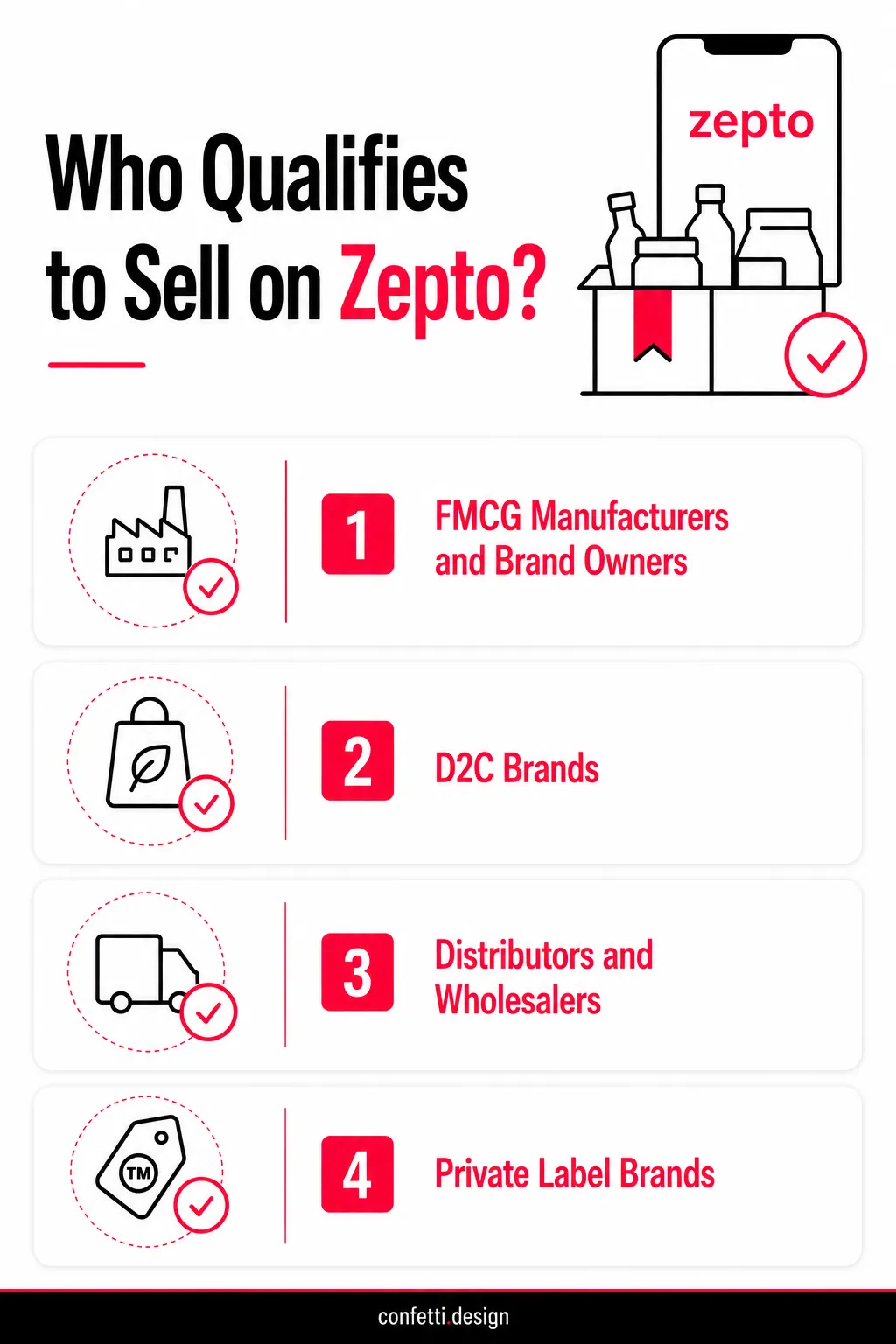
Eligibility breaks down into four clear categories. If you fall into one of these, proceed. If not, you need to restructure your business first.
➡️FMCG manufacturers and brand owners with valid GST registration.
Your GST number must be active and match your business address exactly. Any mismatch triggers automatic rejection.
➡️D2C brands in food, wellness, personal care, or home essentials.
This is where most readers sit. If you are a packaged food startup or a direct-to-consumer skincare brand, you are in the right zone. But "being a D2C brand" is not enough.
You need packaging that works for dark stores, not just Instagram unboxings. That means durable, shelf-stable, and properly barcoded.
➡️Distributors and wholesalers with consistent supply capabilities.
Zepto does not want brands that run out of stock every two weeks. If you are a distributor representing multiple brands, you can apply as a supplier.
But you must guarantee fill rates above 95%. Anything lower, and Zepto will delist you quickly.
➡️Private label brands with proper trademark documentation.
If you manufacture products for retailers or other brands, you can sell through Zepto. But you need trademark registration or a pending application. Generic, unbranded products do not get listed.
📌Zepto has also launched programs for early-stage startups. The Zepto Nova programme, backed by DPIIT, selected eight early-stage companies in its first cohort including Milleto Nutto, Thy Chocolate, No Cap Foods, and Nesta Toys.
If you are a very young brand, this is a faster path than standard onboarding. The second cohort is scheduled, apply before 22nd May 2026.
Here is the checklist of deal-breakers. If you miss any one of these, your application stops before it starts.
⛔No GST registration.
If you don’t have a GST, it will lead to immediate rejection. No exceptions. Zepto's vendor portal validates GST numbers automatically.
⛔No FSSAI license for food or beverage brands.
If your product is edible or drinkable, you must have an FSSAI license before applying on Zepto. Based on the turnover you need a State or Central FSSAI licence.
⛔No barcode or EAN code on products.
Zepto's dark store inventory system relies entirely on barcode scanning.
Without a valid EAN or UPC on every single unit, their pickers cannot scan your product during packing. That means your product cannot move through their fulfillment process. Period.
⛔Categories not currently supported by Zepto.
Do not try to list industrial chemicals, large furniture, or perishable fresh meat without cold chain approval. The platform simply does not accept them.
⛔Inconsistent supply or failing to meet minimum quantity requirements.
Zepto requires brands to maintain specific inventory levels across dark stores. If you cannot commit to regular restocking, do not apply.
Running out of stock for three consecutive days in a high-demand pin code will get your brand flagged for removal.

Talk to Confetti experts about onboarding and performance optimisation for your brand on quick commerce.
Book a Strategy Call
Zepto's onboarding is surprisingly linear if you follow each step exactly. Skipping steps or submitting incomplete information adds weeks to your timeline.
Here is the exact path from application to going live.
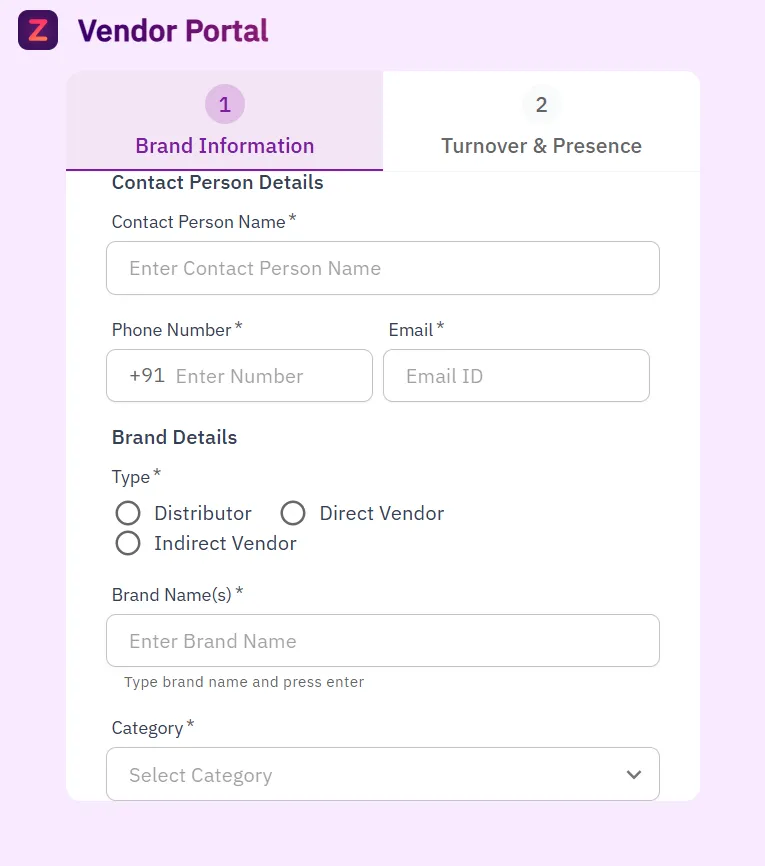
Go to brands.zepto.co.in or brands-onboarding.zepto.co.in.
Fill in your brand details, category, GST number, and estimated monthly supply volume. The application also asks for your brand name, contact details, existing sales channels, and other basic information.
Here is where new founders stumble. The application asks for monthly supply volume.
If you can reliably supply 5,000 units per month, say 5,000.
Undershooting signals that you are not serious about scaling with Zepto. Overshooting by 300% signals that you do not understand your own production capacity.
Both get your application flagged for manual review, which adds delays.
Once you submit, Zepto's category team reviews your application. They look at four things:
👁️Category fit (are you in a high-demand vertical?)
👁️Product velocity potential (do customers actually buy this type of product?)
👁️Brand credibility (professional packaging, clear branding), and
👁️Supply reliability (can you restock consistently?)
The timeline is usually 5 to 15 business days. It can stretch longer during festival seasons or when Zepto is expanding into new cities. Silence does not mean rejection.
Zepto's team processes thousands of applications. If you have not heard back after 15 business days, send a follow-up email to the address listed on the partner portal. Include your application reference number.
Approval triggers document collection. Do not wait until this step to gather your paperwork. Have everything ready beforehand.
Zepto will send you a seller agreement. Read the commission structure, payment settlement terms (usually 15-30 days), and any exclusivity clauses.
Some categories require minimum advertised price (MAP) compliance. Sign and return.
You'll upload your product catalogue through Zepto's seller dashboard. Each SKU needs:
Zepto has defined image specifications: resolution, aspect ratio, background and non-compliance either gets your listing rejected or pushes it into low-visibility placement.
On a 10-minute delivery app, customers scan products. A blurry image or missing shot kills conversion before the product gets a chance.
The product image in the app is essentially your packaging doing the selling. If your label design isn't digital-ready: clear product name, visible flavour or variant, strong brand hierarchy, you'll lose the click to a competitor who got that right.
Once your listing is approved, Zepto will designate which dark store(s) in your target city receive your inventory. You ship to their inbound facility. Zepto handles everything from there: storage, picking, packing, and delivery.
Go-live, it usually happens within 2 to 7 days after inventory is received and passes quality check. After that, your product is live in the app for every customer in that dark store's delivery radius.
One thing to plan for from day one: your replenishment schedule. Going out of stock in the first few weeks signals low supply reliability to Zepto's category team, and it's harder to recover from than most brands anticipate.
Zepto charges sellers a commission ranging from 2% to 18% based on the product's selling price, and 8% to 25% based on category.
Additional costs include advertising, returns handling, and a security deposit for new brands.
Zepto's commission structure ties directly to your product's selling price, not MRP. Lower-priced items pay lower commission percentages. Higher-priced items pay more.
A ₹299 packaged snack pays 2% commission, or about ₹6. A ₹1,500 skincare product pays 18%, or ₹270. That gap changes your entire pricing strategy.
Low-priced, high-volume staples work well under this model. Premium products need higher margins to absorb that 18% hit.
Category also matters.
📌Always confirm your category-specific rate before signing the seller agreement.
The commission is visible. These costs are not. They will eat your margin if you ignore them.
➕Security Deposit
Most new brands are asked for an upfront deposit of approximately ₹25,000 at onboarding. This is not a fee. It is refundable if you meet performance metrics and exit cleanly.
But it ties up cash when you are already spending on inventory and packaging.
➕Advertising Budget
Sponsored placement inside the Zepto app is practically mandatory for visibility, especially in your first ninety days.
Zepto's search and category pages prioritize paid listings. Budget ₹10,000 to ₹50,000 per month to start.
The lower end works for niche categories with less competition. Packaged foods and personal care sit at the higher end.
➕Return and Damage Costs
Unsold or expired stock is difficult to retrieve from dark stores. Zepto may store it, but getting it back requires coordination and often shipping costs.
Write-offs hit your margin directly. Food brands with short shelf life lose the most here.
➕Logistics to Dark Stores
Zepto does not cover inbound shipping. You pay to transport inventory from your warehouse or manufacturer to each dark store.
For a brand stocking five dark stores across Mumbai, that can add ₹8-15 per unit depending on distance and volume.
➕Zepto's "Swap & Save" Feature
This one hurts new and premium brands the most. At checkout, Zepto suggests lower-priced alternatives to consumers.
Your ₹399 organic cold-pressed juice gets swapped for a ₹199 packaged juice from a larger brand. The customer saves money. You lose the sale.
This feature is designed to drive value for Zepto's customers, not for your brand. If you cannot compete on price, you need packaging and brand recognition strong enough to make customers ignore the swap suggestion.
Here's a simplified unit-level P&L for a ₹299 product:
That's 33–50 rupees eaten before you've accounted for production, packaging, or any overhead. For brands with thin gross margins, the numbers get uncomfortable quickly.
The margin math on Zepto works differently from Amazon or your own D2C website. Set your MRP with the full cost stack in mind, not just the commission rate.
Getting listed is step one. Staying listed is the harder part and most brands don't think about it until they're already on the platform.
Zepto manages dark store shelf space like a retailer manages a planogram. Every SKU is expected to earn its spot. If it doesn't sell, it gets replaced.
Understanding what drives that decision helps you prepare before you apply, not after you're already in.
Zepto is entirely data-driven at the category level. A rough benchmark: new brands should be targeting a minimum of 30 to 50 units sold per dark store per month to stay viable.
Fall consistently below that and your listing gets reviewed or quietly pulled.
Categories with naturally high velocity give new brands more runway: snacks, beverages, personal care, and baby products tend to move fast. If you're in a slower category, your pricing, packaging, and ad spend need to work harder to compensate.
Dark store staff pick hundreds of orders per shift. Your product is one item on a dense shelf, identified and pulled in seconds.
Packaging needs to be immediately recognisable by shape, colour, or label, not just pretty.
Practically, that means:
Poorly designed packaging increases pick errors, damages in transit, and return rates. Each of those hits your margin and your performance metrics on the platform.
Zepto customers expect pricing similar to or slightly above local retail. They are paying for speed, not a premium on the product itself. Deep discounting trains customers to wait for sales. Avoid it.
Heavy price variation between channels creates channel conflict and confuses customers. If your product is ₹199 on your website and ₹249 on Zepto, customers notice. They may still buy on Zepto for convenience. But they feel cheated, and that feeling shows up in reviews.
Consider creating Zepto-exclusive SKUs: smaller pack sizes, trial packs, or bundles that do not exist elsewhere. This protects your MRP structure across channels.
For example, a ₹99 trial pack that has no equivalent on Amazon or your website gives you pricing flexibility without cannibalizing your core SKUs.
In-app search on Zepto works similarly to e-commerce search: product title, category keywords, and imagery all influence where you appear. In the early weeks, organic discovery alone won't generate enough velocity to keep your listing healthy.
Run Zepto's sponsored listings from day one. The goal in the first 30 to 60 days isn't profitability, it's building enough sales data for the platform's algorithm to start surfacing you organically.
Ratings and reviews accumulate over time, but that flywheel doesn't start spinning until you have initial volume.
Your listing images and product copy also carry more weight here than on a traditional e-commerce platform. On Zepto, customers make decisions in seconds. A strong product image, a clear variant name, and a readable label in the photo are very important.
Most brands treat Zepto onboarding as a paperwork problem. Get the GST in order, fill out the portal, submit the catalogue. That's not wrong but it's incomplete.
The brands that struggle on Zepto after listing almost always have the same issue: they weren't prepared for what the platform actually demands from a product.
Registration gets you in. Design, compliance, and strategy determine whether you stay.
We work with D2C and FMCG brands at the packaging stage before onboarding begins because fixing packaging after a listing goes live is expensive and disruptive.
Getting it right the first time is more important on quick commerce than anywhere else.
👉Dark-store-ready formats:
Packaging that's compact, structurally durable, and built to survive inbound logistics, dark store stacking, and last-mile delivery without damage or deformation.
Structural failures in transit become return costs and return costs hit margins fast.
👉App-first visual design:
On Zepto, your product thumbnail is often 80×80 pixels. Customers make a decision in under three seconds.
We design for shelf impact at that scale: clear brand name, readable variant, strong colour blocking, so your product earns the click even against established competitors.
👉Compliance built in, not bolted on:
EAN barcode placement, FSSAI license number, MRP declaration, nutritional panel, manufacturer address, all integrated into the design system from the start, not added as afterthoughts that compromise the layout.
👉Multi-SKU consistency:
If you're listing five to ten SKUs on Zepto, visual coherence across your range builds brand recognition within the app. Customers who buy one SKU should immediately recognise the next. We build design systems that scale across your catalogue, not one-off labels.
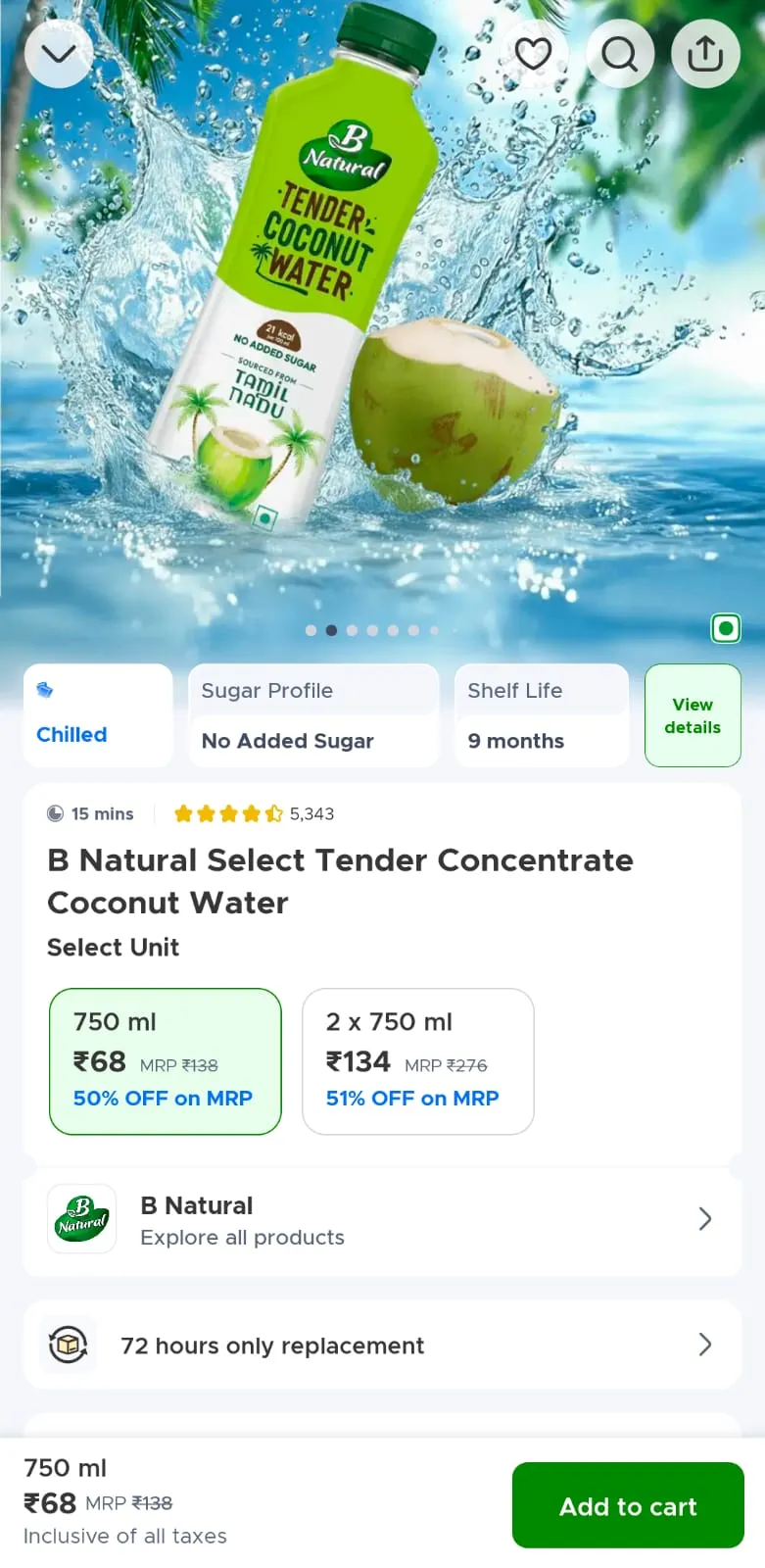
📌Our work with ITC B-Natural Coconut Water shows how this plays out in a high-velocity beverage category exactly the kind of SKU that needs to perform on quick commerce. The result is packaging that works at thumbnail scale and on a dark store shelf.
Beyond packaging, we at Confetti, help brands navigate the quick commerce platform itself:
✔️Category and documentation guidance:
Understanding what Zepto's category team actually evaluates, and ensuring everything is in order before you apply
✔️Catalogue and listing setup:
Product photography, title and description optimisation, HSN code mapping for accurate categorisation.
✔️Multi-platform readiness:
We prepare brands for Zepto, Blinkit, and Swiggy Instamart simultaneously, consistent brand identity across all three, so you're not rebuilding assets platform by platform.
Many competent founders destroy their Zepto launch within weeks. Not because their product was bad. Because they made preventable errors.
Learn from their mistakes:
🚫Applying without FSSAI
Food and beverage brands submit applications without an active FSSAI license. Zepto rejects them automatically. You just lost two to three weeks. Get the license first. Then apply.
🚫Listing too many SKUs initially
Founders get excited. They want to list their entire product range. 10 flavors. 5 sizes. Bad move.
More SKUs mean more inventory risk, higher management complexity, and slower sell-through per SKU. Start with three to five best-sellers. Prove velocity. Then expand.
🚫Ignoring advertising
No ads equal no visibility. No visibility equals zero velocity. Zero velocity equals delisting within sixty days. Budget for Zepto ads from Day 1 as a cost of entry, not an experiment.
🚫Setting MRP too low
You launch with an introductory price. Volume looks good. Then you try to raise prices. Zepto customers notice. Your velocity drops.
Competitors eat your shelf space. Set your intended long-term MRP from the start. Use temporary promotions if you need launch buzz, not permanent low pricing.
🚫Sending too much inventory
Excess stock sitting in dark stores is not your friend. It ties up cash. It ages. It gets damaged.
And retrieving it requires coordination and shipping costs. Start with conservative inventory levels. Replenish based on actual sell-through data, not optimism.
🚫Not preparing for returns
Damaged goods. Expired stock. Customer rejections. You need a process before you ship your first case to a dark store.
Who handles write-offs? Who covers return shipping? What is your threshold for retrieval versus disposal? Decide now.
🚫Treating Zepto like Amazon
Zepto shoppers want speed over discovery. They search for specific products. They do not browse endlessly. Amazon rewards long-tail SEO.
Zepto rewards in-stock percentage, pick accuracy, and fast restocking. Do not copy-paste your Amazon strategy onto Zepto. It will fail.
New brand founders often assume all quick commerce platforms are the same. They are not. Each operates with a different strategy, different category strengths, and different implications for your margin and shelf access.
🎯Blinkit has the largest dark store footprint and stronger penetration outside the top metros if your distribution ambitions extend to Tier 2 cities early, it's worth prioritising.
🎯Swiggy Instamart benefits from cross-sell exposure through Swiggy's food ordering platform, which can work well for snacks, beverages, and impulse-purchase categories.
🎯Zepto's user base skews urban and younger, with a curated catalogue that means less competition once you're listed.
So which platform should you start with?
For most new FMCG and personal care brands, Zepto is a strong first platform.
The barrier to entry is real, but so is the upside of a focused, growing user base in metros, and a catalogue environment that doesn't bury new brands under thousands of competing SKUs.
If your inventory and capital are limited, start with one platform. Prove velocity, stabilise your supply schedule, understand your actual unit economics, and then expand.
Spreading thin inventory across three platforms simultaneously often results in stockouts everywhere which damages your standing on all three.
If you have supply capacity and advertising budget to support multiple listings from day one, listing on all three simultaneously with a consistent brand identity is viable and gets you sales data across platforms faster.
Just make sure your packaging and catalogue assets are consistent. Customers increasingly shop across all three apps, and brand recognition compounds when the visual identity holds.
Can a new brand with no offline presence sell on Zepto?
Yes. Zepto accepts D2C brands with no offline retail history. However, you need a valid GST number, a FSSAI license (for food products), and product barcodes.
Having proven sales velocity on another platform (like Amazon or your own website) improves your chances of getting shortlisted by Zepto's category team.
How much does it cost to list on Zepto?
There is no fixed listing fee. However, new brands usually pay a security deposit of around ₹25,000. Commission ranges from 2% to 18% depending on product selling price.
Factor in advertising spend (₹10,000–₹50,000/month), inbound logistics to dark stores, and potential return costs. Total monthly investment for a new brand: ₹35,000–₹80,000 in the first few months.
How long does Zepto onboarding take?
The end-to-end process from application to going live usually takes 4 to 8 weeks.
Application review: 1–2 weeks. Document verification and agreement signing: 1 week. Catalogue setup and inventory placement: 1–2 weeks. Delays are usually caused by missing documents (FSSAI, trademark) or incomplete product listings.
Can I sell products on Zepto without GST?
No. A valid GST registration is mandatory to sell on Zepto. If your brand is not GST-registered, you cannot be onboarded.
Additionally, food and beverage brands must have a valid FSSAI license. Both documents must be in the name of the selling entity, not a personal name.
How does Zepto decide which brands to list?
Zepto's category team evaluates brands based on: category fit with current demand, product sell-through potential, supply reliability, pricing competitiveness, and brand credibility.
New or small brands benefit from having strong packaging, a focused SKU range, and evidence of demand (reviews, social proof, or prior marketplace sales). Applying through an onboarding partner can improve acceptance speed.
What happens if my product doesn't sell on Zepto?
If a product has low velocity (poor sell-through), Zepto may delist it to free up dark store space. You would need to arrange retrieval of unsold inventory, which can be operationally complex and sometimes incurs fees.
Running in-app ads in the first 30–60 days is critical to generating initial velocity and avoiding early delisting.
Can I list on Zepto and Blinkit at the same time?
Yes. There's no exclusivity clause that prevents brands from listing on multiple quick commerce platforms simultaneously.
In fact, most successful FMCG brands list on Zepto, Blinkit, and Swiggy Instamart at the same time. Ensure consistent MRP across all platforms to avoid channel conflict and consumer confusion.
Want strategic branding and packaging like this for your business?





.webp)
.webp)

.webp)
.webp)
.webp)
.webp)
.webp)







.svg)
.webp)


