%201.webp)
02
AI Snaps
.svg)
.svg)
01
Our Work
03
About Us
04
Brand Audit
05
Contact Us
06
Client Success
12
07
Blogs
08
Careers
Book A Call
.svg)



.svg)
Need Help In Building Your Brand?
Click the button below & book a call with our founder directly.

Rishabh Jain
Managing Director
Getting a brand listed on Zepto takes 4 -8 weeks end-to-end. The 15-business-day figure Zepto publishes is real but it covers only the activation phase.
This guide breaks down the full Zepto onboarding timeline, phase by phase, and covers exactly what your brand needs to move through it without delays.
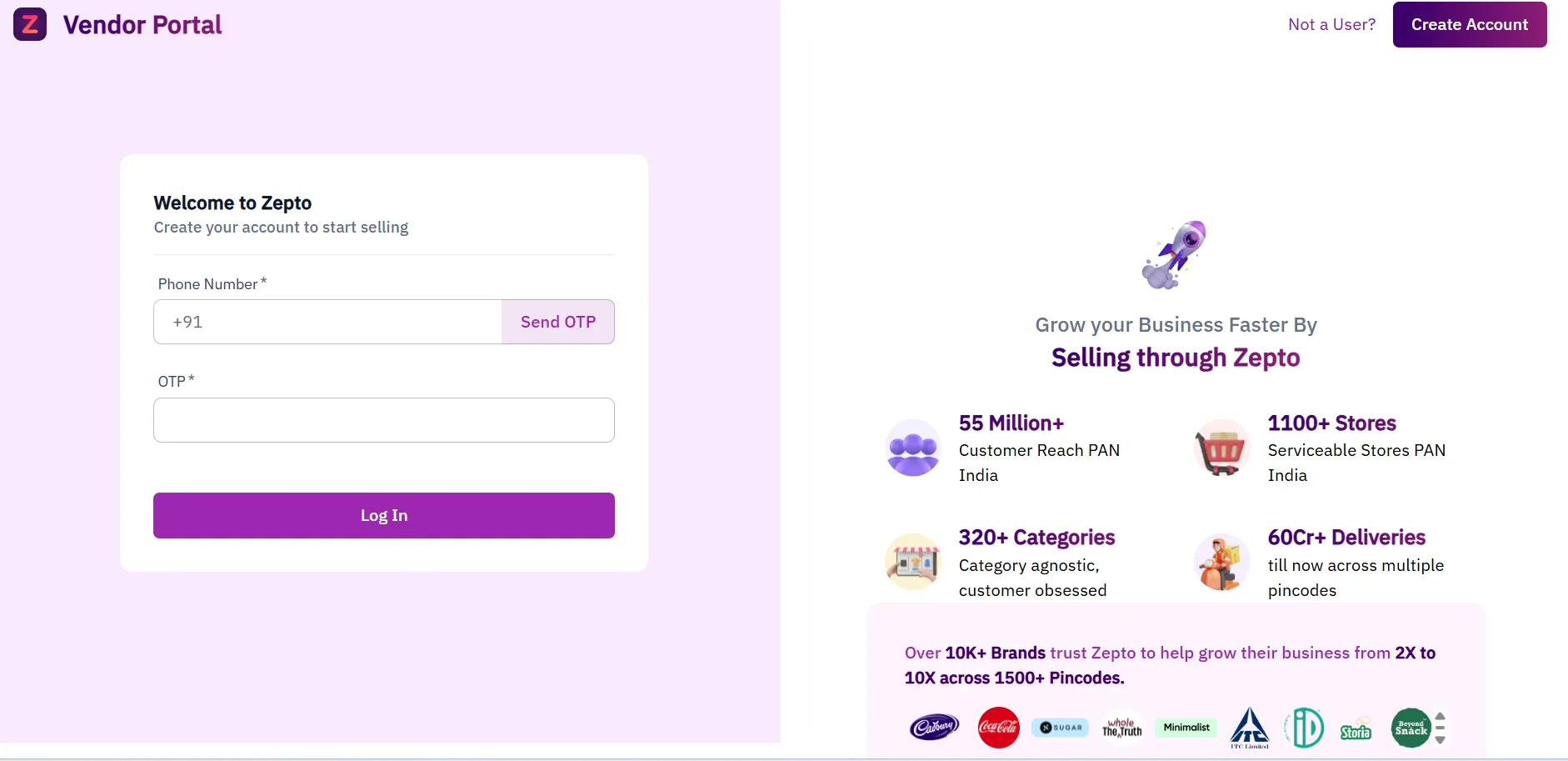
Zepto onboarding takes 15 business days for qualifying brands but that clock doesn't start when you apply. It starts after your brand clears category review, which itself takes 1–2 weeks.
End-to-end, most brands are looking at 4–8 weeks minimum.
The 15-business-day figure comes directly from Zepto's seller portal. It's accurate, but only for a narrow slice of the process.
Brands that plan around it without understanding what it excludes tend to miss their target launch windows by 3-4 weeks.
🗓️The Two Phases Brands Consistently Conflate
Zepto onboarding happens in two distinct phases:
⌛Pre-qualification phase, from initial application to category review to approval-in-principle. Zepto controls this entirely.
Your application goes to a category manager, who evaluates fit against current inventory gaps, brand credibility, and category saturation. This review takes 1–2 weeks. You can do nothing here except submitting a strong application.
⌛Activation phase, document submission, seller agreement execution, catalogue setup, pricing and margin finalization, and physical inventory placement at dark stores.
This is where it takes 15-business-days. And this phase is heavily influenced by how prepared your brand is when it enters.
Documents missing. Barcodes are non-compliant. Catalogue spreadsheet incomplete or using wrong Zepto taxonomy. Packaging dimensions not matching what's in the system.
Any of these stalls the process, sometimes by days, sometimes by weeks.
The 15 days covers roughly the middle three rows. The application review before it, and any delays in document or inventory readiness after it, requires a total of 4-8 weeks.
Example: Two brands, same product, different outcomes
Consider two food brands applying to Zepto in the same category, same week. Brand ‘A’ submits with active GSTIN, a valid FSSAI licence, EAN-barcoded units, Legal Metrology-compliant packaging, and a pre-filled catalogue spreadsheet in Zepto's required format.
Brand ‘B’ applies with intent, strong product, real traction but scrambles for documents after receiving category team interest.
✅Brand ‘A’ moves through review and into activation without a single back-and-forth.
⛔Brand B spends two weeks resolving document gaps, discovers its packaging MRP declaration is non-compliant, and misses its intended launch window entirely.
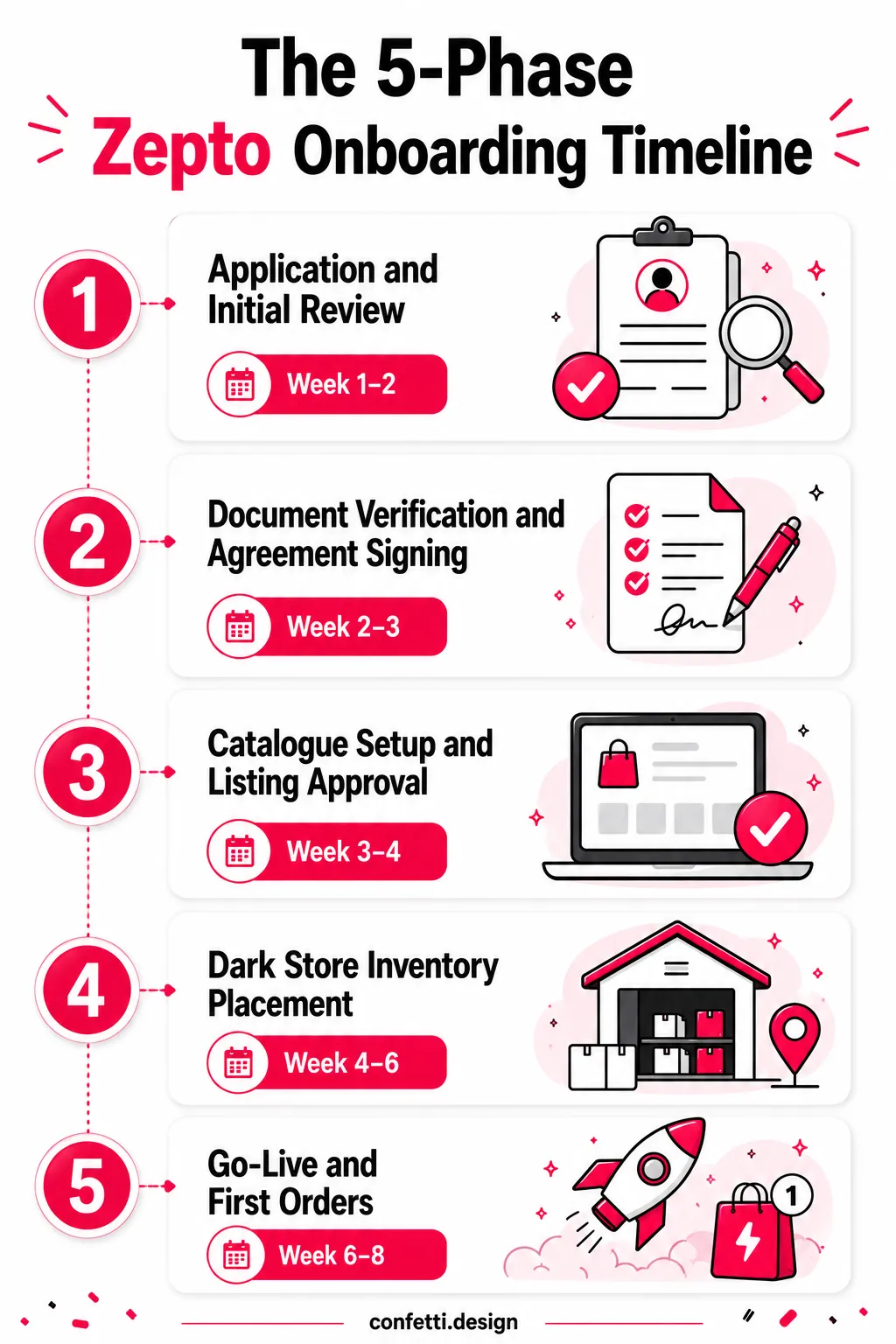
When you enter Zepto’s onboarding process, 5 phases stand between your application and your first order.
Here's what actually happens in each one, what you need ready, and where things usually go wrong.
You submit interest via Zepto's seller portal.
Zepto's category team evaluates your submission internally.They look at catalogue width, category fit, demand potential, supply reliability, pricing competitiveness, and brand credibility.
It is a pitch. Your application competes against every other brand in your category.
What you need ready before you click submit:
⛔What causes delays here:
Most delays in Phase 1 are self-inflicted. You apply too early. You apply without basics. You apply without proof that customers already want your product somewhere else.
You get a category manager assigned after initial approval. Now documents become important.
Upload via Zepto's portal: GST certificate, PAN card, cancelled cheque, FSSAI license (mandatory for food and beverage), trademark certificate or authorization letter, authorized signatory copy.
Then you negotiate. Commission rates range 8%–25% depending on category. Payment settlement cycles are standardised but negotiable for larger brands.
New brands usually face tighter terms in comparison. Then you sign the Zepto seller agreement.
⛔What causes delays in Phase 2:
You create product listings: product name, descriptions, MRP, weight, shelf life, barcode mapping. You upload high-resolution images: white or light background, multiple angles.
Every physical unit must carry an EAN or UPC barcode on a flat, scannable surface. Zepto's dark store pickers scan it.
If your barcode is on a curved surface, wrinkled label, or glossy material that reflects scanner light, it fails. Your listing gets rejected. You restart Phase 3.
⛔What causes delays in Phase 3:
Packaging becomes an operational issue at this stage. Your beautiful matte finish label might be impossible to scan under dark store fluorescent lighting.
At Confetti, we work with brands before they apply to Zepto because fixing packaging after a listing rejection costs more and takes longer than getting it right in design.
One missed barcode placement can add another two weeks to your timeline.
You coordinate with assigned dark stores across target cities. Initial inventory usually stays between 50 to 200 units per store depending on category and city.
Inbound logistics to dark store fulfillment hubs is your responsibility. Zepto does not pick up your stock. You ship it.
The dark store team receives, scans, and slots your product into shelving.
⛔What causes delays in Phase 4:
Phase 4 is about supply chain readiness. Brands that have only shipped D2C, individual orders from their own warehouse, underestimate the shift to bulk inbound fulfillment.
You are not shipping to a customer. You are shipping to a micro-warehouse with rules.
Zepto dark stores restock every 1 to 2 days. Your initial inventory must sustain sell-through until the first replenishment cycle. If you understock, your listing goes dark before you build momentum.
Your listings go live on the Zepto app in relevant pincodes.
First orders arrive.You get seller dashboard access: order tracking, inventory levels, performance metrics.
Organic visibility for new listings on quick commerce is minimal. Zepto's app surfaces established brands with proven sell-through rates. New brands without ad spend feel it challenging to show up in search results.
📌 At Confetti, we help brands throughout and post the onboarding phase, Be it developing a pin-code rollout strategy, ensuring inventory is placed in right dark stores, or optimizing listings.
The focus is not just getting listed on Zepto, but building the early traction, visibility, and performance needed to scale across more pin codes and drive sustained sales.

Talk to Confetti experts about getting quick commerce-ready and launch faster.
Book a Strategy Call
Zepto's category review is the first real gate in the onboarding timeline and this is where you have the least control.
Understanding what's being evaluated during this window helps you submit stronger, get reviewed faster, and avoid the back-and-forth that adds weeks to the pre-qualification phase.
The review is a commercial viability screen. Zepto's category team is asking four questions implicitly:
❓Does this brand have a product range worth listing or is this a single-SKU experiment?
❓Is there evidence that consumers actually want this product?
❓Can this brand replenish dark stores every 1–2 days without disruption?
❓Does this product add something to the category or duplicate what's already there?
Brands that answer all four clearly, through their application and existing channel presence, move through review in 1–2 weeks.
Brands that are not able to provide clear answers to the questions above invite follow-up, additional evaluation, or outright rejection. Each of which resets your timeline.
Zepto's internal processes take the time they take. What you control is how much additional time you add through an incomplete or unconvincing application.
Document verification runs in parallel with commercial evaluation but any gap in your paperwork pauses the entire process.
Account verification after submission takes 3–7 working days under normal conditions. A single missing or mismatched document restarts that window.
What specifically delays or extends timelines❓
These appear consistently across first-time applications and can adds days to your onboarding process:
⛔PAN mismatch: Founder's personal PAN submitted instead of business entity PAN. Triggers full re-verification.
⛔FSSAI missing or expired: For food and beverage brands, the application does not progress. No exceptions.
⛔Entity name inconsistency: GST, PAN, and bank account in different entity names. Common after business restructuring or late incorporation.
⛔Trademark documentation absent: No registered trademark and no authorisation letter. Flags the application for additional scrutiny.
⛔Catalogue images non-compliant: Low resolution or lifestyle-only shots without product-on-white images. Fails catalogue review and forces resubmission.
⛔Barcode absent or non-scannable: The single most common reason catalogue setup stalls. Every SKU needs a valid EAN or UPC barcode from GS1 India, printed on a flat surface on the physical unit.
Each of the issues above weakens your application and adds a discrete block of time to your onboarding timeline at the worst possible moment.
Packaging failures don't show up at the application stage.
They surface at catalogue review and dark store intake: two phases deep into the process, after weeks of evaluation have already passed.
This is why we at Confetti, create packaging design for optimised for quick commerce.
⏰Catalogue review delays
Zepto's catalogue team cross-checks every physical SKU against its listing. Three packaging issues consistently trigger rejections here:
A single rejection sends the brand back to the start of Phase 3. If the fix requires a packaging reprint, the delay isn't days, it's 3–4 weeks minimum.
New print run, updated photography, resubmission, second catalogue review cycle. Your Category Manager waits. Your go-live date moves by a month.
⏰Dark store intake refusals
Declared dimensions and weight in the catalogue must match the physical product exactly. Intake is a mechanical check with no manual override.
A mismatch means the shipment is refused at the hub. The brand re-dispatches with corrected packaging or corrected data. Either way, the timeline slips by 1–2 weeks minimum.
Structural failures create a different problem post-intake. Packaging that deforms under stacking, pouches without rigid bases, or closures that open in transit generate damaged inventory, returns, and seller metric penalties.
Poor metrics affect pincode coverage decisions at Zepto's next category review.
➕The compounding effect
A brand that hits both failure points in sequence can add 6–8 weeks to its timeline beyond the standard 4–8 week window. That's a brand going live three to four months after it was expected to.
At Confetti, we support brands throughout the entire Zepto onboarding journey from building a market-ready brand to driving visibility and sales after launch.
We support you with:
We work with D2C and FMCG brands at the packaging and brand strategy stage, specifically at the point before quick commerce applications go in.
Confetti's branding and packaging design experts build your brand across all touchpoints including branding, packaging design, and if needed, website plus digital marketing. A strong brand and digital footprint increases the likelihood of getting onboarded on quick commerce apps.
Brands that arrive at Zepto onboarding with packaging that isn't barcode-compliant, structurally durable for dark store handling, or digitally legible at thumbnail scale get caught in listing rejections and catalogue revisions.
What our quick commerce packaging work covers:
Our work is structured around three layers, each one addressing a distinct point of failure in the onboarding chain:
🛍️Structural specification
🛍️Regulatory compliance
🛍️Digital shelf design
Our packaging work spans established FMCG names and emerging D2C brands across food, beverage, personal care, and wellness.
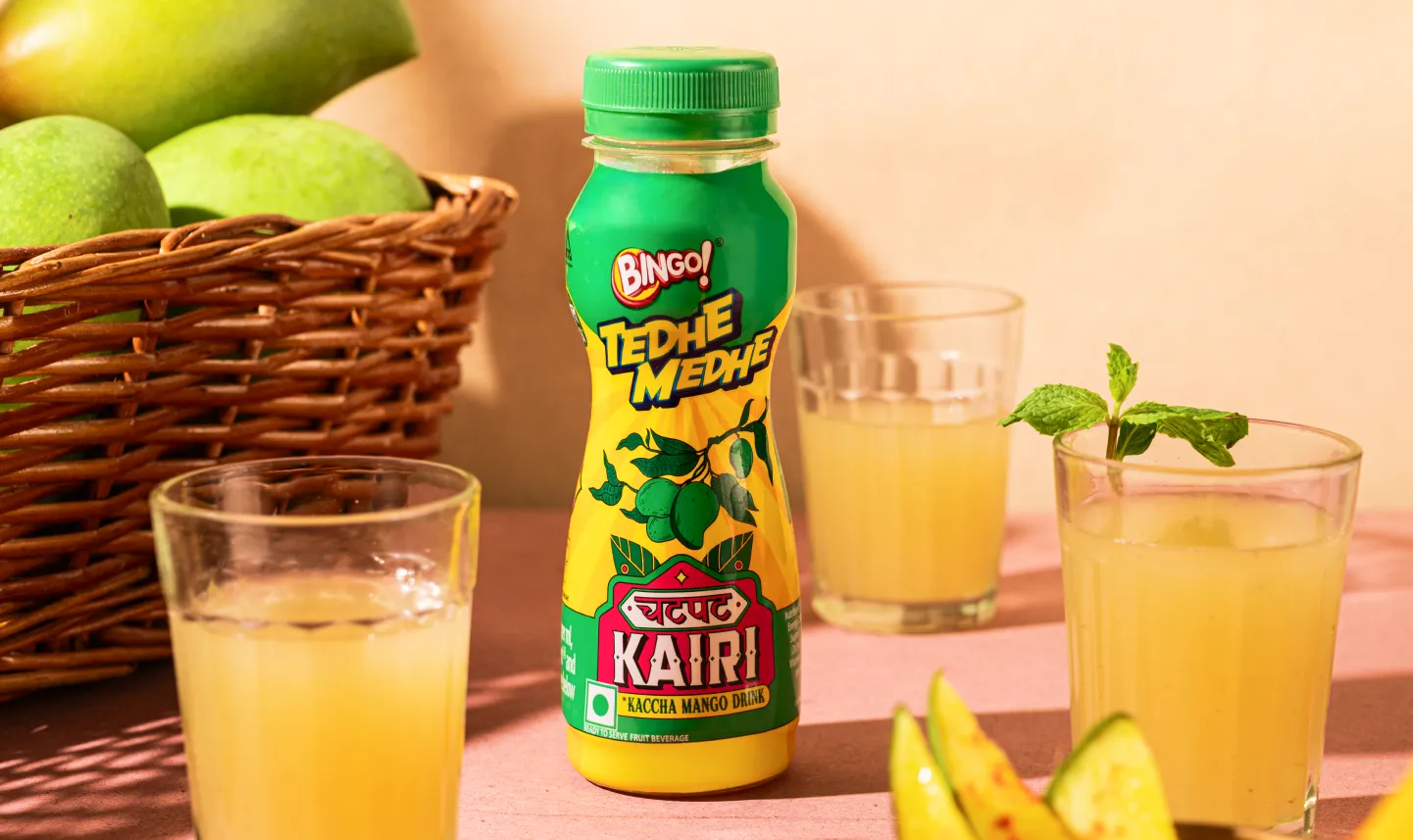
📌We worked with ITC on the Bingo Chatpat Kairi launch, a new-format beverage expanding into e-commerce and quick commerce, which won the World Brand Design Society Award 2025 and was featured in Packaging of the World.
Once brand-readiness is established, Confetti moves to getting the brand formally listed and positioned competitively on the platform.
We analyse your category, competitors, and pricing landscape to create the right pricing strategy, supported by optimised listings, product photography, and creative assets.
We create listing-ready creative assets. Product photography and creative assets are developed, the materials customers will see when they look at a product on quick commerce apps.
After going live, the work continues.
We help you improve visibility and sales through listing optimisation, in-app advertising, and ongoing performance monitoring to help your brand grow.
Our quick commerce experts study changing market trends and seasonality to guide brands towards better performance: through optimised listings, in-app ads, and much more.
The results from real client work illustrate the impact.
Most of the 4–8 week onboarding window isn't Zepto's doing. The brands that go live in 4 weeks have done 90% of their preparation before they hit submit.
The brands that take 8+ weeks are doing that preparation in real time, one rejection at a time.
Five specific things that compress the timeline:
1. Apply with proof of velocity
Zepto's category team has limited bandwidth and a long queue of applications. A brand with 500+ Amazon reviews, a 4.3-star rating, and demonstrable repeat purchase data moves to the front of that queuenot because of any formal policy, but because the commercial evaluation is faster.
The category team doesn't need to speculate about demand; you've already proved it.
If you're planning to launch on Zepto, get six to eight weeks of traction on Amazon or your own D2C channel first. That data trail is worth more than any follow-up email to your Category Manager.
2. Pre-build your catalogue before applying
Most brands start building their product catalogue after receiving category approval. That's a 1–2 week delay that's entirely avoidable.
Before you submit your application, prepare a spreadsheet with product name, EAN barcode, MRP, declared weight, shelf life, and hosted image links for every SKU.
When your Category Manager is assigned and catalogue setup begins, having this ready cuts the phase from 1–2 weeks to 2–3 days. The Zepto catalogue team doesn't have to chase you for information, they can work directly from what you've provided.
3. Sort barcode infrastructure before your first production run
GS1 India is the only authorised source for EAN barcodes in India. Registration takes time. Receiving your company prefix, generating individual GTINs per SKU, and getting those barcodes incorporated into your packaging artwork, this is a multi-week process if started from scratch.
Brands that discover they need GS1 registration after production has begun face two options: apply barcodes as stickers (non-compliant for dark store scanning and rejected at intake) or reprint packaging with barcodes built in.
The second option means a production delay and a budget overrun that wasn't in the plan. Put barcode registration on the packaging brief before it goes to your vendor. It costs almost nothing to do it early and more to fix it late.
4. Know your target dark stores before your Category Manager is assigned
When your Category Manager first makes contact, having a clear answer to "which cities are you targeting and why" signals a different level of operational readiness than vague national expansion intent.
Research Zepto's dark store coverage across your target cities. Understand which pincodes are active in your category. Be specific.
Brands that come into that first conversation with a city-by-city dispatch plan, units per store, logistics partner already identified, don't just impress. They remove a negotiation layer that otherwise adds days to the activation phase.
5. Plan inbound logistics before go-live, not after
First dispatch to dark stores is entirely the brand's responsibility. Zepto will tell you which hubs to ship to; getting product there on time, in compliant cartons, within the delivery window, is yours to manage.
Plan for 50–200 units per dark store per city. If you're launching in three cities across five dark stores each, that's potentially 750–1,000 units in the first dispatch.
Budget the logistics cost, identify your 3PL or own transport arrangement, and confirm your inbound carton labelling format with the dark store operations team before your go-live date is confirmed. This phase produces the most common 2-week slip for brands that assumed it would sort itself out.
How long does Zepto onboarding take for new brands in India?
The full process from application to first live sale, usually takes 4 to 8 weeks for new brands. Zepto's official timeline is 15 business days, but this applies only after your brand passes the initial eligibility review.
Document verification, catalogue setup, and dark store inventory placement each add time on top. Brands that prepare all documents and a catalogue-ready product sheet before applying consistently go live at the faster end of that range.
Is there any onboarding fee to sell on Zepto?
There is no upfront registration or platform fee to list on Zepto. However, rather than per-SKU Zepto bundles onboarding costs into a package, usually around ₹5–6 lakh.
Zepto then charges a commission of 8–25% on each sale, depending on product category and the commercial terms agreed with your assigned Category Manager.
What documents are required for Zepto seller registration?
Mandatory documents include: GST Registration Certificate, PAN Card in the business entity's name, cancelled cheque or bank statement, authorized signatory copy, and a Trademark Certificate or brand authorization letter.
Food and beverage brands must additionally provide a valid FSSAI license. All products must carry a valid EAN or UPC barcode on physical packaging, without it, dark store processing is not possible.
Can a new D2C brand with a single SKU get listed on Zepto?
Zepto evaluates catalogue width as part of its selection criteria, making single-SKU brands harder to onboard through the standard route.
Zepto's Brands Launchpad programme offers an accelerated path for early-stage brands. If you have a strong product with clear demand signals, ratings on Amazon, D2C sales velocity, offline distribution, your chances improve regardless of SKU count.
What causes delays in the Zepto onboarding process?
The most common causes of delay are: missing FSSAI or trademark documents, packaging without a valid EAN barcode, catalogue images that don't meet Zepto's specifications, and first-time coordination issues with dark store inbound logistics.
Brands that prepare all documents and a catalogue-ready product sheet before applying consistently go live faster than those who treat onboarding as a post-application task.
Does Zepto require special packaging for quick commerce?
Zepto does not publish explicit packaging design standards, but three requirements apply: a valid EAN barcode on a flat, scannable surface; structural packaging that survives dark store stacking and last-mile delivery without damage; and MRP and regulatory labelling compliant with Legal Metrology rules and FSSAI requirements.
Packaging that fails at any of these checkpoints causes listing rejection or dark store intake refusal.
What products sell best on Zepto for new brands?
Zepto's strongest categories for new brands include premium or differentiated snacks, health-focused beverages, personal care with strong ingredient claims, and specialty grocery with a regional or health angle.
Commodity grocery: atta, rice, oil, is dominated by large FMCG players and difficult for new brands to compete in on price. Categories with a clear differentiation angle and impulse purchase potential consistently outperform.
Want strategic branding and packaging like this for your business?





.webp)
.webp)

.webp)
.webp)
.webp)
.webp)
.webp)







.svg)
.webp)