%201.webp)
02
AI Snaps
.svg)
.svg)
01
Our Work
03
About Us
04
Brand Audit
05
Contact Us
06
Client Success
12
07
Blogs
08
Careers
Book A Call
.svg)



.svg)
Need Help In Building Your Brand?
Click the button below & book a call with our founder directly.

Rishabh Jain
Managing Director
Creating a brand identity that genuinely shifts how customers behave requires more than a logo, a colour palette, and a style guide.
This blog exists for founders who are ready to build an identity that performs. We break down the process into actionable steps and a checklist with a reality check into cost and timeline realities.
.webp)
Brand identity is the complete expression of your business.
It turns your brand strategy: your purpose, positioning, values, and personality, into a consistent experience across every customer touchpoint, from your website and packaging to social media and sales conversations.
👉More than a visual design, brand identity is a practical system that guides decisions. Its real job is to remove decisions for everyone who touches your business after it's built.
Every one of those moments either happens fast, because the identity already answered the question, or it happens slowly, because it didn't.
That's the entire test of whether a brand identity is working, not whether it looks polished in a deck.
Example: Two founders have identical products.
One has a documented identity system: a locked color palette, a typography hierarchy, a written tone of voice. Every new hire, vendor, or packaging printer opens the same file and makes the same correct call.
The other founder has a logo and a vague sense of "vibe."
Every new vendor gets briefed from scratch, every decision gets re-litigated, and the visual identity drifts a little further from itself with each new touchpoint.
A professionally designed brand identity does much more than make a business look attractive. It directly influences customer perception, brand recognition, trust, and long-term growth.
Research from Lucidpress found that consistent brand presentation can increase revenue by up to 33%. Likewise, studies by Edelman consistently show that trust plays a significant role in purchasing decisions, especially in competitive markets.
A consistent identity helps businesses:
This is particularly important for startups and growing businesses.
When resources are limited, every customer interaction needs to reinforce the same message.
A clear identity ensures the business grows with consistency instead of becoming fragmented as new employees, agencies, and partners join the journey.
Global brands such as Apple and Nike show us how a consistent identity extends far beyond logos. Every product, advertisement, retail store, website, and customer interaction reinforces the same personality and values.
Ultimately, your brand identity should make every business decision easier and every customer interaction more familiar.
👉If customers have to repeatedly figure out who you are, what you stand for, or whether they can trust you, your identity is not doing its job.
A strong brand identity is a business asset that reduces friction, builds trust, improves consistency, and creates the foundation for sustainable growth.

A brand identity that performs is not one that looks good in a presentation. It is one that drives recognition, builds trust, and makes commercial decisions easier.
Here is a practical seven-step framework that helps you build a brand identity that is distinctive, scalable, and commercially effective.
Before designing a logo or selecting colours, define why your business exists, who it serves, what it stands for, and how it is different from competitors.
Your brand strategy should include your mission, vision, core values, target audience, and brand positioning.
Mission answers why your business exists and what difference you plan to make in your customers' lives. Vision answers where you are headed. Values establish the principles that guide every decision your company makes.
These elements become the benchmark against which every future design and marketing decision is evaluated.
A simple brand positioning framework is:
"For [target audience], our [product or service] delivers [key benefit] unlike [competitor] because [unique differentiator]."
✅Actionable step: Write a single sentence for each: mission, vision, and three core values. Test them with your founding team.
If anyone disagrees or is confused, refine until everyone can articulate them consistently.
Strong brands understand both their customers and their competitors before they begin designing.
Research should answer three questions:
✅Actionable step: Physically purchase 20 to 30 competing products. Line them up, photograph them together, and map the visual patterns.
Then interview five potential customers. Not friends or family, actual strangers who fit your target profile. Ask them what they notice, what they ignore, and what makes them choose one product over another.
Translate your strategy into a visual direction.
Develop a mood board containing references for photography, typography, colour palettes, textures, layouts, packaging, and digital experiences that reflect your desired brand personality.
This creates alignment between founders, marketers, and designers, reducing unnecessary revisions later.
At Confetti, mood boards are developed over three to five days as a critical step that prevents misalignment later.
✅Actionable step: Curate 15–20 images that represent your brand's personality, tone, and aesthetic. Include colour references, texture examples, photography styles, and competitor examples you want to emulate or avoid. Share with your team and refine until everyone agrees on the visual direction.
Rather than treating individual assets separately, build an integrated system that includes:
✅Actionable step: Work with your designer to create these elements as a system, not as isolated assets. Each element should be documented with usage rules. Then test everything at actual size, a logo on a 50px social media avatar, a colour on a mock-up package, a font in body copy.
Brand voice is how your brand sounds: its personality, tone, and language. Messaging is what it says: the key points you want people to remember.
Consistency in language builds familiarity and trust over time.
Example: for CRMB, the tone is "calm, thoughtful, and gently expressive"the verbal equivalent of a quiet moment in a café. For Slosh & Co., the tone was designed to flirt, with flavour and with the audience.
✅Actionable step: Write a one-page brand voice guide that answers:
Your brand guidelines are the operational manual that keeps your identity consistent as your business grows.
They should include:
Clear guidelines help internal teams, agencies, developers, and suppliers make consistent decisions without constant approvals.
At Confetti, guidelines go beyond the basics to include photography guidelines covering composition, lighting, styling, and visual energy, ensuring consistency even when images are sourced externally.
✅Actionable step: Create a single document (PDF or Notion page) that contains all of the above. Make it accessible to everyone who works on your brand. Update it as your brand evolves.
A brand identity is only successful when it performs in the real world.
Apply it across your most important customer touchpoints, including your website, packaging, social media, presentations, retail environments, and online marketplaces. Then gather feedback and measure whether customers perceive the brand the way you intended.
As your business grows, continue refining your identity while maintaining its core consistency.
Monitor metrics such as brand awareness, branded search traffic, repeat purchases, customer feedback, referral rates, and brand recall.
✅Actionable step: Conduct a brand audit every 12 to 18 months to ensure your identity remains consistent, relevant, and aligned with your evolving business goals.
Use this checklist to evaluate whether your brand is built on a solid strategic foundation and is ready to perform across every customer touchpoint.
🎯Brand Strategy
☐ Have you clearly defined your brand purpose?
☐ Do you have a concise mission and vision statement?
☐ Are your core values documented and understood by your team?
☐ Have you identified your target audience and ideal customer personas?
☐ Have you researched your competitors and category conventions?
☐ Do you have a clear brand positioning statement that differentiates you?
☐ Can every major design decision be justified by your positioning?
🎨Visual Identity
☐ Do you have a complete logo system (primary, secondary, icon, monochrome)?
☐ Have you defined a primary and secondary colour palette with HEX, RGB and CMYK values?
☐ Have you selected typography that works across digital and print?
☐ Are your photography, illustration and graphic styles clearly defined?
☐ Have you tested your identity across different sizes and formats?
🎤Brand Voice & Messaging
☐ Have you defined your brand personality using 3–5 attributes?
☐ Do you have documented tone of voice guidelines?
☐ Have you created a consistent messaging framework?
☐ Is your tagline or value proposition clearly articulated?
☐ Does your website, social media, packaging and sales material sound like the same brand?
📃Brand Guidelines
☐ Do you have a comprehensive brand guideline document?
☐ Does it include logo usage, colours, typography, imagery and messaging?
☐ Is the document easily accessible to employees, agencies and partners?
☐ Are there examples of correct and incorrect brand usage?
⁉️Real-World Testing
☐ Have you tested your identity on your website, social media and marketing materials?
☐ If you're a product brand, have you tested it on packaging and retail shelves?
☐ Does it remain recognisable as a small digital thumbnail?
☐ Have you shown it to people from your target audience and gathered unbiased feedback?
✅Scalability & Governance
☐ Can your identity support future products, services and new markets?
☐ Is there a clear owner responsible for maintaining brand consistency?
☐ Have you planned regular brand audits to prevent inconsistency?
If you answered:
The cost of brand identity is a wide range. In India, this can be anywhere between ₹20,000 to well past ₹1 crore.
Here is what actually determines the cost and timeline:
Most brand identity projects consist of five core layers.
The more comprehensive the scope, the more valuable and future-proof your identity becomes.
Many low-cost projects focus only on creating visual assets while skipping the strategic work that gives those assets meaning.
In global markets, comprehensive brand identity projects often range from US$5,000 to US$100,000+, depending on the agency's expertise and project scope.
Rather than choosing the lowest quote, compare proposals based on what is included. A strategic identity system often delivers greater long-term value than a lower-cost logo package that requires a complete redesign a year later.
Several factors determine the final investment:
For example, creating a brand identity for a local consulting firm is very different from building a complete identity system for an FMCG company launching 30 product SKUs across retail, e-commerce, and quick commerce platforms.
A brand identity project usually follows this sequence:
The biggest factor affecting timelines is usually the client's decision-making process.
Delayed feedback, multiple approvers, changing project scope, or unclear objectives can extend even straightforward projects.

Things like "inconsistent colours" or "poor font choices" are symptoms of brand identity failure, not causes.
Here are the actual failure patterns we see repeatedly:
1. Strategy Gets Ignored
Many companies invest in a strong brand strategy, then never use it. Design, messaging, and marketing become driven by personal taste instead of strategic decisions.
The result is an identity with no clear direction. Treat your strategy as a decision-making tool, not a document that gathers dust.
2. Design by Committee
When founders, advisors, and stakeholders all have equal input, the identity becomes a compromise. Brands built by consensus lose their distinctiveness.
Assign one decision-maker who filters feedback through the brand strategy instead of trying to satisfy everyone.
3. The Identity Doesn't Scale
A logo may look great on a website but fail as a social media icon, packaging mark, or mobile header.
Without clear usage rules, teams make inconsistent decisions over time. Build a flexible visual system with practical guidelines, not just a collection of assets.
4. Difficult Conversations Are Avoided
Teams sometimes approve work they know isn't right just to meet deadlines or avoid extra revisions.
That short-term decision often leads to an expensive rebrand later. It's far cheaper to fix problems before launch than after customers have seen the brand.
6. It Looks Good but Doesn't Perform
Internal teams may love the logo and colour palette, but customers are the real test.
If the identity doesn't communicate the right positioning or attract attention in the market, aesthetics don't matter. Validate your brand with real users before finalising it.
The success of your brand identity depends as much on who creates it as it does on the process itself.
A great partner will challenge your assumptions, ask difficult questions, and build an identity rooted in strategy.
The wrong one may simply give you a logo that looks attractive but fails to support your business goals.
Before approaching any partner, clearly define your objectives, expected deliverables, timeline, and budget. This makes proposals easier to compare and reduces the risk of scope changes later.
Ask these before a single mood board:
Do they start with positioning, or with visual references?
If the first working session is a Pinterest board instead of a conversation about audience and category, Step S is being skipped, and you already know where this project is headed.
Do they document guidelines, or hand over raw files?
"You'll get the logo files" is a different answer than "you'll get a guideline document with usage rules and application examples." Ask which one, specifically, is in scope.
Is verbal identity part of the deliverable, or a separate line item you'll need to source elsewhere?
A lot of proposals quietly exclude naming, tone of voice, and messaging — then present a visual identity as if it's the whole picture.
Do they test the identity across real touchpoints before final delivery, or only present it in mockups?
Ask specifically whether packaging, digital thumbnails, and print applications get tested, or whether "final delivery" means a brand deck and a folder of logo files.
How do they handle scale?
Ask what happens to the system at SKU ten, or in a second market. A partner with a real process will have an answer ready. One without will improvise it in the room.
A portfolio full of polished, standalone logos, with no visible guideline system, no applied touchpoints, no strategy language anywhere in the case study is a preview of what your engagement will look like.
If a portfolio can't show you the system behind the mark, it probably didn't build one.
Watch for proposals that quote a single flat fee for "branding" without breaking out what's actually included.
A vague scope is often a sign that strategy, guidelines, and application testing aren't priced in, because they weren't planned for.
Be cautious of timelines that sound too fast for the scope promised.
A full six-step identity system delivered in under two weeks usually means one or more steps got compressed or cut, not that the team is unusually efficient.
Most agencies treat brand identity as a visual exercise.
We do not.
At Confetti Design Studio, brand identity is the translation of strategy into a system that performs. Every decision, from the shape of a letter to the weight of a paper stock, is rooted in strategic intent.
The Confetti Way: Strategy First, Always
We start with immersion, not design. Before a single pixel is created, we conduct comprehensive brand immersion. We engage with the founding team to understand vision, values, and challenges. We analyse the competitive landscape, map category codes, and identify whitespace.
For Kooji, a heritage perfume brand, immersion revealed that the visual identity communicated function but not feeling, character, or origin. The insight became the strategic shift: stop communicating what the product smells like, and start showing where it takes you.
Mood Boards: Strategy Becomes Visual
We typically develop two to three distinct mood boards for the same positioning, using a combination of AI imagery, curated photography, colour systems, and typography.
Each board shows what different strategic paths could look like at the finish line. The chosen board becomes the definitive reference point for every decision that follows.
Colour and Typography: Decisions Made in Context
Colour and typography are never finalised on swatches alone. We apply them to real use cases: social media mock-ups, packaging visuals, website applications, early in the process.
A font that works beautifully at large scale may not perform on a product label. Testing across contexts reveals these issues before they become expensive problems.
Verbal Identity: Brand Voice as a System, Not an Adjective
Verbal identity is developed with the same rigour as visuals.
For AOBA, a tropical resort wear brand, the voice is "confident, vibrant, and celebratory." Brand voice is not decorative. It is as deliberate as the visuals.
Visual Identity: A System, Not a Collection
Logo design is presented in black and white first: colour creates bias, and the form must work before colour is added. Colour palettes are built with primary, secondary, and neutral colours, each with defined usage rules.
Typography is structured with hierarchy and tested for readability across formats. The goal is a system that works across packaging, digital, social media, and retail and scales.
Brand Guidelines: The Operational Document
Guidelines are operational documents, not decorative PDFs.
They include photography guidelines covering composition, lighting, and styling ensuring consistency even when images are sourced externally. We document usage rules, edge cases, and the reasoning behind every decision.
Applied Across Categories
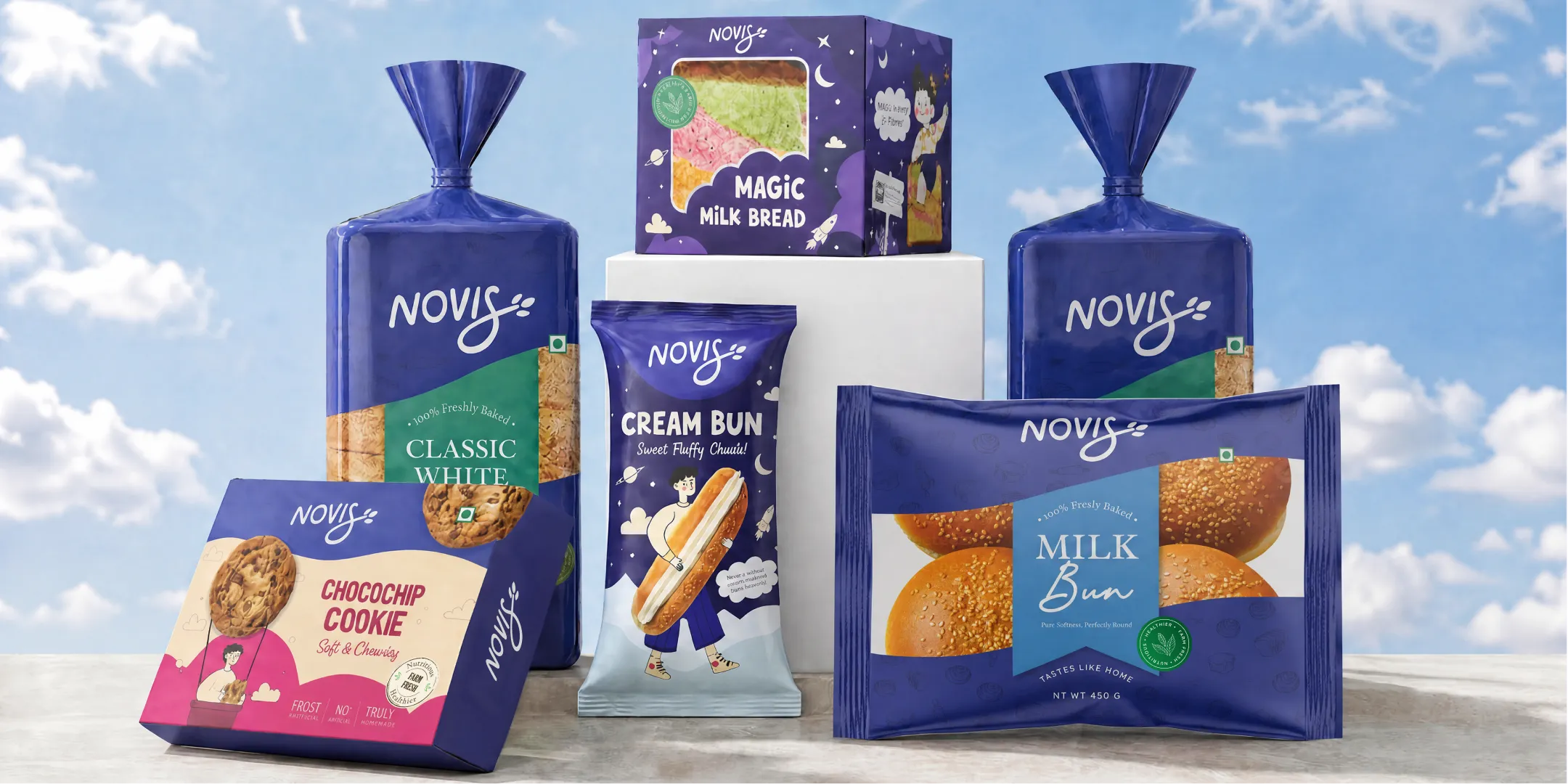
This is the process we apply across 200+ brand projects, including work for ITC, Dabur, heritage brands like Kooji, and early-stage startups like Novis Bakery.
The outcome is always the same: a brand identity rooted in strategy, built as a system, and designed to perform, not just to look good.
How do I create my own brand identity?
Creating your own brand identity starts with strategy. Begin by defining your brand foundation: mission, vision, and core values. Then research your market, competitors, and audience. Develop a clear positioning statement that answers who you are for and why you matter.
Only then move to visual elements: logo, colour palette, typography, and brand voice. Document everything in brand guidelines. Test your identity with real customers before finalising. The process typically takes 8–12 weeks for a complete system.
What are the key elements of a brand identity?
The key elements of a brand identity include your brand foundation (mission, vision, values, positioning), visual identity system (logo with variations, colour palette with usage rules, typography hierarchy), brand voice and messaging framework, and comprehensive brand guidelines.
Your identity also encompasses photography style, iconography, and application rules across every touchpoint: packaging, digital, social media, and retail. These elements work as a system, not a collection of standalone assets.
How long does it take to create a brand identity?
Creating a brand identity typically takes 8 to 12 weeks for a complete project. A startup-tier identity can be completed in 4–6 weeks. Mid-market brands require 8–14 weeks. Complex institutional identities can stretch to 16–28 weeks.
The timeline breaks down as: discovery and research (1–2 weeks), strategy development (2–4 weeks), visual identity design (3–6 weeks), and guidelines and asset preparation (1–2 weeks). Your decision-making speed is the biggest variable.
How much does professional brand identity design cost?
Professional brand identity design in India ranges from ₹20,000 to well past ₹1 crore. For startups, typical costs fall into three tiers: early-stage branding (₹30,000 – ₹75,000), strategic brand identity (₹1.5 lakh – ₹4 lakh), and premium or FMCG branding (₹5 lakh – ₹15 lakh+).
Freelancers charge ₹15,000 – ₹1 lakh. Boutique studios range from ₹1.5 lakh – ₹10 lakh+. The final cost depends on scope layers, partner type, and number of deliverables.
Should a startup build brand identity in-house or hire an agency?
A startup should build brand identity with an agency when scope includes strategy, positioning, and a coordinated launch, especially if the work directly impacts revenue. Agencies provide strategic depth, external perspective, and cross-category experience that in-house teams lack.
Build in-house only when brand work is continuous across quarters and you need daily iteration. For most seed to Series B startups, a boutique studio offers the best balance of quality, cost, and direct senior access.
Want strategic branding and packaging like this for your business?





.webp)
.webp)

.webp)
.webp)
.webp)
.webp)
.webp)







.svg)
.webp)