%201.webp)
02
AI Snaps
.svg)
.svg)
01
Our Work
03
About Us
04
Brand Audit
05
Contact Us
06
Client Success
12
07
Blogs
08
Careers
Book A Call
.svg)



.svg)
Need Help In Building Your Brand?
Click the button below & book a call with our founder directly.

Rishabh Jain
Managing Director
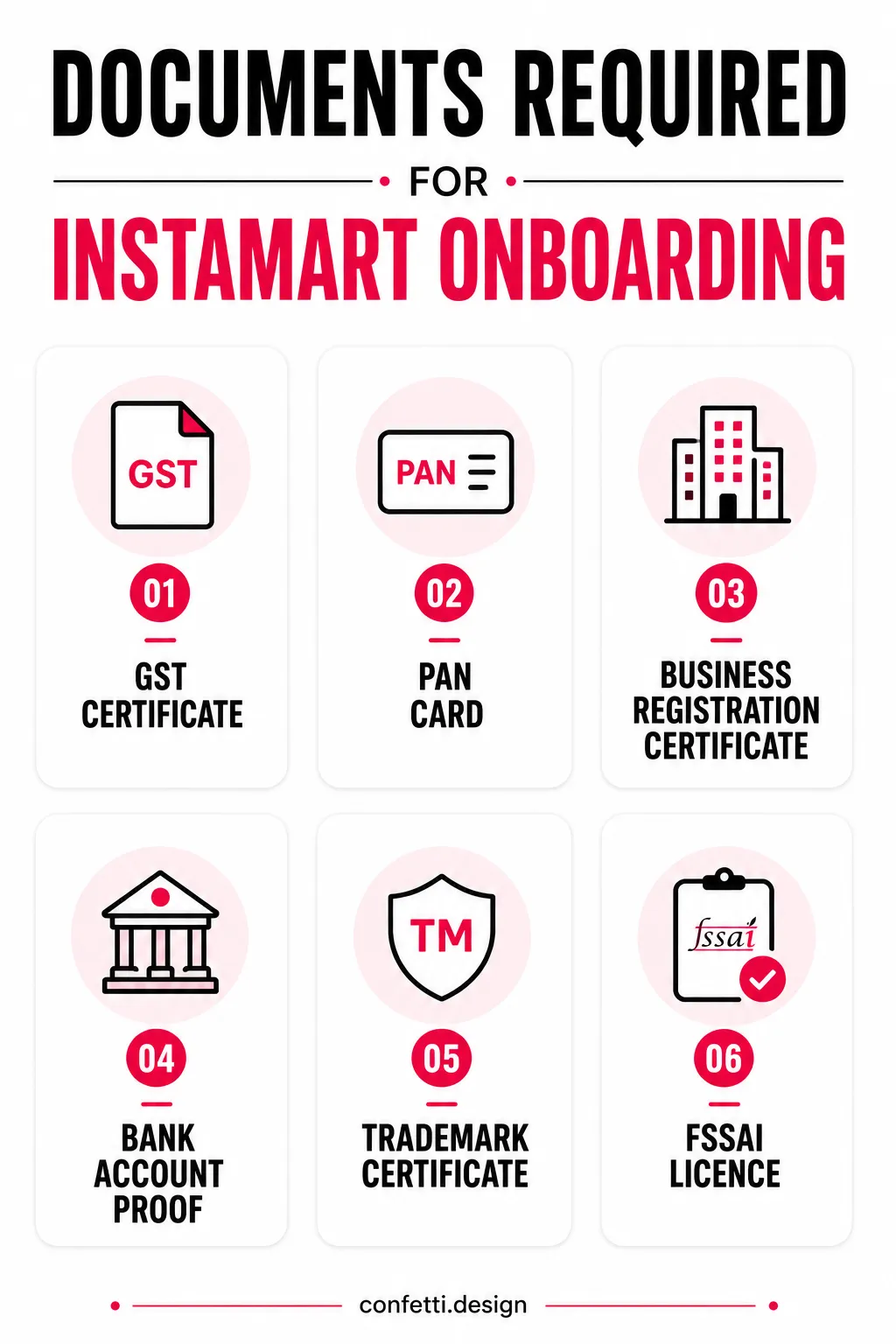
Before your brand goes live, you need to submit a complete set of documents required for Instamart onboarding in India. Every single document needs to be accurate, current, and consistent with each other.
This guide covers every document required for Swiggy Instamart vendor registration. This includes core business paperwork, FSSAI compliance, reseller authorisation, multi-state GST, and the product-level assets.
Instamart's verification system cross-references every submitted document against a single master business name.
🚫For example, if your:
The system flags all 3, because they aren't identical. Each inconsistency triggers a manual review exception. Each exception adds 5–7 working days to your timeline.
This is the most common compliance blocker in Instamart onboarding, and it's avoidable.
Every document you submit must show the exact same legal entity name, including punctuation, abbreviations, and spacing. "Private Limited" and "Pvt. Ltd." are different strings.
📌Before you upload anything, open every document side by side and run a character-by-character check. GST certificate, PAN card, bank account statement, business registration, all 4 should be identical in how your entity name appears. If they aren't, resolve the discrepancy first.
New brands may find it challenging to avoid all such mistakes, which is why we at Confetti support FMCG brands with Quick Commerce onboarding.
What to Check Beyond the Name❓
Name consistency is the primary check, but it isn't the only one. So, you should also verify:
If you're a food or beverage brand, your FSSAI licence must cover all product categories you intend to list.
These 6 documents are mandatory for every brand, regardless of product category, entity type, or the cities you intend to supply:
Your Goods and Services Tax registration certificate, issued by the GST Network (GSTN).
Under Section 24(ix) of the CGST Act, every person supplying goods through an e-commerce operator that collects Tax Collected at Source (TCS) must register for GST, regardless of annual turnover.
📌There is no small-seller exemption on quick commerce platforms. No GST registration means no Instamart listing.
The GST document must show:
If you store inventory in Instamart dark stores across more than one state, each state requires its own GSTIN.
📌Supplying from Gurugram for NCR orders and from Bengaluru for Karnataka orders means you need active GSTINs in both Haryana and Karnataka. These are Additional Place of Business (APOB) registrations.
🕐Processing time for a new GST registration or APOB: 3–7 working days via the GSTN portal.
Your business entity's Permanent Account Number (PAN) is required for taxation identity verification, TCS reconciliation, and payment settlements.
Instamart deducts 1% TCS under Section 52 of the CGST Act before remitting payments and reconciles this against your entity PAN.
The Document must show:
⚠️Common rejection triggers: a director's personal PAN submitted instead of the company's entity PAN; entity name formatted differently from the GST certificate.
📌If you operate as a sole proprietorship, your personal and business PAN may be the same document. Ensure any business name associated with it matches your other registrations exactly.
Legal proof of your business entity. What you submit on Instamart depends on your entity type:
What the document must show: legal entity name matching your GST certificate exactly; date of incorporation or establishment; registered business address.
⚠️Common rejection triggers: personal document submitted instead of a business entity document; partnership deed unsigned by all partners; Certificate of Incorporation not updated after a name change.
A cancelled cheque or recent bank statement for the business account to which Instamart will remit payments.
The account must be in the business entity's name. Personal accounts are not accepted for companies or LLPs.
The document must show:
⚠️Common rejection triggers: account in a personal name when the selling entity is a company or LLP; account holder name abbreviated differently from the GST entity name; cheque or statement from an inactive or closed account.
Confirmation of the registered business address from which you will supply inventory to Instamart.
Acceptable documents:
⚠️Common rejection triggers: utility bills older than 2–3 months; address on the proof document not matching the GST certificate address; document in a personal name when the entity is a company.
Identity verification for the individual executing the commercial agreement with Instamart on behalf of your business.
You can submit:
Your document must show: full name of the signatory; clear photograph; valid (not expired).
⚠️Common rejection triggers: expired identity document; Board Resolution naming a different person from the one who signed; low-quality scan where the name or photo is illegible.
If your brand sells any edible product, packaged food, beverages, dairy, health supplements, snacks, condiments, or drinking water, FSSAI compliance is mandatory.
No valid licence means no Instamart listing for food products.
The most common FSSAI error is applying with the wrong licence category.
The type you need depends on your annual turnover from food operations.
Who needs central FSSAI regardless of turnover:
What the FSSAI document must show for Instamart submission:
There are 2 separate FSSAI requirements in the Instamart onboarding process. Most brands know about the first. Many miss the second entirely until it's too late.
📃The licence certificate: submitted during document verification.
📃The 14-digit FSSAI number printed on the physical packaging of every food product you list.
Instamart's NPI (New Product Introduction) team verifies this during catalogue review, which happens after document verification and commercial agreement have already been completed.
A packaging failure at this stage can add 7–15 days to your timeline and requires a packaging correction before any inventory can be dispatched.
During NPI review, the catalogue team checks product images against the following mandatory label elements:
📌If your FSSAI number appears on a panel that's usually covered by an outer carton, or if it's printed in a font size that makes it illegible in a product photograph, it will be rejected at NPI.
Fix the packaging before you dispatch inventory to dark stores. Corrections made after rejection add time, courier costs, and in some cases require reprinting labels or packaging entirely.
You need additional documentation that establishes your legal right to list and sell those products on the platform.
This applies to distributors, importers, and agencies managing Instamart listings on behalf of a brand.
A formal letter from the brand owner, the manufacturer or registered trademark holder, explicitly authorising your business to resell their products on Swiggy Instamart.
Note that a general distributor agreement, a purchase invoice, or a supply contract does not satisfy this requirement.
Instamart needs a document that names the platform, names your entity, and states the authorisation directly.
The document must show:
For brand owners, this document isn't mandatory. But in product categories with significant reseller competition, a trademark certificate signals to the category manager that your application comes from the primary source.
It can accelerate category review and reduce the likelihood of your listing being held pending verification.
For resellers, the relationship works differently. If the brand you represent holds a registered trademark, the brand authorisation letter should reference the trademark registration number.
This strengthens the letter's validity and makes it harder to dispute. A letter tied to a registration number is more credible and Instamart's verification team treats it accordingly.
📌If the trademark is pending registration rather than registered, include the application number and filing date. It doesn't carry the same weight as a registration certificate, but it establishes that a formal claim exists.
If you intend to supply Instamart dark stores across more than one state: Delhi and Mumbai, Bengaluru and Chennai, your current GST registration is insufficient.
Submitting a single-state GSTIN for a multi-state application will get your application flagged before it reaches the category team.
An Additional Place of Business (APOB) is a GST registration for a secondary location where your business stores or dispatches goods.
Under Section of the CGST Act, every state where you maintain inventory, including in a third-party warehouse or a dark store operated by Instamart, requires its own state GSTIN.
Instamart's compliance team verifies whether your GSTIN covers the states you're applying to supply. Applying to supply dark stores in 4 states with a single-state GSTIN will be flagged.
Each unregistered state adds a separate exception to your application, and each exception delays the process.
📃APOB registration requires:
🕚Processing time: 7–15 working days per state via the GSTN portal.
📌If you're launching in one or 2 cities initially, start in your home state. A single-city launch within the state where your primary GSTIN is registered avoids the APOB requirement entirely for initial onboarding.
Once you're live and operationally stable, file APOBs for the next states you intend to supply, Delhi (Haryana GSTIN if supplying from Gurugram), Mumbai (Maharashtra GSTIN), Chennai (Tamil Nadu GSTIN) and expand city by city as each registration clears.
After document verification and commercial agreement, every SKU goes through Instamart's New Product Introduction (NPI) process before going live.
NPI has its own document and data requirements:
Instamart's dark store fulfilment system runs entirely on barcode scanning. Every individual unit of every product requires a valid GS1-registered EAN-13 or UPC barcode.
⛔Internally generated barcodes, QR codes, and PDF417 codes are not accepted.
GS1 barcode registration requires:
🕐Processing time: 7–10 working days from application submission and fee payment.
📌Barcode placement is important as much as barcode registration. The barcode must appear on the physical unit in a position that can be scanned while the product is shelf-stacked in a dark store.
Every product listed on Instamart requires a correctly declared Harmonised System of Nomenclature (HSN) code.
The HSN code determines GST rate applicability and must be consistent across 3 points:
A mismatch between the HSN declared in your GST certificate and the HSN entered in the catalogue upload is a common NPI rejection trigger.
Verify your product HSN codes with a CA before you submit the catalogue.
📃HSN reference for common FMCG categories:
Each SKU needs both structured data fields and product images that meet Instamart's specifications.
📃Mandatory data fields per SKU:
📃Mandatory images per SKU (minimum 3):

Talk to Confetti experts about Quick commerce onboarding and optimisation
Book A Call
Use this to audit your document folder before submitting your Instamart application. Every row should be confirmed before you upload anything.
Come back to this checklist again before NPI submission, the product-level requirements are equally binding.
Use this to audit your document folder before submitting your Instamart application. Every row should be confirmed before you upload anything.
Come back to this checklist again before NPI submission, the product-level requirements are equally binding.
✔️GST Registration Certificate: Active GSTIN; entity name matches all documents; correct HSN codes; address matches registered business address.
✔️PAN Card: Entity PAN, (not personal unless sole proprietorship); entity name matches GST certificate exactly
✔️Business Registration Proof: Document matches entity type: Certificate of Incorporation for companies, Partnership Deed for firms, trade licence or GST certificate for proprietorships; entity name consistent across all documents
✔️Cancelled Cheque / Bank Statement: Account in entity name, not a personal account; name matches GST certificate exactly; account is active; statement dated within 3 months
✔️Business Address Proof: Dated within 2–3 months; address matches GST registration address exactly; issued in entity name
✔️Authorised Signatory Document: Valid Aadhaar or passport; Board Resolution included if company; person named in Board Resolution is same as executing agreement
✔️FSSAI Licence: Correct licence (Basic / State / Central); min 6–12 months remaining validity; entity name matches GST certificate; 14-digit licence number
✔️FSSAI Number on Physical Packaging: 14-digit number clearly visible, in unobscured position, not hidden by outer carton or label overlap
✔️Mandatory Label Elements: Product name; ingredients list; nutritional information; MRP; manufacturer or packer address; best before format; net weight/ vol; country of origin
✔️Brand Authorisation Letter: Issued by brand owner; names your entity; explicitly references Swiggy Instamart; validity period current (not expired)
✔️Trademark Certificate: From brand owner (if available); references trademark registration number in authorisation letter
✔️APOB GSTIN for Each Additional State: GST registration or REG-14 amendment filed and processed for every state where Instamart dark stores will hold inventory; registration confirmed complete
✔️GS1 EAN Barcode for Every SKU: GS1 India-registered barcode; printed on physical product shelf-scannable position; takes 7–10 working days from application to receipt
✔️HSN Code Verification: HSN matches GST registration; matches category declared in planned catalogue upload; verified with CA before submission
✔️Product Catalogue Draft: Product name in structured format (Brand | Product | Variant | Pack Size); MRP matches physical product exactly; shelf life at 60% or above remaining at inwarding; correct category/ sub-category mapping
✔️Product Images: Minimum 3 per SKU: front-of-pack, back-of-pack or nutritional panel, lifestyle shot; minimum 1000x1000px; white or plain background; readable at 200x200px
If your Instamart application has stalled, or you want to make sure it doesn't, one of these 5 errors is almost certainly the reason.
The most frequent delay triggers across all seller types. Your legal entity name must be character-for-character identical on every document you submit: GST certificate, PAN card, bank account, business registration, and FSSAI licence.
"XYZ Foods Private Limited" and "XYZ Foods Pvt. Ltd." are not the same string. The verification system doesn't infer intent, it matches characters.
✅Identify the legally correct full name from your Certificate of Incorporation (for companies) or GST certificate (for other entities). That version is your master reference. Check every other document against it.
Where a document shows a different version: abbreviated, punctuated differently, missing a word, correct that document before submitting anything. Don't assume the system will accept close enough.
An expired licence cannot be submitted. A Basic Registration from a brand whose turnover now exceeds ₹1.5 crore will be flagged. A licence with less than 6 months of remaining validity will be rejected before it reaches the category team.
✅Before you begin your application, check your FSSAI licence status on the FOSCOS portal. If your licence expires within 12 months, renew before applying.
If you are on Basic Registration but your current scale requires a State Licence, begin the upgrade now. The upgrade takes 30–60 days. Starting it after your application stalls means a 30–60 day pause on top of however long you've already waited.
Instamart cannot settle payments to a personal account when the selling entity is a company or LLP.
This catches early-stage D2C founders who opened a bank account before formalising their business structure, the account exists, transactions flow through it, but it's held in a personal name rather than the entity name.
✅Open a current account in your business entity name at any scheduled commercial bank. This usually takes 3–5 working days. Required documents are your Certificate of Incorporation or GST certificate, PAN, and identity proof for the authorised signatory.
Once the account is open, obtain a cancelled cheque or recent statement showing the entity name and submit that. Don't attempt to work around this with a joint account or a rebranded savings account, neither will pass verification.
Brands usually discover this at NPI, by which point they've already passed verification and signed the commercial agreement.
They have a GS1 registration certificate, but the barcode hasn't been printed on their packaging yet. Sometimes it has been printed, but in a position that can't be scanned while the product sits on a dark store shelf.
✅Obtain GS1 barcodes before your packaging goes to print. Build barcode placement into your packaging artwork brief. Verify that the barcode position is accessible for shelf scanning before the artwork is approved.
If your packaging is already printed without barcodes, a label sticker application is a workable short-term solution while you update artwork for your next production run. It isn't ideal, but it clears the NPI block without requiring a full reprint.
Brands planning multi-city launches, often apply to supply dark stores across multiple states with a single-state GSTIN.
Instamart's compliance team checks this during verification. The application gets flagged, the exceptions stack up, and the timeline extends by weeks.
✅Apply for APOB registrations in every state where Instamart has dark stores you intend to supply. Allow 7–15 working days per state registration.
If your APOBs aren't complete by the time you're ready to apply, limit your initial launch to cities within your registered GST state.
Go live there first, demonstrate operational readiness, and add cities as each APOB clears. A phased launch with clean compliance is faster in total than a simultaneous multi-city application that stalls in verification.
Confetti is a branding and packaging design studio that works with D2C and FMCG brands across India and also supports brands across the full quick commerce lifecycle, from pre-onboarding preparation through to live listing performance.
We work with brands mainly on the four things that actually decide performance:

Getting listed on Instamart is step one. What happens in the weeks after listing determines whether the channel actually generates revenue.
Our process covers: :
🎯Pre-onboarding preparation
We cover the brand-building activities that increase the likelihood of getting accepted: packaging, digital presence, and brand credibility signals that category managers assess before approving a new vendor.
🎯Onboarding and pricing consultation
It involves category-level research: understanding which SKUs are already performing in your category on Instamart, what the pricing band looks like, and where your products can compete without being undercut.
🎯Performance optimisation
This begins once you're live. This means listing optimization, in-app advertising through Instamart's ad platform, and tracking category trends and seasonality to adjust strategy as you scale.
📌We've worked with brands across food and beverage, personal care, health supplements, and personal wellness from early-stage D2C founders to ITC, Dabur, and Aditya Birla Group.
We helped a pet care brand go from ROAS 2.4x to 6.5x over 6 months, with GMV growing 5x. We have achieved this through inventory management, SKU-level targeting, campaign structure, and organic-to-ads balance.
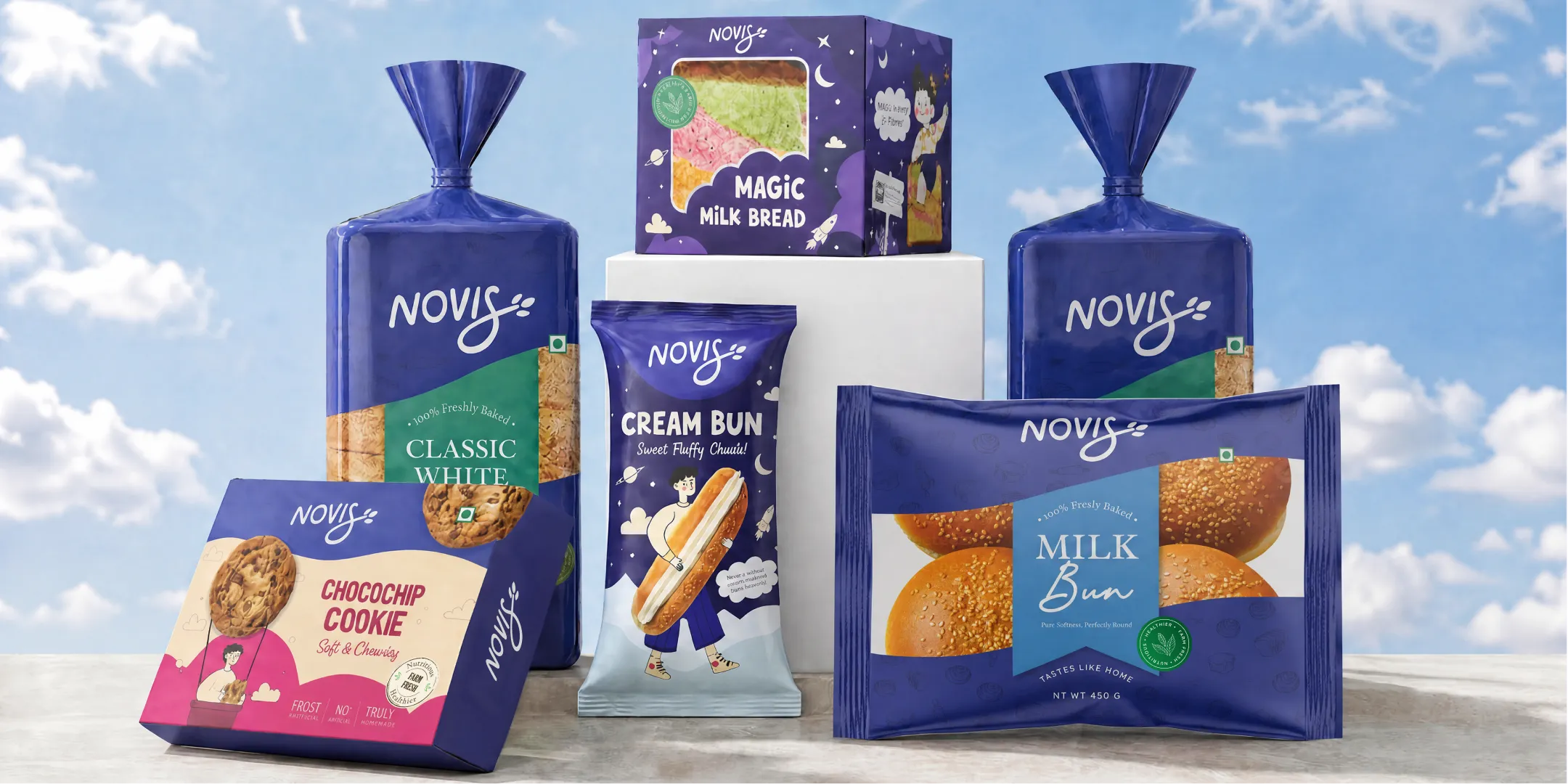
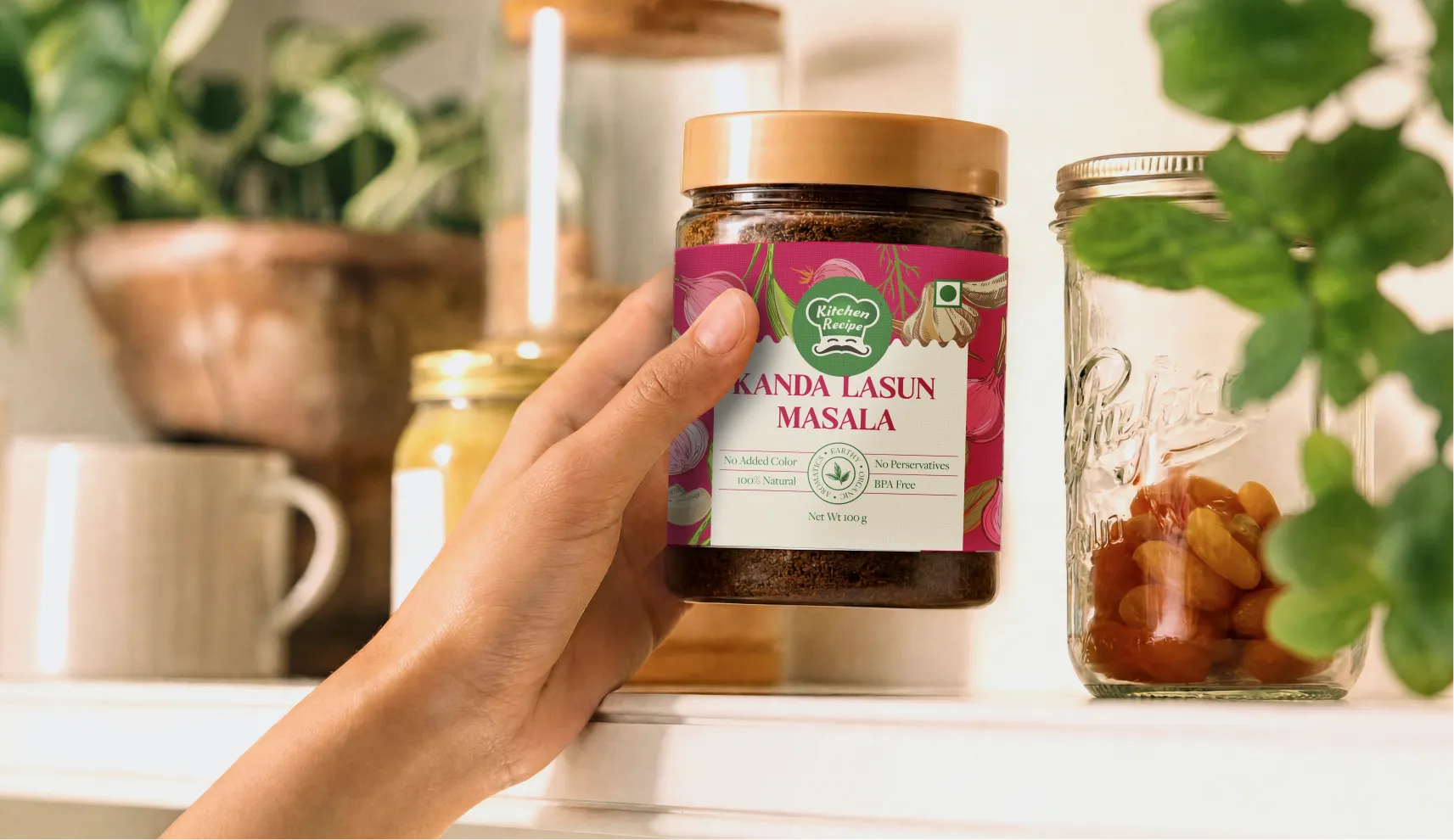
At Confetti, we work with brands at the packaging design stage with Instamart's NPI requirements built into the brief.
We mainly focus on:
🎯FSSAI and MRP compliance in the label
We design product labels with mandatory regulatory elements integrated from the start: FSSAI number, MRP, ingredient list, best-before format, positioned for maximum legibility and designed to remain visible.
🎯Barcode placement for dark store scanning
We brief barcode placement for shelf-stacked accessibility. We position barcodes to be operational.
🎯Product images at Q-commerce specifications
We produce the 3 required product images per SKU: front, back, and lifestyle, formatted to Instamart's exact technical specifications: minimum 1000x1000px, white background, correct aspect ratio. Every image is tested at 200x200px mobile thumbnail scale before sign-off.
🎯Screen-first label design
Your primary product image is your only salesperson on Instamart's category page. We design labels that work at both sizes: the full physical pack and the mobile thumbnail.
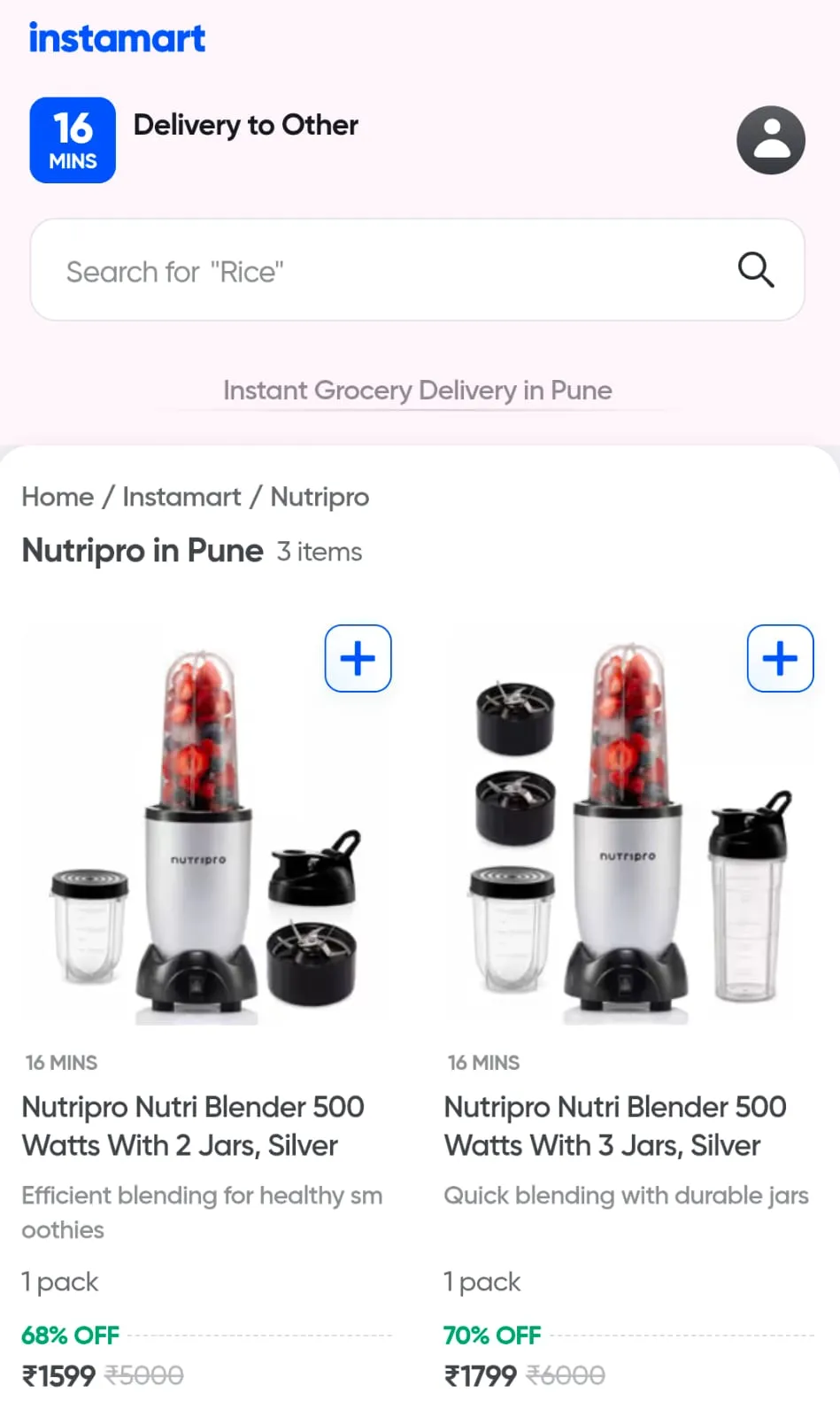
📌Products designed by Confetti are already live on Instamart and other quick commerce platforms. For example, Nutripro, an electronics brand for which Confetti built the full brand system, strategy, visual identity, verbal identity, and packaging.
What documents are required to sell on Swiggy Instamart?
Core documents for all sellers: GST Registration Certificate (active GSTIN), PAN Card, business registration proof (Certificate of Incorporation, Partnership Deed, or equivalent), bank account details (cancelled cheque or bank statement), and an authorised signatory document (Aadhaar).
Food and beverage brands additionally need a valid FSSAI licence with at least 6–12 months remaining validity. Resellers need a brand authorisation letter from the brand owner. Multi-city sellers need APOB GST registrations for each supply state. Every product SKU needs a GS1-registered EAN barcode.
Do I need GST to sell on Swiggy Instamart?
Yes, GST registration is mandatory for all sellers on Swiggy Instamart, regardless of annual turnover. Any business supplying goods through an e-commerce operator that collects TCS must register for GST, there is no turnover-based exemption for quick commerce sellers.
If you supply dark stores across multiple states, you need separate GSTIN registrations (APOB) for each state where inventory is stored.
Is FSSAI mandatory for Swiggy Instamart?
Yes, it is mandatory for packaged food, beverages, dairy, meat, snacks, health supplements, flavoured water, and similar products. The licence must be active, in the business entity's name, the correct type for your annual turnover (Basic / State / Central).
The 14-digit FSSAI number must also appear on the physical product packaging, inccluding in the submitted licence document.
What happens if my documents have a name mismatch?
A name mismatch between any 2 submitted documents. For example, your GST certificate and bank account showing different formatting of the same entity name,triggers a manual review exception in Instamart's verification system.
Each exception adds 5–7 working days to your approval timeline. Multiple mismatches can delay document verification by 3–4 weeks.
Do I need a trademark to sell on Swiggy Instamart?
Not if you are the brand owner and manufacturer selling your own products. A trademark certificate helps demonstrate brand legitimacy during category review but is not a mandatory submission document.
It is mandatory if you are a reseller, in that case, you need either the brand's trademark certificate or a brand authorisation letter issued directly by the trademark owner specifically permitting you to sell on Swiggy Instamart.
What is an APOB and when do I need one for Instamart?
APOB (Additional Place of Business) is a GST registration for a state where your business stores or dispatches inventory beyond your primary registered state. You need APOB registrations for every state where Instamart dark stores will hold your inventory.
If you're launching in one city within your home state only, your existing GSTIN is sufficient. If you plan to supply dark stores in multiple states simultaneously, obtain APOB registrations before applying, processing takes 7–15 working days per state.
Do I need a GS1 barcode before applying to Instamart?
GS1 barcode registration can be done in parallel with your Instamart application, but the physical barcode must be on your product before inventory is dispatched to dark stores. Instamart's NPI process requires a valid EAN code in the catalogue upload.
The barcode must be printed on the physical product unit in a position accessible for scanner use in shelf-stacked orientation. GS1 India barcode registration takes 7–10 working days and costs from approximately ₹3,000 + GST for MSME plans.
Want strategic branding and packaging like this for your business?





.webp)
.webp)

.webp)
.webp)
.webp)
.webp)
.webp)







.svg)
.webp)