%201.webp)
02
AI Snaps
.svg)
.svg)
01
Our Work
03
About Us
04
Brand Audit
05
Contact Us
06
Client Success
12
07
Blogs
08
Careers
Book A Call
.svg)



.svg)
Need Help In Building Your Brand?
Click the button below & book a call with our founder directly.

Rishabh Jain
Managing Director
Learning how to evaluate a branding agency the right way can save you from hiring the wrong partner and the likely cost attached to it.
In this guide, we provide a five-criteria SCORE method, a weighted scorecard, 15 questions with what answers actually mean and the red flags you need to look out for.
If you are a brand evaluating a branding agency, it can mean one of the two things:
🟣Evaluating To Choose: You're comparing shortlisted agencies before you signing.
You're scoring their pitches, portfolios, and proposals against one another, trying to find out which one will deliver the best results once the contract is signed.
When doing this, the evaluation criteria must include strategic thinking, process methodology, portfolio depth, team composition, and client retention data.
🟣Evaluating To Keep: You already have an agency. You're around 6-18 months into the relationship. Now you need to decide whether to renew, renegotiate the scope, or move away.
Key indicators you need to track here:
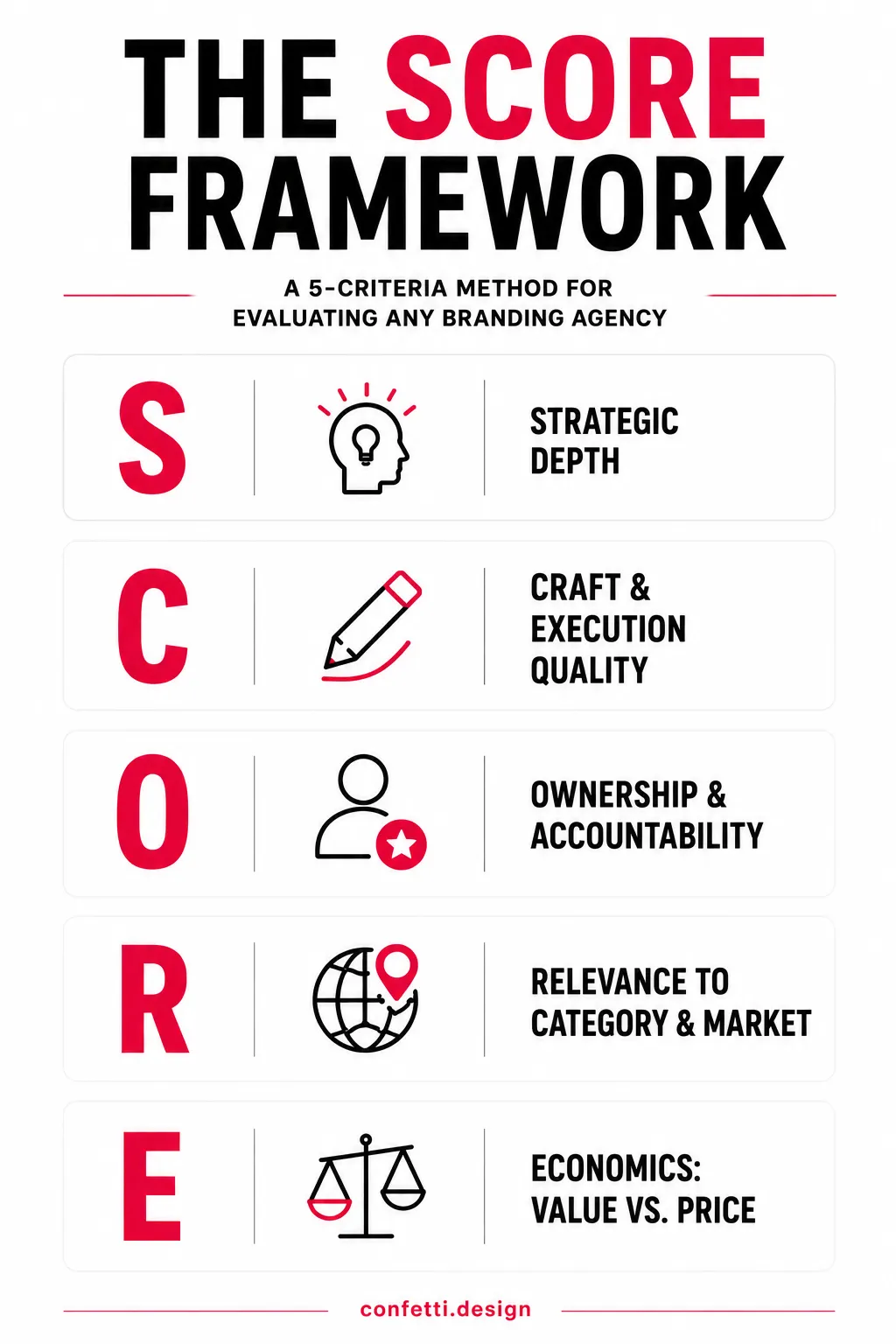
Here’s a method that can help you evaluate any branding agency
Score each criterion between 1 to 5 for every agency you're comparing, or for the one you already work with.
Although uncommon, a score of 25 is indicates a genuinely strong partner. Any score consistently below 3 across two or more criteria should generally be considered disqualifying.
🔷(S) Strategic Depth is a non negotiable.
If the very first call with your branding agency goes to "what colours are you thinking?" without them asking about who your customer is, how you're positioned against competitors, or what job your brand needs to do commercially, you're looking in the wrong place.
🔷(C) Craft & Execution Quality does not mean if you like their portfolio. Anyone can show you their three best projects.
Ask what the rest of their client list looks like, and look for consistency.
🔷(O) Ownership & Accountability is something not many consider but should be a major evaluation criteria.
The senior strategist who led your pitch may disappear into new business, leaving your account to whoever is available. Ask who will own your account throughout the engagement and what happens if that person leaves.
🔷(R) Relevance to Category & Market is equally crucial.
An agency that's only worked with SaaS or fashion brands doesn't automatically understand India’s FSSAI labelling constraints, regional pack-size expectations, or how packaging needs to cater to different needs at a shelf vs ecommerce app.
Category-specific experience improves speed and leads to fewer revision cycles.
🔷(E) Economics: Value vs. Price is about whether the fee results to something concrete.
A defined scope, a realistic timeline, a clear number of concepts and revision rounds. Vague pricing almost always turns into scope creep, and scope creep is where budgets and timelines quietly double.
Not every criterion we listed above should carry equal weight.
Strategic depth is more important than the other four combined, because design without strategy won’t survive contact with the market.
Here's the weighting we'd recommend:
Calculation:
To calculate a weighted score, multiply each raw score (1-5) by its weight, then add up.
You can adjust the weights slightly to fit your situation, but keep Economics below 20%. We understand the price sensitivity, but when you over-weigh cost, you end up choosing the cheaper, weaker option and paying more later through rework.
Worked Example:
Say you're choosing between two agencies for a packaging refresh for a quick commerce launch.
🟤Agency A has an impressive portfolio, two award-winning case studies, sharp visuals. But the account will be run by a project manager. And the pitch never asked about your retail data or competitive positioning.
🟤Agency B has a more modest portfolio, no award-winning hero project, but the founder or a senior strategist runs every account personally. And they've worked with three other FMCG brands on quick commerce packaging specifically.
📌On portfolio alone, Agency A looks like the obvious choice. Run the full rubric, and Agency B wins clearly.
This is because ownership and category relevance predict how the engagement will actually run, and Agency A is weak on both.
Strategic Depth (S)
❓Walk us through how you'd position us against [a named competitor], using our actual category
❓What's would you do if our founder or lead team disagrees with your branding recommendation
❓Show us a project where the strategy shifted after research. What changed, and why
A vague response to the first question, or generic positioning that could apply to any brand in any category, is a clear red flag.
The best branding agencies like Confetti get specific quickly because they’ve already started thinking deeply about your business before the call.
Craft & Execution Quality (C)
❓Beyond your three top case studies, what does an average project for you look like
❓Can we speak to a client whose project was smaller or less high-profile than your hero work
❓What was your most difficult project in the last couple of years, and what went wrong
That third question is very important. An agency willing to speak openly about a project that went off track and what they changed as a result tells you more about its standards and approach than a polished case study.
Ownership & Accountability (O)
❓Who specifically will be our day-to-day point of contact, and is that the same person leading the strategy
❓What happens to your account if that person leaves the agency or gets reassigned
❓How many other accounts is our strategist or creative director currently running
This criterion predicts relationship quality. An agency structured around one or two people handling multiple things run very differently from one where a founder-level person genuinely tied to your engagement.
Relevance to Category & Market (R)
❓Have you worked with a brand in our category before, and what did you learn from it
❓Do you understand labelling requirements in the particular market or packaging constraints for let’s say a platform like Carrefour in UAE
❓What retail or e-commerce data do you look at before making a design recommendation
Real category expertise shows up in the questions an agency asks.
An experienced FMCG branding and packaging design partner like Confetti will quickly get into the practical details of your business, from packaging and product formats to distribution and shelf-life considerations.
Economics: Value vs. Price (E)
❓What exactly is included in this fee, and are there any additional costs that we should know about
❓How many concept directions and revision rounds are built into this scope
❓What happens if the timeline slips on your end, does the fee or scope change
Pricing clarity is critical. An agency that's vague now about what triggers extra billing will be vague later when the invoice actually shows up.
📌 Fifteen questions across five key areas. Evaluate the answers carefully, and you’ll uncover the weaknesses that a polished, generic pitch deck can easily conceal.
Some warning signs are obvious while others are subtler. Here are five red flags that you should consider for your SCORE:
🔴A full proposal within 24 hours, with no clarifying questions asked
A serious agency cannot scope your project accurately without understanding your category, your competitors, your retail footprint, and your budget realities.
If your prospective branding agency hands you over the proposal the very next morning without a single follow-up question, they are likely using a template with your logo attached to it. This tells you the agency didn't think about your problem before pricing it.
🔴A portfolio built from single visual assets rather than full systems
Watch for case studies that rely on a hero image, logo, pack render, or homepage screenshot without showing the thinking behind the work. A real brand system includes guidelines, reasons for the choices made, and evidence of how the identity performs across multiple applications.
A portfolio that can't show you the thinking behind the visuals, only the visuals suggests the agency may not have done the strategic work in the first place, or isn't confident enough in it to show you.
🔴Junior-only calls after the contract is signed
This is the most common complaint founders raise about agencies once the contract is signed. The senior strategist or creative director who was there for your first three meetings vanished into new business development.
Every call after that is with a project manager or junior designer relaying decisions rather than making them. This is something you need to clarify explicitly before you sign, not after.
🔴Vague, hourly, or loosely bundled "package" pricing with no line-item scope
If an agency can't tell you how many concept directions, revision rounds, and deliverables are included in a fee, you have no way to know whether you're being charged fairly or whether the scope will quietly expand once work starts.
This is one of the easiest red flags to catch early, because all it takes is asking for a line-item breakdown.
🔴No willingness to connect you with an active client
Past logos on a case study page prove an agency did work once. They don't prove the relationship held up. An agency confident in its current client relationships should be able to offer at least one reference who's still an active, paying client.
Reluctance here suggests either the relationship didn't end well or there isn't much of a current client base to draw from.

Most people evaluate a branding and packaging design portfolio the way they'd evaluate art.
They scroll, they react, they pick the agency whose work they personally like the most. That’s not a very reliable way to predict how an agency will perform on your brand.
A portfolio should be judged on consistency.
Here's a simple three-question audit to run against any portfolio:
❓Is the "why" documented, or just the "what"
A strong case study explains the brand's actual problem before showing you the solution. What was the market challenge, who was the audience, what constraint shaped the design decisions.
A weak case study skips straight to the final render with a line or two of the promotional copy underneath it.
❓Does execution vary appropriately by brand, or does everything look like the same house style regardless of client
You can check this by opening four or five projects from the same agency, ideally across different categories. If a skincare brand, a snack food brand, and a supplements brand all come out looking like variations of the same aesthetic, that’s a lack of range.
Good strategic work looks different from client to client because the underlying problems are different.
❓Is there a commercial outcome attached, or only an award
Awards don't tell you whether the work helped the business.
Look for case studies that mention shelf performance, sales impact, retail listing outcomes, or platform-specific results, not just recognition from a design publication.
📌Confetti's case study for Pawsible pet food launch is a useful example of what a complete write-up looks like, because it shows the pattern clearly.
India's retail landscape has several markets running in parallel. A mass-market snack brand needs packaging that performs on a packed kirana shelf.
A premium D2C skincare brand needs packaging that reads as credible on a 400-pixel-wide thumbnail on someone's phone.
This is why you need three India-specific sub-questions in addition to the general one.
❓Have you designed for Indian modern trade and quick commerce/ecommerce thumbnails
These are different platforms with different constraints. A pack that reads beautifully on a supermarket shelf can fail completely as a small app thumbnail if the typography isn't legible at that scale or the colour blocking doesn't hold up when compressed.
An agency that's only worked in general or export-market retail may not have direct experience with the specific compression and legibility demands of Blinkit, Zepto, or Instamart listings.
❓Do you understand regional language and script needs on-pack
India's linguistic diversity is often central to how a brand builds trust in a specific geography.
An agency that defaults to English-only design systems, without asking whether your category or target region needs Hindi, Tamil, Bengali, or another script worked into the pack architecture, is showing you a real gap in market understanding.
❓Have you worked within labelling constraints without compromising the design?
FSSAI mandates specific font sizes, mandatory declarations, and placement rules for nutritional information, allergen warnings, and manufacturing details.
An agency encountering these constraints for the first time on your project will either produce a design that needs significant rework once compliance is checked, or worse, ship something that isn't compliant at all.
An agency that's done this before builds the compliance requirements into the design system from the first draft, rather than bolting them on afterward.
Here’s how to evaluate your existing branding agency against the SCORE Method:
🟡Strategic Depth (S) at 90 days and beyond should show evidence that the agency is learning from your actual data.
By this stage, your partner should be able to point to specific patterns in sales, retail listings, quick-commerce performance, and other market signals, and explain what they mean for the brand.
If the conversation still sounds like the original pitch, repeating broad positioning statements without incorporating what the market is actually telling you, that’s a clear sign that strategic depth is starting to erode.
🟡Craft & Execution Quality (C) should be stable or improve. It’s natural for the first deliverable to receive extra attention. Early in the engagement, the agency is still earning your trust and setting the standard for the relationship.
The real test comes later: deliverables 5,10, 15 and beyond. Does the quality of thinking and execution remain consistently high, or does the work start to feel routine, rushed, or like the account is running on autopilot?
🟡Ownership & Accountability (O) is the criterion most likely to erode.
Ask directly: is the same senior person who ran your pitch still running your account, or has it quietly moved to a project manager relaying decisions from someone you no longer speak with?
🟡Relevance to Category & Market (R) should be increasing. An agency eight months into your account should understand your business, your customers, and your category better than they did at signing.
If category understanding hasn't visibly deepened, that's a sign the relationship has become transactional rather than genuinely invested.
🟡Economics: Value vs. Price (E) should still be proportionate. Has the scope quietly expanded without a corresponding fee conversation? Has output slowed while billing has stayed flat?
This is often where founders lose visibility most quickly. The retainer stays fixed, creating a sense of stability, while the scope, effort, and quality of work quietly begin to decline.

🎯We Focus on Strategy First
Every project begins with positioning, audience definition, and category context. This means, the design decisions that follow are grounded in a commercial rationale.
🎯Full Brand Systems
Confetti builds complete identity systems, logo, typography, colour, packaging architecture, and guidelines, so the brand holds together consistently across every touchpoint. That means shelf, app, and digital touchpoints.
🎯Packaging Design is Built to Perform
Design decisions are evaluated using an internal Packaging Resonance Score across visual appeal, brand alignment, emotional impact, functionality, and shelf presence. So packaging is tested against how it'll actually perform in a store or on a quick commerce thumbnail before it ships.
🎯One Senior Team, Start to Finish
A senior strategist and project manager stay attached to the account from initial positioning through final packaging. The people who scope the project are the ones delivering it.
🎯Category-Specific Experience Across FMCG, D2C, and Premium Retail
Work spans food and beverage, beauty, wellness, fashion, and gourmet categories, across both mass and premium price points. Which means most new briefs map to a comparable project already done rather than a first attempt.
🎯India-Specific Retail Understanding
Design accounts for how brands actually get discovered in Indian retail, kirana shelves, modern trade, and quick commerce platforms, where the same pack needs to perform differently depending on the channel.
🎯One Agency Instead of Multiple Vendors
Brand strategy, identity, packaging, and digital are handled under a single team, removing the coordination overhead and consistency gaps that come from managing separate agencies for each project.
What's the difference between choosing and evaluating a branding agency?
Choosing is a one-time decision made during selection. Evaluating is a repeatable scoring method, you can apply it once to compare shortlisted agencies, then reapply it every quarter to an agency you've already hired, to check whether the relationship still justifies its cost and scope.
What are the most important criteria for evaluating a branding agency?
Five things are important: strategic depth (do they research before designing), craft consistency across their portfolio, ownership (a stable senior contact), relevance to your specific category and market, and whether pricing maps to a defined scope. Together these form the SCORE method.
How do I know if a branding agency's portfolio is actually good?
Check for consistency. A strong portfolio documents the "why" behind each design decision and shows commercial outcomes.
If every case study looks stylistically identical regardless of the client's category, that signals a house style being imposed rather than strategy being applied.
What questions should I ask a branding agency before hiring them?
Ask category-specific questions, request a real positioning example against one of your actual competitors, ask who stays on the account after the pitch, and ask for a still-active client reference. Vague or rehearsed answers are a warning sign.
How often should I re-evaluate a branding agency I've already hired?
Quarterly, at minimum, and always before a retainer renewal date. Re-apply the same criteria you used at hiring, strategic thinking should visibly evolve with your market data, and the senior team that won the pitch should still be involved.
What are common red flags when evaluating a branding agency?
A proposal that arrives within a day with no clarifying questions, vague hourly pricing with no line-item scope, portfolios showing isolated assets instead of full brand systems.
And juniors replacing the senior team immediately after signing are the most common warning signs.
Is a branding agency evaluation different for the Indian market versus other regions?
Yes. In India, relevance should also account for shelf behavior across modern trade, kirana, and quick commerce, regional language and labeling needs, and compliance handled without compromising design, criteria a generic global evaluation checklist won't cover.
Want strategic branding and packaging like this for your business?





.webp)
.webp)

.webp)
.webp)
.webp)
.webp)
.webp)







.svg)
.webp)