%201.webp)
02
AI Snaps
.svg)
.svg)
01
Our Work
03
About Us
04
Brand Audit
05
Contact Us
06
Client Success
12
07
Blogs
08
Careers
Book A Call
.svg)



.svg)
Need Help In Building Your Brand?
Click the button below & book a call with our founder directly.

Rishabh Jain
Managing Director
Most brands discover they weren't ready for quick commerce three months after they've gone live.
This blog covers six domains of quick commerce readiness checklist. A brand that passes all six is genuinely ready to apply.
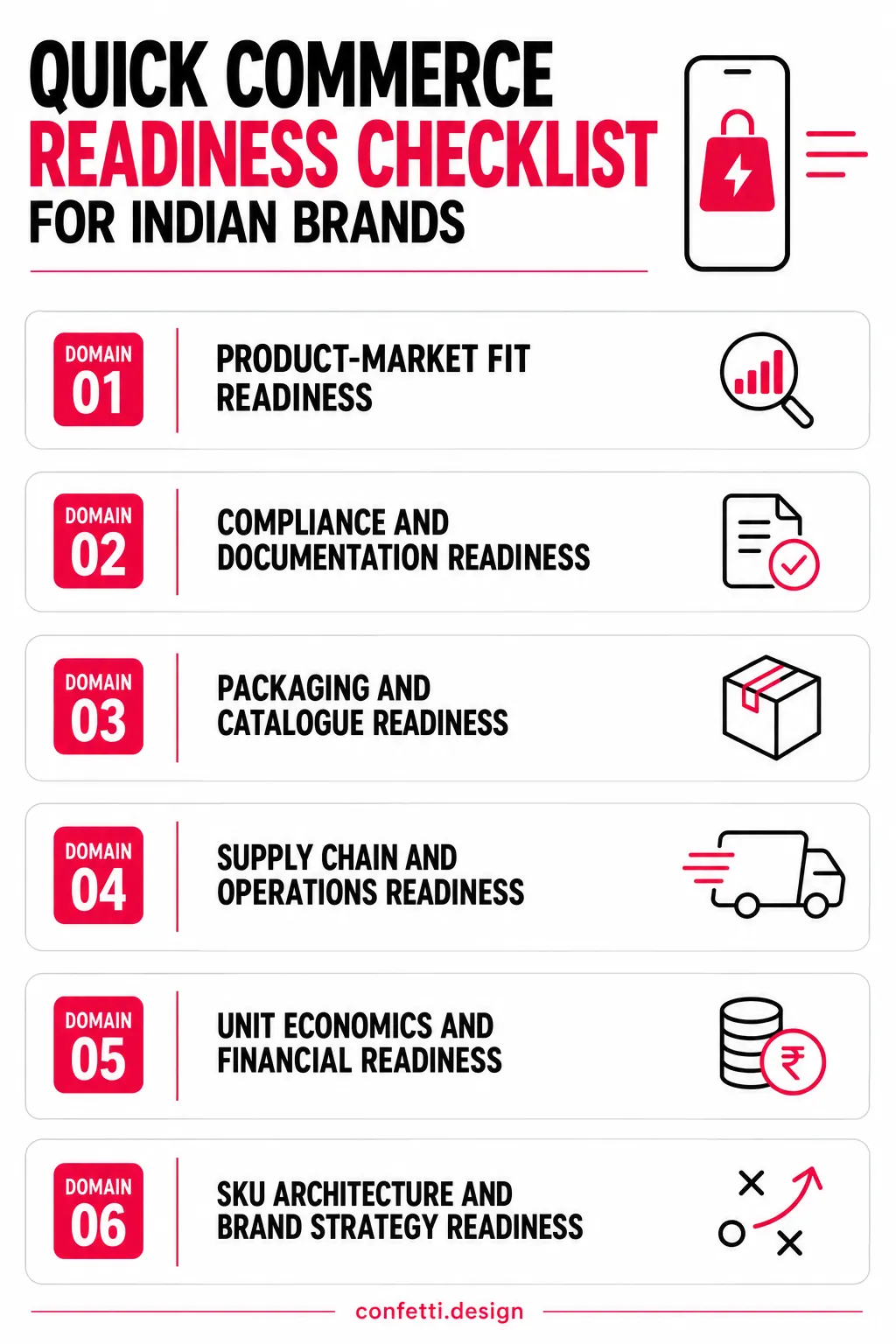
Use this as a pre-application audit. Complete it 4–8 weeks before applying to Blinkit, Zepto, or Swiggy Instamart so you have enough time to fix any issues.
Consider the six domains for the complete checklist. Each contains specific, gradeable criteria. For every criterion, assign one of three grades:
Be honest with the grading.
At the end of each domain, tally your Greens, Ambers, and Reds and calculate that domain's readiness score.
Add all 6 domain scores together to get your total, and use the verdict section near the end to interpret it.
Whether you're ready to apply now, ready in a few weeks with targeted fixes, or not ready at all.
📌Important Distinction: Requirements lists tell you what to upload. This checklist covers what platforms evaluate but rarely publish.
Passing the requirements list gets you onboarded. Passing this checklist is what determines whether onboarding was worth doing.
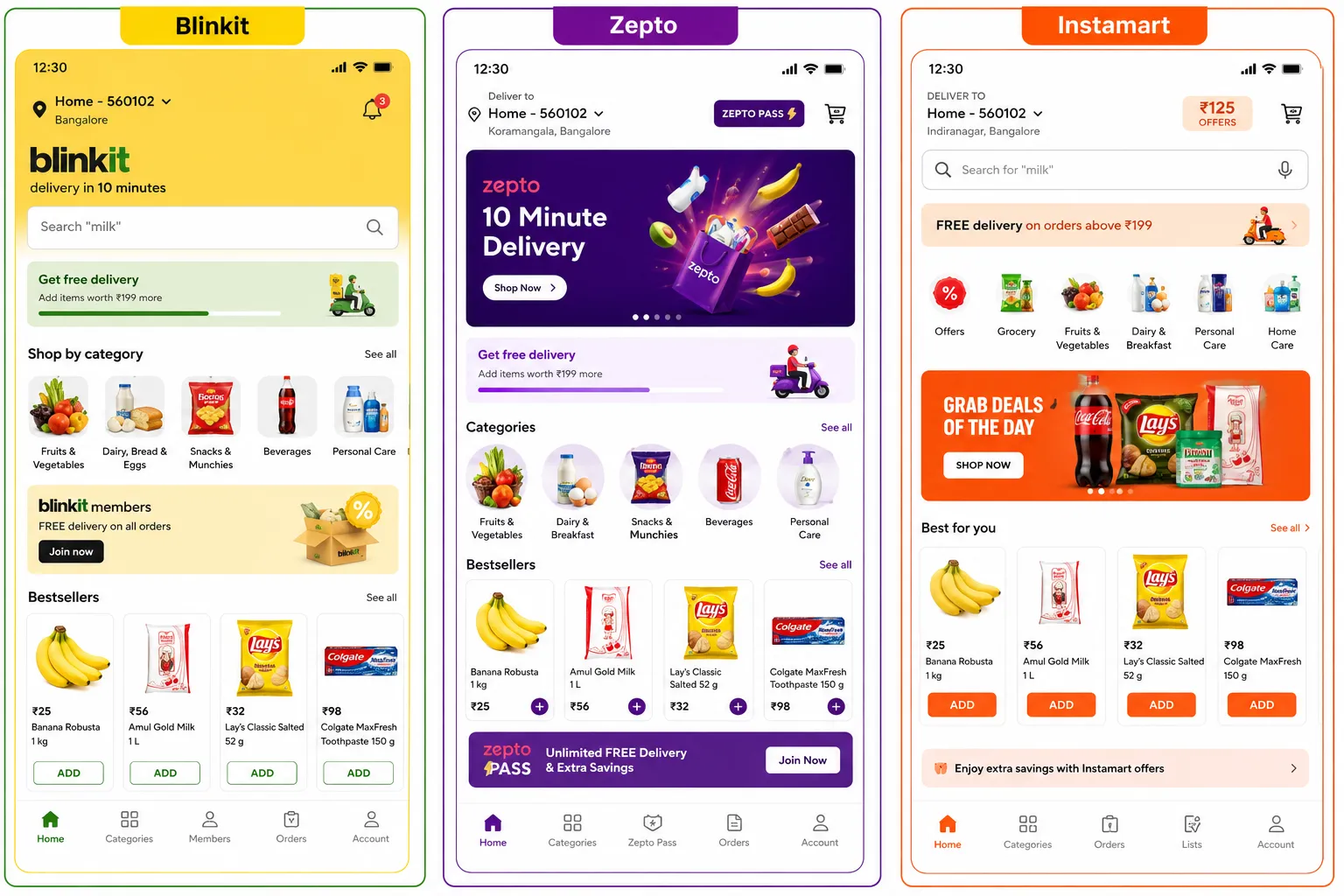
Q-commerce rewards certain buying behaviors and penalizes products that don't fit, regardless of brand strength or ad spend.
Run your product through these 6 criteria before you go further:
1. Is your product a high-frequency, repeat-purchase item?
🟢Consumers buy it at least monthly. Examples: grocery staples, packaged snacks, beverages, personal care essentials, baby care, pet care, and health supplements.
🟠Repurchase happens quarterly or less. You'll get trial purchases, but not enough repeat buying to drive velocity.
🔴It's a high-consideration purchase. Examples: electronics above ₹2,000, premium cosmetics that require shade matching, or products customers typically want to inspect before buying. These are poor primary SKUs for Q-commerce.
2. Does your product match a "right now" purchase occasion?
🟢 The product solves an immediate need. Examples: hunger, a run-out emergency, an impulse snack, or everyday replenishment.
🟠 The product is useful, but not urgent. Shoppers may buy it eventually, but they're unlikely to add it to their basket on impulse.
🔴The product requires planning, comparison, or education before purchase. Q-commerce gives you only a 3-second decision window, not enough time to explain why your product is different.
3. Is your product priced within Q-commerce's impulse psychology?
🟢₹49–₹299,converts best on impulse. ₹300–₹499 can still work if you already have strong brand awareness or a clear value-bundle angle.
🟠Covers ₹500–₹999, conversion is possible, but it drops sharply without heavy ad support and prior brand recall.
🔴Anything above ₹1,000. It rarely converts as an impulse buy. If your product is priced higher, launch a smaller, Q-commerce-specific SKU first.
4. Is your product compatible with dark store pick-and-pack operations?
🟢The product is compact, lightweight (under 3kg for most categories), structurally durable, stackable, and pickable in under 90 seconds without special handling.
🟠The product is slightly bulky or handling-sensitive, but manageable with reinforced packaging.
🔴The product is fragile: glass without protective packaging, bags over 5kg, oversized products, or items requiring unreliable temperature control.
5. Does your product have sufficient shelf life for dark store operations?
These differ by platform:
🟢Your food or beverage product carries 180+ days total shelf life and comfortably clears these minimums at dispatch.
🟠Shellf life is borderline, you'll need to tighten production timing to guarantee remaining shelf life at inwarding.
🔴Shelf life is under 60 days remaining at usual dispatch. Write-off risk is severe, and without cold chain infrastructure, multi-dark-store distribution isn't realistic yet.
6. Does your category have documented demand on Q-commerce platforms?
This is the quickest check and most founders skip it. Search your sub-category on Blinkit or Zepto.
🟢Meaningful results, active listings, visible ratings, demand is established.
🟠Some results, but thin. The category is emerging, which means upside but little algorithmic support to lean on.
🔴Nothing comes up. Either the category isn't listed at all, or demand hasn't materialised and no amount of onboarding preparation fixes that.
📌If you're scoring mostly Amber or Red in domain 1, it's worth stepping back before you invest further
Our complete eligibility criteria across all three platforms breaks down where product fit and platform eligibility intersect.

A missing document or a mismatched entity name stops your application down.
These six criteria account for the majority of automated rejections platforms seen at the application stage, and almost all of them are avoidable with a document audit.
7. Is your GST registration active and correctly structured?
🟢You have an active GSTIN for the selling entity, registered as a Regular Taxpayer. Your HSN codes should also match your actual product categories.
🟠The GST exists but the entity name doesn't exactly match your bank account or PAN, "ABC Foods Pvt. Ltd." on GST versus "ABC Foods Private Limited" on the bank statement.
🔴You don’t have GST, or Composition status. Registration takes 3–7 working days through the GSTN portal, start now if you're Red.
8. Do you have APOB registrations for every target state?
🟢You hold an Additional Place of Business (APOB) registration under your GSTIN for every state where you plan to supply dark stores.
🟠You have your home-state GST sorted but planning a multi-city launch without the APOBs in place; apply now, since each state takes 7–15 working days.
🔴You are planning multi-state supply with no APOBs at all, it's a statutory violation under the CGST Act, and it has to be resolved before a single unit is dispatched.
9. Is your FSSAI licence valid, correct, and on the physical product? (Food brands only)
🟢You have a valid licence in the right category: Basic, State, or Central, based on your annual turnover, and the 14-digit FSSAI number printed on the primary consumer unit itself, legible from arm's length under normal lighting.
🟠Correct FSSAI placement on the carton but not the consumer unit.
🔴You have an expired licence, the wrong category, or no FSSAI number on the physical product. Any of these triggers a hard rejection at NPI review or at dark store inwarding.
10. Do you have GS1-registered EAN barcodes on every product unit?
🟢You have GS1-registered EAN-13 or UPC-A barcode on every individual consumer unit, positioned so it can be scanned in shelf-stacked orientation.
🟠Your registration in process (7–10 working days) or a barcode that exists but is positioned wrong for dark store scanning workflows.
🔴No GS1 barcode. An internally generated QR code.
11. Are your Legal Metrology declarations complete on the physical product?
🟢Your pack carries all packaging labeling requirements:MRP, net weight, manufacturer details, origin, manufacturing date, expiry/best-before, and consumer care contact.
🟠Most of these present with one or two missing or wrongly formatted, fixable in your next label run, but not something you want discovered at inward inspection.
🔴Multiple missing declarations, which gets a consignment rejected outright at the dark store gate.
12. Are all document entity names character-for-character identical?
🟢Your business name matches, exactly, across your GST certificate, PAN card, bank account statement, FSSAI licence, and business registration, no abbreviation differences, no punctuation drift.
🟠Minor formatting inconsistency, like "Pvt." versus "Private," which triggers manual review and needs standardising before submission.
🔴You have different name across documents, a trading name that doesn't match your legal entity. Which causes hard rejection at verification.
📌If several checks are Amber or Red, fix them before submission. Document mismatches are the biggest cause of go-live delays.
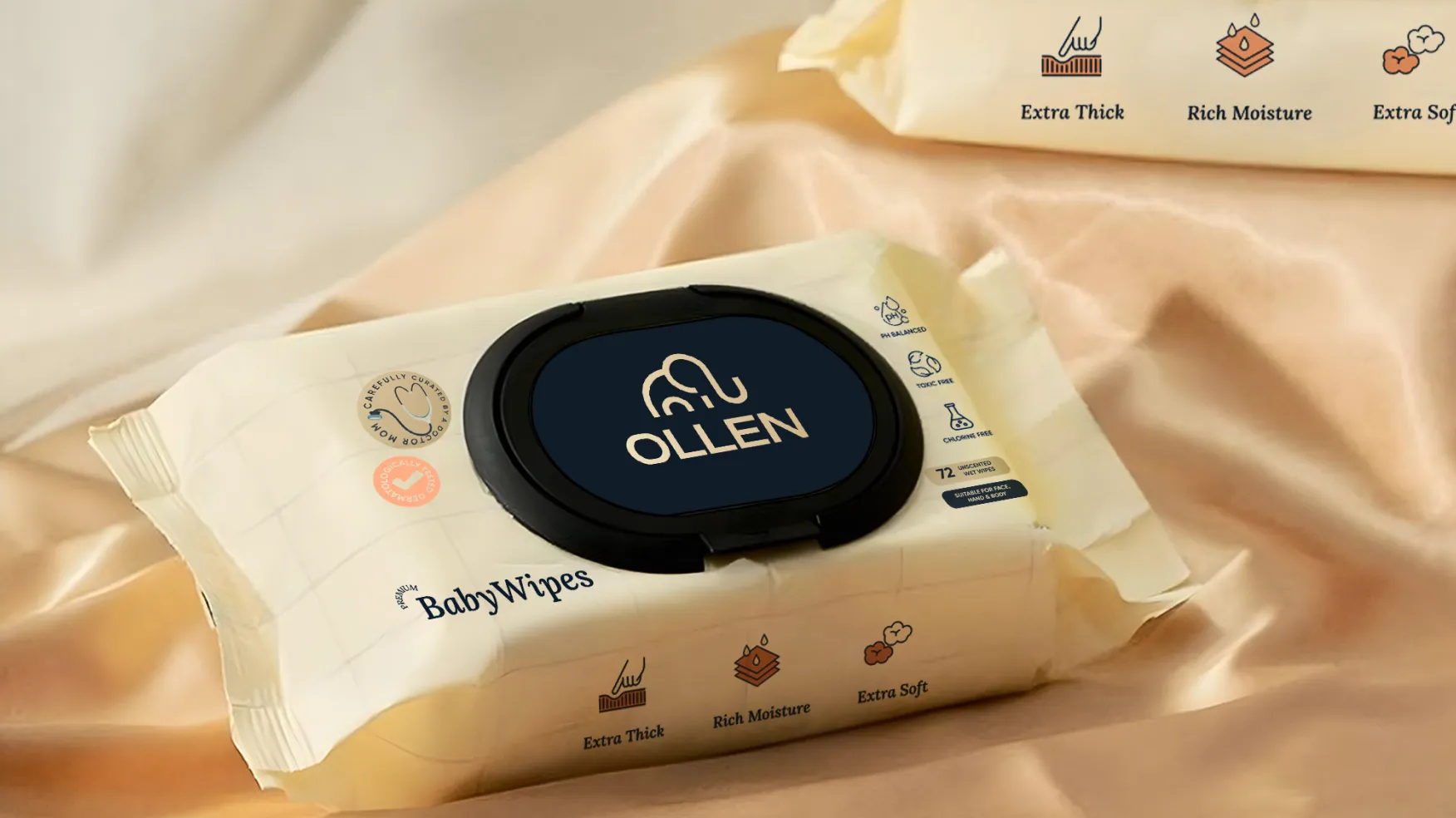
Packaging on Q-commerce fails in two separate ways.
Physical: does the pack survive dark store handling and pass inward inspection.
Digital: does the pack image actually work as a 200-pixel thumbnail competing against other products on a mobile screen.
13. Does your product image read clearly at 200x200 pixels on a mobile screen?
Test this literally. Open your product photo on your phone, shrink it to thumbnail size, and look at it the way a scrolling shopper would.
🟢The brand name is instantly readable, the variant is distinguishable from the rest of your range, and the image holds contrast against a row of white-background competitor thumbnails. It earns the click in under three seconds.
🟠A brand name that's readable but a variant callout that isn't, or an image that blends into the category page instead of standing apart from it.
🔴An image that's simply illegible at thumbnail scale, fine typography, an intricate illustration, or a low-contrast palette that disappears at 200px.
14. Is your packaging structurally rated for dark store pick-and-pack operations?
🟢The pack survives a 1-metre drop onto a hard surface, survives being stacked 5–10 units high without deforming and survives being grabbed quickly, bagged, and delivered on a two-wheeler without damage.
🟠Your packaging is adequate but borderline. If your previous e-commerce sales already show some damage claims, expect those to increase in a dark store environment.
🔴Your product is fragile: unprotected glass, crush-prone plastic, or has frequent damage complaints on Amazon or your D2C site.
15. Are all three required NPI images prepared per platform specifications?
🟢You have a front-of-pack image (1000x1000px minimum, white background, legible at phone screen), a back-of-pack or ingredient/ nutritional panel image with every compliance element visible, and a lifestyle or in-use contextual image.
🟠You have images shot for Amazon or retail catalogs, not optimized or tested for Q-commerce thumbnails. They may pass NPI review but still underperform on live CTR.
🔴You have only one product image, images below 1000x1000px, or a non-white background, which Instamart auto-rejects outright. Any of these stalls your NPI submission before it starts.
16. Is the NPI product data template ready with all required fields?
🟢Your product name follows the structured format platforms expect.
Brand | Product | Variant | Pack Size.
Your EAN code matches the physical product exactly, your HSN code matches your GST registration, your catalogue MRP matches the physical pack MRP down to the rupee, shelf life is declared in total days, and category/sub-category mapping is complete.
🟠Data exist but the title reads like ad copy instead of a structured field, or where one or two entries still need verification.
🔴No data template prepared at all, or multiple unverified fields. And this one has a real cost attached: each NPI correction round adds 5–7 working days to your timeline.
📌Packaging and catalogue readiness is where design meets performance. A pack that looks premium on a retail shelf can still fail the 100px thumbnail test and hurt CTR.
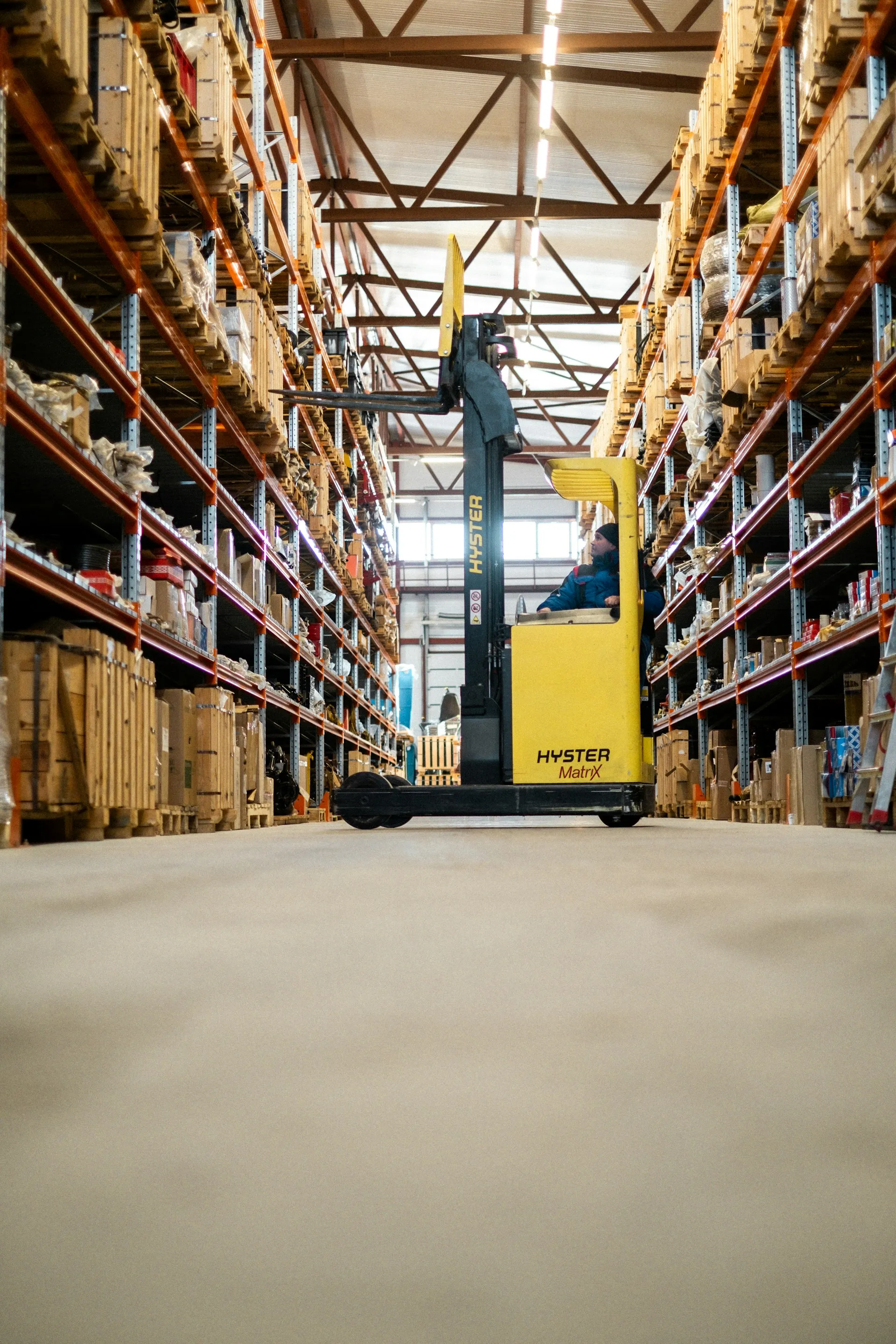
Q-commerce needs frequent, small dispatches to dozens of individual dark stores across a city, with almost no room for a stockout at any single one of them.
17. Can you replenish dark stores on a 2–3x per week cycle for fast-moving categories?
🟢Your warehouse can dispatch directly to individual dark stores, 2-3 times a week, and your logistics partner can get that stock into the dark store's receiving window within 24–48 hours of dispatch.
🟠You can do weekly replenishment, which is workable for slower-moving categories like personal care or health supplements but will generate stockouts fast in high-velocity food and snack categories.
🔴You can do a monthly or bi-monthly dispatch to a central warehouse. A model that simply isn't compatible with how dark stores operate.
18. Can you maintain 3–4 weeks of buffer stock per target city?
🟢Your warehouse can hold 3–4 weeks of projected demand simultaneously across every dark store in a given city. Enough buffer to absorb a demand spike from a viral post, an influencer feature, or a festive-season surge without running dry.
🟠1–2 weeks of buffer, fine for steady-state demand but exposed the moment demand isn't steady.
🔴Just-in-time production with under a week of buffer, which means a single spike triggers stockouts, and stockouts trigger algorithmic demotion.
19. Is your production lead time short enough for weekly replenishment?
🟢You’re a manufacturer or contract manufacturer who can produce and deliver within 5–10 working days of a replenishment order, consistently, across seasons.
🟠You have 2–3 week lead time, which is manageable with buffer stock but demands careful demand forecasting to avoid gaps.
🔴You take 4+ weeks, which forces you into either very high buffer stock, tying up working capital you'll want elsewhere or accepting stockouts.
20. Do you have inventory visibility at the dark store level, not just at the platform level?
🟢You can track or can quickly stand up tracking for your inventory position at individual dark stores, city by city. You know a specific dark store is running low before it hits zero.
🟠Platform-level visibility only, which means you find out about stockouts reactively, after the algorithm has already started responding to them.
🔴No visibility beyond your own warehouse dispatch. You won't know a dark store has stocked out until your listing gets demoted, which is the most expensive way to find out.
21. Is your fill rate commitment achievable at 95%+ across your target dark stores?
🟢Your current supply chain: capacity, lead times, buffer stock can sustain a 95%+ fill rate on platform orders, which is the industry-standard benchmark.
🟠Your fill rate is 85–94%, which draws some algorithmic scrutiny but is manageable short-term with active monitoring.
🔴Anything below 85%. Blinkit's algorithm begins demotion below an 80% fill rate, and losing dark store coverage this way is faster and harder to reverse than almost any other readiness failure on this checklist.
📌If most of your answers here are Amber or Red, that’s a sequencing problem. Supply chain can be built before launch, not after a stockout has already hurt your listing's performance.

Brands often accept platform commissions as the cost of doing business, only to discover later that it was just one of six or seven margin drains.
The hidden costs, not the commission itself, are what quietly turn Q-commerce growth into scaled losses.
22. Have you modelled your net contribution margin at the full Q-commerce cost stack?
🟢You've calculated net contribution per unit across the full stack: MRP minus commission, GST on commission, inbound logistics, inwarding, dark store costs, advertising, and write-offs. The model stays contribution-positive at 2,000 monthly orders.
🟠You stop at commission. Advertising and write-off risk aren't accounted for, which understates your real cost base significantly.
🔴No model at all, just an assumption that the channel will work because other brands are on it. Run the numbers before you spend a rupee on listing fees.
23. Does your gross margin exceed 55–60% before platform costs?
🟢Your gross margin on the specific Q-commerce SKU, is above 55–60%. Use the actual Q-commerce pack size and its actual production cost. This threshold is where the economics usually work at moderate volumes, roughly 2,000–5,000 monthly orders.
🟠Your margin is 45–55%, workable at higher volumes, but with zero room for discounting or promotional markdowns.
🔴Margin is below 40%, which doesn't work at any realistic startup volume. At that point your options are raising MRP, redesigning pack size to reduce COGS, or holding off on the channel until one of those changes.
24. Have you budgeted for the full first 90 days of advertising?
🟢You've committed a budget covering advertising at 10–15% of projected monthly GMV for the first 90 days. A minimum of ₹30,000–₹50,000 per month per platform in competitive categories, plus listing fees and inventory float, all before you apply.
🟠You’ve budgeted listing fees and inventory, but treated advertising as optional. For new brands, paid support is essential in the first 30–60 days—without sales history, the algorithm has no signal to amplify.
🔴You don’t have an advertising budget, assuming organic visibility will carry you from day one. It won’t. Organic visibility needs velocity, velocity needs sales, and new brands need advertising to create that momentum.
25. Have you calculated the working capital required for inventory float?
🟢You know exactly how much capital will be tied up in dark store inventory, stock, storage costs that haven't sold yet. Across every target city at any given point, and that float is funded without pressure on your operating cash flow.
🟠Float that exists in reality but hasn't been explicitly modelled, which risks cash flow strain when dark store stock and new production orders overlap.
🔴You have not considered this at all.
Brands report ₹15–30 lakh tied up in dark store inventory at any given time for multi-city Instamart launches, driven by fixed weekly POs with no guaranteed sell-through.
📌If this comes out mostly Red, pause here before moving forward. A brand can be compliant, well-packaged, and operationally sound, yet still lose money on every order because the true cost stack wasn’t modelled.
Our breakdown of when quick commerce genuinely works for startups goes deeper into which business models clear this bar and which don't.
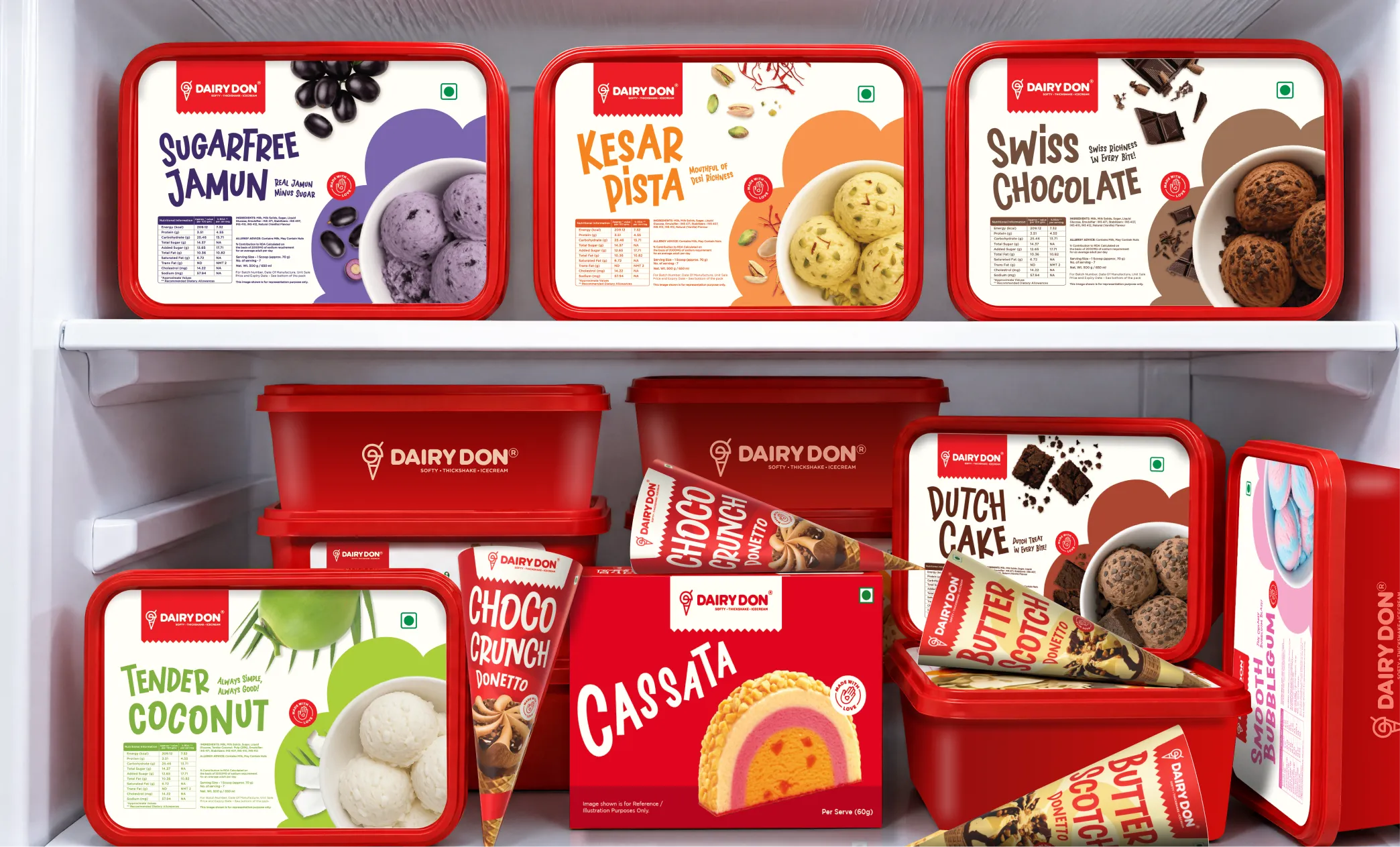
This is the domain that separates brands building a durable Q-commerce position from those that get listed, see a short burst of orders, and quietly plateau.
26. Have you selected 2–5 hero SKUs to launch with, and resisted the temptation to list your full catalogue?
🟢You've narrowed your launch to 2–3 specific SKUs chosen deliberately, highest velocity potential, a Q-commerce-compatible pack size, an optimal price point, strong gross margin, and packaging that actually converts at thumbnail scale.
🟠You’ve identified strong SKUs but still plan to launch 8–12 at once. This divides early sales momentum across too many products, making it harder for any single SKU to build the signals the algorithm rewards.
🔴Listing the full catalogue: 15+ SKUs. This spreads velocity too thin. Products rank nowhere, and platforms may delist slow movers before you can support them with advertising or attention.
27. Are your Q-commerce pack sizes different from retail or e-commerce where needed?
🟢You've evaluated your intended SKUs against Q-commerce buying psychology specifically. The ₹99–₹299 range, a right-now use occasion, no more than 2-3 days of supply per pack and your pack sizes reflect that, rather than being carried over from general trade.
🟠A mixed picture: some pack sizes work, others are straight retail carry-overs (a 5kg atta pack, a 400ml shampoo bottle) that will underperform against smaller, more impulse-friendly formats built specifically for this channel.
🔴Listing existing retail pack sizes without evaluation creates risk. A 5kg rice pack may go live because it’s already in production, not because it matches how customers buy on Blinkit or Zepto.
28. Have you chosen which platform to enter first, and why?
🟢You've made a deliberate choice between the quick commerce platforms. Grounded in category fit, audience platform usage, available capital for listing fees, and dark store coverage in your target city, you’re starting with one platform.
🟠You’ve picked a platform without a clear rationale, or trying to launch on two platforms at once with a budget that can't generate meaningful velocity on either.
🔴Launching on all platforms simultaneously without the advertising budget to properly support any of them.
29. Do you have a demand signal to present to the category manager?
🟢You walk into the application with evidence. Documented prior sales (Amazon orders per month, a prior Blinkit or Zepto test, D2C website orders) and at least 50 reviews averaging 4.0 or above, packaged into a brand brief you can send alongside your application.
🟠You’ve some sales history but thin review counts, or reviews that exist on social media and your website but nowhere a category manager can independently verify them.
🔴No prior marketplace sales, no reviews, nothing beyond your own belief that the product is good. Category managers routinely deprioritise applications without demand evidence.
They're managing limited dark store shelf space and have no reason to bet on an unproven SKU.
30. Have you defined your first 90-day post-launch plan?
🟢You have a specific, budgeted plan covering advertising start dates by platform, a weekly review cadence for velocity and fill rate.
And a communication schedule with your category manager, social content that drives traffic to the platform. Along with a defined trigger point for when you'll add a second SKU or a second platform.
🟠You’ve a rough post-launch instinct without a real plan, budget, or review rhythm behind it.
🔴Plan that ends at "go live". Treating the listing itself as the finish line.
📌This domain is where SKU architecture and brand strategy overlap directly with packaging and pricing decisions.
Once all six domains are graded, scoring your results is simple.
With 30 criteria across the checklist, your maximum possible score is 60.
Add up your total, then find your verdict below.
📌Any single Red in Domain 2 (Compliance) or Domain 5 (Unit Economics) is a hard stop, regardless of how high the rest of your score is.
Blinkit, Zepto, and Instamart each layer on additional requirements. If you're entering all three, you need to clear these in addition to everything covered so far.
❓Do you have 60–70% gross margins
Blinkit's commission structure runs 2–18% depending on price tier, and that's before you factor in ₹50 per order in fulfillment charges and ₹1 per unit per day in storage.
Stack those together and 60–70% becomes the realistic margin floor for the economics to hold.
❓Can you fund the ₹25,000/SKU/state listing fee upfront
This is paid at registration, and it converts into Brand Central ad credits rather than sitting as pure cash outflow.
But the upfront number still needs to be funded before you've made a single sale. For 3 SKUs across 2 states, that's ₹1.5 lakh committed before revenue starts, and brands who haven't budgeted for it as a lump sum are often caught off guard.
❓Have you added Blinkit's dark store locations as APOB in your GST?
Blinkit's inwarding process requires an APOB GSTIN for every state where dark stores receive your stock, the same requirement, applied platform by platform.
A missing APOB here is a guaranteed inward rejection.
❓Are you prepared for the Trial-to-Level progression?
New brands don't get pan-city coverage. You start at Trial status, with access to a limited set of dark stores, and your velocity gets evaluated over the first 30 days before you progress further.
Your launch plan and your advertising budget pacing needs to be built around this constraint.
❓Do you have a prior demand signal strong enough for Zepto's curated onboarding
Zepto's category manager reviews demand evidence before approving an application.
A brand with zero marketplace presence still needs to show something: regional distribution reach, a social following with documented sales attached, or existing distributor relationships that indicate real off-platform traction.
❓Have you prepared a brand brief
Blinkit's onboarding runs largely through a self-service portal. Zepto's category team reviews applications with a genuine commercial lens, closer to a pitch review than a form submission.
A one-page brief covering prior sales data, your SKU summary, and a supply chain overview meaningfully speeds up approval here.
❓Are you prepared for Jarvis bundled advertising
Zepto's ₹5–6 lakh bundled onboarding fee includes advertising placement through its Jarvis platform. Jarvis is Zepto’s ad platform whose targeting is hyperlocal: pin-code level, and tied to your actual inventory position at each dark store.
Understand this before launch, or you'll be confused when your ads simply don't show in zones where you don't have stock sitting in the local dark store.
❓Have you modelled the fixed weekly PO working capital requirement
Instamart issues purchase orders of ₹2,000–₹5,000 per dark store per week, and critically, these POs don't guarantee sell-through. You supply against the PO and then wait to see what actually sells.
Model exactly how much capital that ties up across all your target dark stores before you commit. This is the mechanism behind the ₹15–30 lakh inventory float figure from Domain 5, and it's specific to how Instamart's supply model works.
❓Do you have APOB GST registrations for all target supply states
Instamart operates on a B2B supplier model. Which means your GSTIN needs to cover every state where a dark store is holding your inventory.
Without APOB in place, your NPI submission gets blocked for those states specifically.
❓Have you reviewed OTIF expectations
Instamart tracks On Time In Full (OTIF) delivery performance as a core vendor scoring metric. A weak OTIF score directly reduces future PO volumes and, if it persists, can lead to delisting.
Before you commit to Instamart, confirm your logistics partner can actually hit its delivery-to-dark-store appointment windows consistently.
Knowing your score and knowing exactly what to do about a Red is useful.
📃Entity Name Inconsistency
Pull every document side by side, GST certificate, PAN, bank statement, FSSAI licence, business registration and identify the correct legal entity name from your Certificate of Incorporation, or your GST certificate if you're not incorporated as a company.
Correct every document that deviates from it. Identifying the mismatch takes about an hour. Correcting it takes 1–4 weeks, depending on which document is wrong and which authority you're dealing with.
📃FSSAI Expired or Wrong Category
Check your status at foscos.fssai.gov.in directly rather than assuming it's fine.
If you need to upgrade from a Basic to a State licence because your turnover has crossed the threshold, add another 30–60 days.
📃No GS1 Barcode
Register at GS1 India. Cost starts from ₹3,000 plus GST, and processing runs 7–10 working days.
The barcode needs to be physically on the product before you dispatch inventory.
📃Image Fails the Thumbnail Test
You have two options. New product photography using your existing label is cheaper and faster, a 1–2 week turnaround.
Redesigning the label's front face for better thumbnail performance is a bigger commitment. 4–6 weeks, involving artwork revisions and a reprint on your next production run.
📃Physical Packaging Durability
Structural reinforcement, corrugated inserts, bubble wrap pouches, hermetic sealing can usually go into production within 2–4 weeks without touching the product or the label design at all
If your unit economics comes out negative at current MRP and COGS, there are 3 real paths forward.
📃Raise MRP: the simplest lever available. Maintain MRP parity across channels, and check whether a 10–20% increase materially affects conversion in your category before committing to it. Some categories absorb this easily, others don't.
📃Create a Q-commerce-specific pack size at a higher MRP: that doesn't invite a direct price comparison with your retail SKU. A 150ml face wash at ₹199 doesn't sit next to your 200ml retail pack at ₹179 in the consumer's head the way a like-for-like pack size would. Different formats break the comparison instinct.
📃Accept that the channel doesn't work at this margin and don't enter it: This is the right call, for commodity FMCG brands in saturated categories running below 40% margin. Forcing entry here doesn't fix the economics.
Restructuring replenishment cycles, identifying 3PL partners with actual dark store experience, and building real buffer stock realistically takes 6–12 weeks.
Don't apply before this is in place. The algorithmic penalty for early stockouts doesn't reset quickly.
We at Confetti support brands throughout the Q-commerce onboarding journey from building a market-ready brand to driving visibility and sales after launch.
The process runs in 3 stages:
🟤Pre-onboarding
This includes branding, packaging, website, and digital marketing that improve both your platform readiness and your approval odds.
🟤Onboarding and Pricing Strategy
We study your category, your competitors, and the pricing landscape on the platform you're targeting, and build a pricing approach around that.
🟤Performance Optimisation and In-App Ads
This is where listing optimisation, in-app advertising, and ongoing performance monitoring turn a listing into actual sales.
Our quick commerce packaging work is structured around 3 layers, each addressing a distinct point of failure in the onboarding chain:
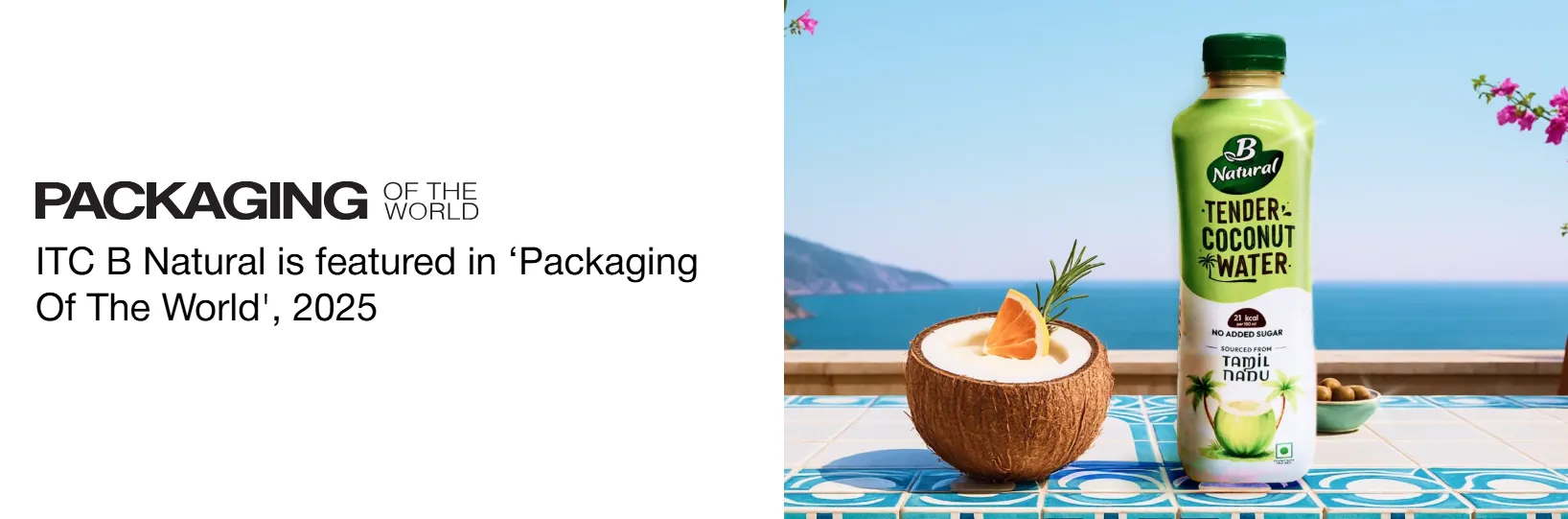
📌ITC B Natural is an example of a brand for which Confetti built the complete brand system: strategy, visual identity, verbal identity, and packaging, end to end.
How do I know if my brand is ready for quick commerce in India?
Audit six domains: product-market fit, compliance, packaging/catalogue, supply chain, unit economics, and SKU architecture. You need predominantly Green scores across all six to apply.
Common failure points: thumbnail-scale packaging, entity name mismatches, unmodelled unit economics, and replenishment cycles that can't support 2–3x weekly dispatch.
What are the most common reasons brands fail after entering quick commerce?
Common reasons include: Thin ad budgets in the first 30–60 days, stockouts from mismatched replenishment cycles, packaging that underperforms at thumbnail scale, too many launch SKUs diluting velocity, and unit economics never modelled against the full cost stack.
How many SKUs should I launch with on quick commerce?
2–3 hero SKUs for the initial launch. Not more. A brand with 3 SKUs generating real velocity builds an algorithmic position faster than one with 15 SKUs generating weak velocity.
Expand the SKU range only after hero SKUs have generated positive contribution margin for at least 3 consecutive weeks.
What margins do I need for quick commerce to be profitable?
Gross margin above 55–60% is the general threshold at which Q-commerce economics can work at moderate startup volumes (2,000–5,000 monthly orders).
Sustainable Q-commerce contribution margin, after all platform costs, usually falls between 15–22% in most FMCG and personal care categories when managed well.
How long does it take to prepare for quick commerce after identifying readiness gaps?
Compliance gaps: 1–8 weeks depending on severity. Packaging gaps: 1–6 weeks for new photography to 4–8 weeks for full label redesign and production run. Supply chain restructuring: 6–12 weeks for brands that need to switch from monthly central warehouse to dark-store-level frequent dispatch.
Want strategic branding and packaging like this for your business?





.webp)
.webp)

.webp)
.webp)
.webp)
.webp)
.webp)







.svg)
.webp)