%201.webp)
02
AI Snaps
.svg)
.svg)
01
Our Work
03
About Us
04
Brand Audit
05
Contact Us
06
Client Success
12
07
Blogs
08
Careers
Book A Call
.svg)



.svg)
Need Help In Building Your Brand?
Click the button below & book a call with our founder directly.

Rishabh Jain
Managing Director
Global packaging design standards define how packaging must be designed, labelled, tested, and disposed of across different countries and product categories.
This guide covers every major standards body, breaks down regional compliance requirements (including UAE and GCC) and gives you a practical checklist to audit your current packaging before it becomes a problem.
The global packaging market is projected to reach $1.75 trillion by 2035.
Every product in that market needs packaging that clears customs, sits on retailer shelves, and meets consumer safety requirements, in every market where it sells.
Global packaging design standards make this possible.
These are the technical and legal frameworks that define how a package must perform, what it can be made of, how it must be labeled, and how it should be managed after use.
If you are a brand owner, product developer, or packaging manager, you cannot afford to ignore these.
Non-compliance on a single regulation can get your shipment held at customs, your product delisted by a retailer, or your brand fined by regulators.
Mandatory regulations are laws. Set by governments, enforced by regulators, and backed by financial penalties.
If your food packaging doesn't meet FDA 21 CFR requirements in the US, or FSSAI labelling rules in India, you face import rejection or market withdrawal.
Voluntary standards are developed by industry bodies like ISO, ASTM, ISTA. They carry no automatic legal penalties. But ignoring them creates commercial problems.
Walmart, Amazon, and Target increasingly require suppliers to meet APR Design Guide criteria for plastic recyclability. A brand that doesn't comply doesn't get stocked.
Hybrid standards sit in between. The APR Design® Guide and RecyClass are technically voluntary but major retailers now treat them as mandatory for private label products.
The fastest-growing area right now is Extended Producer Responsibility (EPR), a regulatory model that makes brands financially responsible for the end-of-life of their packaging.
It's now active in all EU states, the UK, India, Canada, South Korea, and several US states.

Global standards now determine market access
Regulators have shifted from setting goals to active enforcement. The EU’s Packaging and Packaging Waste Regulation (PPWR), effective August 12, 2026, replaces the previous directive with legally binding rules on recyclability, recycled content, and restricted substances.
It applies to all packaging sold in the EU, including imports. Food-contact packaging containing PFAS above 25 µg/kg is banned, and “recyclable” is now a legally enforceable standard.
Harmonization across markets is not possible
Following one standard does not guarantee global market access. North America’s APR Design Guide differs from Europe’s RecyClass and Asian regulatory systems.
Standards also evolve rapidly, meaning compliant designs today may require revision within months.
Standards are now checklists
Compliance can no longer be addressed after packaging is finalized. Material choices, adhesives, labels, and packaging structure directly affect regulatory approval.
With EPR laws expanding globally, producers are increasingly responsible (financially and legally) for packaging end-of-life management.
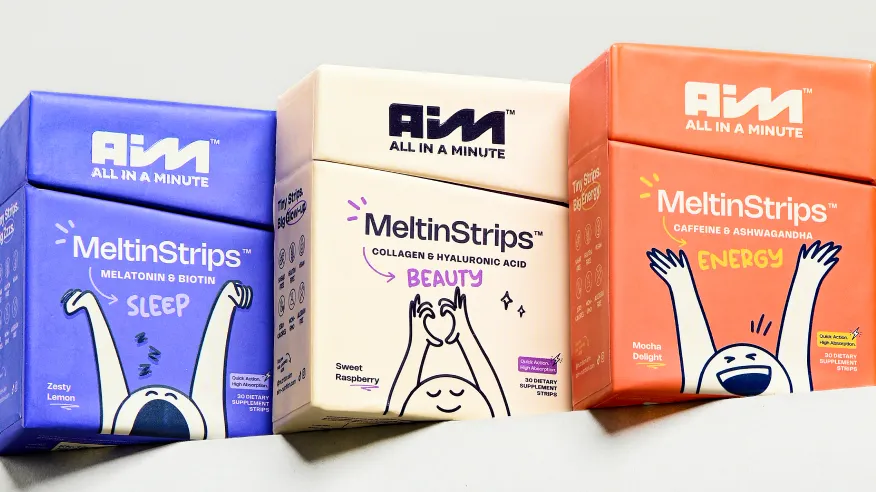
Let us understand some of the most important global packaging standards and how they interact.
ISO is the world's largest standards body, covering packaging across multiple series. The ones that matter most for brand and design compliance:
ISO standards are voluntary. But if you're supplying major European or US retailers, expect them to appear in procurement specs and supplier contracts.
The ISO 18600 series has become a reference framework for regulators writing EPR rules.
ASTM International sets performance and testing standards, the engineering layer behind packaging compliance. For brand teams, the key ones to know:
ASTM publishes six categories of standards: Test Methods, Practice, Specification, Classification, Guide, and Terminology.
For packaging, Test Methods and Specifications are the most operationally relevant.
ISTA focuses on one thing: does your packaging keep the product intact from factory to end consumer.
Its protocols test vibration, mechanical shock, compression, and climate exposure at every stage of transit. The key protocols:
If you sell D2C or on any major marketplace, ISTA compliance is needed.
Amazon's FFP program also requires curbside-recyclable materials and tool-free opening, which means structural design decisions and sustainability decisions are linked from the start.
The APR Design® Guide is North America's authoritative standard for plastic packaging recyclability.
Its "Preferred Design Recognition" (PDR) program offers third-party validation that your packaging is compatible with existing recycling systems.
The APR has recently broadened its program, and its recognition decisions are directly tied to emerging US regulations like California’s SB 54, which redefines what can be advertised as "recyclable."
Designing outside the APR Design Guide is designing for litigation or brand risk.
For global trade, you need to know GS1. Its Sunrise 2027 initiative is a ticking clock: by the end of 2027, all retail point-of-sale systems must be able to scan 2D barcodes (QR Codes and DataMatrix).
Your packaging redesign must accommodate both the legacy UPC/EAN and new 2D barcodes on the same panel space. This is the future of retail data and traceability.
The Codex Alimentarius Commission sets international food safety standards including food-contact packaging requirements.
These are adopted as baseline requirements by regulators in over 130 countries.
WHO guidelines on pharmaceutical packaging covering materials, testing, and labelling are adopted by national drug regulators globally. If your brand operates in food, beverage, nutraceuticals, or pharmaceutical categories, Codex and WHO are the international floor your domestic regulations are built on.
💡Implications for Brand:
If you are designing a package, start with your target markets. Use ISO as your global framework. Use ASTM or ISTA to ensure the package survives transit. Use APR or EN standards to prove its circularity. Use GS1 to future-proof its data. And use the FTC Green Guides or How2Recycle to communicate its end-of-life honestly.
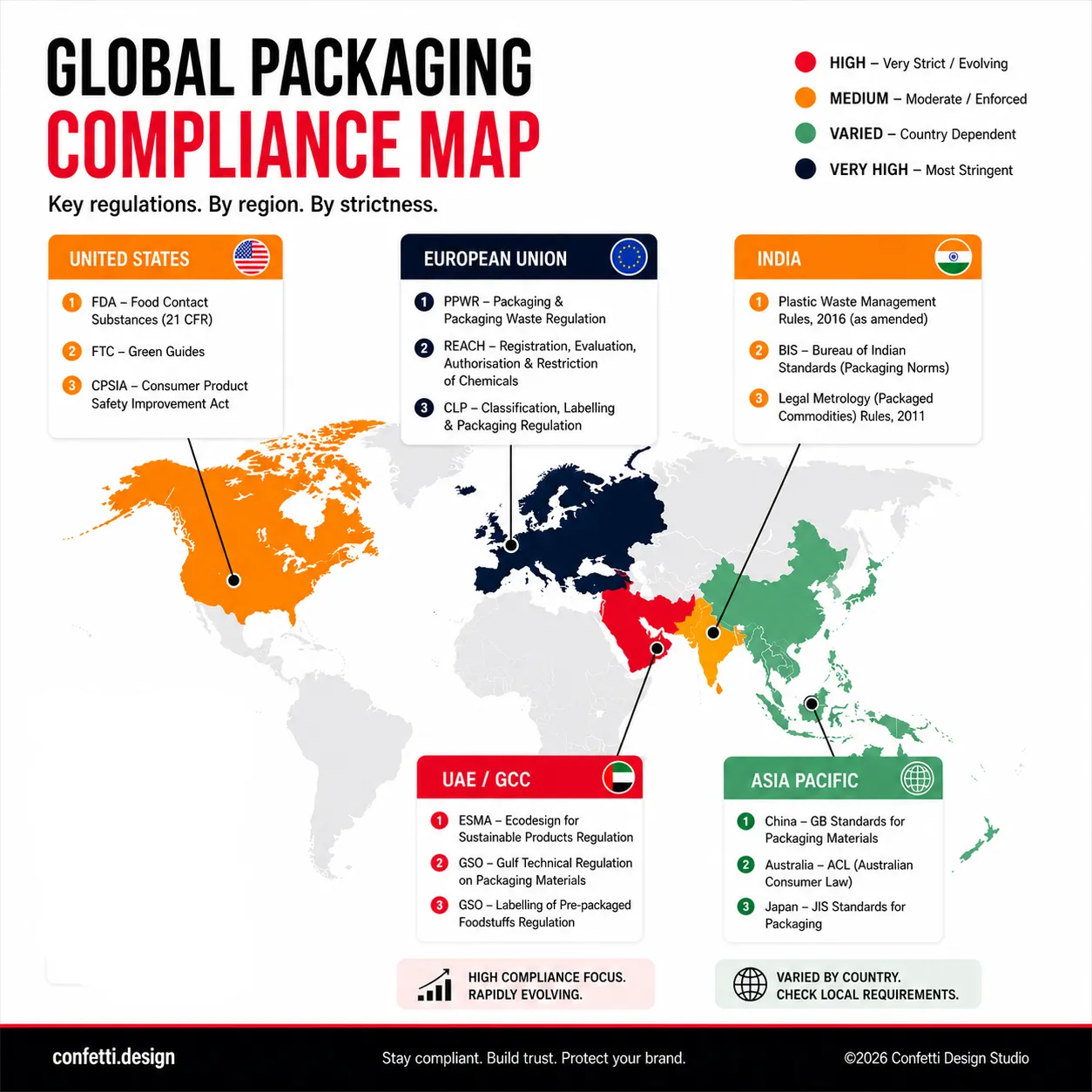
A packaging design that works in New York can get your shipment rejected in Dubai.
You cannot design for “the global market”. You design for specific jurisdictions.
Here is what you need to know for the four most complex and high-stakes regions in 2026.
The EU has the most comprehensive and rapidly evolving packaging regulatory framework of any major market.
⚖️PPWR (Packaging and Packaging Waste Regulation): Updated in 2024–25, this law mandates minimum recycled content percentages by material type, bans specific single-use formats, and sets 2030 targets for all packaging to be recyclable at scale.
If you're selling in the EU, your packaging design today must be planned against where the rules will be in 2030.
⚖️EPR: All EU member states now mandate EPR registration. You pay fees based on packaging weight and material type.
Germany runs the strictest enforcement regime with registration on the LUCID portal mandatory before placing any packaged goods on the German market.
France has the strongest plastic reduction mandates. Both countries audit compliance actively.
⚖️REACH Compliance: The REACH regulation restricts hazardous substances in packaging materials, including certain inks, adhesives, and coatings.
Brands using printing or finishing processes should verify REACH compliance for every material in their pack.
The US doesn't have one unified federal packaging law. It has a mix of federal oversight and increasingly aggressive state legislation.
⚖️FDA (Title 21 CFR): Governs food-contact packaging materials like permitted substances, migration limits, and material specifications.
Also governs pharmaceutical packaging labelling. If you sell food, supplements, or medical products in the US, FDA compliance for packaging materials is non-negotiable.
⚖️FTC Green Guides: These regulate environmental claims on packaging. "Recyclable," "compostable," "eco-friendly," "sustainable" , all require substantiation.
The FTC issued updated guides in 2012 and updated enforcement guidance is expected in 2026. Unsubstantiated green claims on packaging have resulted in FTC enforcement action against major brands.
⚖️California SB 54: The most consequential US packaging law in a generation. By 2032, all plastic packaging sold in California must be recyclable or compostable.
Given California's market size, this is the de facto national standard. If you design packaging for the US market, you are designing for California SB 54 compliance whether you intend to or not.
⚖️State EPR laws: Oregon, Colorado, Maine, and California have passed EPR legislation for packaging. More states are following in 2025–2026.
Unlike the EU, US EPR implementation is fragmented by state, brands selling nationally need to track each state's timeline separately.
India's packaging regulation is rigorous, with multiple overlapping frameworks that catch many international brands off guard.
⚖️BIS (Bureau of Indian Standards): Sets IS standards for packaging materials, testing methods, and structural performance. BIS certification is mandatory for certain product categories before they can be sold in India.
⚖️FSSAI (Food Safety and Standards Authority of India): Strict food-contact packaging rules including a specific restricted substances list.
Mandatory labelling elements include the FSSAI logo and licence number, the green (vegetarian) or red (non-vegetarian) dot symbol, allergen declarations, manufacturing date, and best-before date. For organic products, the India Organic certification mark is required.
⚖️Legal Metrology (Packaged Commodities) Rules: Mandatory MRP, net quantity, manufacturer name and address, batch number on all packaged goods, regardless of category.
This catches imported products regularly: foreign brands sometimes omit MRP, which is a legal requirement in India even for premium imports.
⚖️EPR (Plastic Waste Management Rules): Brands must register on the Central Pollution Control Board (CPCB) portal.
India's recycled content targets require 50% recycled content in rigid plastic packaging by 2025 and 60% by 2026. Brands selling plastic packaging in India should audit their current material specs against these targets now.
For brands from India, Europe, or Asia expanding into the Gulf, this is one of the highest-growth consumer markets in the world.
⚖️The GCC Standards Architecture
The six GCC member states:UAE, Saudi Arabia, Bahrain, Kuwait, Oman, and Qatar, operate under a regional standards framework managed by the GCC Standardization Organization (GSO).
GSO develops standards across food-contact materials, dangerous goods packaging, labelling, and environmental compliance.
Once a GSO standard is adopted by an individual member state, it becomes enforceable national law.
But adoption timelines and enforcement approaches vary significantly by country. Compliance in the UAE does not automatically mean compliance in Saudi Arabia.
⚖️Core GSO food-contact packaging standards:
If your packaging already complies with EU Regulation 10/2011 on plastics, you are largely well-positioned for GCC food-contact compliance.
GSO 1863/2013 was deliberately designed to align with the EU standard to facilitate trade.
UAE
UAE packaging must comply with ESMA-recognised GMP standards and, where applicable, ECAS certification.
Dubai and Abu Dhabi enforce separate municipal import inspections, so clearance in one emirate does not guarantee approval in another.
Updated Gulf standards introduced in 2025 require many older compliance documents to be reviewed.
Saudi Arabia
Saudi Arabia requires SASO compliance and SABER registration for regulated products. Importers must obtain both a Product Certificate of Conformity (PCoC) and a Shipment Certificate of Conformity (SCoC).
Missing either certificate can result in customs rejection, demurrage fees, or destruction of goods.
⚖️Packaging Design implications unique to the GCC:
China (GB Standards): China's mandatory national standards (GB) govern food-contact materials, hazardous substance limits (GB 9685), and packaging waste labelling.
A new national recycling label system was introduced in 2023. Any brand importing packaged goods into China must verify current GB compliance, the standards are updated frequently and enforcement has strengthened.
Japan (JIS Standards): Japan Industrial Standards cover packaging performance, food safety, and waste management.
Japan operates one of the world's most sophisticated packaging waste recovery systems, with near-100% collection rates for certain materials.
Packaging must be designed for sortation and recovery within Japanese collection infrastructure, which differs significantly from European or US systems.
Australia and New Zealand (APCO): The Australian Packaging Covenant sets recyclability targets under the National Packaging Targets: 100% of packaging reusable, recyclable, or compostable by 2025 (enforcement still evolving).
APCO signatories include major retailers and manufacturers, making it effectively mandatory for brands wanting national retail distribution.
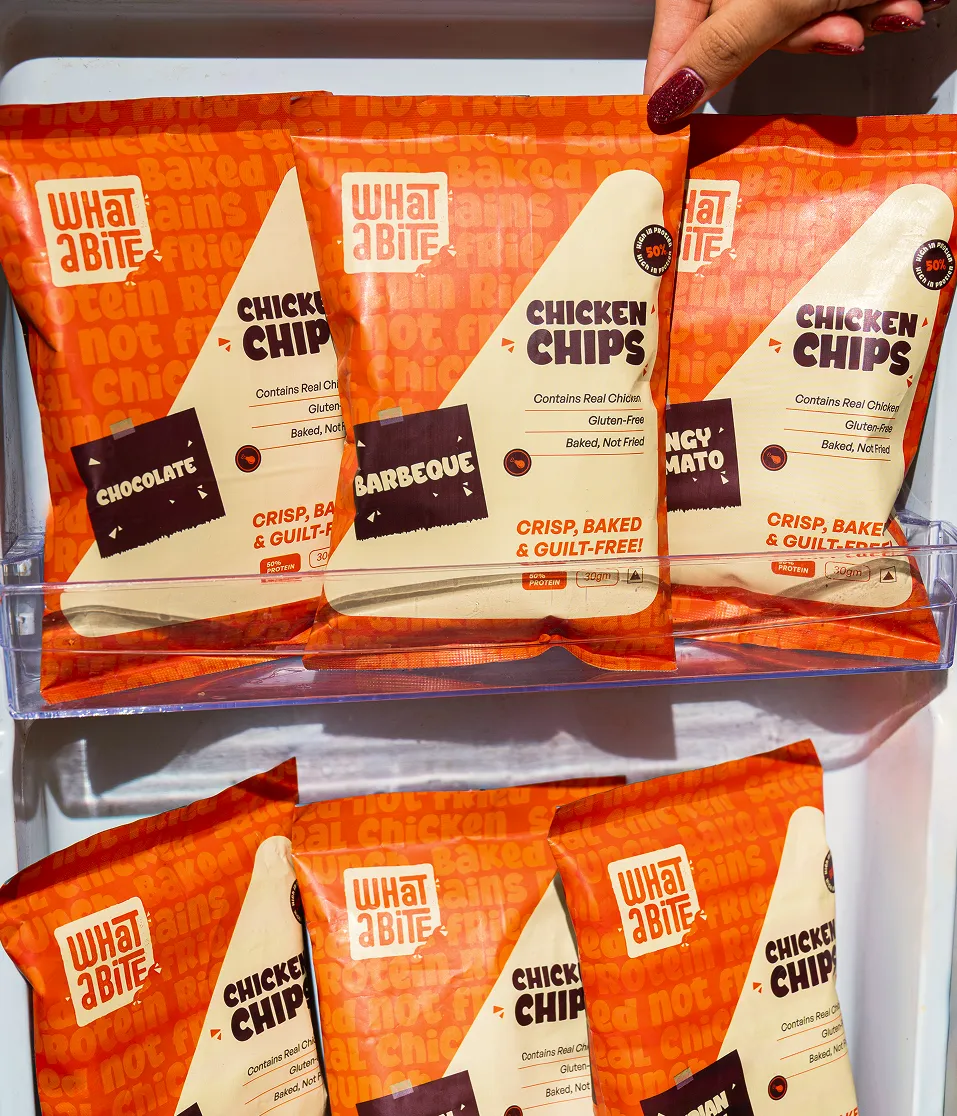
EPR is now the single fastest-growing compliance area in packaging. It's also the area with the most direct connection between design decisions and financial cost.
EPR makes the brand that puts packaging on the market financially responsible for what happens to that packaging at end of life.
Fees are calculated based on material type, weight, and recyclability rating.
Example: A non-recyclable multi-laminate pouch incurs higher fees than a mono-material PE pouch of equivalent weight. A black PET tray that fails NIR sorting generates more EPR liability than a clear PET tray that sorts cleanly.
These are design decisions, made weeks or months before production, that have direct and ongoing financial consequences.
EPR is now active in all EU member states, the UK, Canada, India, South Korea, and four US states.
GCC markets are actively developing EPR frameworks: Saudi Arabia's July 2025 regulatory update explicitly mirrors EU packaging waste legislation, including producer duties.
The RecyClass recyclability assessment evaluates plastic packaging across four performance areas: sortation, decontamination, reprocessing, and end-market compatibility. Each design element affects the score.
Design decisions that directly affect recyclability ratings:
Over 80% of a package's environmental impact is locked in at the design stage.
Once production begins, material choices and structural decisions are expensive or impossible to reverse. This is why EPR compliance is a brief-stage conversation, not a pre-launch check.
Beyond EPR fees, several markets impose direct taxes on plastic packaging:
💡3 clear design principles from EPR frameworks:
First, material choices now carry financial consequences. EPR fees, recycled content costs, and compliance documentation expenses are direct design trade-offs.
Second, thresholds are enforceable. PFAS limits in Europe are precise numeric values. Indian recycled content requirements have specific annual percentages. California’s source reduction data is due in weeks, not years.
Third, supplier verification is your responsibility regardless of jurisdiction. PPWR requires importers to verify that non-EU producers have completed compliance documentation. GCC customs requires SABER-registered Product Certificates of Conformity before manufacturing begins.
Label requirements vary by market and category in ways that aren't intuitive.
Regardless of market, most regulators require these elements on every pack:
🏷️Product name and generic description
🏷️Net quantity (by weight, volume, or count, expressed in the units of the target market)
🏷️Manufacturer or importer name and address (not just brand name — the legal entity)
🏷️Country of origin
🏷️Batch or lot code and date marking (best before, expiry, or manufactured-on date, depending on category and market)
🏷️Recycling and disposal instructions (increasingly mandatory, not optional)
🏷️Barcode in GS1 format
On barcodes: GS1's Sunrise 2027 initiative is transitioning the retail sector from 1D barcodes (standard UPC/EAN) to 2D barcodes (QR codes and data matrix codes) by 2027.
Major retailers in the US and EU have committed to supporting 2D barcodes at point of sale by that date.
If your packaging design has a long shelf life, your dieline templates need to accommodate this transition now.
🏷️Globally required across most markets: Ingredient list (in descending order by weight), allergen declaration, nutritional information, net weight, storage instructions.
🏷️EU specifics: Major allergens must be visually emphasised in the ingredients list. Front-of-pack nutritional labelling is recommended; in the UK, the traffic light system is standard. Minimum font sizes for mandatory label information, brands cannot reduce type to make designs cleaner.
🏷️India (FSSAI): The FSSAI logo and licence number are mandatory on all food packaging. The green (vegetarian) or red dot (non-vegetarian) symbol is legally required. Jain product declarations and organic certification marks must appear where applicable. All text must appear in Hindi and English as a minimum.
🏷️US (FDA): The Nutrition Facts panel format is tightly specified: panel layout, type sizes, bold requirements, and % Daily Value calculations are all governed. Allergen declarations under FALCPA require the declaration of the top allergens clearly.
🏷️EU Cosmetics Regulation (EC 1223/2009): The full ingredient list must use INCI (International Nomenclature of Cosmetic Ingredients) naming. The PAO (Period After Opening) symbol is mandatory.
🏷️US FDA (21 CFR Part 700–740): Label must include product identity, net quantity, warning statements, and ingredient list. Ingredient names follow INCI where applicable. Certain product categories (sunscreens, anti-dandruff shampoos) are classified as drugs and face stricter labelling requirements under drug regulations.
🏷️UAE: New cosmetic labelling regulations require English and Arabic labelling, INCI nomenclature, allergen warnings, prohibition on medical claims, and specific declaration of nano-ingredients with size and concentration limits. Products containing pork-derived ingredients are either prohibited or must be clearly labelled. Microbiological and heavy metal testing in accredited labs is now required for all imported cosmetics before sale.
Language requirements are the design constraint most agencies underestimate.
🏷️EU: Labelling must be in the official language(s) of each member state where the product is sold. A product sold in France, Germany, and Poland needs three languages — at minimum
🏷️Canada: The Consumer Packaging and Labelling Act requires bilingual English and French on all packaged goods. Mandatory information must appear in both languages with equal prominence
🏷️GCC: Arabic and English, both mandatory, both accurate, both given equal visual weight
🏷️India: Hindi and English as standard; regional language requirements may apply in specific states for certain product categories
💡Design Implication:
Translated text, especially from English to Arabic or from English to most European languages runs about 20–40% longer. Text expansion must be planned in the layout from the start.
Typography choices, column widths, and hierarchy structures that look clean in English often break in Arabic or German. Designing a compliant multi-market pack requires this to be solved in the packaging design brief.
Two frameworks consistently come up when brands talk about what packaging needs to achieve.
The 5 P's (Promote, Position, Present, Provide, and Protect) define the five jobs your packaging must do. Every one has a regulatory dimension:
Specific design decisions, made in the first week of a packaging brief, determine whether a finished package passes or fails compliance requirements in markets the brand may not enter for another year.
✅Pigment and colour choices: Carbon black pigments prevent plastic packaging from being detected by near-infrared (NIR) sorting systems, often causing failure under APR or RecyClass recyclability assessments. Many brands now use carbon-black-free or clear plastics to improve recyclability and reduce EPR costs.
✅Label adhesives: Adhesives must be compatible with recycling systems. APR and RecyClass specify approved adhesive types by substrate, and non-approved adhesives can render otherwise recyclable PET packaging non-recyclable in practice.
✅Ink coverage: Heavy printing on paper packaging can reduce fibre quality during repulping. Brands seeking recyclability claims must ensure ink coverage aligns with recycler compatibility guidelines.
✅Closure design: EU Regulation 2019/904 requires tethered caps on plastic beverage containers up to 3 litres from July 2024. Non-compliant closure designs cannot legally be sold in the EU.
✅Shrink sleeves: Full-body sleeves can disrupt PET recycling by interfering with NIR sorting and separation processes. Sleeve materials must meet approved recyclability specifications and be removable under standard recycling conditions.
✅Multi-material laminates: Foil, plastic, and paper laminates are difficult to recycle and perform poorly under major recyclability frameworks, limiting the validity of recyclability claims.
If you're not sure whether your current packaging would pass compliance review in your target markets, an audit is the fastest way to find out.
The difference between a packaging audit and a redesign is significant in cost and time and an audit is always the right starting point when you haven't formally reviewed your packaging in the last 12–18 months.
Most brands discover compliance gaps during artwork review or, worse, during pre-production. At that stage, fixing a material specification or label architecture costs significantly more than addressing it before design begins.
At Confetti, we work with FMCG, food and beverage, cosmetics, and consumer goods brands entering or scaling in international markets.
What we do differently:
💡Compliance mapping at brief stage: Before any creative work starts, we identify the target markets, mandatory regulatory requirements, and design constraints for each. This produces a brief that the designer works within.
💡Design for recycling from day one: Our structural and graphic designers work together. Material choice, label adhesive specification, ink coverage planning, and format decisions are evaluated against APR, RecyClass, and APCO criteria during the concept phase.
💡Multi-market pack architecture: We design packaging systems that accommodate different markets' language requirements, mandatory symbols, and regulatory label hierarchies without restructuring the core visual identity. A pack that works in India, the UAE, and the EU needs to be planned as a system.
💡Compliance audit integration: Our packaging audits assess your existing packaging against applicable standards across four dimensions: cost efficiency, design effectiveness, structural performance, and sustainability compliance.
What makes packaging globally compliant?
Globally compliant packaging: uses materials approved for the target market (food-safe, hazardous-substance-free), carries all mandatory label information in the correct language and format, and meets recyclability or disposal rules where applicable.
There's no single global standard, compliance is market-specific. A pack sold in the EU, India, and UAE must satisfy three different regulatory frameworks at once.
How do you check if packaging meets international standards?
Start by listing every market where the product sells, then map the mandatory requirements for each: labelling, material safety, recyclability, and EPR registration.
Cross-reference your packaging specification against the relevant bodies: RecyClass or APR for recyclability, FDA or FSSAI for food contact, ESMA or SASO for GCC markets.
If you haven't done a formal review recently, a packaging audit is the fastest way to identify gaps before they become compliance failures.
What packaging standards apply in the UAE and GCC countries?
The GCC Standardization Organization (GSO) sets regional packaging standards, including GSO 2231/2012 (food-contact materials), GSO 1863/2013 (plastic food-contact materials), and GSO 2654:2023 (hazardous goods labelling aligned with GHS 7).
The UAE uses ESMA and the ECAS conformity scheme, while Saudi Arabia requires SASO compliance and SABER registration before customs clearance.
All GCC markets mandate bilingual Arabic-English labelling and ban oxo-degradable plastics.
What is EPR in packaging and why is it important for packaging design?
Extended Producer Responsibility (EPR) makes brands financially responsible for packaging waste management.
Fees are based on material type, weight, and recyclability, meaning early design decisions directly affect annual compliance costs. Switching from non-sortable black plastic to clear PET, for example, can reduce EPR costs for a SKU by 30–50%.
Do global packaging standards apply to small and medium-sized brands?
Most packaging regulations apply regardless of company size. Food-contact, labelling, and safety requirements including FDA, FSSAI, and GCC bilingual labelling rules apply to all brands.
While some EPR schemes offer minimum tonnage exemptions, core compliance obligations do not vary by business size.
Want strategic branding and packaging like this for your business?





.webp)
.webp)


.webp)
.webp)
.webp)
.webp)
.webp)







.svg)
.webp)