%201.webp)
02
AI Snaps
.svg)
.svg)
01
Our Work
03
About Us
04
Brand Audit
05
Contact Us
06
Client Success
12
07
Blogs
08
Careers
Book A Call
.svg)



.svg)
Need Help In Building Your Brand?
Click the button below & book a call with our founder directly.

Rishabh Jain
Managing Director
Blinkit, Zepto, and Swiggy Instamart each have a structured eligibility process that operates on two levels, legal compliance and commercial evaluation.
This Confetti guide covers both layers in detail. Understand how eligibility differs by business type and platform, and the specific failure modes that disqualify otherwise eligible brands before they go live.
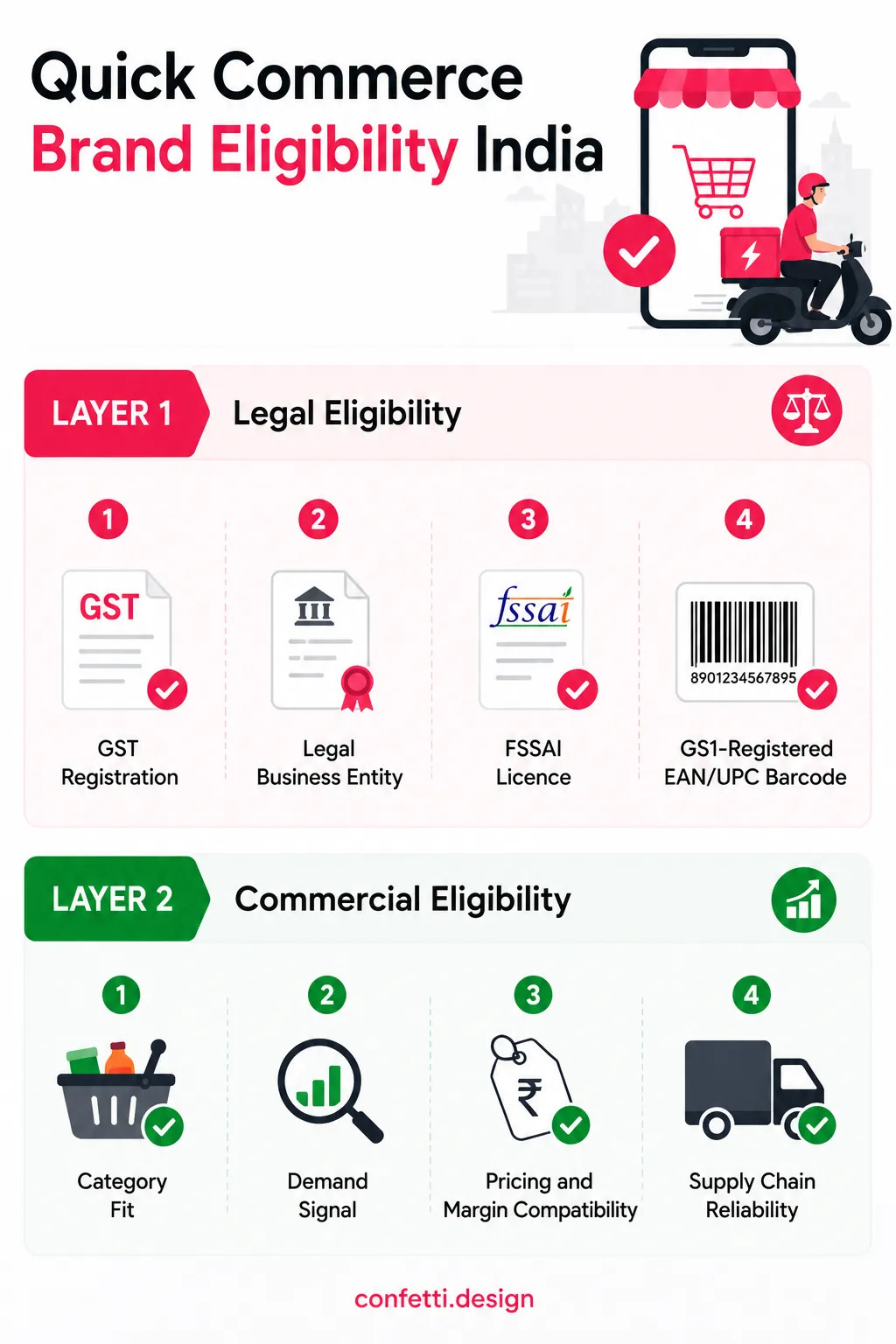
Before any platform reviews your product catalogue, pricing, or margins, it does a compliance check. If your business doesn't clear this layer, the application doesn't move forward.
These are statutory requirements under Indian law that Blinkit, Zepto, and Swiggy Instamart all enforce uniformly.
Under Section of the CGST Act, any business supplying goods through an e-commerce operator that collects Tax Collected at Source (TCS) must register for GST, with no turnover threshold and no exemptions.
Blinkit, Zepto, and Swiggy Instamart all collect 1% TCS under Section 52 of the CGST Act before disbursing payments to sellers. That makes GST registration unconditional for every Q-commerce seller.
🕐GSTIN registration takes 3–7 working days via the GSTN portal with Aadhaar-based OTP verification. Physical verification, when triggered, adds another 3–5 working days.
📋Multi-State Supply and APOB Registration:
If a platform's dark stores hold your inventory across multiple states, each of those states is a place of business under GST law. You'll need a separate GSTIN or an Additional Place of Business (APOB) registration on your existing GSTIN for each such state.
Blinkit's seller system flags this automatically and will block supply to dark stores in states where your registration doesn't cover.
📌Your GSTIN business name must match every other submitted document exactly: PAN card, bank account, FSSAI licence, business registration.
All platforms require the selling entity to be a legally registered business in India. Accepted structures:
🚫Selling as a private individual is not accepted.
A personal name is not a business entity, unless it's a sole proprietorship where the individual and business identity legally coincide.
This is particularly important for D2C founders who started out selling through Instagram, WhatsApp, or a personal website with payments going into a personal bank account.
That setup doesn't qualify. Formalising the business structure isn't a platform requirement, it's a legal one that predates the Q-commerce application entirely.
If your brand sells food, beverages, dairy, packaged snacks, condiments, health supplements with food-grade ingredients, or drinking water, an FSSAI licence is mandatory. This applies whether you manufacture, brand, or simply resell.
The licence type must correspond to your actual scale:
📋The 14-digit FSSAI licence number must be printed on the primary consumer unit.
Blinkit's dark store inward team checks this physically. If the number doesn't appear on the individual product unit, the shipment is rejected.
All platforms also require a minimum of 6–12 months of remaining validity on the FSSAI licence at the time of application. A licence expiring in 3 months will stall your onboarding until renewal is confirmed.
Every individual unit listed on a quick commerce platform must carry a valid GS1-registered EAN-13 or UPC-A barcode.
🚫Internally generated barcodes, QR codes, and PDF417 formats are not accepted.
Dark store fulfilment systems are built on GS1-standard scanning, anything outside that standard creates pick errors.
GS1 India registration is done at their official portal. For MSME-scale plans covering up to 100 barcodes, cost starts at ₹3,000 + GST. Processing takes 7–10 working days after application and fee payment.
Barcode placement is important as much as registration. The barcode must be on a panel that's visible when the product is shelf-stacked in a dark store.
Printing it on the base of a flat-sitting box makes scanning impossible without removing the product. That causes pick errors and fulfilment failures and eventually, complaints that come back to you.
📋Shelf Life: This isn't a document, but it functions as an eligibility check at the inward stage. Blinkit requires 90–120 days of remaining shelf life when inventory is received.
Zepto and Instamart require approximately 60% of total shelf life remaining at inwarding.
Every platform has a second evaluation layer run by category managers. Real people making active decisions about which brands get listed, in which cities, and with which SKUs.
Quick commerce platforms curate around products that are bought frequently, decided on quickly, and operationally compatible with dark store fulfilment.
If your product doesn't fit that profile, category managers won't approve it regardless of how clean your compliance documents are.
📋High-Fit Categories
Consistent approval across all three platforms:
📋Lower-Fit Categories
Elective approval, higher rejection rate:
Categories Platforms Don't List:
🚫Alcohol (not on Blinkit or Zepto as of mid-2026; available through Swiggy in limited states under a separate regulatory framework)
🚫Tobacco products
🚫Prescription medicines
🚫Large furniture
🚫Heavy appliances
🚫Hazardous chemicals
🚫Unpackaged goods
📌Category trend worth noting: non-grocery is where the real growth is happening. Personal care, health supplements, and electronics accessories collectively grew from 7% to 18.5% of Instamart's SKU mix between FY25 and FY26.
For D2C brands entering these verticals now, competition is lighter and margins are materially better than in grocery staples.
Platforms evaluate how fast your products will move through a dark store. Category managers want evidence that demand already exists.
📋Evidence that moves applications forward:
Active listings on Amazon or Flipkart with documented order volume carry weight. 200+ orders per month with a 4.2+ average rating across 50+ reviews gives a category manager something concrete to evaluate.
Instagram or YouTube presence where influencer features demonstrably drove sales spikes.
Strong retail sales in a specific city, documented through distributor reports or retail scan data, supports approval for that city's dark stores specifically.
Referencing Q-commerce growth in your product sub-category within your brand brief strengthens the application.
A protein bar brand citing the expansion of the healthy snacks category on Q-commerce is making the category manager's approval easier to justify internally.
Category managers evaluate your MRP against 3 benchmarks before approving any listing.
1. Competitive Pricing Within the Category
If comparable products are already on the platform at ₹99 and yours is priced at ₹249, you need a clear differentiation rationale.
Without one, the category manager's concern is conversion rate, a product priced significantly above category average moves slowly, which hurts dark store performance metrics.
2. Margin Viability After Commission
Platform commissions range from 8%–25% depending on category. If your COGS (Cost of Goods Sold) is ₹70, MRP is ₹99, and the commission is 20%, your net realisation is ₹79, barely above cost before logistics and any advertising spend.
Category managers can estimate your cost structure from your MRP and category benchmarks. They know when the economics don't work. They won't onboard a brand that's structurally set up to lose money.
3. MRP Parity Across Channels
Platforms expect consistent MRP across Blinkit, Zepto, Instamart, Amazon, and offline retail.
Pricing lower on one channel than another creates a channel integrity issue that platforms flag and sometimes penalise with algorithmic suppression.
Before applying, model your unit economics at the platform's commission range.
If net margin per unit is negative at a realistic monthly order volume, the brand isn't commercially ready for Q-commerce at its current price point, regardless of how strong the product is.
Every quick commerce platform evaluates the applicant's supply chain capacity at the application stage.
The practical criteria category managers evaluate:
📋Manufacturing or Sourcing Lead Time
A brand with a 6-week manufacturing lead time cannot maintain weekly dark store replenishment for fast-moving categories. Category managers ask about your production lead time or sourcing flexibility.
📋Warehouse Capacity and Location
You need the ability to hold buffer stock, usually 3–4 weeks of projected demand across all dark stores in your target cities and dispatch within 24–48 hours of a purchase order.
📋Replenishment Frequency
FMCG categories (snacks, beverages, personal care basics) require replenishment 2–3 times per week in high-velocity dark stores.
A brand that can only supply monthly is not operationally compatible with the channel.
📋Fill Rate Commitment
Platforms expect 95–98% in-stock availability as a performance target. Brands that consistently miss this target face algorithmic demotion, followed by category manager review, followed by delisting.
At the application stage, the category manager wants confidence that you have the infrastructure to hit this commitment.
📋Minimum Inventory Norms
Blinkit specifies minimum inventory quantities per SKU per dark store at inwarding. The exact quantity is category-dependent, FMCG products have higher minimums than slower-moving personal care SKUs.
Your initial inventory dispatch must meet these norms or the consignment is rejected at inward.
The same platform evaluates a D2C startup differently from a regional FMCG brand, and a distributor differently from a manufacturer.
Your business profile determines which documents you need, where your application is most likely to stall, and how much groundwork you need to do before applying.
Manufacturers carry the strongest eligibility profile across all three platforms. Category managers trust them more because of supply chain credibility.
If a product goes out of stock, a manufacturer can produce more. That operational confidence is important.
📋Manufacturers need to demonstrate production capacity usually through a manufacturing licence, factory registration, or a contract manufacturing agreement.
📋Product-specific certifications apply depending on the category: FSSAI for food manufacturers, BIS certification for certain electronics accessories, ISI marks where statutorily required.
Also, production capability alone doesn't guarantee category approval. Platforms still want a demand signal.
Being able to make a product and being able to sell it on Q-commerce are 2 separate questions, and category managers evaluate both.
Brand owners are eligible across all 3 platforms.
Blinkit explicitly recognises D2C brands as an applicant category. Zepto actively courts them as a way to diversify its catalogue beyond mass-market FMCG names.
📋What Brand Owners Need:
On Blinkit particularly, an unregistered brand with no pending application is a rejection point. Zepto and Instamart have a slightly lower bar, but a registered trademark materially speeds up category manager approval on all three.
Distributors of established brands like HUL, ITC, Nestlé, or Dabur, or D2C brands that sell through distribution can qualify as Q-commerce vendors. The eligibility path is available, but the documentation requirements are specific.
The critical document here is a Brand Authorisation Letter issued directly by the brand owner, naming the distributing entity and explicitly authorising it to sell on the specific platform.
📋A generic distributor agreement doesn't meet the bar. The letter should name Blinkit, Zepto, or Instamart specifically or reference quick commerce platforms in general terms.
Category managers also verify pricing alignment. If a distributor's selling price deviates from the brand's authorised price, whether discounted below or priced above, it's grounds for rejection. Platforms protect brand pricing integrity as a policy.
Regional FMCG brands with strong home-state presence but limited national distribution are increasingly eligible as platforms deepen their Tier 2 and Tier 3 presence.
Instamart's 129-city footprint creates a specific opening here.
A Maharashtra-based snack brand with solid retail distribution in Mumbai and Pune is a natural fit for Instamart's Maharashtra dark stores.
A South Indian rice brand has a strong category fit for Bengaluru, Chennai, and Hyderabad. National FMCG brands can't always replicate regional authenticity, which is a genuine differentiation point that category managers recognise.
📌Regional brands need documentation of existing regional sales (distributor reports, retail scan data, or offline stockist confirmations) to serve as the demand signal for target cities.
And they need APOB registrations for every state where they intend to supply dark stores.
D2C startups selling exclusively through their own website, Instagram, or Amazon can qualify for quick commerce without offline distribution history.
Blinkit and Zepto have both made this their strategy, D2C brands bring differentiated SKUs that reduce dependence on the same mass-market names every platform already carries.
The demand signal requirement is more challenging here than for any other brand type. A startup with no marketplace presence has nothing external for a category manager to evaluate.
This is the most common reason D2C startup applications get deprioritised.
📌So, build a marketplace presence first.
Get to 50–100+ reviews at 4.0 or above on Amazon or Flipkart. Document monthly order volume from your current sales channels. Apply to Q-commerce with that data included in your brand brief.
For a D2C startup with a strong product and a growing community, Zepto's category approach is more favourable than a traditional FMCG buyer relationship would be.
Individual kirana stores can technically apply to list on quick commerce platforms, but the eligibility bar is substantially higher than for branded sellers and in most cases, the model doesn't fit.
Kirana inventories are largely unbranded or repacked from bulk purchase units, which means no GS1 barcodes on individual consumer units.
Most kirana operators lack the supply chain infrastructure for consistent dark store replenishment, and inventory depth usually falls below the minimum stock norms platforms require at inwarding.
📌Where kirana operators can participate is through a different model entirely.
Blinkit has explored franchise-style dark store partnerships where kirana owners operate the dark store infrastructure, as location and operations partners. That's a separate eligibility framework from brand onboarding and doesn't involve listing products in the conventional sense.
The legal and commercial eligibility layers apply across all platforms. But each platform operates a distinct onboarding model, with different financial requirements, approval criteria, and ongoing performance expectations.
Choosing the right platform to approach first can save you months of rejection cycles.
Learn more about the difference in onboarding and success on the three quick commerce platforms.
Most eligibility failures come from the following:
Every document you submit to a quick commerce platform, GSTIN, PAN card, bank account, FSSAI licence, trademark certificate, must carry exactly the same business name. Character-for-character identical.
🚫"PQR Foods Private Limited" and "PQR Foods Pvt. Ltd." are treated as different entities by automated verification systems. So are "ABC Foods" and "ABC Food Products." Each mismatch triggers a verification exception.
Each exception adds 5–7 working days to processing. A brand with three inconsistent documents across a multi-state application can lose 3–4 weeks to a problem that has nothing to do with product quality or commercial viability.
📌Before you submit anything, run a name consistency audit.
Open every document side by side and check the exact legal name, including punctuation, abbreviations, and spacing. One hour of cross-checking is the most cost-effective eligibility task you can do.
Category managers evaluate four things that no platform publishes in its seller documentation:
📋Category Capacity
Category managers track how many SKUs are already stocked in each sub-category. If your product is the 25th variant in a segment that's already well-served, your application gets deprioritised.
Brands entering sub-categories with fewer than 10 established players have measurably higher approval rates. Before applying, check how crowded your specific sub-category already is on each platform.
📋Packaging Quality as a Proxy for Brand Maturity
Category managers use submitted product images and physical packaging design as informal readiness signals.
Low-resolution images, cluttered label design, or generic unbranded packaging tells a category manager that the brand hasn't invested in being Q-commerce ready, which raises doubt about whether they'll perform at the dark store level.
This is an informal filter, but it operates consistently. A brand that looks professional on its catalogue submission moves faster through review than one that doesn't.
📋Supply Chain Narrative
How you describe your supply chain in your brand brief affects how confident the category manager is that you won't cause stockout events. Vague answers about "flexible manufacturing partnerships" carry less weight than specific statements.
For example, “A contract manufacturer in [city] with 10-day lead time, warehouse in [location] with 4 weeks of buffer stock, replenishment frequency of twice weekly.” Specificity reads as operational preparedness.
📋Geographic Readiness
Applying to launch in 8–10 cities simultaneously signals overreach. Category managers interpret it as a brand that hasn't thought through the operational complexity of multi-city fulfillment.
Brands that open with 1–2 cities and can articulate why those cities, with specific inventory availability statements, signal maturity. You can always expand once you have velocity data.
The dark store inward check is a separate physical inspection, and it's where a brand can fail after clearing every other stage.
These are packaging failures that produce the same outcome: your brand doesn't go live, your inventory gets returned, and the relaunch clock restarts.
📌The gap between document verification and inward inspection is where packaging preparation directly impacts business outcomes.
Getting packaging right before dispatch helps brands avoid the most expensive delays in the onboarding process.
Confetti's approach to quick commerce starts before a brand submits its application.
The work happens in sequence: get the brand platform-ready first, then support the channel once it's live.
Lasting growth on quick commerce comes from getting the brand ready before onboarding and staying active on performance after launch.
🛒Making Your Brand Application-Ready
Platform category managers look at more than just your product. Packaging quality, how your brand presents itself digitally, and the credibility signals you put forward all shape how seriously your application gets taken.
Confetti works on those signals before you've had a single conversation with a platform.
🛒Get Pricing and SKU Right the First Time
The pricing and SKU decisions you make at onboarding are hard to walk back once you're live.
Our team invests time in researching your category before you lock anything in, what's already selling, the pricing band across competing products, and where margin pressure happens.
That picture determines which SKUs you lead with and at what price point, so you're not committing inventory to a structure that doesn't hold.
🛒Active Channel Management After Launch
Going live shifts the work. We monitor listing quality, focus on in-app advertising, and track how your category is moving.
When trends shift, we adjust SKU targeting, ad spend allocation, the organic-to-paid balance, as your sales data builds. It's an engagement that evolves with your performance, not a handoff after launch.
📌 A chocolates and gifting brand approached us wanting stronger Blinkit sales without increasing their ad budget.
We restructured their spend around tighter SKU selection, post-5PM budget concentration, occasion-specific keywords, and Level 3 SKU focus. The outcome: 8x–10x their normal weekly revenue, including a single day that crossed ₹1 lakh.
At Confetti, NPI requirements go into the brief from the beginning.
🛒Compliance Built in From the First Draft
FSSAI number, MRP, ingredient list, best-before format, every mandatory element is positioned for legibility before the design goes anywhere near a printer.
🛒Barcodes Placed for Dark Store Picking
Barcode placement is briefed with shelf-stacked accessibility in mind. A barcode that can't be scanned in a picking position creates fulfilment failures before your product reaches a customer.
🛒Product Images to Platform Spec
We produce the 3 required images per SKU, front, back, and lifestyle formatted to each platform's exact technical requirements: minimum 1000×1000px, white background, correct aspect ratio.
🛒Labels Built for a Phone Screen First
Most packaging loses visual hierarchy at mobile scale. We design labels that hold their structure at both sizes, the physical pack and the 200×200 pixel thumbnail, because that's how most customers will first encounter your product.
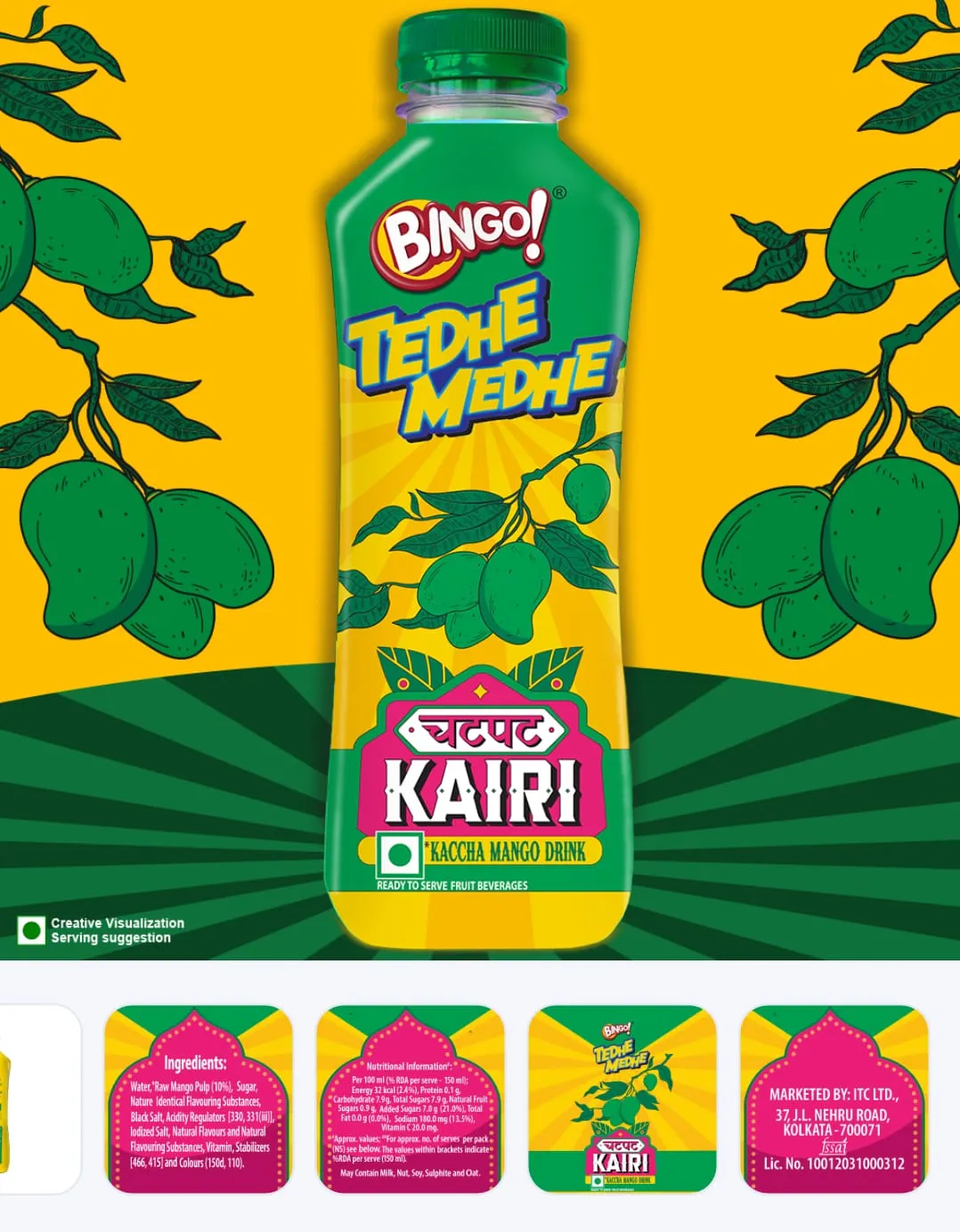
📌 Our packaging work with ITC on Bingo Chatpat Kairi reflects what shelf-ready and platform-ready looks like.
Use this checklist before submitting an application to any quick commerce platform.
📋Legal Eligibility: All Required
📋Commercial Eligibility: All Required for Approval
📋Packaging Eligibility: All Required for NPI and Inward Approval
📌Any unchecked item in Legal or Packaging Eligibility is grounds for rejection or inward failure.
Commercial gaps can sometimes be addressed post-application, but the stronger your signals at submission, the less negotiation your onboarding requires.
Who is eligible to sell on quick commerce platforms in India?
Any legally registered business in India with an active GSTIN can apply to Blinkit, Zepto, or Swiggy Instamart. Eligible sellers include manufacturers, brand owners, distributors, resellers, D2C, and regional FMCG brands.
Food brands also need an FSSAI licence, and all products require GS1 EAN barcodes. Meeting these requirements makes you eligible to apply, but approval depends on category fit, demand, pricing, and supply reliability.
Can a D2C brand with no offline store sell on Blinkit and Zepto?
Yes. Both Blinkit and Zepto explicitly welcome D2C brands. You do not need a physical store, you need a registered business entity, active GSTIN, compliant product packaging, and the ability to supply inventory to dark stores.
What D2C brands without prior marketplace presence need most is a demonstrable demand signal: documented orders and reviews from any channel before applying to Q-commerce platforms.
Is GST mandatory to sell on quick commerce platforms in India?
Yes, without exception. Under Section of the CGST Act, any business supplying goods through an e-commerce operator that collects TCS must register for GST regardless of turnover.
All three Q-commerce platforms collect 1% TCS under Section 52 of the CGST Act. There is no turnover threshold exemption for Q-commerce sellers. Composition Scheme registration is also disqualifying, Q-commerce sellers must be registered as Regular Taxpayers.
Can I sell on quick commerce without a trademark?
You can apply without a registered trademark, but approval is more likely with one. For Blinkit, a trademark application receipt is generally sufficient for brand verification.
On Zepto and Instamart, a registered trademark speeds up approval and helps prevent counterfeit or reseller disputes. Private-label products are accepted on all platforms if required compliance documents (e.g., FSSAI, GST, compliant labelling, and barcodes) are in place.
Which product categories are not eligible for quick commerce in India?
Products generally not accepted across platforms include alcohol (restricted or limited by platform/state), tobacco products, prescription medicines (except through dedicated pharmacy programs), large furniture, heavy appliances, industrial chemicals, and loose or unpackaged goods.
Products are also unsuitable if they have less than 60–90 days of shelf life at dispatch, require unsupported cold-chain logistics, or are too fragile or oversized for dark-store operations.
Can a small regional brand sell on Zepto or Blinkit?
Yes. As q-commerce expands into Tier 2 cities, regional brands with strong local retail distribution are increasingly attractive. Instamart is the most accessible platform due to its presence in 129 cities.
Requirements include GST, FSSAI, barcodes, compliant packaging, and APOB GST registrations in states where the platform's dark stores operate outside the brand's home state.
What is the minimum shelf life required to sell on quick commerce platforms?
Blinkit requires 90–120 days of remaining shelf life at the time of dark store inwarding. Zepto and Instamart require approximately 60% of total shelf life remaining at inwarding, so a product with a 180-day shelf life needs at least 108 days remaining when it arrives at the dark store.
Products dispatched with insufficient remaining shelf life are rejected at the dark store gate regardless of whether all other eligibility criteria have been met.
Want strategic branding and packaging like this for your business?





.webp)
.webp)

.webp)
.webp)
.webp)
.webp)
.webp)







.svg)
.webp)