%201.webp)
02
AI Snaps
.svg)
.svg)
01
Our Work
03
About Us
04
Brand Audit
05
Contact Us
06
Client Success
12
07
Blogs
08
Careers
Book A Call
.svg)



.svg)
Need Help In Building Your Brand?
Click the button below & book a call with our founder directly.

Rishabh Jain
Managing Director
Swiggy Instamart is suitable for new FMCG brands that have a validated demand signal, margins above 55%, and packaging designbuilt for a mobile thumbnail.
This Confetti guide covers what Instamart actually costs, where it creates commercial risk, and which categories work and which don't.
We also take a look at what the brands that succeed on the platform do differently. We help you decide whether to apply now, prepare first, or look elsewhere.
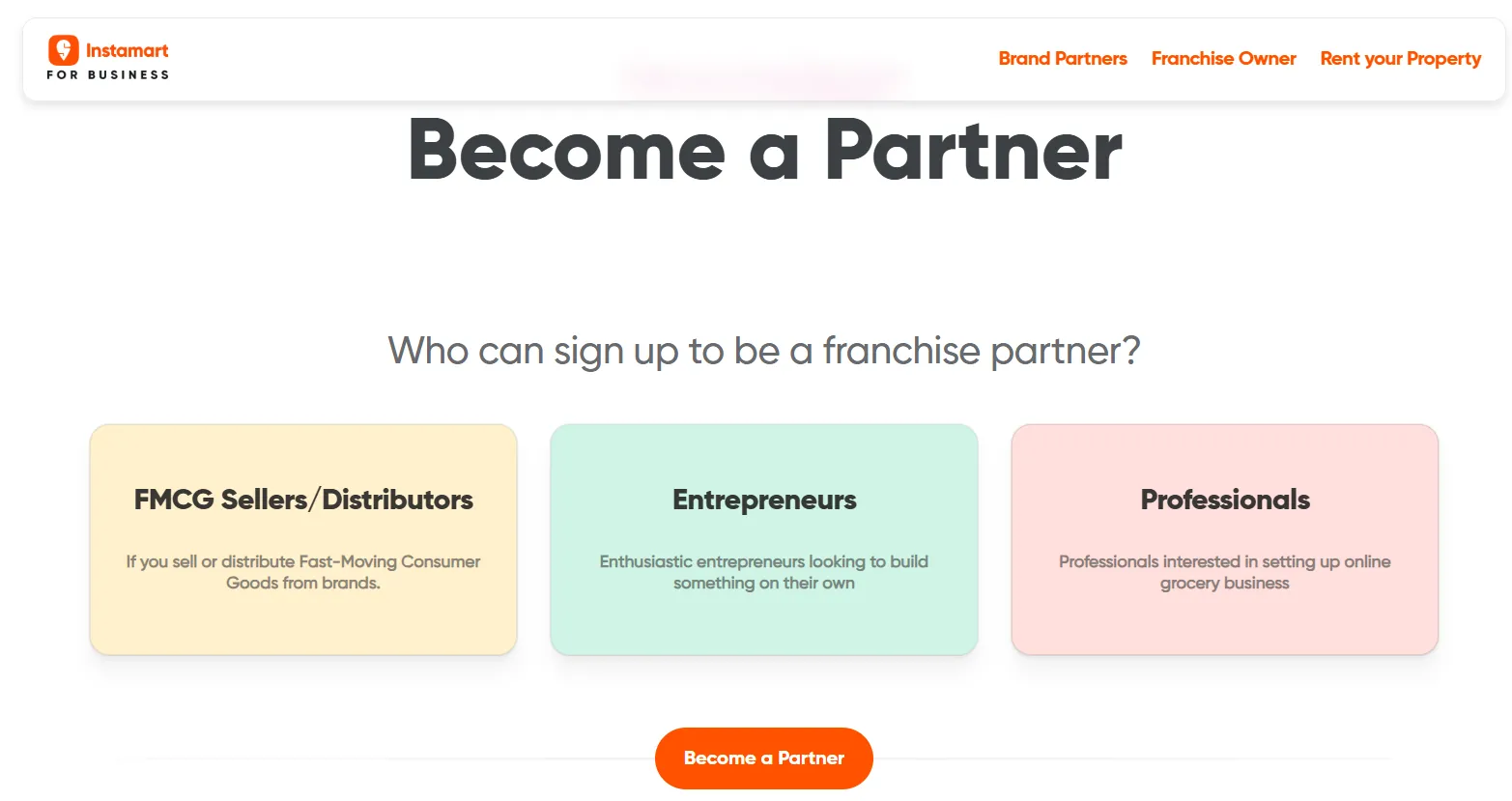
Before getting into where Instamart creates problems for new brands, it's worth being clear about what it actually offers.
At Confetti, we have helped brands to get onboarded on Instamart and have observed that the platform has real structural advantages and for the right brand entering at the right moment, some of which are difficult to replicate elsewhere.
Swiggy has over 50 million active food delivery users.
A customer opening the app to order dinner can discover your protein bar, your artisanal chips, or your cold-pressed juice in the same session and add it to their cart without switching platforms.
That cross-session discovery is unique to Swiggy and doesn't exist on Zepto or Blinkit.
New Instamart shoppers discover grocery products through the Swiggy food delivery surface.
For brands in snack, beverage, health, and personal care categories, the impulse-friendly categories that pair naturally with a food order. This creates a discovery mechanism that costs you nothing from the moment you go live.
Instamart runs a curated seller model. Fewer brands per category. That's a structural visibility advantage for any new brand that earns a listing.
Blinkit's 2000+ dark store network with 40%+ market share and Zepto’s 1000+ dark store with 29% market share attract established brands with existing ad budgets and aggressive category spending.
The cost of visibility is correspondingly higher, CPMs are more expensive, competition per sub-category is denser, and a new brand enters with limited organic surface area.
On Instamart, a new brand with strong product imagery and a focused SKU range has more room to rank organically before paid advertising is necessary.
📌A new plant-based snack brand entering Blinkit might face 25+ established SKUs in the healthy snacks sub-category. The same brand entering Instamart's equivalent sub-category may find 10–12 SKUs, giving it genuine ranking room in the early months.
Instamart operates 1000+ dark stores across 120+ cities, the broadest quick commerce footprint in India.
For brands with regional awareness, a Maharashtra-based snack brand, a South Indian beverage label with an established home market, Instamart's Tier 2 and Tier 3 expansion is a real first-mover opportunity.
📍Dark stores are now active in Jaipur, Lucknow, Indore, Coimbatore, Kochi, Chandigarh, Visakhapatnam, and 15+ other Tier 2 cities.
Advertising competition in these markets is lower, organic visibility is higher, and locally resonant brands have an advantage that national players can't easily replicate.
FMCG categories are seeing year-on-year growth across quick commerce in these cities.
A customer who orders your product at 7 PM has received it, tried it, and formed a repeat-purchase opinion by the same evening. That cycle takes days on Amazon and weeks in modern trade.
For new FMCG brands, this speed is operationally useful. You can test a new variant in one city, track repeat purchase rate within 30 days, and make product or positioning decisions faster than any other channel allows.
In 2025, PepsiCo ran ads on quick commerce platforms that automatically triggered during heat spikes, surfacing cold drinks to consumers at the exact moment they were most likely to buy.
A new brand can apply the same logic at a smaller scale: launch in one dark store cluster, track sell-through over two weeks, and adjust before expanding.
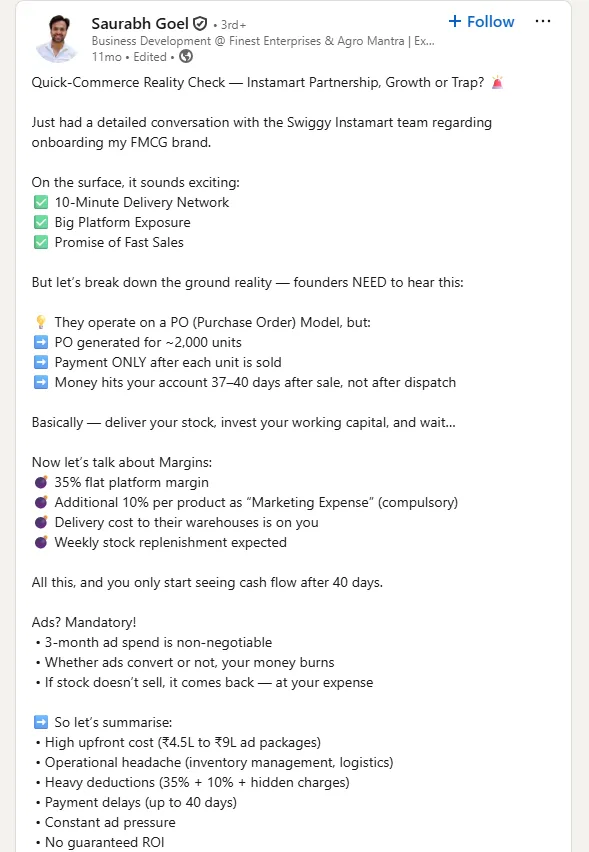
The risks here are specific, and some of them are structural, meaning they don't improve with better execution.
The actual cost of operating on Instamart is the commission plus everything else:
💡Total operating cost: 35–50% of MRP, before product cost.
Some brands have reported Instamart quoted ₹8–10 lakh quarterly for listing-cum-ad wallet fees in certain categories.
The math works for volume. Large FMCG companies absorb these costs across hundreds of thousands of monthly orders.
For a new brand shipping less than 5,000 monthly orders, the fixed cost structure: inwarding, storage, promotional spend, makes per-unit economics unviable regardless of what commission rate you negotiate
When you enter Instamart as a new FMCG brand, you can not expect immediate organic visibility. Initially, your brand's visibility will depend on advertisements you run within the platform.
This is where you need to consider your ROAS or Return on Ad Spend as a new brand. It measures how much revenue you generate for every ₹1 spent on advertising.
Example: If you spend ₹100 on ads and make ₹300 in sales, your ROAS is 3x. On most performance marketing channels, a new brand targets 2.5x–4x ROAS to stay profitable.
As a new brand you should consider all the cost components plus ROAS to analyse if your brand can really sustain on this platform.
For most new FMCG brands, Instamart ROAS in the first 90 days ranges between 1.2x and 2x.
The brands that reach 3x+ ROAS within six months are almost always the ones that entered with strong packaging, a concentrated SKU set, and listings optimised before going live.
📌At Confetti, we work with brands to improve their ROAS like for a pet-care brand , we helped reach 6.5x ROAS from 2.4x over the 6 months.
We did this through systematic inventory management, CPC optimisation, SKU-level targeting experiments, and a complete campaign rebuild.
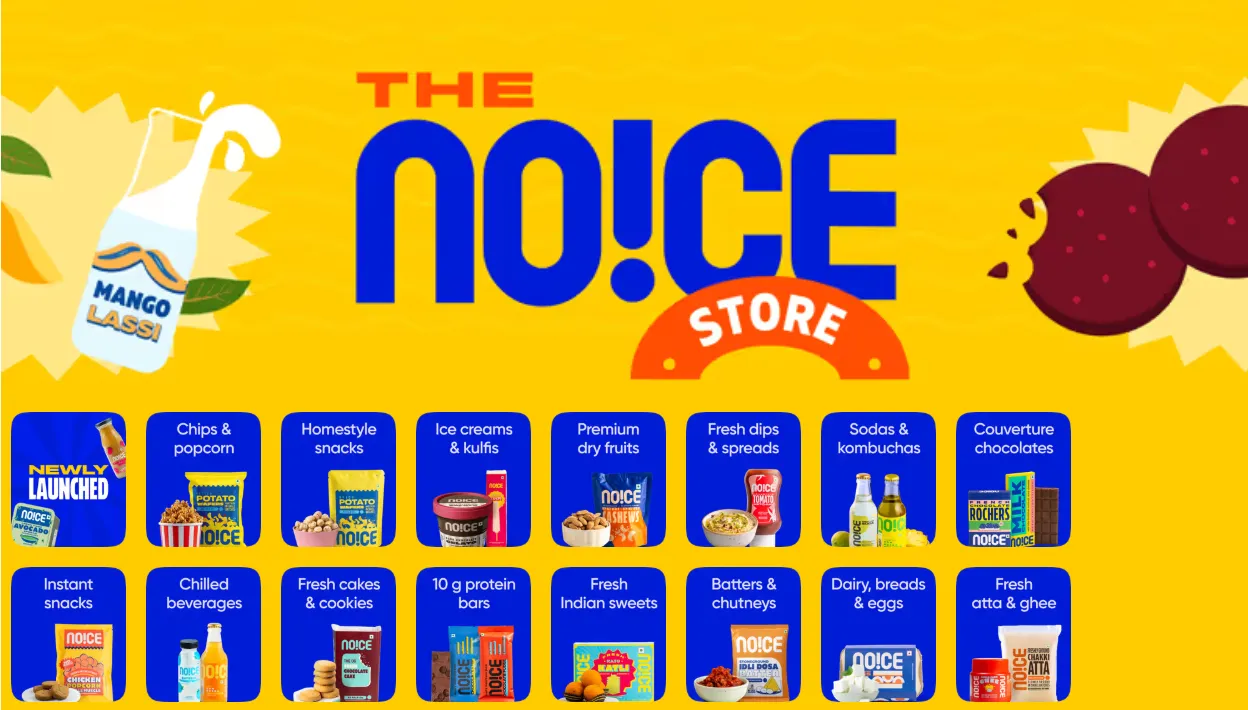
Swiggy launched Noice in August 2025, its own private label FMCG brand covering paneer, bread, dosa batter, snacks, and everyday grocery products.
Noice has since expanded to over 200 SKUs across 13 categories. It competes directly with brands that sell on Instamart, including brands whose commission revenue helped fund Noice's development.
Noice receives preferred placement on category pages. It is prominently featured in search results for the categories it occupies.
Its bright packaging design is built specifically to stand out in the thumbnail environment where third-party brands compete for clicks.
Private label margins for Instamart's own brands run at 40–60%. Commission from third-party sellers runs at 15–25%. The platform profits more from selling Noice than from selling yours. That financial incentive is reflected algorithmically.
💡If you intend to sell bread, paneer, snacks, eggs, or any category where Noice or Swiggy's other private label Supreme Harvest operates, your listing competes against a product the platform owns, promotes, and makes more money from.
The practical implication: strategically aware brands enter Instamart in categories where Noice doesn't currently compete.
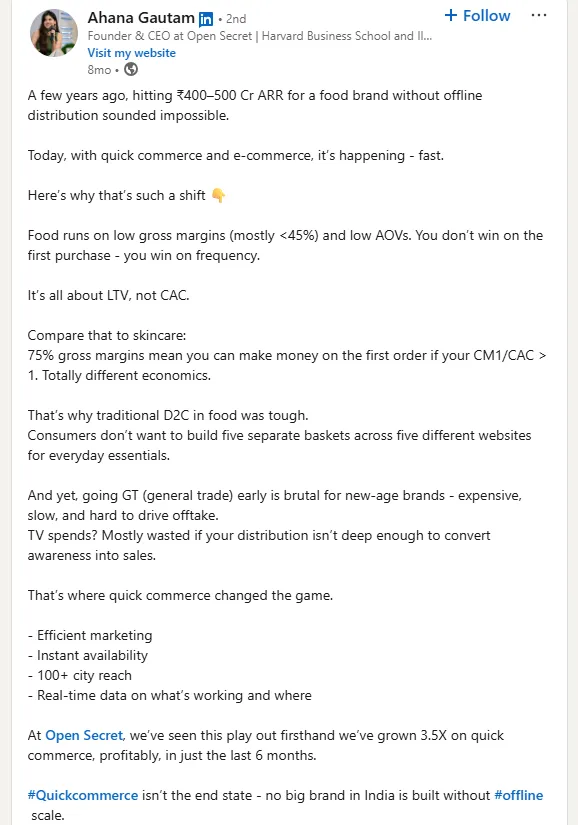
Founder of Open Secret, made an observation that holds: quick commerce boosts trials and availability, but risks eroding brand differentiation by turning products into interchangeable tiles on search-led pages.
On Instamart's category pages, your product is a small thumbnail next to identically formatted competitor tiles. The purchase decision happens in under three seconds, based almost entirely on:
Packaging equity, brand story, and years of brand-building compress down to a thumbnail and a price point.
💡For a new FMCG brand without established equity, this is a real risk. If your product enters Instamart positioned as the cheaper alternative or undifferentiated option, that's how the earliest customers will perceive it and that perception becomes sticky.
It gets baked into rating patterns, reorder behaviour, and algorithmic ranking. Reversing it later is difficult.
Instamart's dark store model requires consistent, high-frequency inventory replenishment.
When your product goes out of stock in a dark store, it disappears from search results in that store's catchment zone. The algorithmic penalty for stockouts persists even after you restock, the platform has registered your product as unreliable.
New FMCG brands with manual supply chain management, long production lead times, or manufacturers with inconsistent output face a structural problem here. The platform doesn't accommodate supply chain inconsistency. It penalises it.
Instamart returns unsold stock to the brand at the brand's cost. A brand that fails to move inventory doesn't just lose the sales, it receives damaged or short-dated stock back and absorbs the logistics cost of that return.
For brands operating with tight working capital or small production runs, this isn't a minor operational inconvenience. It's a cash flow risk that can be existential.
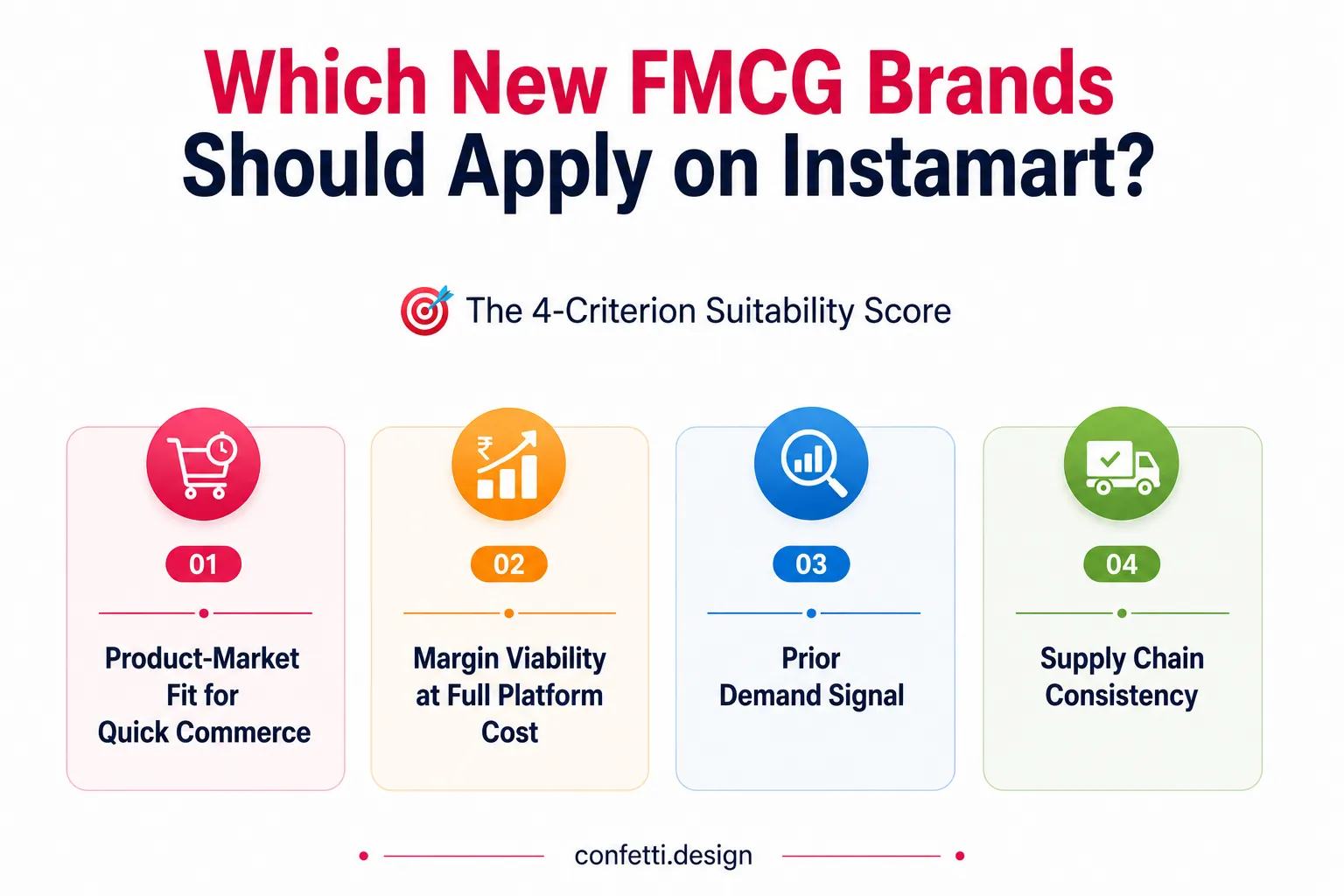
Not all new FMCG brands face the same Instamart economics. Whether the platform is right for you depends on four criteria evaluated together.
Meeting three out of four isn't enough. Each criterion is a hard threshold.
Instamart is built for products that are bought frequently, consumed quickly, and decided on impulsively. The categories that consistently perform are:
Products that underperform:
📌The self-evaluation here is simple: would your product be bought by someone who has three seconds to decide, needs something for tonight, and already trusts the category?
If yes, you have Q-commerce fit. If the honest answer is "they need to read about it first", quick commerce is the wrong first channel, regardless of how good the product is.
Model your net margin per unit at Instamart's actual cost stack before you apply.
💡Use 20% as your commission baseline, add GST on commission, inwarding, storage, inbound logistics, promotional spend, and a 3% write-off provision.
Run the number at two volumes: 2,000 monthly orders and 10,000 monthly orders.
If net margin is positive at 2,000 orders, you're viable from early months. If it only becomes positive at 20,000 orders, ask honestly whether you can reach that volume within 90 days of going live and what the cash position looks like if you don't.
The working threshold: brands with gross margins above 55–60% can usually operate profitably on Instamart at moderate volumes.
Brands below 40% gross margin will face negative unit economics unless they're doing high volumes that spread fixed operational costs efficiently. At lower volumes, those costs don't compress, they compound.
Instamart's category managers evaluate every application against evidence of demand, documentation that customers in your target cities want your product.
Brands with existing marketplace sales on Amazon, Zepto, Blinkit, or Flipkart, strong ratings (50+ reviews at 4.2 stars or above), or documented regional distribution present a credible demand signal.
Category manager evaluating your application: documented demand makes the decision faster and the approval more likely.
Instamart is not the right first channel for a brand with no prior sales track record. It works for brands that have validated demand somewhere and want to scale that demand to faster, broader distribution.
💡Practical minimum before applying: 100 documented online orders, 30+ verified customer reviews, and a 4.0+ average rating on at least one platform. That's the baseline signal that makes your application competitive.
Can you replenish dark stores on a weekly or bi-weekly cycle without stockouts?
That requires a manufacturer or sourcing partner with reliable 5–10 day lead times, buffer stock of at least 3 weeks of projected demand per dark store at launch, and an inventory process that tracks dark store stock levels close to real time.
If your supply chain is manual, fragmented, or dependent on a single supplier with variable output, resolve that before committing dark store inventory.
The algorithmic penalty for stockouts on Instamart will undo visibility gains from advertising faster than your budget can compensate. Once the platform registers your product as unreliable, recovering that ranking takes months.
🎯The 4-Criterion Suitability Score:
✅All four criteria met → Apply.
✅Three or fewer met → Prepare first, apply later.

Work with Confetti experts to create quick commerce brand assets before you apply.
Book a Strategy Call
Any 2 brands with identical margins and supply chains can have completely different Instamart outcomes based solely on category dynamics. This is where most new brand evaluations get imprecise.
📦Packaged snacks (non-commodity)
Artisanal chips, protein bars, makhana, trail mixes, healthy biscuits. This category has the strongest alignment with how Instamart actually works:
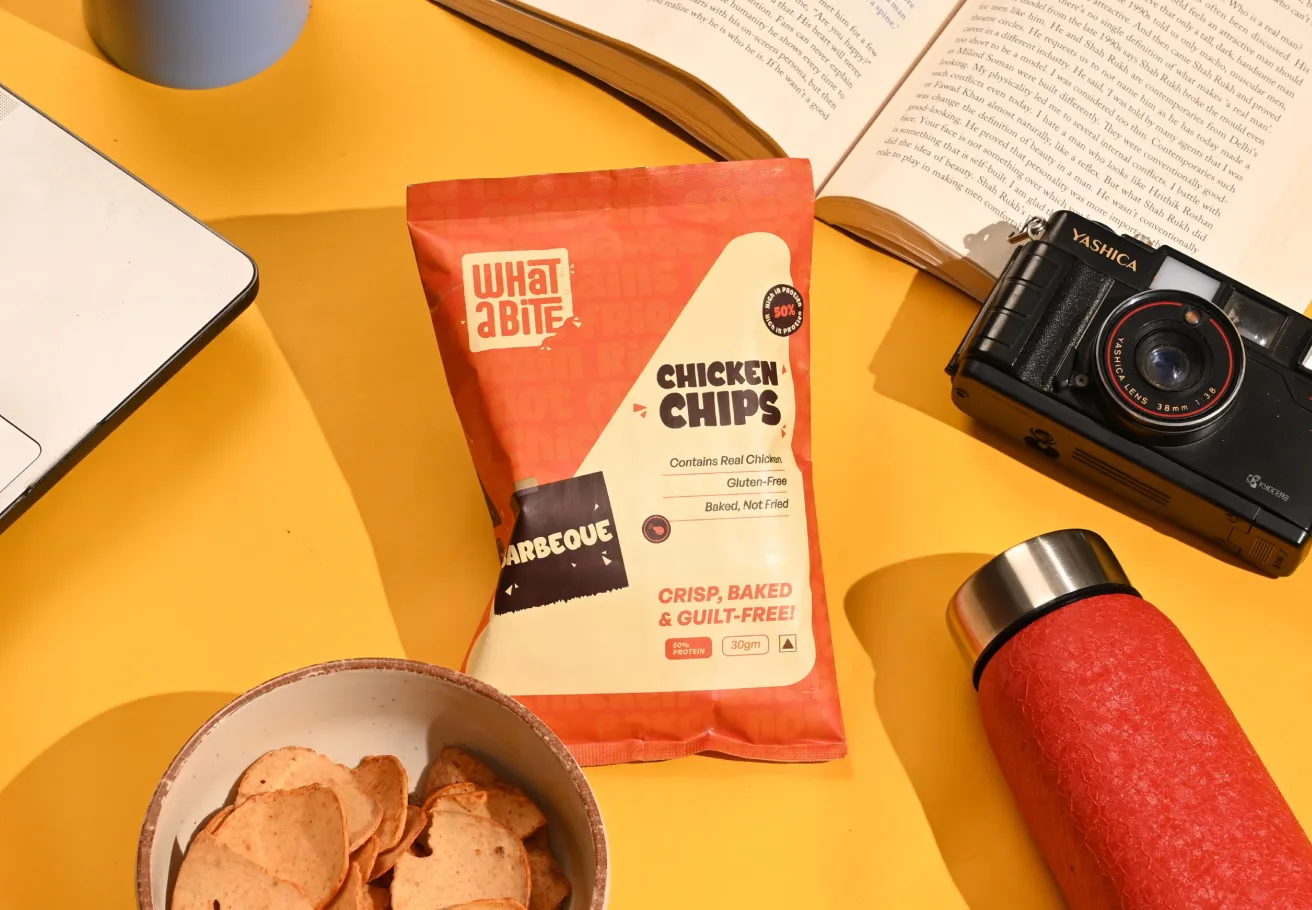
Noice doesn't have a strong presence here. A visually distinctive snack brand with clear nutritional differentiation: high protein, no seed oils, low sugar, has room to earn organic traction before heavy ad spend is required.
The cross-sell mechanism from Swiggy's food delivery surface works especially well for snacks: a consumer ordering dinner is already in a food mindset.
📦Health supplements and functional foods
Protein powders, vitamin supplements, collagen drinks, health bars. Gross margins in this category are usually 60%+, which means the Instamart cost structure is absorb-able at moderate volumes.
Younger urban consumers, Instamart's core demographic are the same buyers driving supplement category growth. Noice doesn't compete here.
Premium positioning survives the thumbnail environment because the purchase decision is more considered: a buyer searching for "whey protein isolate" has intent, not just impulse. That intent-driven search behaviour rewards specific, legible product claims.
📦Personal care (differentiated)
Specialty face wash, sulphate-free shampoos, organic skincare, men's grooming. Non-grocery categories now account for 18.5% of Instamart's category mix, the fastest-growing segment on the platform.
Personal care is a major contributor to that shift. Seller density per sub-category is lower on Instamart than Blinkit, and margins in differentiated personal care usually support the platform's cost structure.
The key condition: differentiation must be specific and legible. "Natural" is not a differentiator at the thumbnail scale. "Sulphate-free, dermatologist-tested, fragrance-free" is.
📦Baby care and pet care
High frequency, high urgency, strong repeat purchase behaviour, and above-average brand loyalty. Once a parent or pet owner finds a product they trust on Instamart, reorder rates are among the highest on the platform.
Competition per sub-category is lower than in FMCG staples, and Noice has no presence. The operational requirement, consistent stock availability, is much required here.
A stockout in baby care or pet food is a lost customer who switches to a competitor and doesn't return.
📦Regional specialty foods
A Maharashtra brand selling its own-recipe thecha, a South Indian brand with a traditional rice variety, a brand built around a regional masala blend with genuine provenance, these have a differentiation story national FMCG companies cannot replicate.
Instamart's Tier 2 expansion creates a first-mover advantage for brands with real regional credentials. In cities like Coimbatore, Lucknow, or Visakhapatnam, local familiarity and regional trust convert better than national brand recognition.
The advertising competition is lower, the organic ranking opportunity is higher, and the brand story is one that platform algorithms alone can't replicate for a competitor.
📌At Confetti, we have worked with various brands in these categories to get onboarded on quick commerce platforms.
📦Commodity grocery staples
Atta, rice, dal, cooking oil, sugar. Swiggy's Supreme Harvest private label competes directly in this space.
National brands: Fortune, Tata, Aashirvaad, hold existing consumer awareness and platform advertising relationships that new brands cannot match on budget.
Margins are thin, differentiation is nearly impossible at thumbnail scale, and the promotional investment required to appear above established players would erode whatever margin exists. This is the hardest category entry point on the platform for any new brand.
📦Basic dairy
Milk, curd, paneer, butter. Noice holds meaningful shelf presence in paneer and bread.
The category operates on commodity pricing. Write-off risk for perishables is severe, unsold stock expires and returns to you at your cost.
New brands have almost no differentiation window, and the margin-to-cost ratio makes profitable operation at new-brand volumes unlikely.
📦Standard beverages
Regular juices, packaged water, standard soft drinks. PepsiCo, Coca-Cola, and established national brands dominate through existing platform relationships, deep advertising budgets, and consumer recognition.
That is effectively impossible to displace with a new brand's launch budget. New entrants get buried algorithmically and have no margin left after the promotional investment required to surface.
The exception: a genuinely differentiated beverage: functional, regional, or ingredient-specific, that can justify a premium and survive the thumbnail scan.
📌A standard mango juice brand has no path here. A cold-pressed kokum drink with a clear regional story does.
The brands who win on Instamart have a set of strategic choices made before the first listing goes live.
Here is what the winners do differently:
The FMCG brands that build lasting visibility on Instamart have their packaging designed to work at Q-commerce scale.
Instamart's category pages display products as small thumbnails on a mobile screen. It has to carry the entire brand and product communication in a thumbnail that a consumer scans in under three seconds, while five competitor tiles are visible in the same frame.
Brands that design for the thumbnail environment:
Earn better clicks, build velocity faster, and reach organic algorithmic ranking sooner without additional ad spend.
At Confetti, the FMCG brands we've worked with have built durable organic ranking on Instamart with effective packaging designed for the Q-commerce environment.
The brands that build traction fastest launch 3–5 hero SKUs in 1 or 2 cities. They concentrate inventory, advertising spend, and review-building effort on a small, focused product set.
At Confetti, we help brands in onboarding and pin code strategy. We identify where the ideal customer is most likely to be located based on the user persona developed during brand strategy, and ensure products are stocked in the dark stores serving those areas.
That concentration creates the order velocity the algorithm needs to surface them organically, much faster than the same budget spread across 15 SKUs in eight cities, where every SKU is starved of the sales history it needs to rank.
Once those hero SKUs have established sales history, reviews, and organic ranking in the launch cities, expansion in the near future will be easy through algorithmic strength.
The brands with the smoothest Instamart onboarding and the fastest post-live traction are the brands that spent three to six months building marketplace presence on Amazon, Zepto, Blinkit, or their own D2C store. They accumulated 100+ reviews. They have a documented sales history.
When they apply to Instamart, the application comes with a demand signal attached with evidence that customers in their target cities already want the product.
The post-live flywheel also builds faster: early Instamart customers who search the brand name find ratings and reviews from other platforms, which accelerates the conversion rate before the brand has accumulated significant Instamart-specific review history.
We at Confetti, have worked with 200+ brands across branding, packaging design and quick commerce onboarding & optimisation
Q-commerce performance for a new brand is decided before the listing goes live in its:
We help brands with all three.
The channel setup and go-to-market execution is the operational and marketing layer that decides whether a well-designed product actually builds traction once it's live.
Confetti's quick commerce setup service includes the end-to-end onboarding process:
✅Platform application support: Brand building activities to increase the likelihood of getting onboarded.
✅Listing optimisation: Product & pricing research along with consultation to successfully onboard you on Q-commerce platforms.
✅Product photography formatted for quick commerce grids: Detail and texture shots help consumers understand formulation, finish, and quality.
✅Early visibility strategy: Listing optimisation, in-app ads to boost your quick commerce sales.
📌When a gifting brand approached our Confetti team, we took a brand to 10x revenue. And during peak season the revenue increased by ₹1 lakh peak day without spending a single extra rupee on advertising.
On Q-commerce platforms a product has roughly a second to register before the scroll moves on. Confetti designs FMCG packaging specifically for this reality. Our process covers the full packaging system:
Every project ends with platform-specific mock screens, our client's product placed alongside real competitor brands in a simulated Instamart, Zepto, or Blinkit grid, at the actual thumbnail scale a consumer encounters while scrolling.
This is where issues that are invisible in a full-size artwork review become obvious.
Confetti's packaging work spans FMCG categories across snacks, health supplements, beverages, personal care, and baby care, the categories where Instamart performance is most directly tied to thumbnail clarity.
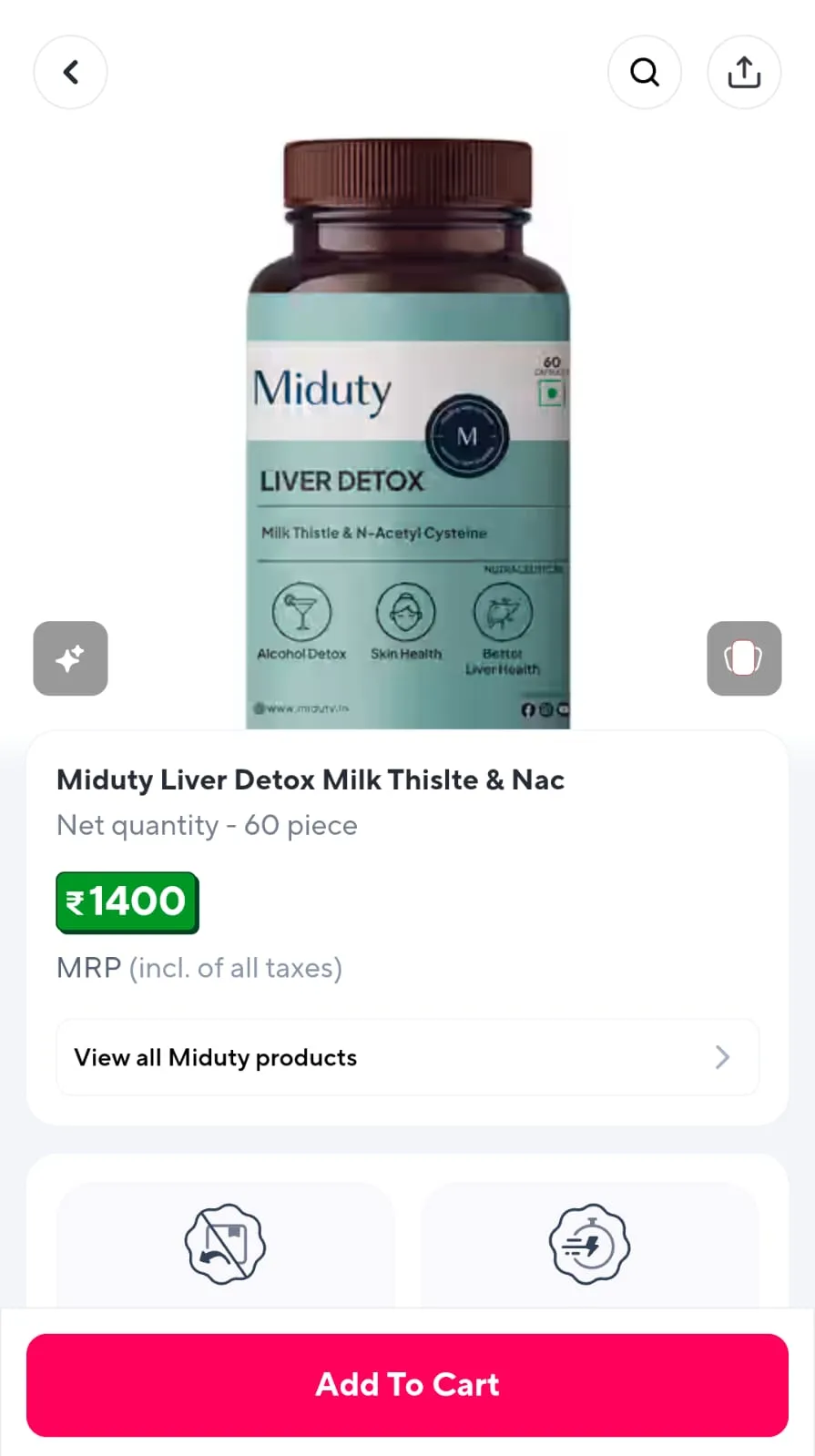
📌When Miduty, a personal care and wellness brand came to Confetti, we built: brand strategy, visual identity, verbal identity, and packaging designed to win on a 10-minute shelf.
Can a completely new FMCG brand get listed on Swiggy Instamart?
Yes, but the approval is harder without prior marketplace presence. Instamart's category managers evaluate applications against demand signals: sales data, reviews, and marketplace track record.
A new brand with no prior online sales history is a higher-risk application. The practical advice: build 3–6 months of marketplace presence on Amazon, Zepto, or Blinkit first, accumulate 50–100 reviews, then apply to Instamart with documented demand evidence attached.
What is the minimum budget a new FMCG brand needs for Instamart?
Budget for at least ₹8–10 lakh per quarter as a starting position, covering the platform's listing and advertising requirements, inbound logistics to dark stores, and operational costs.
This excludes product cost and inventory investment. Brands with tighter budgets should consider whether the per-unit economics work at their projected volume before committing.
Running the full cost model (commission + GST on commission + inwarding + storage + logistics + promotional spend + write-off provision) at 15%, 20%, and 25% commission is mandatory before negotiating commercial terms.
Does Swiggy Instamart's Noice brand compete with new FMCG brands?
Yes, directly in several high-frequency categories: bread, paneer, snacks, eggs, and dairy-adjacent products. Noice has expanded to 200+ SKUs across 13 categories since its August 2025 launch. It receives prominent placement on Instamart's category pages.
New brands entering categories where Noice is active face implicit additional competition from the platform's own product and should differentiate on visual identity, nutritional claim, or price positioning in a way that clearly separates their product from Noice in the thumbnail environment.
What FMCG categories work best for new brands on Instamart?
The highest-performing categories for new FMCG brands on Instamart are specialty packaged snacks (protein bars, artisanal chips, makhana), health supplements, differentiated personal care (sulphate-free, organic, men's grooming), baby care, pet care, and regional specialty foods.
Categories with the lowest suitability for new brands: commodity grocery staples, basic dairy, and standard beverages, all of which have intense competition from national brands, low margins, and direct competition from Instamart's own private labels.
How does Instamart compare to Zepto for new FMCG brands?
Instamart offers broader geographic reach (120+ cities vs. Zepto's 10 major metros), a cross-sell advantage from 50M+ Swiggy food delivery users, and lower category competition than Blinkit.
Zepto offers faster initial onboarding (3–7 days for qualified brands vs. 6–8 weeks for Instamart), stronger targeting capability through its Jarvis ad platform, and better fit for D2C and trend-driven FMCG brands targeting younger urban demographics.
Most established brands eventually operate on both. New brands with limited capital should choose based on category fit and geographic ambition, not platform prestige.
Is Instamart profitable for new FMCG brands?
It depends on margins, volume, and category. Brands with gross margins above 55–60% can operate profitably at moderate volumes (2,000–5,000 monthly orders). Brands with margins below 40% usually cannot achieve profitability until very high volumes, which take time to build.
The additional risk factor is the Noice private label in certain categories, which creates pricing pressure that further compresses third-party brand margins. Run the full cost model before committing.
Want strategic branding and packaging like this for your business?





.webp)
.webp)

.webp)
.webp)
.webp)
.webp)
.webp)







.svg)
.webp)