%201.webp)
02
AI Snaps
.svg)
.svg)
01
Our Work
03
About Us
04
Brand Audit
05
Contact Us
06
Client Success
12
07
Blogs
08
Careers
Book A Call
.svg)



.svg)
Need Help In Building Your Brand?
Click the button below & book a call with our founder directly.

Rishabh Jain
Managing Director
As an early-stage D2C brand, to get the results that you want from quick commerce, you must understand pros and cons before onboarding.
In this Confetti blogblog, we are going to cover exactly which startups should enter Q-commerce platforms, which brands should wait, and what the winning brands do differently.

India's quick commerce market reached approximately $3.65 billion in early 2026 and is projected to grow to $6.64 billion by 2031. Expanding at a compound annual growth rate (CAGR) of 40–45%.
Over 4,000 dark stores now operate across 400+ cities.
🟣Blinkit leads with 46% market share and roughly 2000 stores.
🟣Zepto holds 29% with 1,000+ stores.
🟣Swiggy Instamart has at 23–25% share with 1000+ stores.
All three platforms crossed ₹1,000 crore in annual advertising revenue by FY25.
Those numbers make quick commerce look like an obvious channel for any consumer brand.
For large FMCG companies, it currently represents 2–4% of total revenue but that slice is growing 50–100% year-on-year, which is why every major player is pouring resources into it.
For startups, the math looks entirely different.
Early-stage D2C brands frequently derive 70–80% of their revenue from quick commerce platforms. But that dependency cuts both ways.
Large brands come in with established supply chains, dedicated key account managers, negotiating leverage on margins, and the brand recall to survive a slow month. Most early-stage founders come in with none of that.
Quick commerce platforms are algorithm-driven retail environments where visibility, replenishment velocity, return rates, and review scores all feed into how prominently your product gets surfaced.
A brand that gets listed but can't maintain consistent stock across dark stores will get deprioritised fast. The algorithm doesn't make exceptions for brands still figuring it out.
This is the gap that doesn't show up in market size reports. The opportunity is real. So is the operational complexity of capturing it.
📌This is where Confetti helps brands to understand Q-commerce and get onboarded. From pre-onboarding to performance optimization we support brands.
For the right product with the right economics, quick commerce offers structural advantages that no other Indian retail channel can match.
Here are the real mechanisms:
Traditional retail distribution demands 12–24 months of groundwork: distributor appointments, stockist negotiations, modern trade listing fees, field sales hiring, and shelf compliance management. All of that before a single unit moves through the channel.
Quick commerce collapses that to 4–8 weeks.
Register, clear document verification, list your SKUs, dispatch inventory to dark stores. No distributor margin to absorb (usually 8–12% in traditional trade). No listing fee negotiations with modern trade chains. No city-level sales team.
The platform handles last-mile logistics and the customer interface. Your operational job is inventory replenishment and platform advertising.
This advantage is not uniform across all brands.
A startup already in modern trade gains less from it. The maximum benefit goes to first-time founders and D2C brands entering physical distribution for the first time.
📌For example, a protein bar brand with no offline history can be selling across 300+ Mumbai pincodes within 6–8 weeks of Blinkit onboarding. Equivalent modern trade coverage would take 18 months, a city sales manager, and significant relationship capital.
Blinkit and Zepto sessions are different from Amazon browsing. The customer has already decided to buy something in this category. The average session lasts under 10 minutes. The per-product decision happens in under 3 seconds.
For a startup in an impulse-friendly category, a bold snack variant, a functional beverage, a new condiment, this is the lowest purchase barrier available in Indian retail today.
Quick commerce platform conversion rates are higher than D2C websites.
🛒A consumer who sees your product while ordering groceries at 9 pm, adds it on impulse, and receives it in 12 minutes has now trialled your brand with near-zero friction. If the product delivers, reorder probability is high.
Compare that to the D2C acquisition journey:
Instagram ad → landing page → consideration → email nurture → first purchase.
That cycle runs 7–14 days with a Customer Acquisition Cost (CAC) of ₹300–₹600. A Q-commerce impulse trial can bring that CAC down to ₹80–₹150, within the same session.
📌NatHabit, the personal care startup, has publicly noted that Q-commerce consistently drives a meaningful share of new customer acquisitions in Tier I cities.
Blinkit's Brand Central gives SKU-level sales attribution by pincode, by keyword, by city, on the same day the sale happens. You can see which search term drove a purchase, in which zone, for which variant, at what time.
Traditional modern trade gives you a monthly sell-through report. Amazon gives you 48-hour delayed data.
For a startup testing a new SKU or pack size, this is operationally significant. Launch on Blinkit, generate demand signals across hundreds of dark stores within weeks, and make product decisions based on actual purchase behaviour.
🛒Which variant sells in South Mumbai evening orders. Which price point converts in Bengaluru. Which keyword drives category discovery in Delhi NCR. All available in the seller dashboard, in real time.
This data builds up. A brand that enters Q-commerce todayand actively uses its sales data will have 18–24 months of granular consumer behaviour insights by the time it sits across the table from a modern trade buyer. That is a negotiating position that no amount of market research can replicate.
Adding a 2nd city on a Q-commerce platform doesn't require a distributor appointment, a logistics partner, or a city sales manager.
It requires APOB GST registration for the new state, inventory dispatched to the relevant dark stores, and ad targeting extended to the new geography.
A startup can move from Bengaluru to Delhi, Mumbai, and Hyderabad, on the same platform, with the same team, in weeks.
📌Healthy Master, the health snack brand, rolled out simultaneously across Blinkit, Zepto, Swiggy Instamart, Flipkart Minutes, Amazon Now, BigBasket, and FirstCub as part of its pan-India expansion beginning January 2025.
That coverage would have taken years through traditional distributor-led trade.
Quick commerce compresses the test-and-learn cycle to 30 days.
Launch an SKU, observe sell-through across multiple dark stores, and make product, pricing, or packaging decisions before committing to a full production run.
SKUs that perform in Week 1 get algorithm amplification. Ones that don't, surface problems early, before the brand has over-invested in inventory. This is commercially equivalent to a live consumer panel, except it generates revenue while it informs.
Specific questions startups can answer within a month:
❓Does the 50g or 100g pack sell better in premium urban zones
❓Does a ₹99 or ₹149 price point affect conversion differently across dark store clusters
❓Which flavour variant wins in which city
No other channel in India gives you that level of detail, that fast.

Talk to Confetti experts about creating quick commerce onboarding and optimisation.
Book A Call
Here is the specific, documented reality of where the quick commerce platforms damages startup economics, operations, and long-term brand health.
The platform dashboards do not include these analytics.
Along with the commission, you should consider all other cost components before thinking about selling on quick commerce platforms.
Many startups are not aware of all the cost components.
For startups with gross margins below 55–60%, the math is structurally negative. The channel costs more than it earns at usual startup volumes.
The brands that win on Q-commerce are almost always the ones with premium positioning and margins that survive the full cost stack. It won’t work for brands that entered at low price points hoping volume would make the economics work.
📌Q-Commerce Viability Test
MRP - commission (use 20%) - GST on commission - logistics - advertising as % of GMV - write-off provision = Net margin per unit.
If this number is negative at 2,000 monthly orders, the channel is not viable at your current margin structure.
All three platforms: Blinkit, Zepto, and Instamart, calculate Return on Ad Spend (ROAS) in their seller dashboards using MRP, not the actual transaction price after platform discounts and promotional deductions.
For example, if your MRP is ₹300 and the platform has discounted it to ₹210 on a promotional day, your dashboard shows ROAS calculated against ₹300. Actual net ROAS is 30–50% lower than what the platform reports.
A startup reading its Blinkit dashboard and seeing 7x ROAS may believe the channel is working. The same startup running the calculation on actual net transaction value finds 3.5x, which, after subtracting the full cost stack, may be loss-making.
Multiple founders have scaled Q-commerce spend on the basis of dashboard ROAS, only to discover the miscalculation when their monthly P&L showed losses the platform dashboard had not predicted. By then, the capital is spent.
Never make a scaling decision based on dashboard ROAS. Always recalculate manually using net transaction value pulled from your own accounting system.
Large FMCG companies with in-house finance teams know this adjustment and apply it automatically.
📌For a startup founder reading their seller dashboard for the first time, it is an invisible trap and it has cost several early-stage brands significant capital before they understood the mechanism.
When your product shows "unavailable" in a dark store zone, customers switch. Available data suggests roughly 50% of those customers switch to a competing platform rather than waiting for your product to return.
Simultaneously, the platform's algorithm deprioritises your product in search results for that zone, because it has learned that your product is an unreliable fulfilment option.
The penalty persists after you restock. The algorithm continues to suppress your ranking in that zone until you rebuild purchase velocity.
This means you need additional advertising spend to recover a position you had earned organically. Every stockout sets your ranking clock back by weeks.
The stockout risk is acutely higher for startups because:
Early-stage D2C brands frequently derive 70–80% of their revenue from Q-commerce platforms.
The channel produces real volume with relatively low operational overhead. It is also structurally dangerous in ways that only become visible when something goes wrong.
Platforms can delist products for performance failures, compliance gaps, or category restructuring.
They can renegotiate commission terms at renewal. They can launch private-label products that compete directly with yours inside the same dark store.
📌Instamart's Noice, Zepto's private label strategy, and Blinkit's growing owned-brand portfolio are all active examples of this.
They can update their algorithm in ways that can reduce visibility for third-party brands in favour of platform-owned SKUs. This will be challenging for startups who mainly depend on quick commerce platformers.
This is the structural cash flow problem.Here’s an example to understand this.
Under Instamart's fixed Purchase Order model, you produce goods, ship them to Swiggy's warehouses, and wait for them to sell before receiving payment while simultaneously being asked to fulfil the next week's PO.
Instamart's fixed weekly POs per store don't guarantee sell-through. If the product doesn't move, the stock will be there in the dark store. You're not paid. Eventually, it comes back to you at your cost, often damaged or with reduced shelf life remaining.
A brand stocked across 50 dark stores in Mumbai, Delhi, and Bengaluru may have ₹15–30 lakh of inventory there in platform warehouses at any given moment, not yet paid for, not yet certain to sell.
For startups with limited working capital or investors who haven't budgeted for channel inventory float, this creates genuine cash flow strain.
That strain can lead to manufacturing delays, which then cause stockouts, which trigger the algorithm penalty.
In 2025 and 2026, all three major Q-commerce platforms launched or accelerated their own private label brands.
👉Instamart's Noice expanded to 200+ SKUs across 13 categories.
👉Zepto's 20-20-20 strategy targets 20% of platform revenue from owned brands, 20% gross margin contribution, across 20% of total SKUs.
👉Blinkit's private label and curated brand portfolio continues to grow.
These platform-owned brands have structural advantages that third-party startups cannot match:
For startups entering categories where these private labels are active: bread, paneer, snacks, everyday staples, the competitive environment is structurally asymmetric.
You pay commission and advertising spend to appear on the same category page as a product the platform profits more from than your listing.
📌It does mean your differentiation in product, packaging, nutritional positioning, or price-to-quality ratio needs to be strong enough.
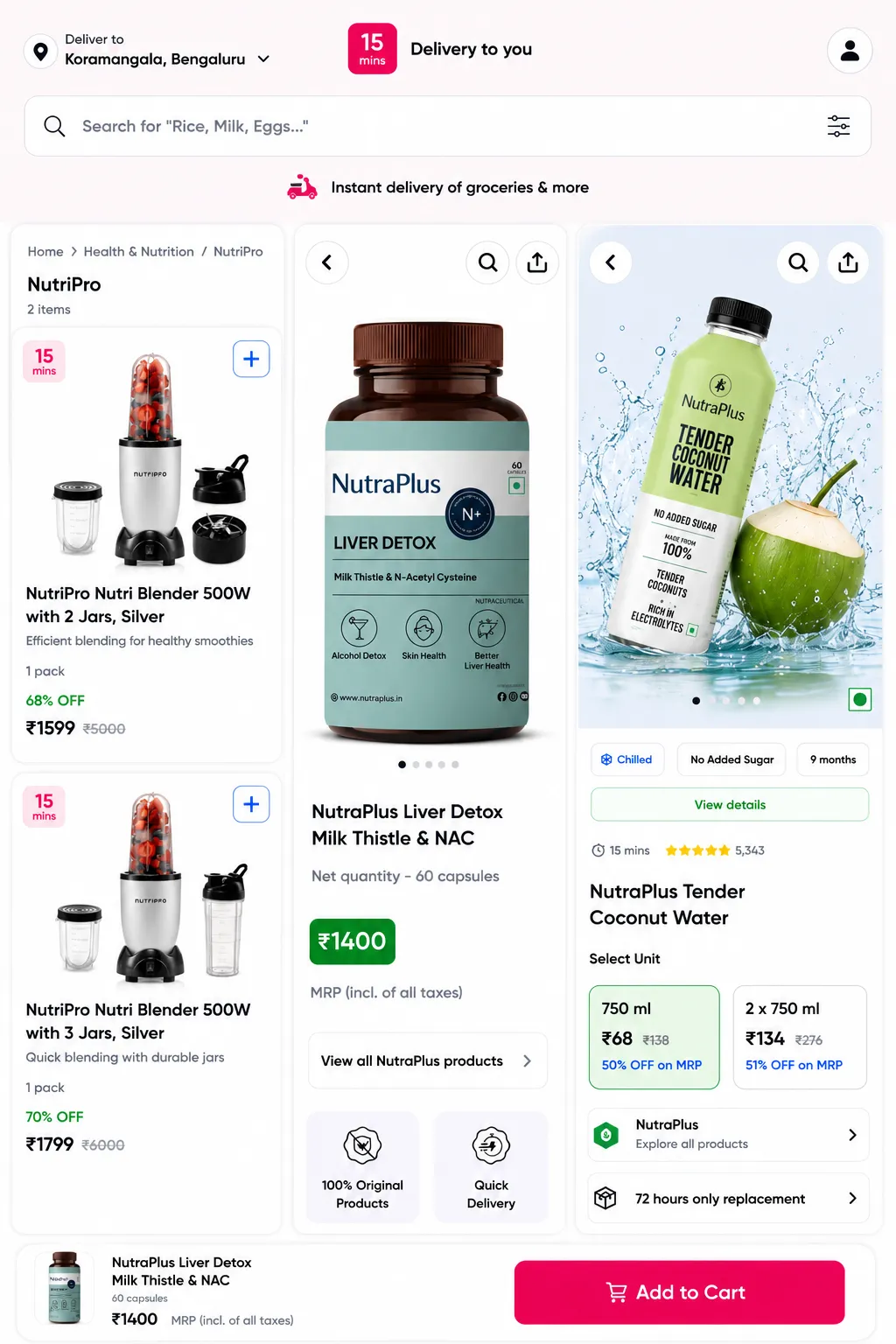
On Blinkit or Zepto, every product is a roughly 200x200 pixel tile on a white background. The consumer sees: brand name, product name, price, weight. In three seconds.
The entire emotional and narrative brand experience a startup might spend years building through its D2C channel, its packaging, its social presence, its founder story, compresses to a thumbnail.
If a startup enters Q-commerce before it has a visual identity that translates to that thumbnail environment, it trains its earliest customers to see the product as a commodity. And early customer perception on Q-commerce is sticky.
It sets the review pattern, the repeat purchase rate, and the algorithmic ranking that either compounds or doesn't over the first 12 months.
📌At Confetti, we build packaging specifically for the Q-commerce environment: legible at small sizes, variant-differentiated across a range, and structured so the most purchase-relevant information is immediately visible before a customer ever taps on the product.

Consider 5 things before making your decision regarding entering into quick commerce:
🟢Your Gross Margins are Above 55–60%
The platform cost stack runs 35–50% of MRP before you net anything. Only products with meaningful margin can absorb this and still deliver a positive contribution per unit.
With 55-60% margins, at the volumes, a new brand realistically achieves in the first six months.
🟢Your Product is Impulse-Friendly, Repeat-Purchase, and Fast-Moving
Snacks, beverages, personal care basics, health supplements, baby care, and pet care are categories with demonstrated Q-commerce demand.
Products that require explanation, consideration time, or a high-involvement purchase decision do not convert in a 3 second thumbnail interaction. If your product needs context to be understood, it needs a different channel first.
🟢You Have a Prior Demand Signal
Category managers at Blinkit, Zepto, and Instamart require evidence before they prioritise a new brand's application: 50+ reviews at 4.0 or above on any platform, documented monthly order volume, or a social following with demonstrated purchase behaviour.
Without this, applications get deprioritised and post-listing algorithmic traction is slower. Organic ranking is earned through velocity and velocity takes time if you arrive with no proof of demand.
🟢Your Supply Chain Can Replenish Weekly
Dark stores require replenishment 2-3 times per week for fast-moving SKUs. If your manufacturer operates on 3-4 week lead times, your replenishment cycle cannot keep pace with Q-commerce demand spikes.
Every stockout carries an algorithmic penalty that requires paid advertising to recover from.
🟢You Have Capital Allocated for the First 90 Days of Advertising
Organic ranking builds over time, but not before you've paid to be visible. Budget a minimum of ₹5–8 lakh across listing fees, onboarding costs, and platform advertising per platform in the first quarter.
Founders who enter under-capitalised tend to go quiet on advertising before organic momentum has had time to develop.
🔴Your Gross Margins are Below 45%
The channel economics don't work at your margin structure. Either raise MRP, reduce COGS, or choose a different distribution channel first.
🔴Your Product has Never Sold Online Before
Q-commerce is not a product validation channel for unproven products. Its algorithmic velocity model punishes brands that don't hit initial sales targets.
Use D2C, Amazon, or social selling to validate your product before committing Q-commerce capital.
🔴Your Supply Chain is Fragile
A single stockout in the first 30 days of listing sets back your algorithmic ranking and requires additional advertising spend to recover.
If your supply chain cannot guarantee weekly replenishment across multiple dark stores in 2–3 cities, wait until it can.
🔴Your Packaging was Designed for Retail Shelf
Retail packaging is designed to be read at arm's length. Q-commerce requires packaging that communicates on a mobile screen.
If your label isn't tested for thumbnail legibility, fix it before applying.
🔴You're Entering a Category Where the Platform has a Private Label
Bread, paneer, commodity snacks, household staples. The competitive environment is asymmetric.
Enter only if your differentiation: organic, artisanal, nutritional, regional, is strong enough to justify a price premium over the platform's own brand.
The "Q-Commerce Startup Readiness Decision Tree"
Below is a decision framework you can use before committing budget and inventory to any Q-commerce platform.
The brands building profitable, durable quick commerce businesses in India understand the channel before they scale anything.
Specifically, they share five behaviours:
✅They Entered with Packaging Built for the Channel
Labels designed specifically for mobile thumbnail legibility, tested at 200x200 pixels before going to print with compliance elements (FSSAI number, MRP, net weight, variant callout) integrated at the design stage.
✅They Launched Concentrated, Not Broad
3-5 hero SKUs in one or two cities, such concentration drives purchase velocity on a smaller number of listings.
Velocity builds algorithmic ranking. Ranking reduces dependence on paid advertising over time.
✅They Modelled the Real First 90 Days Before Committing
Listing fees, advertising, inbound logistics, dark store inventory float, write-off provision, all of it accounted for upfront.
The brands that absorb Q-commerce's cost structure without a crisis are the ones that planned for it. The ones that hit a cash flow crunch in month two are almost always the ones who budgeted for commission and shipping and assumed the rest would be marginal.
✅They Arrived with Proof of Demand
Amazon reviews, prior Instamart or Blinkit trial sales, a social following with documented purchase conversion. Platform category managers are more likely to approve applications and assign better initial dark store coverage to brands that can demonstrate existing customer pull.
Beyond the application stage, organic ranking builds faster when a product already has purchase history and review data behind it. Entering cold, no reviews, no sales data, no following, means paying for every unit of visibility until the product earns its position.
✅They Built D2C Infrastructure in Parallel
Q-commerce for volume and discovery. Their own website, email list, and subscription model running alongside it. By the time 70–80% of their revenue was coming from a single platform, they also had a growing owned channel.
That could absorb a platform-side disruption, a delisting, a category restructure, a commission revision, without the business collapsing. The brands that build this parallel infrastructure early have options. The brands that don't are dependent.
At Confetti, we support brands throughout their quick-commerce journey from platform readiness and onboarding to visibility, conversion, and sales growth once your products are live.
Sustainable growth comes from preparing the brand correctly before onboarding and continuously optimising performance after launch.
🎯Preparing Your Brand for Platform Evaluation
Quick-commerce platforms look at the overall strength of a brand, including packaging standards, digital presence, market positioning, and other trust signals.
Before introducing your brand to a platform, we help strengthen these fundamentals so your application presents a more compelling business case from day one.
🎯Defining the Right SKU and Pricing Architecture
Our team analyses your category landscape, competitor pricing, consumer buying patterns, and margin structures before recommendations are made.
This allows us to identify which SKUs should lead the launch and where they should be positioned within the category.
🎯Driving Growth After Launch
Once products are live, we focus on improving discoverability, maintaining listing health, managing platform advertising, and responding to category-level shifts.
As performance data accumulates, we continuously refine keyword targeting, advertising allocation, SKU prioritisation, and promotional strategy to improve both visibility and profitability.
📌When a sexual wellness brand approached Confetti after struggling to gain traction on Blinkit, we conducted a complete account restructuring.
We helped in identifying hero SKUs, rebuilding campaigns at the city level, and optimising visibility across high-intent search terms. Within a single quarter, the brand's monthly GMV grew from ₹4.7 lakh to ₹17.7 lakh, a 3.7x increase, while ROAS exceeded 3x.
That's why we focus on quick-commerce packaging requirements from the earliest stages of the design process.
🎯Compliance Considered from the Start
Mandatory information such as FSSAI details, MRP, ingredient declarations, manufacturing information, and shelf-life disclosures are integrated into the design in a way that remains compliant while preserving visual appeal.
🎯Barcode Placement Designed for Operations
We plan barcode placement around real-world fulfilment conditions, helping reduce operational friction and improving inventory handling accuracy.
🎯Platform-Ready Product Photography
We create all essential product assets, including front-pack, back-pack, and lifestyle imagery, ensuring they meet platform specifications for dimensions, background requirements, and image quality.
🎯Designed for Mobile Discovery
Our packaging and label systems are designed to maintain visual hierarchy and brand recognition even at reduced digital sizes, helping products stand out during browsing and search.
📌We have designed packaging for various brands like ITC B-Natural, Bingo, Miduty and NutriPro, which got approved by Quick commerce platforms.
Is quick commerce good for new startups in India?
It depends entirely on the product and the startup's financial position. Quick commerce is well-suited to startups with gross margins above 55%, impulse-friendly products (snacks, beverages, personal care), prior demand signal from other channels, and capital for 90 days of advertising.
It is poorly suited to low-margin products, startups with fragile supply chains, products requiring consumer education, or brands entering categories dominated by platform private labels.
What are the main disadvantages of quick commerce for small brands?
The 4 most significant risks are:
How much does it cost to enter quick commerce as a startup?
On Blinkit: approximately ₹6.5–8.5 lakh for 5 SKUs across 2–3 states, covering listing fees (₹25,000 per SKU per state) plus 3 months of advertising minimum. On Zepto: ₹5.25–6.25 lakh covering a security deposit and bundled onboarding and advertising package.
On Swiggy Instamart: ₹8–10 lakh per quarter in listing-cum-ad wallet fees for some brand categories. None of these figures include product cost, inbound logistics, or inventory float.
Can a startup be profitable on quick commerce in India?
Yes, but it requires gross margins above 55–60% and sufficient monthly order volume (usually 2,000–5,000 orders across 2–3 cities) to spread platform fixed costs.
Calculate your full unit economics before entering.
What is the biggest risk of quick commerce for a startup?
The single most commercially dangerous risk is revenue concentration. Where a startup derives 70–80% of its revenue from Q-commerce platforms and then faces platform delisting, algorithm changes, or private label competition without an alternative revenue base to fall back on.
The mitigation is building parallel owned-channel infrastructure (D2C website, email list, subscriptions) from the moment Q-commerce revenue begins.
Want strategic branding and packaging like this for your business?





.webp)
.webp)

.webp)
.webp)
.webp)
.webp)
.webp)







.svg)
.webp)


