%201.webp)
02
AI Snaps
.svg)
.svg)
01
Our Work
03
About Us
04
Brand Audit
05
Contact Us
06
Client Success
12
07
Blogs
08
Careers
Book A Call
.svg)



.svg)
Need Help In Building Your Brand?
Click the button below & book a call with our founder directly.

Rishabh Jain
Managing Director
A single agency for branding and packaging produces more consistent, strategically coherent, and commercially effective output than two agencies working in silos.
This article explains why and how to evaluate whether an agency can genuinely deliver both.
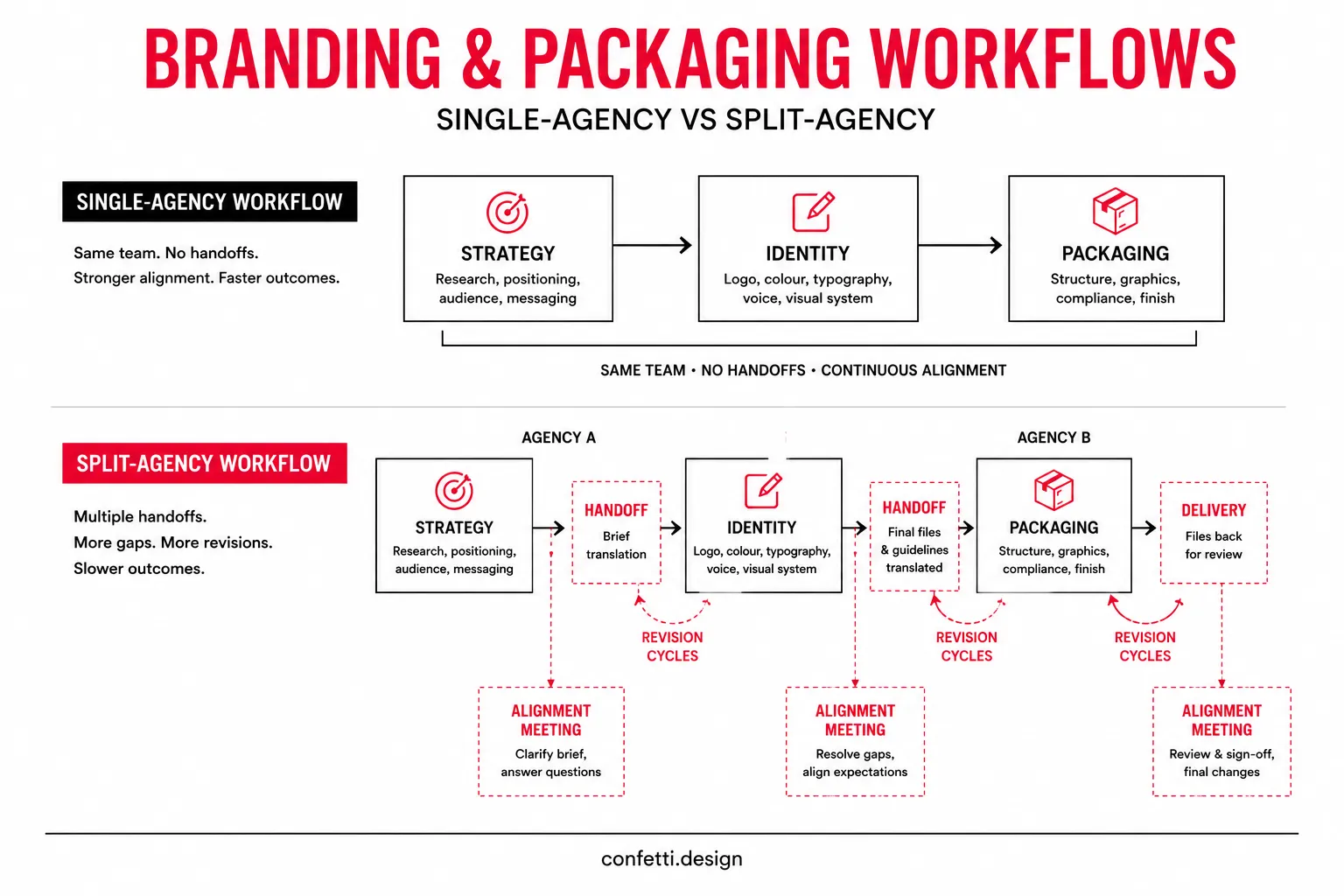
One agency creates your brand identity: logo, colours, typography, and visual system, while another designs your packaging.
On paper, it sounds logical. In reality, this handoff often creates disconnects that brands only discover after time, money, and momentum have already been lost.
Here are the problems it creates:
🛠️Communication Problem: Every brand evolves. But when branding and packaging are handled by separate agencies, every strategic shift has to be communicated twice, to two teams, two creative leads, and through two revision cycles.
What should be one conversation becomes a handoff. And with every handoff, context fades, alignment slips, and the original intent becomes harder to preserve.
🛠️Handoff Issue: Brand guidelines capture logos, colours, typography, and rules, but they can't capture the thinking behind them. The strategic intent, emotional tone, and design rationale often get lost in the transition. As a result, packaging may follow the guidelines perfectly while still feeling disconnected from the brand.
We've seen this repeatedly in projects that began with separate agencies: the right colours used in the wrong way, the correct typeface without the intended hierarchy, and visual elements that feel applied rather than truly integrated.
🛠️ Packaging Performance: It doesn't exist on a screen, it lives on shelves, in consumers' hands, and across different materials and print processes. What looks great in a brand presentation can behave very differently on a pouch, carton, or bottle.
Colours shift, typography changes, and production constraints alter the final result. Without a team that understands both brand strategy and packaging production, the gap between concept and execution grows—leading to more revisions, delays, and weaker shelf impact.
🛠️Pinning Accountability: When branding and packaging are handled separately, problems often fall into a grey area.
One agency blames the brief, the other blames the execution, and the brand is left coordinating both. With a single team, responsibility is clear and issues can be solved instead of debated.
🛠️Strategic Continuity: Branding and packaging shouldn't happen one after the other, they should evolve together. Packaging realities should influence brand decisions just as brand strategy should shape packaging.
When those conversations happen within one team, better opportunities emerge. When they're split, valuable feedback is lost and the brand never reaches its full potential.
🛠️The Briefing Tax: Every time a brief moves between agencies, context is lost.
The result is more revisions, longer timelines, higher costs you pay to both agencies, and slower decisions as brands mediate between teams. Most packaging changes happen because strategic intent gets diluted in translation.
💡The fundamental flaw of the split-agency model is that it treats branding and packaging as separate stages instead of two expressions of the same strategy.
But packaging is often where the brand is experienced most directly. When the teams are separated, some degree of misalignment is almost inevitable because the structure makes true alignment difficult.
"We do both branding and packaging" is something many agencies say. Fewer actually deliver it.
Integration means having the same strategic reasoning behind both. When the team that built your positioning is the same team designing your pack, they know the reason behind every decision.
Every decision made at the brand level is made with packaging constraints and opportunities in mind. Every packaging decision reinforces and extends the brand strategy.
✅One Brief, Not Two
Integration starts with a single strategic brief. Instead of separate branding and packaging briefs, one process defines the brand's positioning, audience, commercial goals, and visual direction, ensuring every decision starts from the same foundation.
✅Brand and Packaging Evolve Together
Brand identity and packaging are developed in parallel, not sequentially. Packaging constraints influence the identity, while brand strategy shapes packaging, creating a continuous feedback loop that leads to stronger outcomes.
✅One Team Owns the Strategy
There is no handoff between agencies. The same team that develops the brand strategy and visual identity is responsible for translating it into packaging, preserving context and intent throughout the project.
✅Faster Decisions, Fewer Revisions
Without multiple agencies to coordinate, decisions happen faster. Changes can be made immediately, reducing re-briefing, revision cycles, project delays, and unnecessary costs.
✅Packaging Expertise from Day One
Packaging production isn't treated as an afterthought. Material choices, print limitations, structural formats, and shelf realities are considered during brand development, preventing costly compromises later.
✅Consistency Across Every Touchpoint
An integrated process creates one coherent visual system across packaging, e-commerce, social media, retail, and every customer interaction. The brand feels consistent wherever consumers encounter it.
✅One Team, One Accountability
With one agency responsible for both branding and packaging, ownership is clear. Problems are solved collaboratively instead of being passed between teams, resulting in faster resolutions and better outcomes.
✅Strategy Drives Every Packaging Decision
Positioning should influence every packaging choice: from colour and typography to messaging and hierarchy. An integrated team understands the strategic reasoning behind those decisions, ensuring the packaging expresses the brand rather than simply following category conventions.
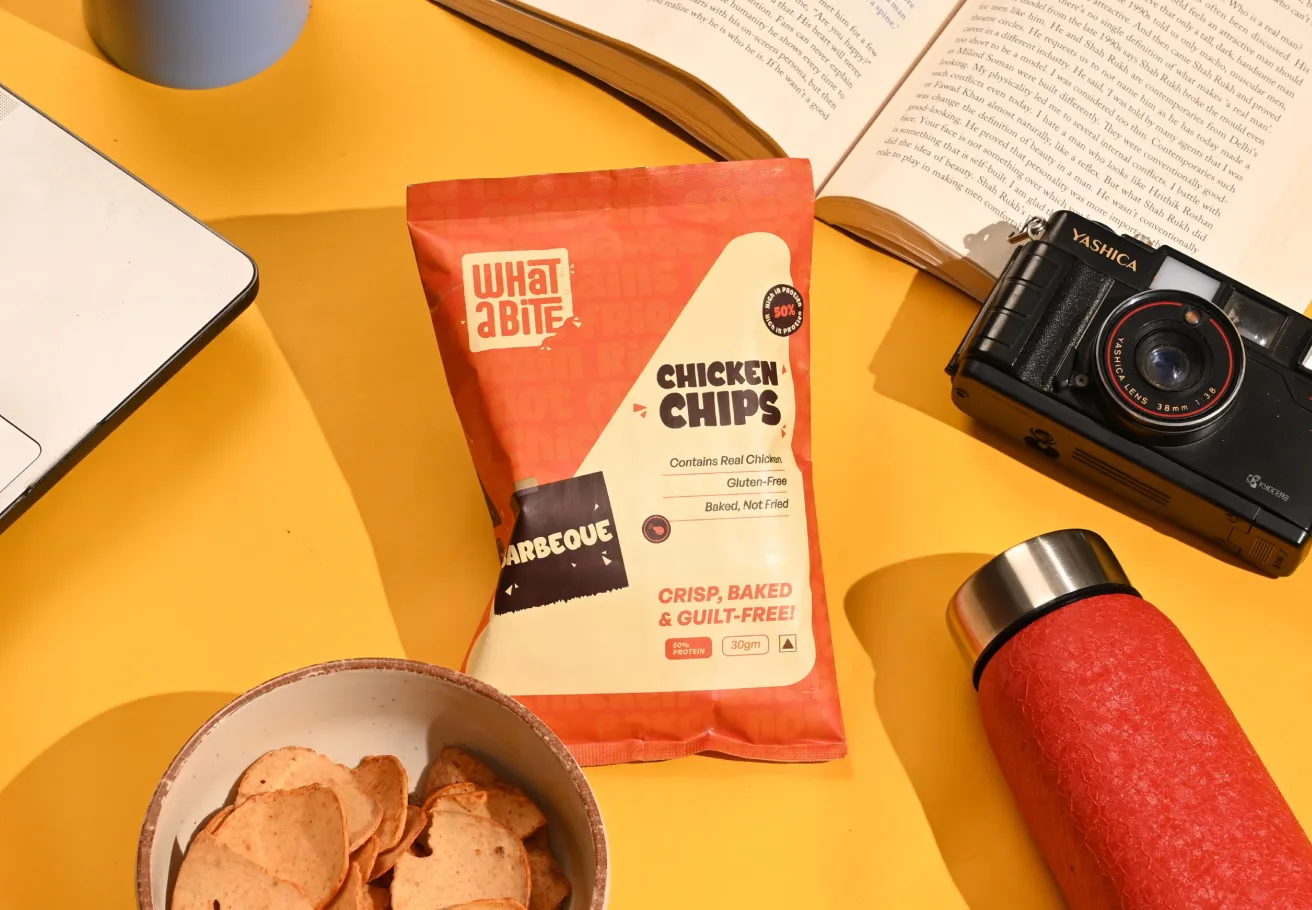
A simple example: Imagine a protein snack positioned for busy professionals rather than fitness enthusiasts. That positioning influences every packaging decision: from typography and colour to messaging and hierarchy.
An integrated agency carries that positioning into every packaging decision:
A packaging agency working from a brief might execute those choices correctly. Or they might default to category conventions like bold colours, large protein callouts, active lifestyle imagery, because those conventions test well in the category.
The difference is that an integrated team knows why those conventions are being rejected. A separate packaging agency is guessing.
This is what we mean by the Position → Translate → Execute sequence.
💡Brand strategy must flow unbroken into packaging decisions. When it passes through a briefing handoff, the thread breaks.
The split-agency model fails in specific, predictable ways depending on the brand's category, lifecycle stage, and go-to-market strategy.
Understanding these help you recognise when the model is costing them more than you realise:
Brands today don't operate in one channel. They operate across quick commerce platforms, modern trade, Amazon, and their own D2C website, simultaneously.
Each channel has different packaging constraints, different visual shelf contexts, and different communication hierarchies.
No briefing document can fully capture that complexity for a separate packaging agency. You need a team that understands these channels, owns the brand positioning, and makes packaging decisions with full awareness of both.
Most D2C and FMCG brands launch with 3–5 SKUs and scale to 15–30 or more within two to three years. At scale, visual consistency across variants, sizes, and flavours becomes the primary brand asset on shelf.
A single integrated agency owning the brand system can scale it coherently because they set the rules. A packaging agency brought in later has to interpret a system they didn’t design for each new SKU.
4700BC's popcorn range demonstrates what SKU-level discipline looks like at scale. The visual architecture is consistent across 20+ flavour variants. The system works because the rules were set early and applied with discipline.
For D2C unboxing experience, the package is the most important physical touchpoint. It’s what customers hold, open, and share online.
When branding and packaging are handled by different agencies, the experience can become fragmented: the website, social media, and email marketing tell one story, while the packaging tells another.
Even small inconsistencies weaken the sense of a unified brand and can gradually erode trust.
An integrated agency ensures continuity across every touchpoint. The same visual system, messaging, and tone carry from digital platforms into the physical package, making unboxing feel like a natural extension of the brand journey rather than a separate moment.
These brands rely on sensory detail: paper weight, foil finish, texture, to signal quality and exclusivity. When branding and packaging are handled separately, the brand agency defines the emotional direction while the packaging agency executes it without fully grasping the intent.
This can lead to technically correct decisions that feel emotionally off, weakening the luxury perception.
For example, a brand built around “artisanal craftsmanship” may develop a visual identity rooted in hand-drawn elements, natural textures, and warm tones. But in execution, a packaging agency might choose a cold, industrial-feeling substrate or overly mechanical finish.
The result still follows guidelines, but it contradicts the intended emotion.
Many agencies claim integrated branding and packaging capability. Here's a practical evaluation framework to check if they actually can handle both :
1. Start with Portfolio Forensics
Don't evaluate an agency by portfolio images alone. Ask them to walk you through an entire project, from research and positioning to the final product on the shelf.
A strong agency should be able to explain how strategic decisions shaped the visual identity, how that identity influenced packaging, and why specific packaging choices were made. You're looking for the thinking behind the work, not just the finished result.
❓Question to ask: "Can you show us a project where you developed the brand identity and packaging together? How did the strategy influence the packaging design?"
🚨What to avoid: Portfolios that separate branding and packaging into different sections with no crossover, or case studies that show attractive visuals but never explain the commercial reasoning behind them.
2. Understand How Their Team Works
Integrated branding requires collaboration between strategists, designers, and packaging specialists throughout the project.
The fewer disconnects in the process, the more consistent the outcome.
❓Question to ask: "Who will work on our project day-to-day? How do your brand strategists and packaging designers collaborate?"
🚨What to avoid: Agencies where the pitch team disappears after the contract is signed, or where branding and packaging are handled by separate teams that rarely work together.
3. Verify Technical Packaging Expertise
Branding is creative. Packaging is creative and technical.
A genuine packaging partner should comfortably discuss printing methods, substrates, structural formats, colour management, manufacturing constraints, and production approvals. They should understand what happens after the design is approved.
If the conversation ends at the artwork, you're probably speaking to a branding agency rather than a packaging specialist.
❓Question to ask: "How do you manage production? Do you coordinate with printers, review proofs, or solve technical issues during manufacturing?"
🚨What to avoid: Agencies that treat packaging as simply placing a logo on a box, or struggle to answer questions about production and print.
4. Look Beyond Beautiful Mockups
Strong packaging succeeds because it attracts attention, communicates clearly, and performs in the environment where customers actually buy.
Look for agencies that explain how their work improves shelf visibility, supports pricing, or differentiates products within a crowded category.
Real products on shelves tell you far more than polished renders.
❓Question to ask: "Can you show examples of products currently in the market, and explain what business problem the packaging solved?"
🚨What to avoid: Portfolios filled with concept work, lifestyle mockups, or projects that never discuss outcomes beyond aesthetics.
5. Test Their Understanding of Your Category and Channels
A skincare brand, protein supplement, and spice brand all compete differently. Likewise, packaging for Quickcommerce, Amazon, supermarkets, and kirana stores serves different purposes.
A capable agency should understand your category conventions, know when to follow them, and recognise when breaking them creates competitive advantage.
❓Question to ask: "Have you worked in our category or similar ones? How would you adapt our packaging for retail, quick commerce, and D2C?"
🚨What to avoid: Agencies that claim they can design for every industry but can't demonstrate real category knowledge or experience across different sales channels.
6. Assess Scalability and Systems Thinking
Brands grow. They launch new products, enter new categories, and expand into new markets.The agency you choose must be able to scale with you. A genuine integrated agency builds systems, not one-off designs.
❓Question to ask: "How do you design for scalability? What happens when we launch a new product in a different category? How does your system accommodate that?"
🚨What to avoid: Agencies that design each package in isolation. Agencies that cannot articulate how their work will scale across a portfolio.
A genuine integrated agency passes all these tests:
At Confetti, we meet every one of these criteria. Our portfolio shows integrated branding and packaging work for brands like ITC Bingo, BNatural, and Aashirvaad.
Our process moves from strategy to final packaging in approximately six weeks, with the same team handling both.
We have deep technical expertise in packaging production. And we have delivered over 200 projects for leading retail brands.
The integrated brief is the single source of strategic truth that governs every downstream design decision: from logo construction rules to the information hierarchy on a 20g sachet.
Here's what an integrated brief covers:
📃Category analysis and competitive packaging audit
An integrated agency first maps what the category looks like on shelf: colour conventions, typography patterns, communication hierarchies, format norms, and identifies where a new brand can own a distinct visual territory.
📃Positioning territory and brand personality
Not just "who is the target audience" but what the brand stands for in the consumer's mind relative to every other option. This is where brand strategy informs the character of the packaging, not just its aesthetics.
📃Visual direction with shelf application in mind
Not a moodboard. A set of principles: what the brand looks like, what it avoids, and why with packaging formats as the primary test of whether the principles work.
📃Packaging architecture
Which information goes where, in what hierarchy, for each SKU and pack size. What changes between a 50g retail pack and a 1kg family pack. What must remain constant. How variant differentiation is handled without breaking brand recognition. This is some of the most technically complex work in brand-packaging integration and it only gets done well when the strategic team owns it.
📃Channel-specific execution rules
How the brand system adapts for Amazon hero images, retail shelf facings, quick commerce grids, and D2C unboxing. These are extensions of the same system. Label compliance rules must be factored in from this stage, not at print-ready.
Integrated Agency Output vs. Split-Agency Model
Our work on AIM Nutrition, and Evox each followed this integrated model: brand strategy first, packaging execution as a direct extension of that strategy, not a downstream handoff.
✅ Strategy-first, not decoration: Design is built to earn its keep and move your business forward, not just look good.
✅ True integration under one roof: Branding, packaging, and marketing aligned from day one, with no handoff gaps or lost vision.
✅ Battle-tested for retail: 200+ projects delivered successfully for leading Indian retail brands.
✅ Trusted by giants like ITC, Dabur & Sunfeast: Proven ability to handle complex, large-scale FMCG branding.
✅ From strategy to shelf in just 6 weeks: A streamlined process that respects your timelines without cutting corners.
✅ End-to-end packaging solutions: 360-degree service from concept and structural design to production guidance.
✅ Unlimited revisions, zero compromise: We refine until it's perfect, with no limits on drafts.
✅ Award-winning global recognition: Honoured with the Manifest Award (2024) and Clutch Global Award (2025).
✅ Proven to create viral shelf impact: Bingo Chatpat Kairi packaging went viral on social media after 20+ failed attempts by others.
✅ Global expertise, local insight: Deep understanding of international design trends, tailored for Indian and global markets.
✅ Scalable systems, not one-off designs: We build flexible brand and packaging systems that grow with your portfolio.
✅ Obsessed with what works for your business: Creative partners who take true ownership of your brand's success.
✅ 43-member powerhouse team: A full crew of strategists, designers, and project managers, not a handful of freelancers.
✅ Elevates unboxing to a brand moment: We design packaging that boosts engagement, recall, and perceived value.
What does a branding and packaging design agency do?
A branding and packaging design agency develops both brand strategy (positioning, identity, visual language) and packaging execution. An integrated agency manages both under one roof, ensuring consistent shelf impact across all SKUs and channels. Unlike packaging-only firms, strategy and design are handled by the same team from a single brief.
Is it better to use one agency for both branding and packaging, or separate agencies?
Most D2C and FMCG brands get better consistency with an integrated agency because strategy directly informs packaging decisions like hierarchy, tone, and visual identity. When strategy and design are split across teams, inconsistencies often appear across SKUs and channels, and brand drift usually starts in the briefing gap between agencies.
How do I know if an agency can genuinely handle both branding and packaging?
Ask for the strategic thinking behind their packaging, not just visuals. How did positioning shape hierarchy? Do they understand your channels—kirana, quick commerce, modern trade, D2C? Look for end-to-end brand-to-shelf case studies, not just portfolio shots. Strategy clarity matters as much as design quality.
What is the cost difference between a single integrated agency and using separate agencies?
A single integrated agency is usually more cost-effective because strategy is defined once and directly guides all packaging design. Split agencies often increase costs through duplicated briefing, extra revisions, and rework, with the biggest impact showing up in longer timelines and higher iteration cycles.
What should I look for in a branding and packaging agency for FMCG or D2C in India?
Look for proven experience in your category and SKU-level consistency across full product ranges, not just hero visuals. The agency should show a clear end-to-end process from strategy to packaging execution, backed by understanding of Indian retail channels. Most importantly, they should be able to explain their design decisions in clear strategic and commercial terms, not just aesthetics.
Want strategic branding and packaging like this for your business?





.webp)
.webp)

.webp)
.webp)
.webp)
.webp)
.webp)






.svg)
.webp)