%201.webp)
02
AI Snaps
.svg)
.svg)
01
Our Work
03
About Us
04
Brand Audit
05
Contact Us
06
Client Success
12
07
Blogs
08
Careers
Book A Call
.svg)



.svg)
Need Help In Building Your Brand?
Click the button below & book a call with our founder directly.

Rishabh Jain
Managing Director
Using AI in packaging design is fast and accessible. Today almost anyone can produce packaging that looks finished in minutes. The real question is: Should you be using it and if Yes, how. If No, why not?
This is your guide to how good AI is for packaging design and where it lags. We also see real examples of how brands are integrating it into their workflows, and what you can learn and implement for yours.

AI in packaging design is a capability multiplier, not a capability replacement.
It can handle volume, speed, and pattern-based tasks. What it does not handle is judgment, taste, or decision making.
👍Consumer trend analysis: AI excels at pattern recognition, generation, and optimization.
It can analyze purchasing data, social signals, search behavior, and competitor packaging to identify market-aligned design trends. This commercially underused application can provide valuable strategic input.
👍Concept generation and visual ideation: Generative AI tools like Midjourney, DALL·E 3, and Adobe Firefly can produce multiple visual directions quickly.
If as a brand you are in an early exploration stage, this is pretty useful. You're reacting to 20 directions instead of providing a packaging brief from a blank page.
👍Dieline automation: Dedicated platforms like Packify.ai and DYP.ai generate packaging templates based on product dimensions.
This reduces manual setup time for formats like pouches, cartons, bottles, and jars. While they don’t replace structural engineers for complex designs, they are effective time-savers for standard packaging needs.
👍3D mockups and digital twins: L.E.K. Consulting's 2026 brand owner survey shows, Unilever is using real-time, physically accurate 3D technology to create digital twins of its products, every variant, label, and language format within a single file.
These are reintegrated directly into creative workflows. The implication: no costly physical prototypes for every iteration.
👍Quality control on production lines: Computer vision systems detect label defects, print misalignments, and structural errors at scale.
Nestlé implemented deep learning image recognition across its packaging production lines, using high-resolution cameras and OCR to verify every package against multilingual compliance standards.
👍Sustainability optimization: AI models analyze material options, structural weight, and configuration to reduce waste while maintaining pack integrity.
This is useful when brands face pressure on both cost and environmental impact.
👎Category-specific consumer psychology: It cannot navigate cultural nuance like color taboos, regional symbolism, and language-specific design logic that determine whether a pack feels right or wrong to a specific buyer.
It cannot build a brand identity system with long-term coherence across a growing SKU range.
👎Brand strategy: AI cannot understand why a category shift needs a distinct visual change or balance brand assets against design trends.
It lacks cultural and strategic intuition, so generative packaging outputs may look plausible but lack meaning without human direction.
👎Constraints well unless explicitly programmed: AI only works within the parameters it’s given.
It may generate impractical solutions like a circular label for a square bottle or fragile premium packaging for shipping, unless constraints such as durability and logistics are clearly defined.
👎Judgment call: It cannot definitely tell what separates a design that looks polished from one that sells consistently.
That requires understanding how your product is bought, compared, and chosen in a real retail environment and no current AI tool has that context built in.
💡Treat it as a capable junior creative assistant: fast, high-volume, useful for generating options, but not responsible for making the call.
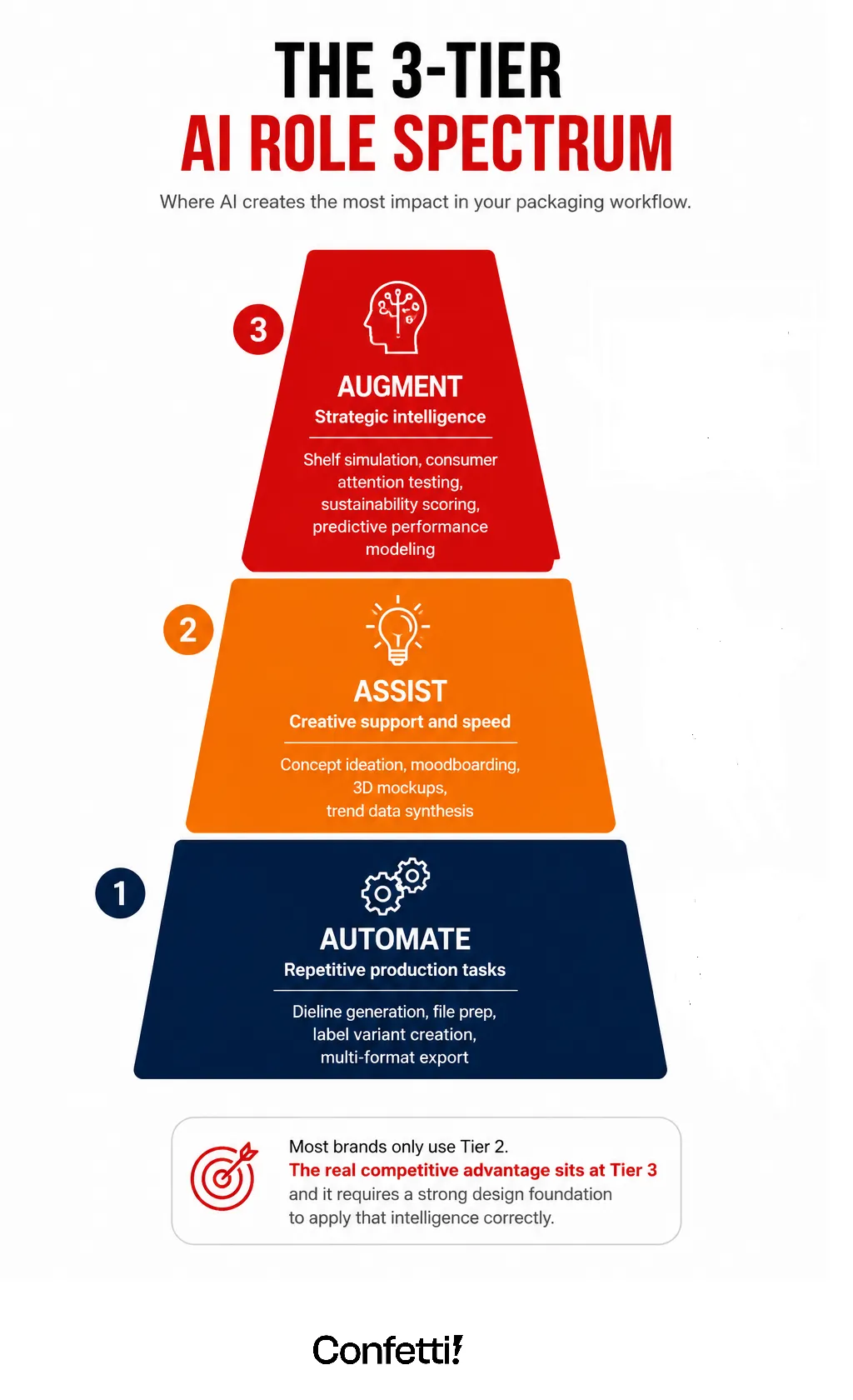
A simple way to think about where AI belongs in your workflow:
Here is how major consumer goods companies are deploying AI packaging tools right now, with specific applications and verified outcomes.
As per Packaging Dive, Nestlé partnered with IBM Research to use generative AI for discovering high-barrier packaging materials by identifying new material combinations from large research datasets.
At the same time, Nestlé experiments with tools like Midjourney and Adobe Firefly for culturally relevant packaging and campaign visuals.
💡AI is used both for material innovation and creative ideation, making it a strategic tool rather than just a design shortcut.
Unilever uses tools like NVIDIA Omniverse and OpenUSD to create detailed digital versions of its packaging.
These digital twins include all product variants, labels, and regional formats, reducing the need for costly physical prototypes across global product lines.
For a brand managing that kind of complexity, design consistency across markets no longer requires a manual review loop at every step.
💡Digital twins help brands scale packaging across markets faster, with greater consistency and fewer costly prototype and review cycles.
The Coca-Cola Company’s Project Fizzion, developed with Adobe, turns brand guidelines into machine-readable rules inside Adobe tools.
It automatically applies design standards across markets, enabling faster localization and more consistent, error-free packaging at scale.
💡Use AI to localise designs. This preserves creative control while accelerating production, exactly where AI belongs in an established brand system.
Diageo’s Project Halo used generative AI and digital printing to produce 50,000 unique Johnnie Walker Black Label bottle designs for Dubai Duty Free.
This shows how AI enables scalable personalization and new revenue through limited, exclusive packaging in travel retail.
💡Use AI to enable scalable hyper-personalization in packaging, turning exclusivity into a direct revenue driver in premium retail channels.
Kenvue used AI-powered artwork management to speed up packaging compliance checks, cutting review time by 95% and reducing defects by 40%.
The system doesn’t design packaging, it verifies accuracy before print, saving time, cost, and reducing recall risk.
💡AI-driven compliance systems deliver the fastest ROI in packaging by drastically reducing review time, human error, and costly recall risks before production.
Smaller brands don't have Nestlé's R&D budget or Unilever's SKU complexity.
But they face a version of the same challenge: how do you produce enough creative directions to explore a concept properly, without burning 3 weeks of a designer's time.
The answer: A HYBRID workflow.
So, your design partner doesn't start from zero. The AI directions become a filter: what's promising, what's off, what's worth developing. This cuts ideation time without cutting quality.
The CRITICAL condition: the Packaging design brief is NOT AI generated and exists before the AI prompt is written.
When every brand uses the same generative AI tools, trained on the same visual datasets, iterating through similar prompts, the outputs converge.
The aesthetic signature of AI-generated packaging is increasingly recognizable. The same color gradients. The same sans-serif typography. The same minimalist illustration style.
What feels fresh today becomes the generic baseline in 18 months.
Why the Data Problem Is Built In
Generative AI models learn from what already exists. That means they're optimizing toward what has historically worked.
A new brand that uses AI to "look premium" often ends up looking exactly like the last three premium brands that ran through the same tool.
What This Does on Shelf
Shelf visibility depends on contrast. Your pack needs to arrest attention, trigger recognition, and communicate differentiation within seconds of a shopper's attention.
If 40% of your category is producing AI-generated packaging with similar training data and similar prompts, that category loses visual contrast.
We've seen this pattern repeatedly in our work with Indian FMCG and D2C brands. A brand brings in AI-generated concepts that look polished on screen. We analyse and on shelf, surrounded by competitors, under real lighting, in a kirana or quick commerce thumbnail, they disappear.
These are your only long-term defense. A 2023 Kantar study across 1,400 brands found that distinctive assets like unique colors, shapes, typography, imagery, drive 47% of brand recognition.
Those assets take years and experience to build. AI-generated packaging, by default, pushes toward category norms, not away from them. It optimizes for “good packaging,” not “uniquely your packaging.”
The AI-generated brand does nothing wrong. It did nothing distinctive.
Before accepting any AI-generated packaging direction or any design, for that matter run it through three questions:
1. Does this pack look like our brand, or like the category in general? If you removed the logo and product name, would this design work for a competitor? If yes, it isn't doing enough brand work.
2. Could this design be mistaken for a direct competitor? Pull the top three competitors in your category. Put their packs next to this design. How different does it read?
3. What visual element on this pack is irreplaceable? There should be at least one thing: an illustration style, a typographic treatment, a structural choice, a color combination, that only your brand could credibly own. If nothing is irreplaceable, nothing is distinctive.
If your AI packaging tool never produces anything that makes you uncomfortable, it is quietly homogenizing your brand.
AI can generate a design. It cannot generate a brand.
The best use of AI in packaging design is using it as a validation tool. Here’s what you can do:
AI-powered platforms like TestPilot CPG simulate real shopping environments. The platform tracks every click, scroll, and purchase decision from actual category buyers in realistic digital simulations. Expert-trained AI then translates observed behaviors into actionable insights
They simulate where a consumer's eye goes first, what they process next, and what gets ignored entirely.This replaces expensive eye-tracking lab studies.
It also surfaces structural problems in a design before you spend money printing 10,000 units.
Traditional eye-tracking shows where people look. Predictive eye-tracking shows whether that attention leads to purchase.
Behaviorally’s 2026 system uses data from 7,500+ packaging tests across categories like cosmetics, pet food, and beer to predict which designs drive shopper choice. Instead of only measuring fixations, it explains what works and why.
AI tools like SalGAN and DeepGaze help brands test packaging digitally, identify attention-grabbing elements, and improve designs before launch.
Amcor's research highlights how AI can continuously monitor consumer trends and update packaging design recommendations as preferences shift, giving brands a real-time feedback loop that traditional annual research cycles can't match.
For fast-moving categories like health and wellness, snacking, and personal care this kind of ongoing signal is valuable.
So, brands must use AI in packaging to make design decisions smarter with more signal, less assumption.
For most Indian D2C brands, the testing is the best use case compared to generating packaging design.
This is because the practical AI adoption for consumer insight remains low outside large FMCG players.
So, as an Indian founder of a D2C brand who wants to experiment with AI, here’s what you can do:
Run one AI-powered packaging test before your next production run. TestPilot and BluePill are two platforms that can help you with that and cost around 4000-5000 INR per test.
Here’s an example workflow to run:
Generate 200 variations using generative AI packaging design. Filter through a category sameness filter. Then test the remaining options using AI-powered eye-tracking and preference prediction before showing anything to a human.
The AI tests another 200 variations for attention and emotional response. The human packaging expert reviews the top 5.
The workflow: generate → filter → test → refine → test again → human decision.
AI testing identifies the winner. Human judgment validates and refines the choice.

Our branding and packaging experts can help shape it into a market-ready design
Book A Call
India's retail landscape is different from the western market. The assumptions don't always translate. Here’s what relevant to India:
✔️Multi-lingual label generation
For brands distributing across multiple Indian states, producing label variants in Hindi, Tamil, Telugu, Kannada, Bengali, and Marathi is a real operational cost.
AI significantly reduces the time and expense of creating these variants as long as a human with language and cultural fluency reviews every output before it goes to print.
FSSAI labeling requirements and state-level language compliance are legally specific. AI can accelerate the creation; it cannot verify the compliance.
✔️SKU Intelligence for Sprawl
As D2C brands expand rapidly, managing hundreds or thousands of SKUs becomes difficult.
AI helps your brand predict demand, choose the right packaging sizes, reduce wasted space, and optimize shipping and warehouse costs.
✔️E-commerce and quick commerce asset optimization
The thumbnail is often the first and only consumer touchpoint on Blinkit, Zepto, Swiggy Instamart, and Amazon India.
AI tools can generate and test packaging imagery optimized for these platform contexts, where desktop hero shots and kirana shelf presence require completely different visual logic.
We at Confetti support brands in getting their visual assets and packaging ready for quick commerce listings as part of our broader branding and packaging work.
✔️AI-Enabled Testing Infrastructure
India is building stronger packaging innovation infrastructure. Indian Institute of Packaging launched its Bengaluru Centre in 2025 with AI-enabled testing and smart packaging facilities.
Industry partnerships and training programs focused on AI, sustainability, and packaging compliance are helping brands adopt advanced packaging technologies faster.
⚠️Cultural literacy
AI tools are predominantly trained on Western design datasets. Color associations, visual symbolism, festival-specific design logic, and regional aesthetic preferences require cultural knowledge that AI does not reliably possess.
A design that reads as premium in one market can read as cold or inaccessible in another. This requires human judgment from someone who understands the market.
⚠️Kirana and general trade shelf logic
The visual priorities for shelf presence in unorganized trade are different from modern retail and e-commerce.
Pack legibility at distance, color punch under mixed fluorescent lighting, and text hierarchy for buyers who scan fast, these parameters are shaped by experience in Indian retail, not by generative models trained on Shopify product pages.
⚠️Complex Structural Simulation
Digital twin packaging and advanced structural simulation tools assume design teams with computational resources and training that most Indian D2C brands do not have.
These tools are relevant for large FMCG manufacturers with dedicated packaging engineering departments. For a D2C brand shipping through third-party logistics, basic structural testing matters more than sophisticated simulation.
⚠️High-End Personalization for Mass Market
Tata Tea's personalized packs worked because the campaign was limited-edition and high-margin. For mass-market FMCG products priced at ₹10–50, per-unit personalization remains economically impossible.
Do not chase hyper-personalization for low-margin categories. Apply AI to personalization only where willingness-to-pay covers the variable cost.
⚠️Regulatory accuracy
FSSAI labeling requirements, BIS marking, MRP declaration formats, net weight specifications, and manufacturer address requirements are legally precise.
Combining AI tools with local design expertise is what actually works for Indian brands. The AI handles volume and speed. Human expertise handles accuracy, cultural fit, and strategic direction.

At Confetti, we have worked with renowned brands like ITC, Dabur, Forest Essentials and more spanning across food and beverage, personal wellness, fashion, and consumer goods.
Our Philosophy: AI as an Execution Medium, Not the Creative Lead
✅Where We Explore AI
Early-stage concept exploration: Generating visual directions quickly to give clients something concrete to react to, rather than presenting a single direction cold. It changes the quality of the first conversation about a project.
Multiple SKUs or regional variants: We use AI to generate consistent label adaptations across formats, languages, and platform specifications, saving meaningful time on repetitive production work without sacrificing brand consistency.
Quick commerce and e-commerce packaging: we use AI to adapt and test packaging imagery across platform contexts, ensuring that what performs on a physical shelf also performs as a thumbnail on Blinkit or a product image on Amazon India.
Attention simulation tools: To test visual hierarchy on designs before they're finalized, checking where a consumer's eye goes first, and whether that hierarchy matches the brand's intended communication priority.
We've also explored AI-assisted photography workflows for product imagery. You can see this in our work on the Nike AI photography project, where strong creative direction drove the AI output rather than the other way around.
❌What We Don't Delegate to AI
The strategic brief: The creative brief is the most strategic document in packaging development. It defines positioning, audience, category strategy, and aesthetic direction. We at Confetti are accountable for that outcome. We do not delegate accountability to a statistical model.
Brand architecture: How a new SKU sits relative to others in the range, and how the range sits relative to competitors on shelf, is a strategic decision that shapes everything: color system logic, typography choices, structural form, hierarchy. This cannot be prompted into existence.
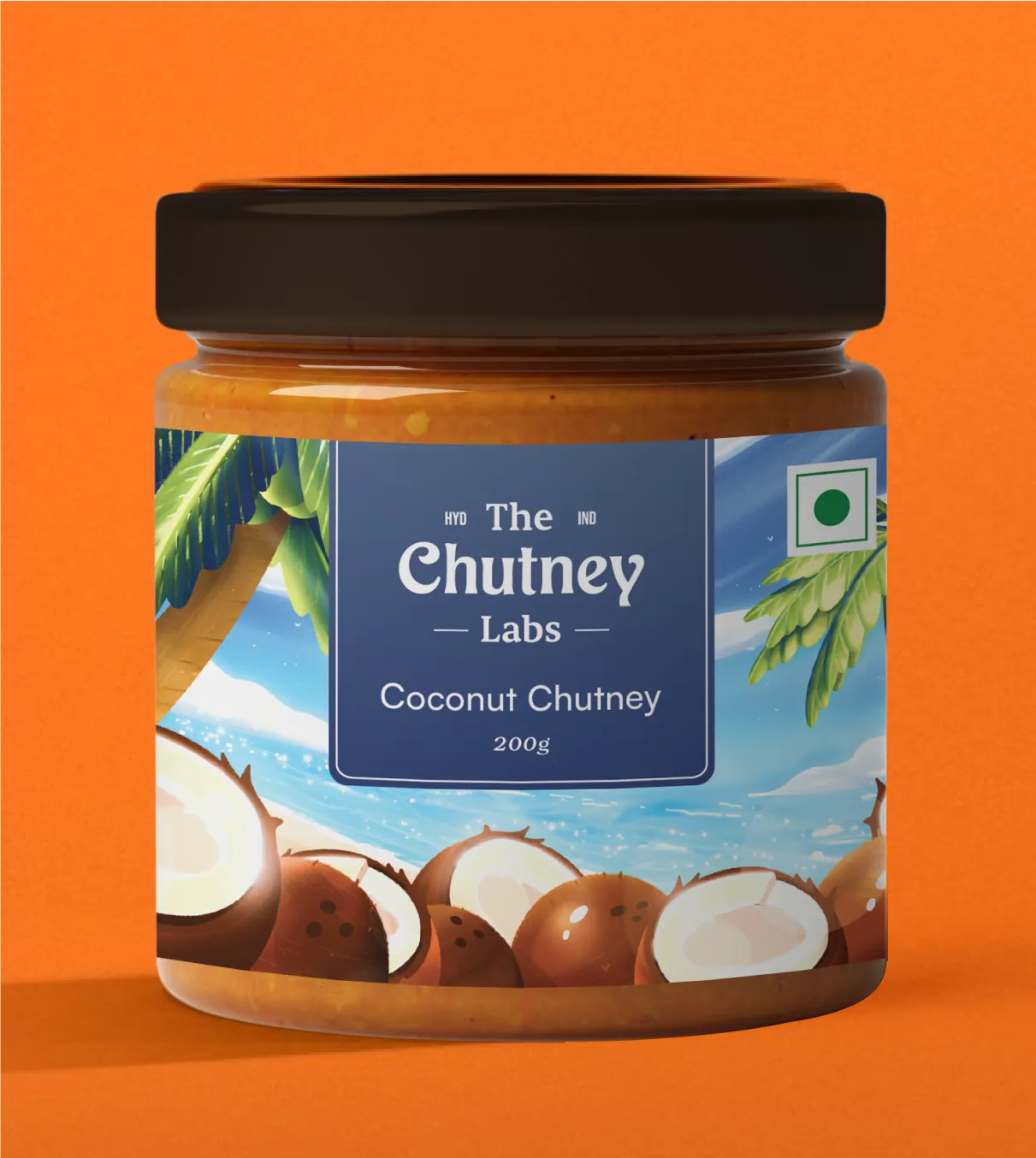
Cultural translation: Our work with brands like The Chutney Labs, hand-drawn illustrations built to carry specific regional flavors as living characters, required navigating category perception, regional identity, and visual personality simultaneously.
Final creative judgment: The decision that determines whether a pack is distinctive, credible, and commercially ready requires taste, market experience, and commercial awareness working together. That combination isn't automatable yet.
You are not hiring Confetti to operate software. You are hiring us to make decisions software cannot make.
If a packaging firm says AI can “replace designers” or “automate creativity,” look at their portfolio from the last five years. If every project looks the same, there’s your answer.
The industry often mixes two different ways of working, and understanding this helps you improve your process and avoid common mistakes when using AI.
💡Again: the prompt is not the brief.
A brief contains market context, competitive landscape, category psychology, consumer behavior data, and commercial objectives.
A prompt contains instructions about what to generate.
When you read about a brand "using AI for packaging," the question worth asking is which column they're actually in. Nestlé and Unilever examples above are AI-assisted.
If you're evaluating AI tools for your packaging workflow, here’s an evaluation criteria:
🔍Brand system input capability: Best tools use real production inputs like dieline size, bleed, color space (CMYK or Pantone), substrate, and regulatory layout. If a packaging AI ignores material thickness or fold tolerances, it’s not a real tool.
🔍Regulatory compliance support: For Indian brands the tool must support packaging labeling requirements like FSSAI, BIS marking, multilingual text specifications, and the mandatory declaration formats.
🔍Testing integration, not just generation: Tools worth paying for include or integrate with predictive eye-tracking, emotional response models, or shelf simulation. Generation without validation is just high-speed guessing.
🔍Export to production-ready formats: Many AI mockup generator packaging tools produce beautiful on-screen renders and useless print files. Verify the export chain before committing.
🔍Human-in-the-loop defaults: Tools designed by engineers prioritize end-to-end automation. Tools designed for designers prioritize checkpoints where human approval is required, which prevents brand erosion.
⛔First product launch: AI cannot build a brand identity design. It can only remix what already exists. The brand foundation has to be set by someone who understands what you're building and who you're building it for.
⛔Complex structural innovation: AI struggles with irregular folds, nested shapes, or tactile closures that require material intuition. If your packaging requires a novel unboxing experience or a structural differentiator, call a packaging design expert.
⛔Packaging Failures: AI can generate alternatives, but it can't diagnose the cause of failure. A structured packaging audit and redesign assessment is the right starting point before any redesign begins.
⛔Cultural or semiotic nuance: Packaging for a regional Indian festival, a religious occasion, or a specific subculture requires understanding that no training dataset captures. AI does not know why a particular shade of red signals auspiciousness in Maharashtra but aggression in Kerala. That cultural translation is a human skill.
⛔Design system that scales across SKU: A packaging design system requires architecture decisions, how colors, form factors, hierarchy, and illustration styles relate across the range, that need to be made deliberately before anything is generated.
⛔Tactile and material innovation: AI can generate images of foil stamping, embossing, and soft-touch coatings. It cannot understand how those finishes feel, wear, or perform on real materials over time. When material choice becomes a brand differentiator, human judgment matters.
AI is increasingly part of packaging design and will keep improving. Here’s how you must know about using it.
For Pre-Launch or Early-Stage Brands (0–10 SKUs)
The biggest challenge here with AI use is indistinguishability. Make every packaging decision that contributes to building a memorable brand identity.
For Scaling Brands (10–200 SKUs)
As brands scale, the biggest risk shifts from differentiation to SKU sprawl and visual inconsistency across teams, freelancers, and production partners.
For Large Brands (200+ SKUs)
For large brands, the primary challenge is managing production friction, compliance accuracy, and governance at scale.
We work with retail brands across India navigating branding and packaging design decisions. If you want packaging that earns its place on shelf and on screen, let's get on a call.
Can AI create packaging design from scratch?
Yes. Tools like Midjourney, DALL·E 3, Packify.ai, and Pacdora can generate visual packaging concepts from a text prompt in minutes. But "from scratch" doesn't mean "production-ready."
AI outputs usually lack brand coherence, correct production specifications (CMYK, vector format, bleed, safe zones), and the strategic foundation that makes packaging work commercially. They're useful starting points, not finished deliverables.
Is AI-generated packaging ready for print production?
Mostly No. General AI image generators produce raster files that don't meet standard print production requirements.
Dedicated platforms like Packify.ai or DYP.ai produce basic dielines and structural layouts, but output still requires verification by a professional designer before going to press.
What is the biggest risk of using AI for packaging design?
The most significant commercial risk is homogenization: packaging that looks like everything else in the category. AI tools are trained on existing designs, which means their outputs trend toward what's already popular.
For brands competing on shelf differentiation, this erodes distinctiveness over time without anyone noticing until the numbers show it.
Does AI replace packaging designers?
No, but it changes what designers spend time on. Repetitive tasks like mockup generation, dieline setup, and label variant creation are increasingly AI-assisted.
Strategic and creative decisions like brand positioning, shelf differentiation, cultural translation, commercial judgment remain firmly human work.
What should I look for in an AI packaging design tool?
Prioritize: production-ready file export in CMYK vector format with correct bleed settings, accurate dieline generation that meets manufacturer specifications, ability to input your brand's actual colors and typefaces, regulatory compliance support for your market (FSSAI for India), and platform-specific asset output for quick commerce and e-commerce thumbnails.
Most general AI image generators fail on at least three of these criteria.
Want strategic branding and packaging like this for your business?





.webp)
.webp)

.webp)
.webp)
.webp)
.webp)
.webp)






.svg)
.webp)