%201.webp)
02
AI Snaps
.svg)
.svg)
01
Our Work
03
About Us
04
Brand Audit
05
Contact Us
06
Client Success
12
07
Blogs
08
Careers
Book A Call
.svg)



.svg)
Need Help In Building Your Brand?
Click the button below & book a call with our founder directly.

Rishabh Jain
Managing Director
By the time most brands figure out what Instamart onboarding demands, their application is already stalled. Knowing how to prepare before applying to Instamart onboarding can save weeks of time and effort.
Here’s your pre-application preparation guide for Swiggy Instamart: documents, catalogue, packaging, pricing, and supply chain, so you submit once and get approved fast.
Most brands approach Instamart the same way they approached Zepto and then they wonder why their application stalls for 6 weeks.
The problem isn't execution. The model of how Instamart actually operates is completely different for sellers.
On Zepto and Blinkit, you are applying to a marketplace. But on Instamart, you are applying to become a wholesale supplier to Swiggy’s retail operation. This is the main difference that changes everything about how you prepare, what you prioritise, and who approves you.
Here’s your entire onboarding checklist.
Instamart runs on a B2B supplier model. You supply inventory to Instamart's dark stores. Swiggy then retails your products to end customers through its platform.
💡You are a supplier in a wholesale-style arrangement where Swiggy controls the pricing presentation, the customer interface, delivery, and returns.
On Instamart, your primary commercial relationship is with a Category Manager. Instamart will handle fulfilling individual orders, and managing customer relationships.
That is structurally different from Zepto and Blinkit, where brands manage their own listings and have more direct control over inventory placement.
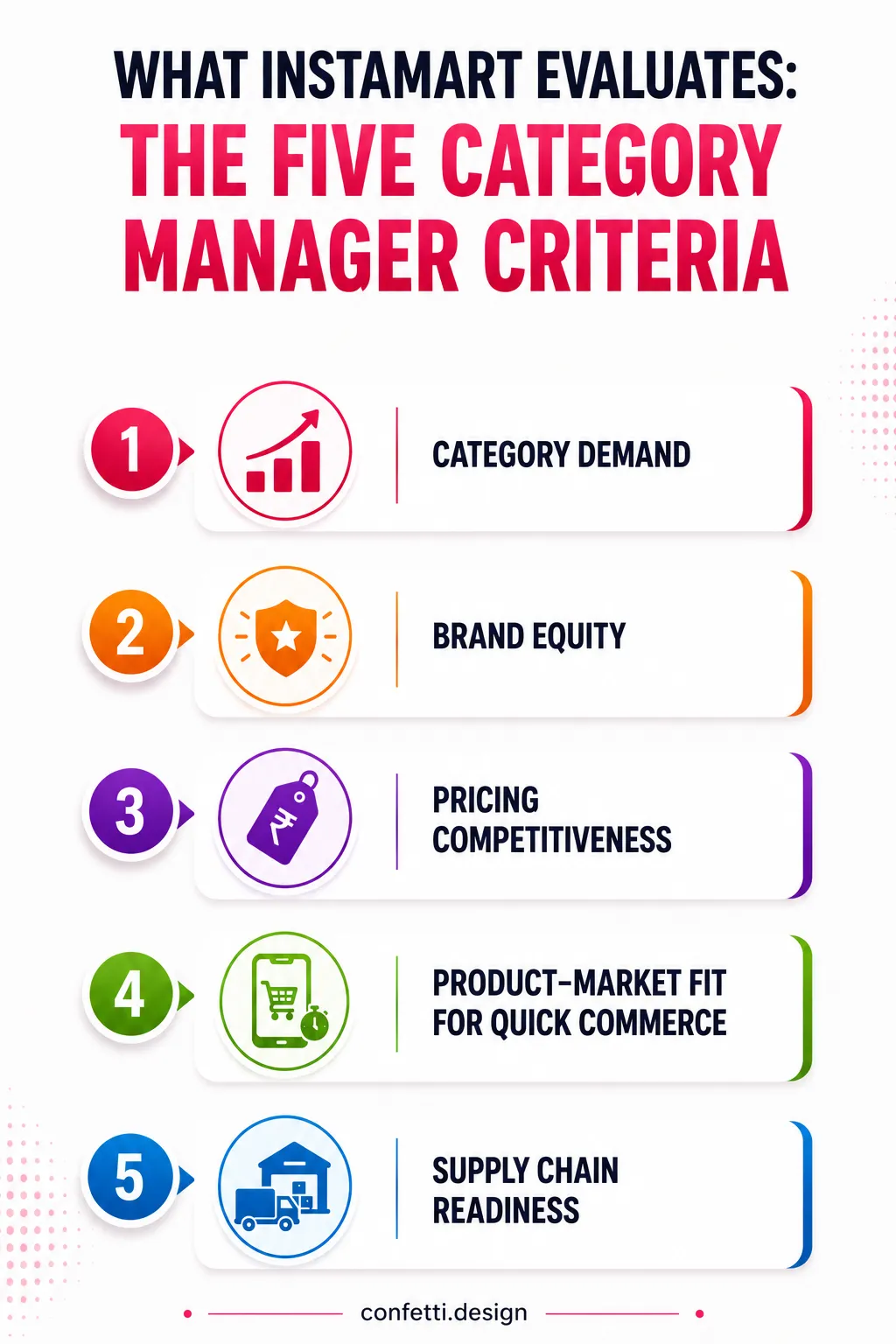
Here’s what Instamart's category team is actually assessing when they review your brand:
👉1. Category demand
Is there existing purchase behaviour on Instamart for products like yours? Daily staples, packaged snacks, personal care, and beverages have proven demand and move through review faster.
If you're in an emerging or niche category, your application needs to compensate with stronger evidence, prior sales data, platform benchmarks, consumer research.
👉2. Brand equity
Brands with prior marketplace presence: Amazon, Blinkit, Zepto, modern trade, get faster approvals.
New brands with no offline or online footprint are not automatically disqualified, but they need a more substantive brand brief that addresses the credibility gap directly.
👉3. Pricing competitiveness
Your MRP is benchmarked against Blinkit, Zepto, and local modern trade at the sub-category level.
If you're priced above channel average without a clear reason, premium positioning, unique format, certified organic, the Category Manager will flag it before commercial discussions begin.
The practical benchmark: price at or below modern trade rates.
👉4. Product-market fit for quick commerce
Instamart's dark stores are built for speed and volume. Products suited to impulse purchase, daily replenishment, or household essential use fit naturally.
Oversized SKUs, products requiring a cold chain that Instamart doesn't support in your target cities, or items with unusually short shelf life will slow your review and limit dark store placement.
👉5. Supply chain readiness
Instamart's existing dark store network is capable of handling more than double current order volume without additional infrastructure, which means the platform is actively looking for brands that can supply consistently at scale.
Instamart evaluates whether new brands can replenish regularly across multiple dark stores. Inconsistent supply post-listing damages your algorithmic ranking and creates a delisting risk.
📌Self-evaluate before you apply. Rate yourself 1–5 on each criterion. If any score is below 3, address it before submitting.
A weak supply chain answer or an uncompetitive price point won't be fixed during onboarding.
Documentation errors are the primary reason Instamart applications stall at verification. Name mismatches, expired licences, and entity inconsistencies across documents cause more application delays than any other single factor.
Prepare everything before you begin registration.
These are mandatory documents for selling on Instamart.
✅GST Registration Certificate
Active, with HSN codes that correctly correspond to the products you intend to list. The business name on your GST certificate must be character-for-character identical to the name on every other document in your application.
"ABC Foods Private Limited" and "ABC Foods Pvt. Ltd." are treated as a mismatch by automated verification systems. Before you submit anything, standardise your legal entity name across every document. This single step eliminates the most common rejection trigger.
✅PAN Card
Issued in the name of the business entity.
If you operate as a proprietorship under your personal name, your PAN may not align with what Instamart's verification system expects. Resolve this before applying.
✅Cancelled Cheque or Bank Account Details
The account must be in the exact same entity name as your GST certificate. Any mismatch, even a formatting variation triggers manual review and adds days to your timeline.
✅Business Registration Proof
Proprietorship certificate, LLP deed, partnership deed, or Certificate of Incorporation for private limited companies. The legal name here must match your GST registration precisely.
✅Authorised Signatory Document
Signature verification for the person who will execute the commercial agreement with Swiggy.
✅Aadhaar of Business Owner or Authorised Signatory
Required for identity verification. Ensure the name matches your business documents where applicable.
✅Business Address Proof
Utility bill, rental agreement, or property document for your registered address, must match the address on your GST certificate.
FSSAI compliance is mandatory for any brand selling edible or drinkable products on Instamart. This applies to packaged snacks, beverages, health foods, condiments, dairy, everything consumable.
The 14-digit FSSAI number must appear on your physical product packaging. Instamart verifies this during catalogue review.
If the number is missing, illegible, or placed incorrectly on pack, your listing gets flagged even after document approval has come through. Get your quick commerce packaging right before you apply.
✅FSSAI Licence is a valid, current, and issued in the name of the selling entity. The licence type must correspond to your actual scale of production and distribution:
Most brands applying to Instamart will need a State or Central licence. A Basic Registration signals a scale mismatch and will slow your category manager review.
If your current FSSAI is a Basic Registration but your turnover or manufacturing scale qualifies for a State licence, upgrade before applying. The process takes 30–60 days, build that into your timeline.
✅Trademark certificate or brand authorization letter.
Required if:
If you are the brand owner with a registered trademark, include the certificate anyway. It accelerates Category Manager confidence. A trademark tells Swiggy you are serious. You have legal protection.
✅APOB registration for multi-city supply.
If you intend to supply Instamart dark stores in multiple states, Delhi and Mumbai, for example, you need an Additional Place of Business (APOB) registration under GST for each state where you hold inventory.
This is a compliance requirement under GST law. But Instamart will verify it during commercial due diligence. Apply for APOBs early if multi-city expansion is part of your launch plan. Processing takes 2 to 4 weeks per state.
✅Cold chain certifications for meat, dairy, fresh produce.
If your products require temperature-controlled storage and delivery, you need documentation of your cold chain infrastructure.
Instamart's dark stores are configured for specific temperature zones, ambient, chilled, frozen. Verify your product's storage requirement matches what the relevant dark stores can accommodate before you commit to supply.
Instamart's Category Managers review a high volume of applications simultaneously. They are assessing demand signal, margin potential, velocity likelihood, and supply reliability.
A brand brief is how you present that case in the language they already think in, before they have to ask for it.
Confetti's quick commerce onboarding service is built exactly for this stage.
The brand brief is your application's most effective advocate at the exact moment when a person is deciding which applications to prioritise.
📋Business Overview
Legal entity name, year of establishment, product categories, and current distribution footprint: cities, channels, retail presence. Half a page maximum.
The goal is to establish that you are an operating business with a track record.
📋Prior Marketplace Performance
This is the most important section of the brief. If you have sales data from Amazon, Flipkart, Blinkit, Zepto, or your D2C channel, include it. Specifically: average monthly order volume, average selling price, review count, and average rating.
A brand doing 1,000 orders per month on Amazon with a 4.4-star rating across 300 reviews is a comparatively easier approval than a brand with no online presence. The data removes the category manager's need to guess at your demand signal.
If you have no prior online sales, lead with your offline distribution, number of retail outlets, cities covered, monthly offtake volumes from distributors. Any evidence of market pull is better than none.
📋Category Demand Evidence
Briefly references the demand context for your product type in the cities you are targeting. This does not need to be a research report.
Google Trends data for your sub-category, growth benchmarks from publicly available quick commerce reports, or coverage of your category's expansion in the D2C or FMCG trade press, any of these work. The brief should signal that you understand the demand landscape.
📋SKU Summary
Present 3–5 hero products. For each, include: MRP, pack size, shelf life, and a single line on the product's relevance to the Instamart customer. Do not list 30 SKUs.
A tight, focused range tells the category manager that you have thought about what fits quick commerce specifically and it reduces their evaluation workload. Brands that submit bloated catalogues at the brief stage signal that they have not done this thinking.
📋Pricing Rationale
State your MRP and benchmark it explicitly against the nearest competing products on Instamart, Blinkit, and modern trade. If you are priced above the channel average, explain why: premium sourcing, certified organic, differentiated format, clinical backing.
If you are priced at or below, say so directly. This eliminates the most common back-and-forth in the early commercial discussion and moves the conversation forward.
📋Supply Chain Statement
Where is your product manufactured or sourced? What is your production lead time? How frequently can you replenish dark stores, and what volume can you provide per store per cycle?
Instamart needs confidence that listing you will not create a stockout problem within the first 60 days. One paragraph that answers these questions specifically is more persuasive than any amount of general assurance about supply capability.

Talk to Confetti experts about onboarding and growing on the platform.
Book a Strategy Call
Catalogue preparation is almost universally treated as a post-approval task. Brands wait for commercial terms to be signed, then start building assets.
That gap: photography, titles, barcode verification, HSN checks, usually adds 2–3 weeks to the time between approval and going live.
At Confetti, we help brands get ready with this sooner to save time.
Instamart's in-app search is keyword-driven. Your product title is the primary organic ranking signal on the platform, and most brands structure it wrong.
The correct format: Brand Name | Product Name | Key Variant or Claim | Pack Size/Weight
✅Correct: "Yoga Bar Oats | Dark Chocolate & Raspberry | High Protein | 480g"
⛔Incorrect: "Yoga Bar's Delicious High-Protein Oats with Real Dark Chocolate and Raspberry Flavour — Great for Breakfast (480g)"
The second version reads well in a paragraph. It performs poorly in search.
💡Customers on Instamart search for "protein oats" or "dark chocolate oats". The algorithm parses the first 3-4 tokens of your title most heavily. Put your most-searched terms there.
A few practical rules:
Build your titles before submission and run a simple test: search for your product category on Instamart. Look at the titles of the top five organic results. If your title structure differs completely from that pattern, revise it.
Instamart requires a minimum of three images per SKU. Each image serves a different function in the purchase decision.
📸Image 1: Front of Pack
This is your primary thumbnail. On a mobile category page, The rendering size is approximately 200 pixels on each side, a surface area roughly the size of a postage stamp. The product name, brand name, and variant must be legible at that scale.
Use a high-contrast background (white is the default standard), bold typography, and a minimum resolution of 1000×1000px.
📸Image 2: Back of Pack or Ingredient Panel
For food, beverage, and personal care products, customers check ingredients before adding to cart, particularly buyers who are managing dietary requirements, allergies, or health goals.
A clear, legible back-of-pack image reduces cart abandonment and return rates. If your back-of-pack is text-heavy, a separate flat-lay or zoomed crop of the nutrition panel can serve the same purpose more effectively.
At Confetti, we take utmost care while designing packs for quick commerce, making sure they comply with all labelling requirements while optimising legibility
📸Image 3: Lifestyle or In-Use Shot
A contextual image showing the product being consumed or used. For food and beverage brands, this is an impulse-purchase driver, the visual that converts browsing into buying.
It does need; a clean, well-lit consumption shot consistently outperforms studio-only images in conversion data across Q-commerce categories.
Every SKU listed on Instamart must have four things verified before catalogue submission.
📑GS1-Registered EAN/UPC Barcode
Instamart's dark store fulfilment runs entirely on barcode scanning. Internally generated barcodes and QR codes are not accepted. If your products do not yet carry GS1-registered barcodes, apply through GS1 India.
Registration costs ₹5,000–₹15,000 depending on SKU count and takes 5–10 working days. Factor this into your preparation timeline, it is a hard dependency that cannot be skipped or substituted.
📑Correct HSN Code
The HSN code in your catalogue must match the product type and the code declared in your GST registration. HSN mismatches cause catalogue rejection and create downstream GST filing complications.
If you have any uncertainty about the correct code for your product, particularly for functional foods, nutraceuticals, or hybrid product formats, verify with a CA before submission.
📑MRP Consistency
The MRP printed on your physical packaging must match the MRP entered in your catalogue upload exactly.
Even a ₹1 discrepancy can trigger a compliance flag. If your packaging has an older MRP, reprint before submitting inventory to dark stores.
📑Shelf Life at Inwarding
For all food products, Instamart applies category-specific minimum shelf life requirements at the point of dark store inventory handover. Most categories require a minimum of 30–45 days of remaining shelf life when stock is inwarded.
Brands that deliver inventory with shorter remaining shelf life face rejection at the dark store, which creates a supply gap that directly affects your ranking and availability metrics in the first weeks of operation.
Coordinate your production and dispatch schedule to ensure stock arrives well within this window.
The commission rate you agree to at onboarding is locked into your commercial agreement. It stays fixed until contract renewal, for most new brands, it is 12 months away.
Brands that enter commercial discussions without a margin model either accept unfavourable terms because they have no alternative reference point, or they agree to rates that make the channel structurally unprofitable from day one. Both outcomes are avoidable.
There is no registration fee to sell on Swiggy Instamart. But you must understand the total cost of operating on the platform after onboarding.
The margin calculation:
Before agreeing to commercial terms, run this calculation:
Net margin per unit = MRP − Commission (15–25%) − GST on commission − Inbound logistics (~3–5%) − Inwarding charges Storage fees - Estimated promotional spend − Projected damage/expiry write-off
💡If net margin per unit is below your minimum viable threshold, your MRP needs to go up or your cost of goods needs to come down before you can profitably sell on Instamart.
If your launch plan covers multiple cities, a single national margin model will give you a misleading picture.
A brand based in Pune shipping to Bengaluru dark stores faces higher per-unit logistics costs than one shipping to Mumbai. A Delhi-based brand supplying Hyderabad dark stores faces a different cost structure entirely.
💡Build city-specific cost models for every market you intend to enter at launch, and bring those models into commercial discussions.
Also, selling in multiple states requires separate APOB registrations under GST for each state. If your APOBs are not ready at the time of commercial discussion, Instamart will restrict your launch to cities covered by your existing GST registration.
Dark store operational requirements affect your packaging structurally. Errors that show up after your first delivery: damage claims, listing flags, dropped rankings will cost you far more than the prep work ever would. Fix it before you apply.
Instamart's dark stores are high-density, fast-pick fulfilment environments. Products are shelved in compact spaces, picked by staff under time pressure, packed within minutes of order placement, and dispatched immediately.
Retail packaging often fails in quick commerce. The environment is different, and three problems come up repeatedly.
🚫Fulfilment damage
Packaging with fragile structural integrity, thin carton walls, unsupported closures, glass that isn't secondary-packed, cracks, crushes, or leaks during pick-and-pack. Damaged products generate customer complaints, negative reviews, and return costs.
All of those are borne by the brand. If you accumulate enough damage events, your listing gets flagged for de-prioritisation by the platform's operational team.
If you move your retail packaging straight into dark store operations without checking whether it holds up structurally, damage claims in the first 30 days are almost guaranteed.
🚫Barcode scanning failures
Instamart's dark store fulfilment runs on barcode scanning. If your barcode is printed on a panel that faces the shelf back when products are stacked, or on a surface obscured by adjacent products in a picking tray, staff cannot scan it efficiently.
Pick errors and fulfilment delays follow, and those metrics reflect on your brand's operational performance. Barcode placement must account for shelf-stacked orientation. That is a functional design requirement that needs to be specified in the packaging brief.
At Confetti, we design packaging by considering all these important details.
🚫Label readability failures
Instamart's picking staff identify products quickly across a fulfillment route. Under warehouse lighting, at arm's length, your product name, variant, and expiry date need to be legible at a glance.
Retail packaging frequently optimises for close-range shelf browsing, fine typography, intricate design detail, colour-forward layouts. That does not always work well in warehouse pick situations.
Instamart customers make purchase decisions on a mobile screen roughly the surface area of a postage stamp. Everything a customer uses to decide whether to tap your product or the one next to it, brand name, variant, pack size, visual contrast, has to work at that scale.
Before your catalogue goes live, do this: pull up your front-of-pack product image on a mobile phone at thumbnail scale and ask three questions.
If any answer is no, the image needs to be remade before submission.
Click-through rate (CTR) is an algorithmic signal on Instamart. A product that earns more clicks at the same search position gets ranked higher organically over time.
Brands that launch with Q-commerce-optimised imagery build algorithmic ranking faster.
Instamart's algorithm demotes listings with stockouts. It does not distinguish between a brand that ran out of inventory because demand exceeded forecast and one that simply couldn't replenish fast enough.
The outcome is the same: lower visibility, fewer orders, weaker ranking signals, and a recovery curve that takes weeks to climb.
Build your supply chain before you make commitments to dark stores.
Once approved, Instamart assigns your products to specific dark stores based on your target cities and category demand.
From that point, you are responsible for maintaining adequate stock levels at those locations on a replenishment cycle. The platform does not buffer your supply gaps.
☑️Minimum inventory at inwarding
Start with 2–4 weeks of projected demand per dark store per assigned city. This is your opening stock position, enough to establish velocity without creating excess that generates storage fees or expiry risk.
Instamart's dark store team performs a quality check on every inwarded shipment, inspecting for damage, expiry compliance, barcode readability, and labelling accuracy.
Stock that fails this check is returned to the brand at the brand's cost. The packaging and compliance work in Steps 3 and 5 directly reduces your rejection rate at inwarding.
☑️Replenishment frequency
High-velocity categories on Instamart like packaged snacks, beverages, personal care essentials, can deplete dark store stock faster than brands running weekly production cycles expect.
Weekly or bi-weekly replenishment is standard for fast-moving SKUs.
Before you commit to a city and a dark store network, map your production lead time, finished goods warehousing location, and dispatch-to-dark-store logistics time against the replenishment frequency the category will require.
☑️Real-time inventory sync
Instamart's system requires real-time or near-real-time inventory data to display accurate availability to customers.
If your internal systems don't support automated inventory updates, you need either a manual update process with sufficient frequency to avoid showing false availability, or integration with a warehouse management system before you go live.
Showing "in stock" when your dark store has zero units generates cancelled orders and customer complaints, both of which affect your operational metrics on the platform.
☑️Damage and expiry management
Brands bear 100% of the cost of unsold, damaged, or expired inventory. It is a structural feature of the supplier model.
Factor a 2–5% damage and expiry write-off into your unit economics model from the start, and build your dispatch scheduling to ensure stock arrives at dark stores with enough remaining shelf life to sell through before expiry triggers a return.
Instamart currently operates across 120+ cities. For a new brand, that reach is both an opportunity and a practical trap.
Brands that launch pan-India from the start spread inventory thin across dozens of dark stores. Each individual store receives insufficient stock to build sales velocity. The algorithm never receives a strong enough demand signal in any single geography to promote the listing organically.
The brand sees weak numbers everywhere and concludes the platform isn't working, when the actual problem was the launch strategy.
🎯The better approach is concentration.
Pick one or two cities where your brand already has some name recognition, where your distributor or warehousing infrastructure is strongest, or where your category has demonstrated demand on other platforms.
Concentrate your opening inventory in those markets. Build strong local velocity. Earn algorithmic promotion in those geographies before requesting expansion to additional cities.
This is also a commercial negotiation point. A brand that arrives at the category manager discussion with a specific, operationally grounded city recommendation, "we are ready to supply Bengaluru and Pune from launch, with Mumbai in month two", signals supply chain maturity.
Before your commercial discussion, answer these questions concretely:
If any answer is uncertain, resolve it before you commit.
Use this as your final review before submitting your Instamart application.
Most brands treat Instamart and Zepto/Blinkit as interchangeable quick commerce channels.
The operational model, the commercial relationship, and the preparation requirements are different enough that what works for one will not automatically translate to the other.
🔰The Commercial Relationship Is Structured Differently
On Zepto and Blinkit, you operate closer to a seller. You manage listings, control inventory placement, and interact with the platform through a largely self-serve interface.
On Instamart, you are a supplier. Swiggy is the retailer and your Category Manager controls every commercial decision: pricing, SKU selection, promotional planning, expansion.
🔰Organic Discovery Works Differently
Blinkit’s and Zepto's discovery model runs on search and category browsing, with rankings driven by sales velocity, ratings, and ad spend, a system that brands with Amazon or D2C experience can navigate relatively quickly.
Instamart has an additional layer: Swiggy's food delivery ecosystem. Instamart listings surface to food delivery users through cross-category recommendations. A user ordering dinner at 8 pm can be exposed to your packaged snack brand through Instamart.
That incremental reach does not exist on Zepto or Blinkit but it is controlled by Swiggy.
You cannot engineer it through your catalogue or ad budget. It comes from consistent availability, strong listing CTR, and Category Manager-driven placements.
🔰The Dark Store Model Carries More Operational Weight
Instamart is moving toward an inventory-led model where Swiggy takes tighter control over sourcing and operations. Standards for inwarding, replenishment, and packaging compliance are getting stricter.
Instamart's inwarding inspection is not lenient. Stock that fails quality checks is returned at your cost. Packaging that creates pick-and-pack problems gets flagged.
For brands coming from Zepto and Blinkit, this is the part that catches them off guard. The packaging audit matters more here than it did there.
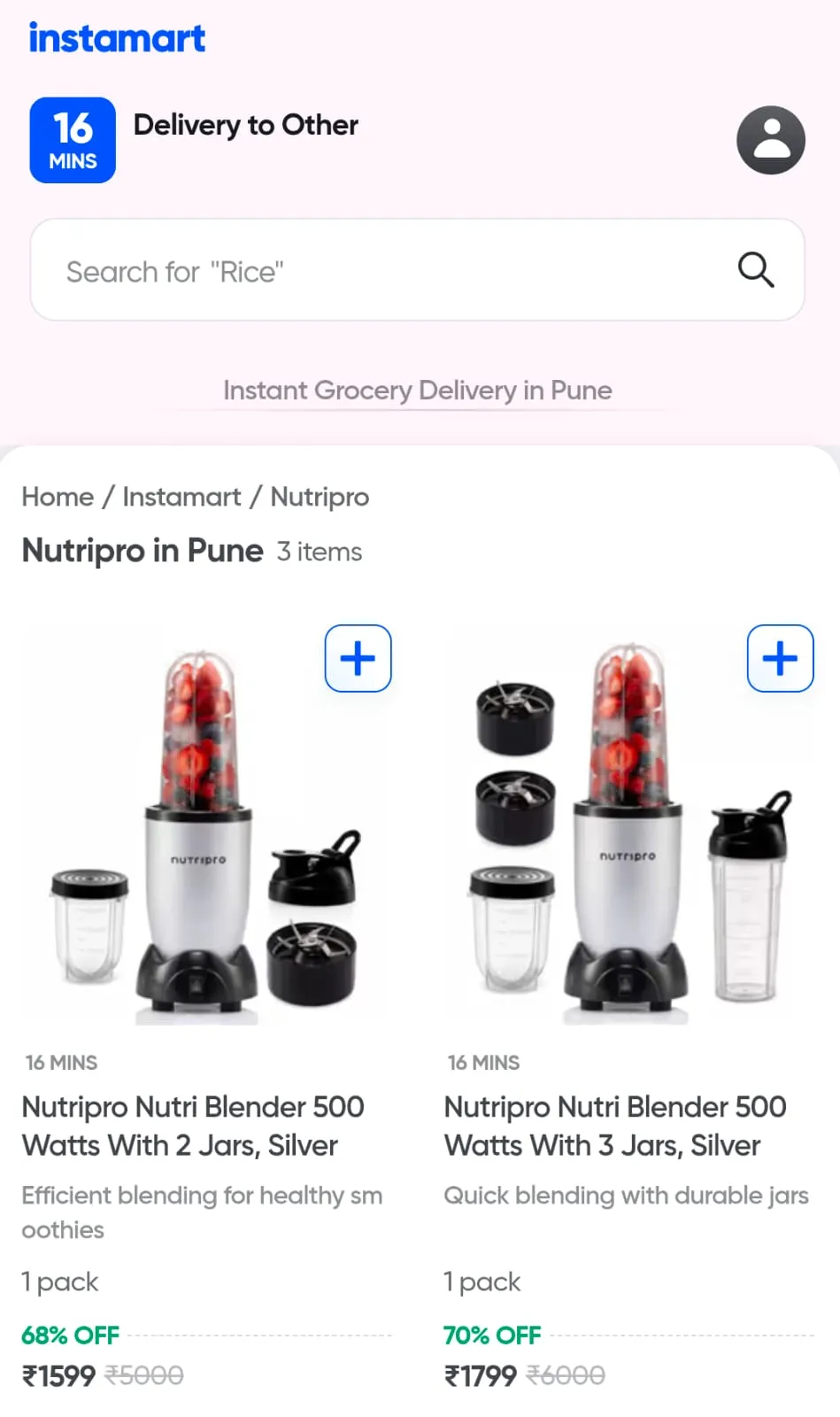
Confetti's work with brands starts earlier, at the preparation stage, because that is where the decisions that determine first-month performance are actually made.
Getting listed on Instamart is not the end goal.
Success on Instamart requires the right pricing, the right SKU selection, a credible brand brief, and a supply chain that can sustain the commitments made during commercial discussions.
Confetti's quick commerce onboarding work covers a three-stage process:
📌For a pet care brand on Blinkit, we helped increase ROAS from 2.4 to 6.5, reduced TACOS from 43% to 16%, and delivered 5x GMV growth within 6–7 months through strategic campaign optimisation and SKU-level targeting.
Confetti designs quick commerce packaging from that starting point.
Our process includes
Our packaging also focuses on operational requirements: dark store durability, barcode placement, label legibility under warehouse lighting.
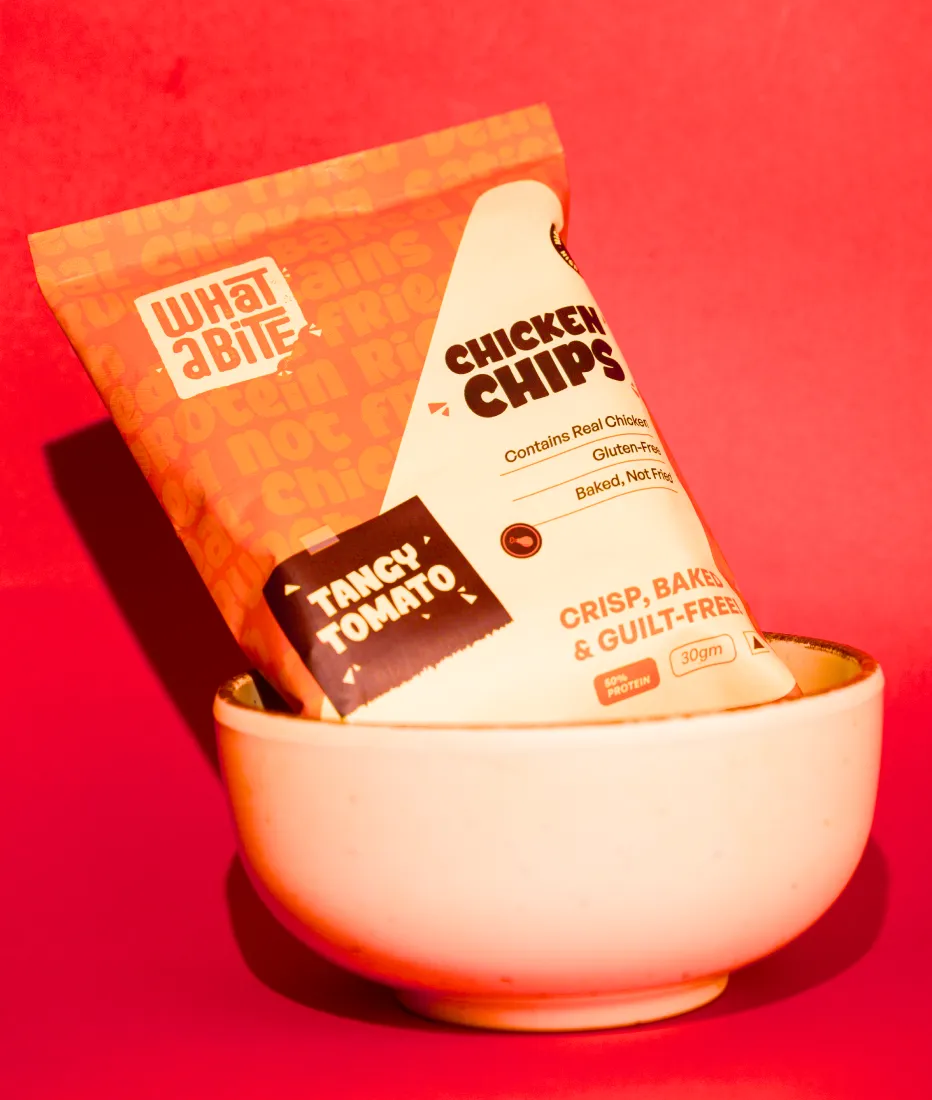
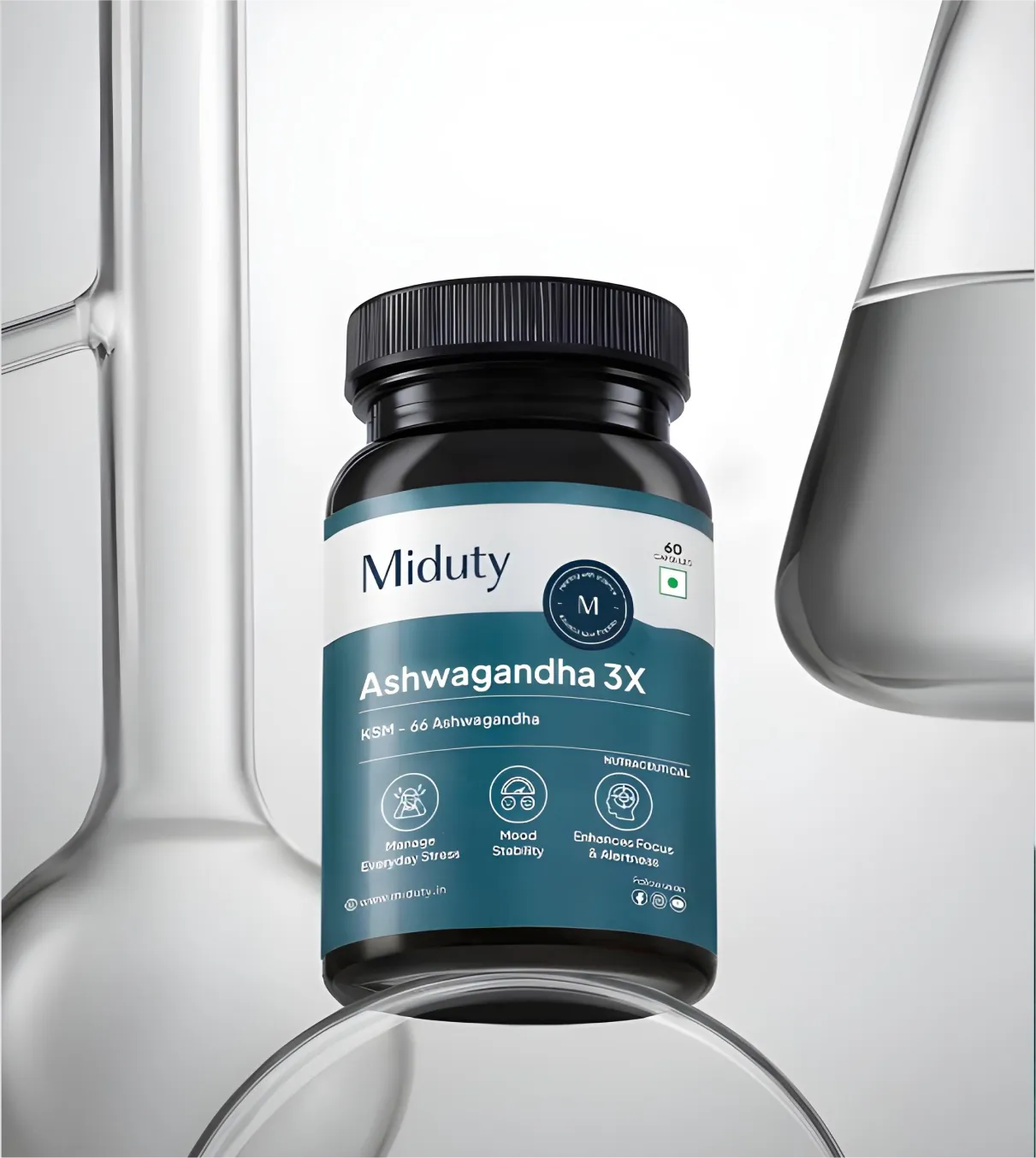
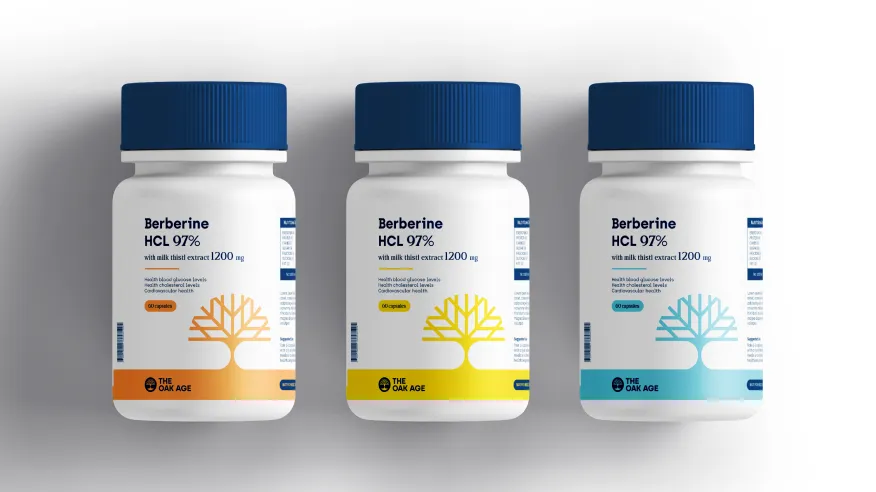
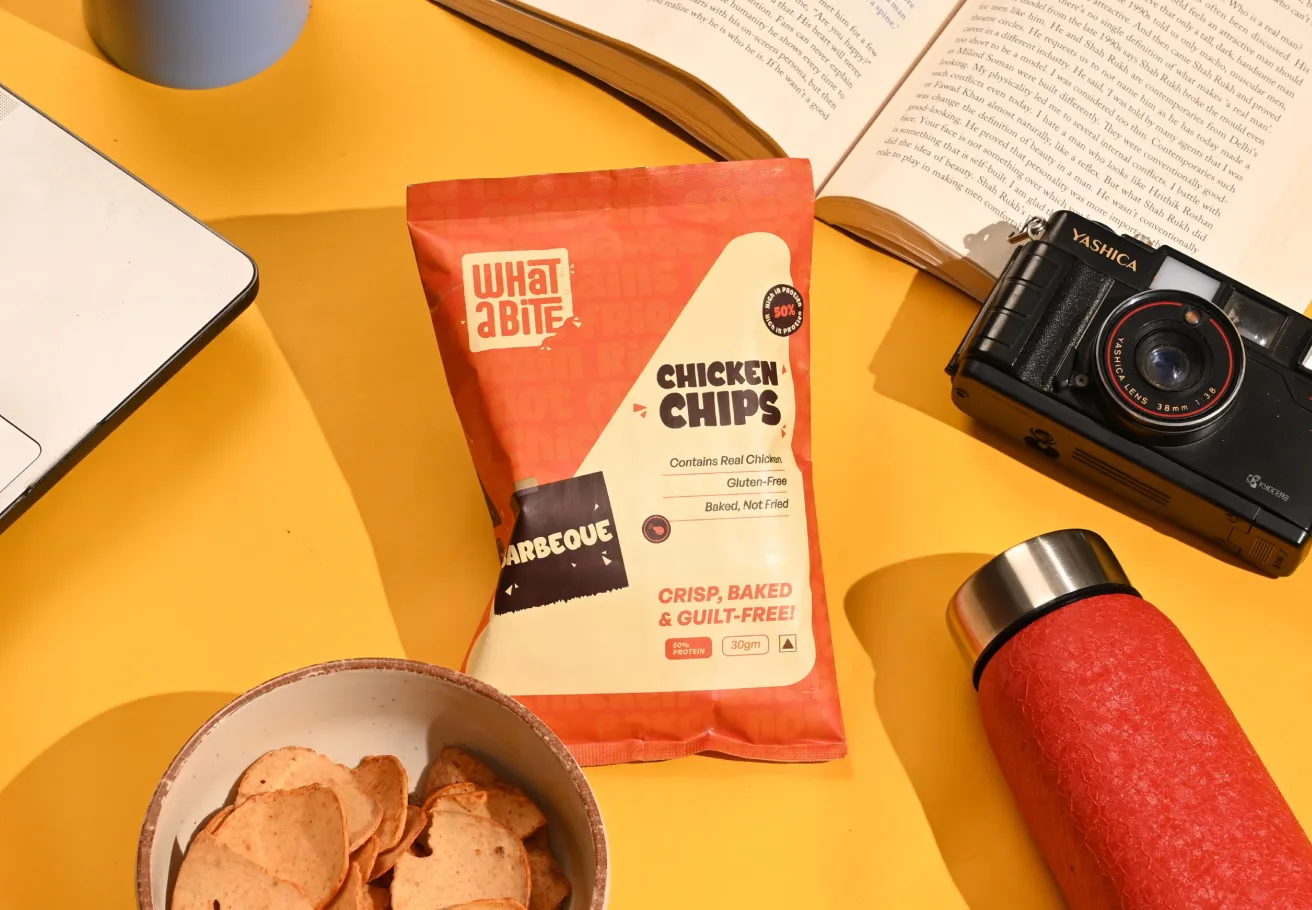
📌Products designed by Confetti can be spotted on quick commerce. This includes the electronics brand Nutripro.
Here We covered the full brand system: brand strategy, visual identity, verbal identity, and packaging design by considering quick commerce success.
What documents are required to sell on Swiggy Instamart?
Core documents: GST Registration Certificate, PAN Card, cancelled cheque, business registration proof, and authorised signatory copy.
Food and beverage brands additionally require a valid FSSAI licence. Brands reselling third-party products need a brand authorisation letter.
For multi-city supply, APOB GST registrations are required for each state. All documents must be in the same business entity name.
How many SKUs should a new brand list on Instamart initially?
Start with 3–5 hero SKUs. A focused range signals supply chain maturity, reduces the category manager's evaluation complexity, and allows you to concentrate inventory and promotional budget on products with the highest velocity potential.
Brands that apply with 20–30 SKUs spread inventory too thin to build meaningful algorithmic ranking in any single product. Expand after your hero SKUs have established sales history.
What is the commission structure on Swiggy Instamart?
Commission ranges from 15% to 25% of the selling price, varying by product category and the commercial terms negotiated with your Category Manager. GST at 18% is applied on top of the commission amount.
Rates are fixed at agreement signing, model your unit economics at multiple commission rates before entering the commercial discussion.
Does packaging quality affect Instamart onboarding approval?
Yes, at two points. First, at dark store inwarding, products with damaged or non-compliant packaging (missing FSSAI number, illegible MRP, barcode in an unscannable position) are rejected by the dark store quality check before going live.
Second, at post-listing performance: product images that don't convert at mobile thumbnail scale generate poor click-through rates, which weakens algorithmic ranking and makes the listing effectively invisible without sustained ad spend.
Which cities should a new brand target first on Instamart?
Start with 1–2 cities where your brand already has name recognition, existing distribution, or where your category has documented demand on Instamart. Launching across 10 cities simultaneously spreads inventory too thin to build velocity in any location.
Strong local demand in 1–2 cities creates the algorithmic signal Instamart's ranking system needs to surface you organically, which is the foundation for expanding to additional cities later.
Want strategic branding and packaging like this for your business?





.webp)
.webp)

.webp)
.webp)
.webp)
.webp)
.webp)







.svg)
.webp)