%201.webp)
02
AI Snaps
.svg)
.svg)
01
Our Work
03
About Us
04
Brand Audit
05
Contact Us
06
Client Success
12
07
Blogs
08
Careers
Book A Call
.svg)




Need Help In Building Your Brand?
Click the button below & book a call with our founder directly.

Rishabh Jain
Managing Director
Bummer | Confetti's Verdict ⭐⭐⭐⭐
Confetti Design Studio has analysed Bummer to understand how a D2C innerwear brand founded in 2020 by Sulay Malav Lavsi, an MBA graduate of the USC Marshall School of Business, grew to Rs 10.7 crore in FY25 revenue at 15% year-on-year growth from Rs 9.3 crore in FY24, raised USD 1.85 million across multiple rounds including Rs 75 lakh from Aman Gupta and Namita Thapar on Shark Tank India Season 1 and Rs 9.25 crore in a pre-Series A1 led by Nikhil Kamath's Gruhas Collective Consumer Fund, built the most recognisable brand personality in Indian innerwear using beechwood-derived MicroModal fabric and bold irreverent design.

The Indian innerwear market is commercially enormous and brand-wise almost entirely without character. Jockey competes on trust and distribution. Lux and Dollar compete on price. A wave of premium D2C entrants competes on fabric quality and minimalist design language. None of them have a voice. None of them have a point of view that extends beyond the product to the consumer's sense of self. Bummer is the first Indian innerwear brand that actually has a personality, and that personality is specific enough to be immediately recognisable and irreverent enough to be genuinely liked.
The brand is fun. The designs are bold. The copy speaks to a consumer who rolls their eyes at corporate wellness language and wants to feel that the brand they are buying from has a sense of humour. That tonal specificity is extraordinarily difficult to maintain in a consumer goods company: the commercial pressure toward safety and genericness is relentless. The fact that Bummer has held its personality through a Shark Tank appearance, multiple funding rounds, and a maturing product range is a genuine organisational and creative achievement. Most brands lose their irreverence as they gain investors. Bummer has not, and that is worth understanding before the audit reaches its more challenging observations.

Rishabh noted something specific and important about Bummer's digital presence: the website is genuinely enjoyable to use. Clean pop colours, thick black outlines, product photography that looks like it was taken by and for people who actually wear the product. The kind of digital experience that a Gen Z consumer encounters and decides, within the first few seconds, that this brand understands them rather than is targeting them.
In a D2C landscape crowded with Shopify stores that are competent but interchangeable, Bummer's website is a brand expression rather than a conversion funnel. The aesthetic is coherent. The photography does not look like it was shot against a white wall with a model who has never worn the product. The navigation does not feel like it was designed by a committee optimising for click-through rate without considering what the experience communicates about the brand. For a brand whose primary revenue flows through digital channels, the website being genuinely good is not a nice-to-have. It is the closest thing Bummer has to a retail flagship, and it earns the attention it receives.
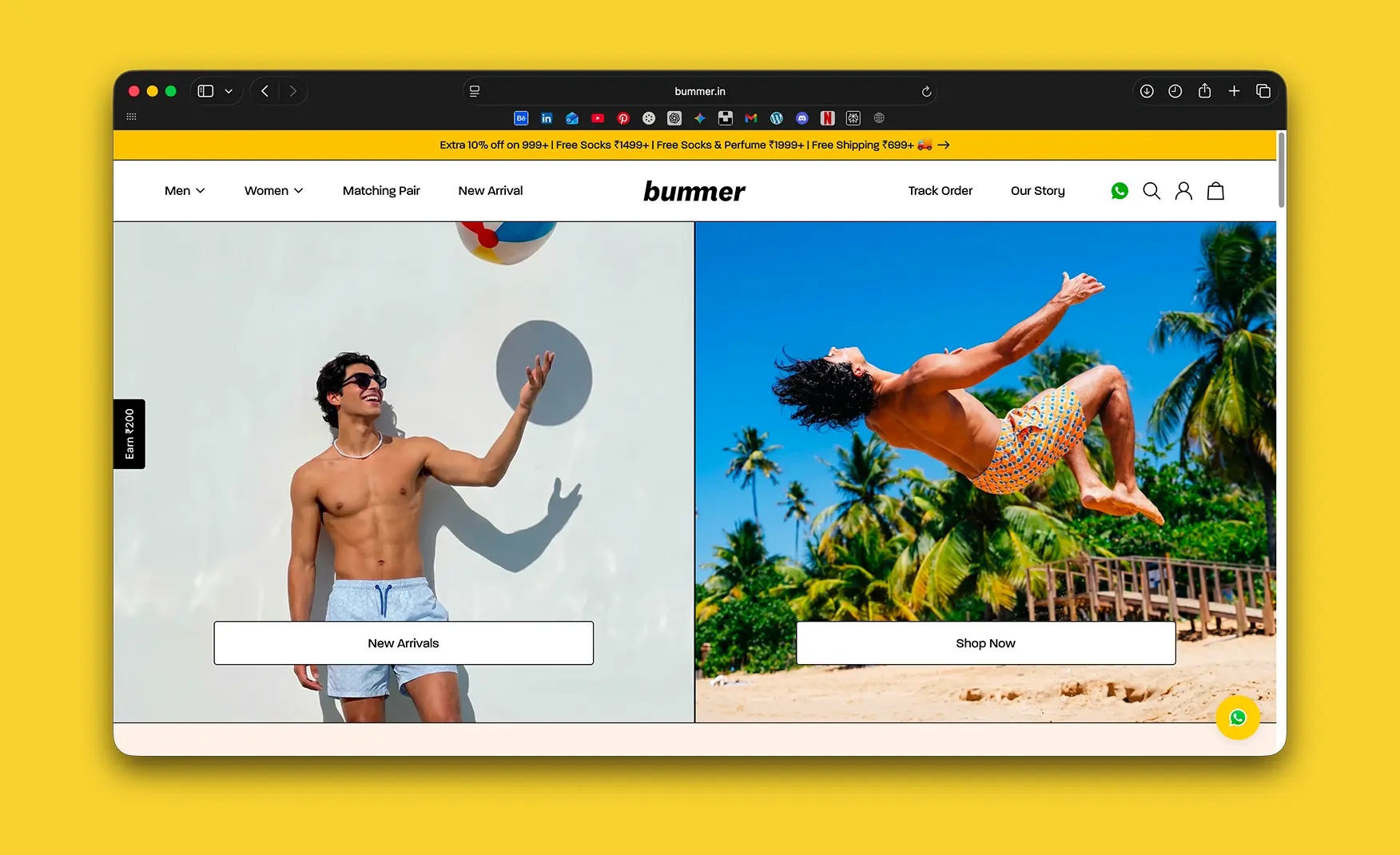
When Bummer first appeared in the D2C landscape, the design language was predominantly loud with all those vivid prints, high-saturation patterns, the kind of aesthetic that photographs well on Instagram and attracts a consumer who wants to make a statement even with what nobody else can see. That design direction built the brand's early following and created the social media presence that made Bummer legible as a genuinely new kind of underwear brand.
Rishabh observed, from his experience studying Bummer while working on an adjacent swimwear brief, that the designs and prints were the primary differentiator visible on Instagram at launch. Quality and fabric feel are discoveries that only happen once the product is in hand. Bummer had to earn trust through the surface before it could prove value through the substance. The current range has matured significantly, bold and minimal now coexist in the catalogue, serving the consumer who wants the statement print and the consumer who wants a clean everyday basic in an elevated fabric. Most brands that attempt to expand their aesthetic range dilute what made them distinctive. Bummer has added options without losing the personality that runs through all of them.

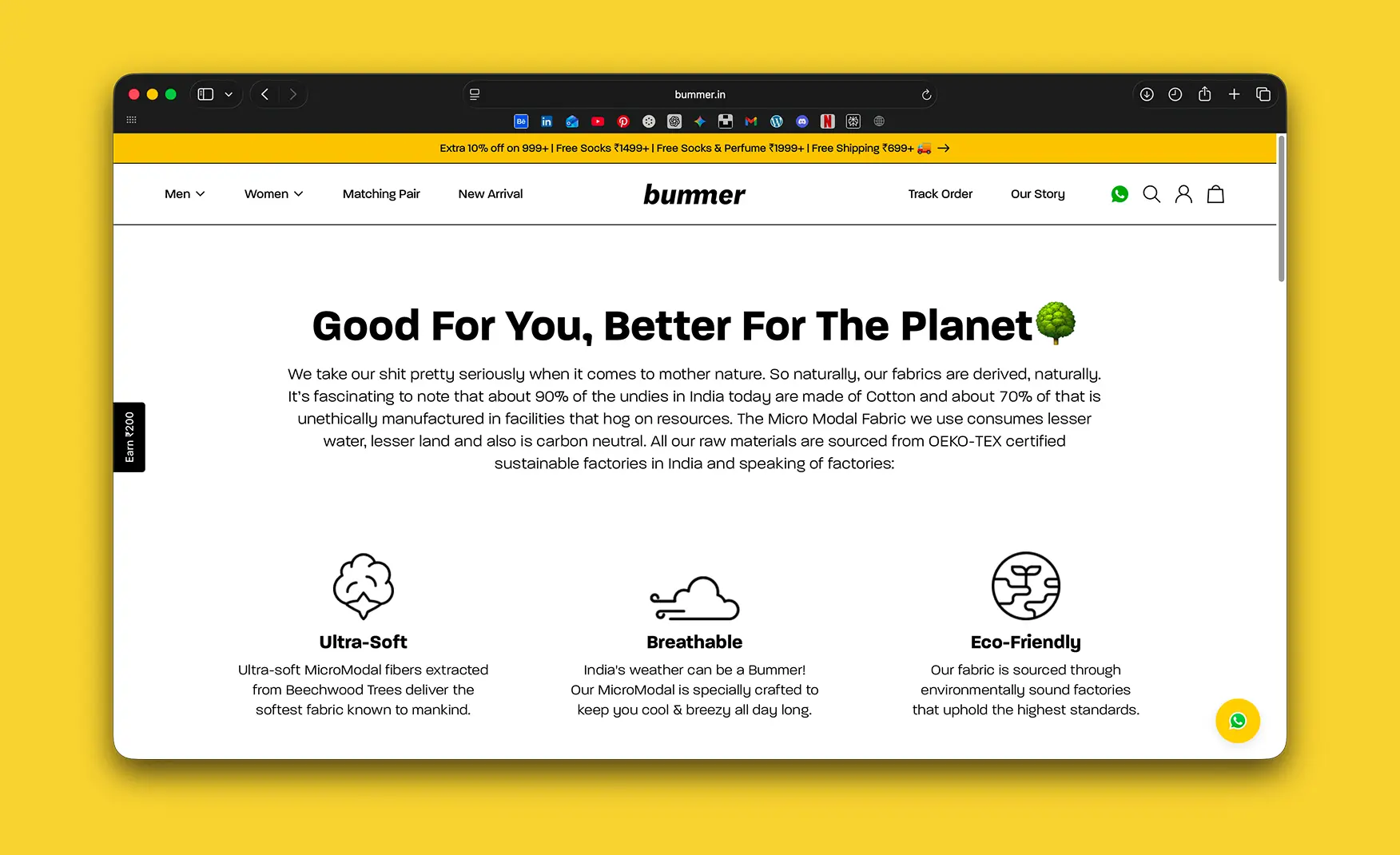
Bummer's use of MicroModal, a fabric derived from beechwood trees that is significantly softer and more breathable than conventional cotton and manufactured through a sustainable closed-loop process, is a material credential that the brand has embedded into its core identity rather than treating as a packaging footnote. The sustainability story behind MicroModal is specific, verifiable, and meaningfully different from the generic "eco-conscious" claims that the apparel category deploys liberally and consumers have learned to distrust.
The founder has noted that Bummer boxers weigh less than 60 grams and bikinis under 30 grams, which is a product claim specific enough to be memorable and verifiable enough to be trusted. A gross margin of approximately 70%, which Sulay disclosed on Shark Tank, is evidence that the premium fabric is priced correctly for the brand's market position. A sustainable material story that is both genuine and commercially viable is one of the most durable brand credentials available in the apparel category, and Bummer has it at a product specification level that competitors cannot replicate simply by updating their marketing language.
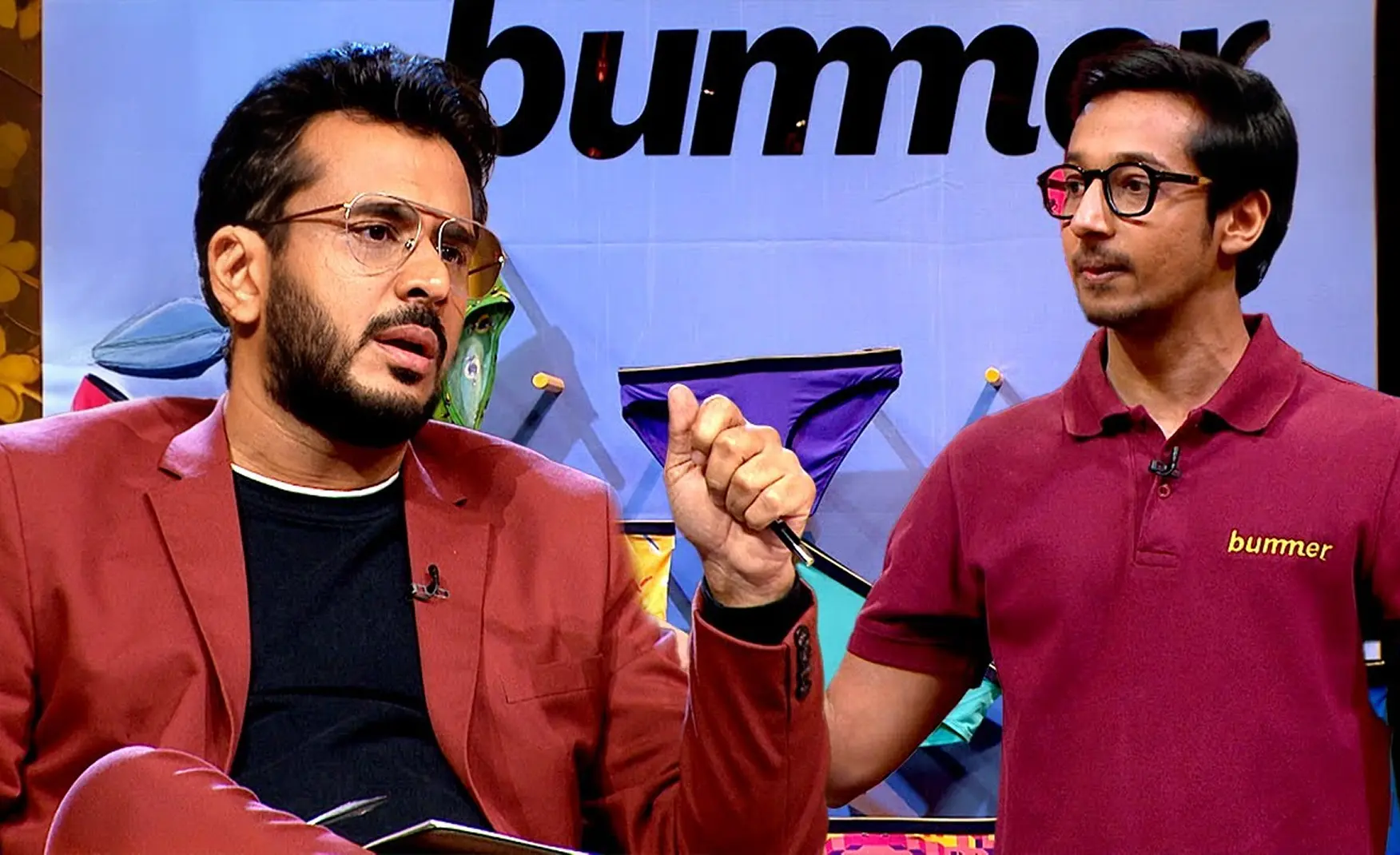
Bummer gained national visibility from Shark Tank India Season 1 through two moments, the deal with Aman Gupta and Namita Thapar for Rs 75 lakh at 7.5% equity, and Ashneer Grover's “yeh sab doglapan hai”, a now-famous exit line during the pitch. Both moments generated cultural conversation around a brand that already had a product worth buying and a personality worth following. The show gave Bummer a national audience. It did not create the brand that audience discovered.
The post-show period reportedly saw monthly revenue grow significantly as the brand's existing quality reached a dramatically wider consumer base. This is the correct commercial sequence. The Shark Tank bump benefits brands with genuine products more than brands that are primarily a pitch. Bummer's post-show growth reflects consumer pull that pre-existed the episode rather than a media moment creating artificial demand. The Ashneer rejection, rather than damaging the brand, became part of the brand story in a way that the brand's audience appreciated for exactly the reasons the brand's personality would predict, it showed the founder did not need the validation to know the product was good. That narrative is one of the most useful brand assets Bummer carries into its next growth phase.
The most commercially significant fact in this audit is not the revenue. It is the cost structure behind it. Bummer spent Rs 6.2 crore on marketing and advertising in FY25 against Rs 10.7 crore in total revenue, representing 58% of revenue in marketing spend alone. Total expenditure was Rs 14.9 crore against Rs 10.7 crore in revenue, a ratio of Rs 1.39 spent per rupee earned, producing a net loss of Rs 4.2 crore that widened 68% from Rs 2.5 crore in FY24.
A brand that is spending more than half its revenue on marketing to grow 15% year-on-year is in a cost structure that requires significant improvement before the business can be considered commercially viable at any meaningful scale. The brand love is genuine, the product is good, and the personality is distinctive. None of these things changes the arithmetic. The path to commercial sustainability runs through either significantly improved customer acquisition efficiency, significantly higher average order values, or a distribution model that does not require this level of paid marketing to generate growth.
Rs 10.7 crore in FY25 revenue is a modest commercial result for a brand with Bummer's level of recognition in Indian D2C circles. The brand is genuinely liked by consumers, respected by investors who understand brand-building, and talked about by brand observers. That mindshare has not yet converted into commercial scale at the level the recognition would imply.
The category context is relevant but not entirely excusing. Innerwear at D2C price points has a modest basket size per transaction and a purchase frequency that requires significant customer volume to generate meaningful revenue. A 17-person team, which Tracxn records as the headcount as of August 2025, is building toward a business that the Rs 10.7 crore FY25 number does not yet justify without the aspiration of what the brand could become. The gap between brand love and revenue scale is real, and closing it within a manageable cost structure is the brand's most important commercial challenge.
The pre-Series A1 capital from Gruhas is earmarked in part for omnichannel expansion toward 10,000-plus offline touchpoints across India, with 50% of revenue targeted from tier-II, III, and IV cities including Ahmedabad, Indore, Hyderabad, Chandigarh, Bhopal, and Jaipur. It is also the moment that most beloved D2C brands discover that maintaining their personality in offline retail is considerably harder than maintaining it on their own website. The demands of offline retail, price negotiation with distributors, packaging standardisation for shelf display, sales team incentives that do not account for brand consistency, and the general visual noise of a multi-brand retail shelf, all push brands toward safety. Building the brand standards and creative discipline to hold the personality across 10,000 touchpoints before the touchpoints are built is harder than it sounds, and it is the challenge no one in the Gruhas funding announcement chose to name directly.

The most important strategic work for Bummer in the next 12 months is not distribution expansion, but it is marketing efficiency. Spending 58% of revenue on marketing to achieve 15% revenue growth is a ratio that does not improve through distribution alone. It improves through a combination of better customer retention mechanics, higher average order values through bundle and gifting strategy, and a content engine that reduces paid media dependency by building an organic audience that reorders without requiring re-acquisition spending on every purchase cycle.
Bummer's brand personality is one of its most underutilised retention assets. A consumer who genuinely likes the brand, in the way that Bummer's customer community demonstrably does, is a consumer who should be significantly cheaper to retain than to acquire. The investment in community, in subscription models, in referral mechanics, and in the kind of CRM that converts a first purchase into a second without a paid touchpoint, is the work that changes the unit economics before the distribution ambition requires a much larger capital raise to execute.
Innerwear as a gift is an underleveraged occasion in India and one that Bummer's design language and brand personality are exceptionally well-suited for. A set of boldly printed, premium-fabric innerwear in a well-designed gift box is a more interesting and more memorable gift than most options in a similar price range, and the gifting context removes the awkwardness that innerwear purchases can carry for a first-time buyer who has not yet experienced the product.
Building a formal gifting strategy, dedicated gift packaging, couple sets positioned explicitly for gifting occasions, and a corporate gifting channel for brands that want a genuinely distinctive employee or client gift, would increase the average order value, the purchase occasion frequency, and the number of first-time Bummer consumers acquired through someone else's endorsement. At Confetti, our work on Vaahe Spices demonstrated how building the packaging and purchase experience specifically for the gifting context, rather than treating gifting as an organic benefit, can transform it into a structured acquisition channel that compounds over every festive season without requiring proportionate marketing spend.
Bummer has a brand narrative that most D2C companies would envy, it has actually built a genuine product, a recognisable personality, and a real consumer community before Shark Tank, and then the show amplified what was already there rather than creating it. The Ashneer rejection became part of the brand story not because it was damaging but because the brand's audience understood that the validation did not matter, because the product was already good.
That "we did not need it" energy is a powerful brand identity for a Gen Z audience that has become quite good at recognising the difference between brands that are built on conviction and brands that are built on investment validation. Telling this story explicitly, in the brand's own irreverent register, as Bummer scales into offline retail and new consumer contexts, would convert the brand recognition that exists into the brand loyalty that sustains a business through the distribution transition. The origin story is as good a brand asset as Bummer has, and it is currently somewhat in our opinion being very much underutilised.
Bummer has done something that most consumer goods companies with ten times its revenue never manage: built a genuinely distinctive personality in a category that has never had one. The brand love is real, the product is good, the MicroModal material story is credible and the Shark Tank legacy is a net positive asset. The Gruhas backing signals institutional confidence in the brand's long-term potential. All of this is true.
It is also true that spending Rs 6.2 crore on marketing against Rs 10.7 crore in revenue, widening losses to Rs 4.2 crore, and growing revenue 15% in a year when brand recognition is at its highest is a commercial picture that requires a clear and specific plan to resolve. The rating of four stars reflects the brand's genuine achievement alongside that honest assessment: the personality is worth protecting, the product is worth scaling, and the work ahead is a commercial problem rather than a brand one. Commercial problems, in a brand this distinctive, are solvable. Brand problems, in a business this commercially focused, are not.
If you are building a fashion or lifestyle brand with a strong personality and want a visual identity, community strategy, and brand system that holds that personality as you scale into new channels, Confetti can help you build the brand your product and your personality deserve.
Want strategic branding and packaging like this for your business?





.webp)
.webp)

.webp)
.webp)
.webp)
.webp)
.webp)







.svg)
.webp)






.svg)
.svg)








































































































.webp)












.webp)



.svg)