%201.webp)
02
AI Snaps
.svg)
.svg)
01
Our Work
03
About Us
04
Brand Audit
05
Contact Us
06
Client Success
12
07
Blogs
08
Careers
Book A Call
.svg)




Need Help In Building Your Brand?
Click the button below & book a call with our founder directly.

Rishabh Jain
Managing Director
Soulflower | Confetti's Verdict ⭐⭐⭐½
Confetti Design Studio has analysed Soulflower, the Mumbai brand that spent two decades quietly building aromatherapy credibility before it became one of the fastest-selling names in Indian hair care. Natasha Tuli co-founded the brand with Amit Sarda in 2001 on essential oils, carrier oils and cold-pressed soaps, long before clean beauty was a marketing category, and after years spent supplying retail chains like Shoppers Stop offline, Soulflower pivoted to direct-to-consumer around 2020.
It closed FY25 at roughly ₹63.9 Cr in revenue, up about 57% year-on-year, with its breakout hero, the Rosemary hair growth oil, now commanding a leading share of the premium hair oil segment on quick commerce. This audit looks at what a genuine ingredient pioneer, having finally found scale, now has to decide about what kind of brand that scale makes it.This audit is as per July 2026.

Most of India's clean beauty brands were born in the D2C boom of the late 2010s, when preservative-free formulations became a pitch deck rather than a practice.
Soulflower made the harder version of that bet almost two decades earlier, starting in 2001 with aromatherapy essential oils and handmade soaps at a time when the Indian consumer had no vocabulary for the category. It built manufacturing and sourcing discipline around purity long before purity was a selling point.
For years the brand operated as an offline B2B business, supplying aromatherapy oils to chains such as Shoppers Stop and Lifestyle, quietly compounding the one asset that cannot be bought on a media plan, real formulation credibility.
When the market finally caught up and started rewarding natural, minimal-ingredient personal care, Soulflower already had the products, the sourcing and the story fully formed.

Every durable personal care brand needs a product that becomes shorthand for the whole house, and Soulflower has built one of the most potent in the Indian market.
The Rosemary hair growth oil has become the brand's defining hero, described across quick commerce as one of the highest-selling hair oils on platforms like Blinkit and Amazon, and by the company's own account it has outsold entrenched incumbents such as Marico's Parachute in online sales.
Rosemary oil arrived with a ready-made cultural tailwind, having become a globally viral hair-growth ingredient, and Soulflower was well positioned to convert that search demand because it already had a credible product on the shelf.
A single well-chosen SKU is now doing the work a hero product is supposed to do, giving a first-time buyer an obvious entry point and pulling the entire catalogue along behind it.
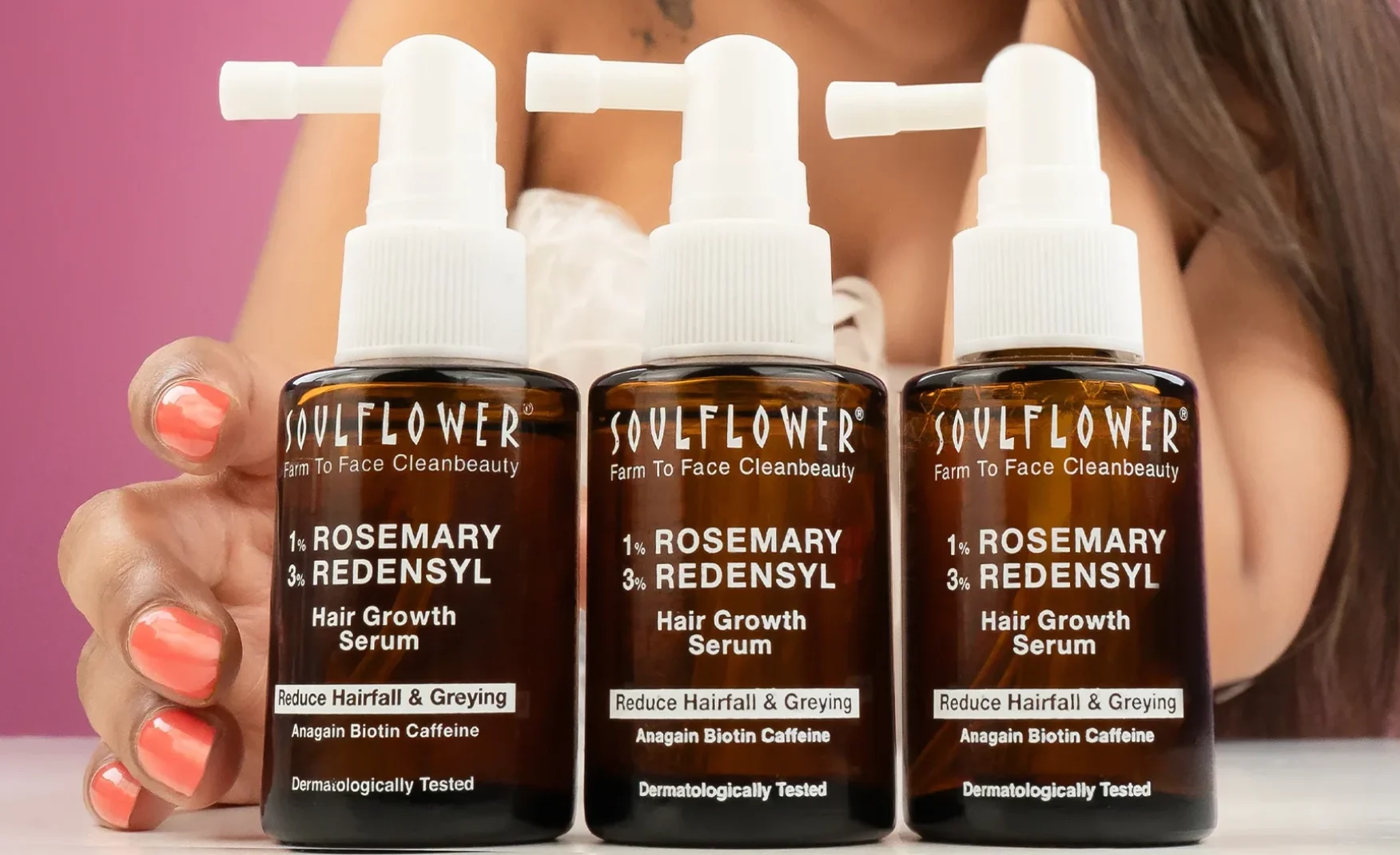
Where luxury naturals brands reach for restraint and muted neutrals to signal premium, Soulflower does the opposite, and it does it deliberately.
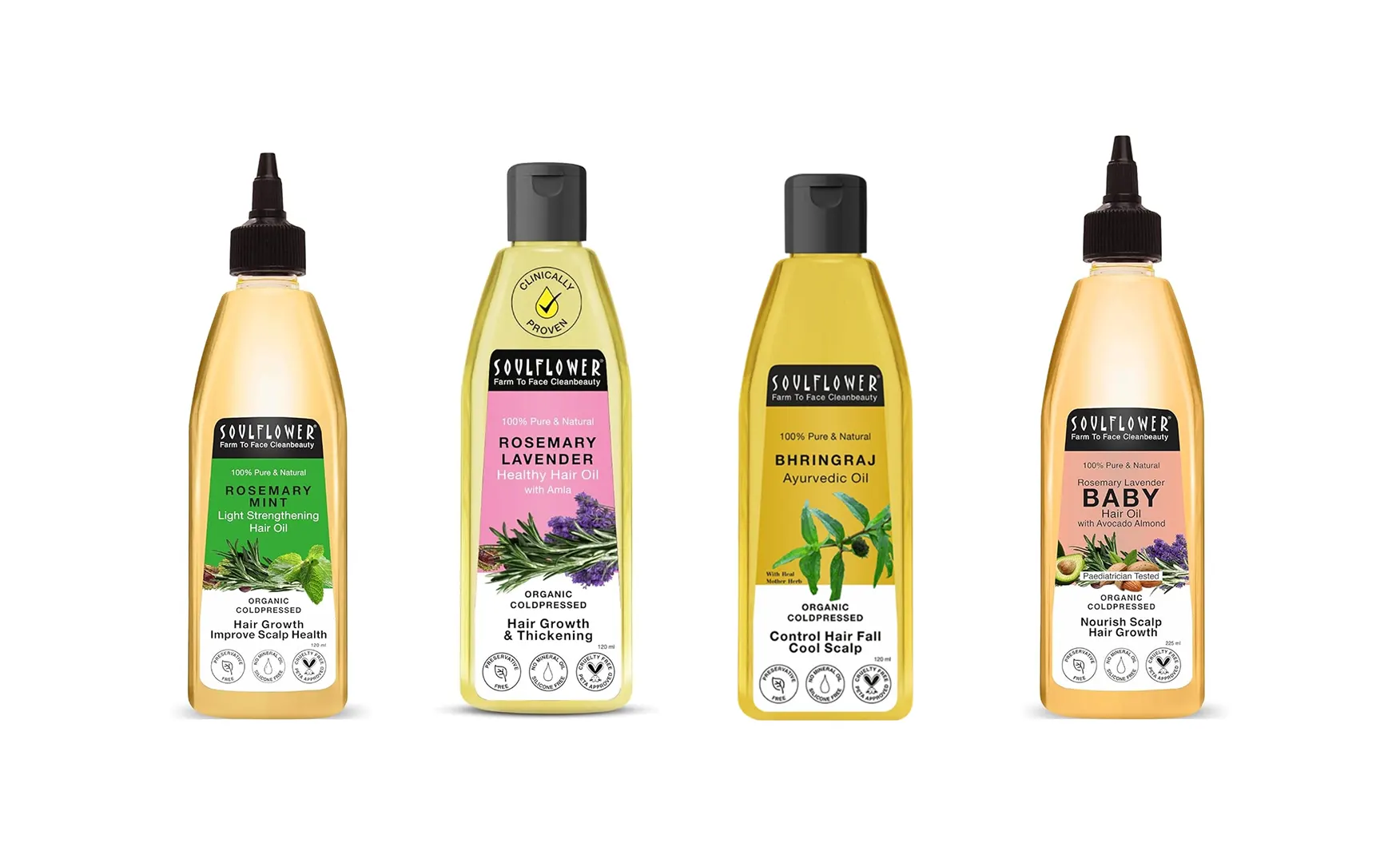
Its packaging is bright, saturated and organised around the ingredient itself, so a bottle of rosemary, tea tree, onion or castor oil reads instantly as what it is from across a crowded quick-commerce grid. In a shopping environment where a customer scans a wall of thumbnails in seconds, that clarity is a distribution advantage rather than a cosmetic choice.
For a catalogue spanning more than 200 active SKUs across oils, soaps, serums and shampoos, that colour-coded, ingredient-led hierarchy is what keeps a very wide portfolio from dissolving into noise.
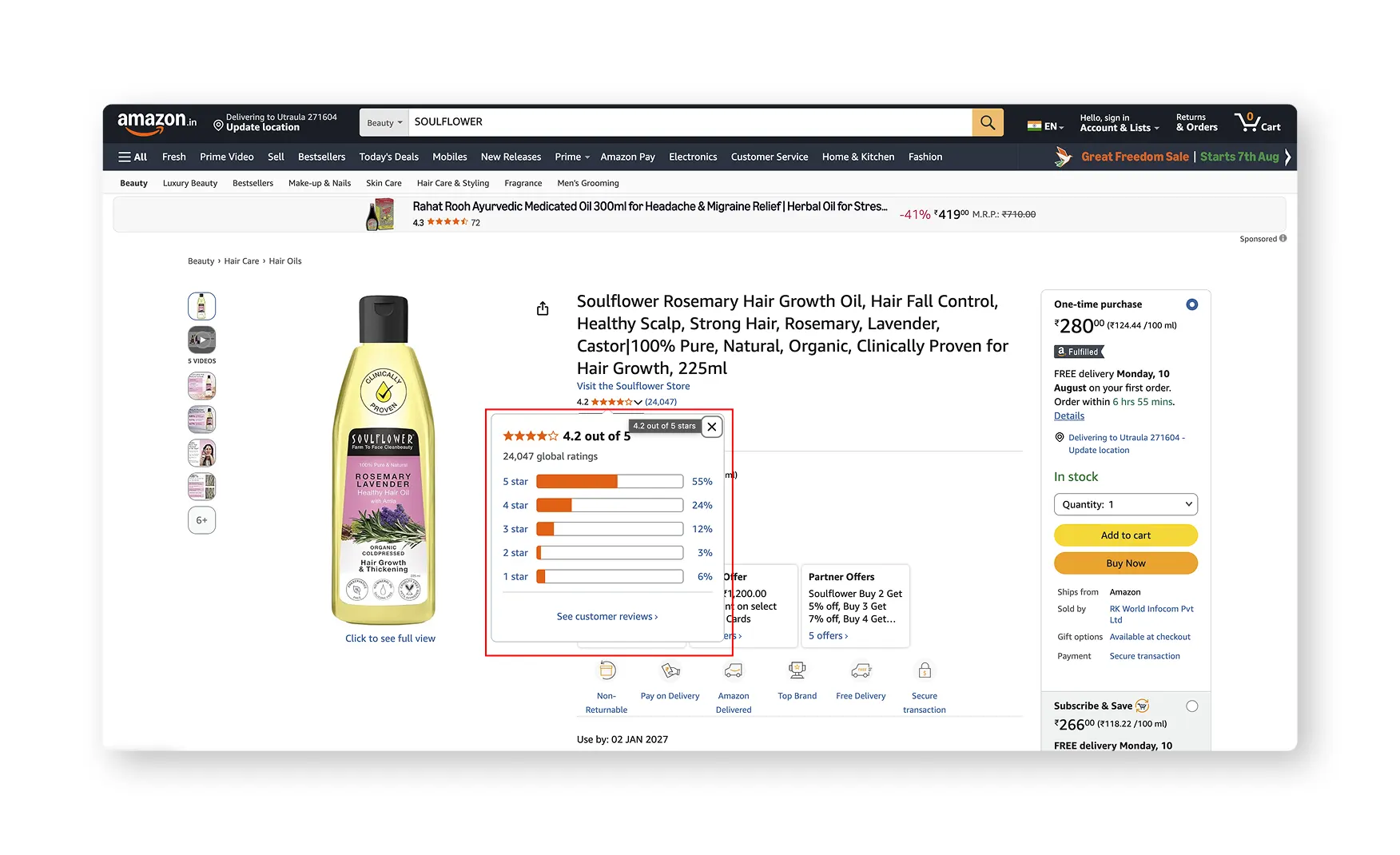
The single most underrated thing about Soulflower is that it wins where most legacy brands struggle.
Soulflower has used the premium hair oil segment on quick commerce to its advantage, reportedly commanding a leading share on Blinkit ahead of established names in the category. Where incumbents built their businesses on general trade and kirana shelves, Soulflower built its recent growth on the ten-minute delivery grid.
Its growth has leaned heavily on word-of-mouth and review-led demand rather than expensive celebrity-led media, which is exactly the posture that suits these platforms and keeps acquisition efficient.
Soulflower operates in a category drowning in the language of natural, and it has done more than most to make that language accountable.
Its products carry real third-party credentials, including Ecocert COSMOS Organic certification and PETA cruelty-free and vegan status, and the brand leans hard on being preservative-free and free of mineral oil, sulphates and synthetic fragrance.
The brand wraps this proof in a positioning it calls farm to face, tracing ingredients through its own Soulflower Farm, and that evidence-led posture has also let it export through Amazon Global Selling since 2016 to markets including the USA, UK, UAE, Singapore and Japan.

Natasha Tuli is not a name tucked away on an About page, she shows up in the banners, on the Instagram page, in the photography and in the brand's own story consistently.
That visible, consistent founder presence is one of the biggest reasons Soulflower reads as a real brand rather than a faceless catalogue of oils, since a founder this present gives every product a human behind the claim.

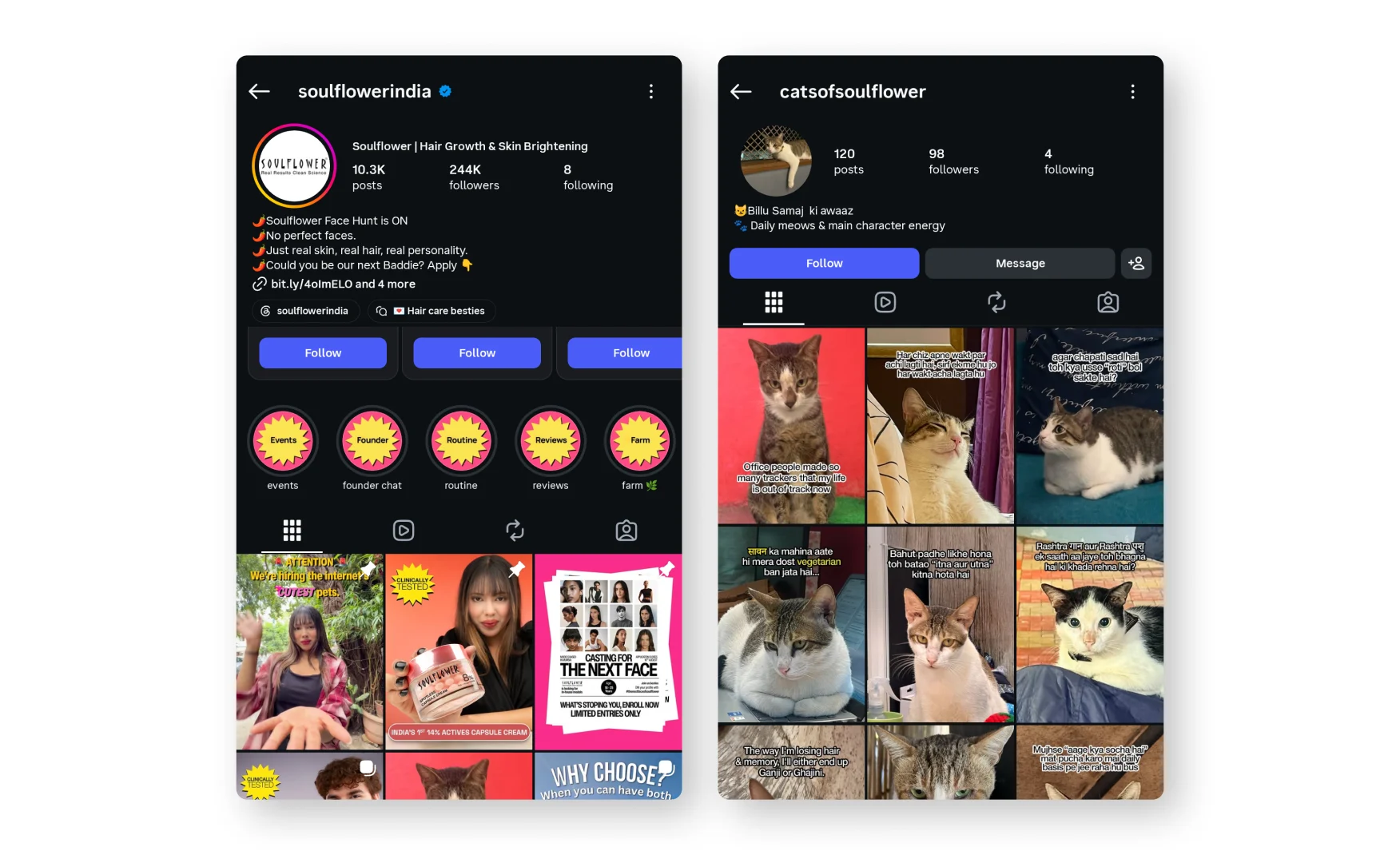
Soulflower's Instagram stays consistently on brand, following the same colours and visual identity across its highlights and posts.
The feed mixes product content, sale updates, memes, before-and-after results, giveaways and user-generated content, all posted regularly and updated through Stories. The brand even runs a second account dedicated to "Cats of Soulflower," daily posts of office cats that add a lighter, more human layer to the brand's presence.
Soulflower's history has left it straddling two quite different identities, and the seam is starting to show.
On one side sits the original brand, a specialist aromatherapy and essential-oils house with genuine depth.
On the other sits the breakout business the market now knows, a mass-appeal hair-growth brand riding a viral rosemary trend on quick commerce.
Left unresolved, this tension caps the brand at both ends, making it harder to command genuine premium for the specialist range and harder to build a single-minded story for the mass range.
For a brand that leans on certifications, purity and a farm-to-face story, Soulflower spends a surprising amount of energy on aggressive discounting.
Its own Instagram bio has read lines like "flat fifty percent off on everything" and "biggest drop" during sale periods, and quick commerce rewards the kind of promotional velocity that trains a consumer to wait for the next markdown.
Every deep, blanket sale quietly tells the customer that the real value of the brand is lower than the shelf price, which makes it harder to hold margin as the category gets more crowded.

The Rosemary oil that powers Soulflower's growth is also its most obvious vulnerability.
Hero products built on a viral ingredient trend are wonderful while the trend is rising, but the same search demand that lifted rosemary can migrate to whichever ingredient the internet decides to love next.
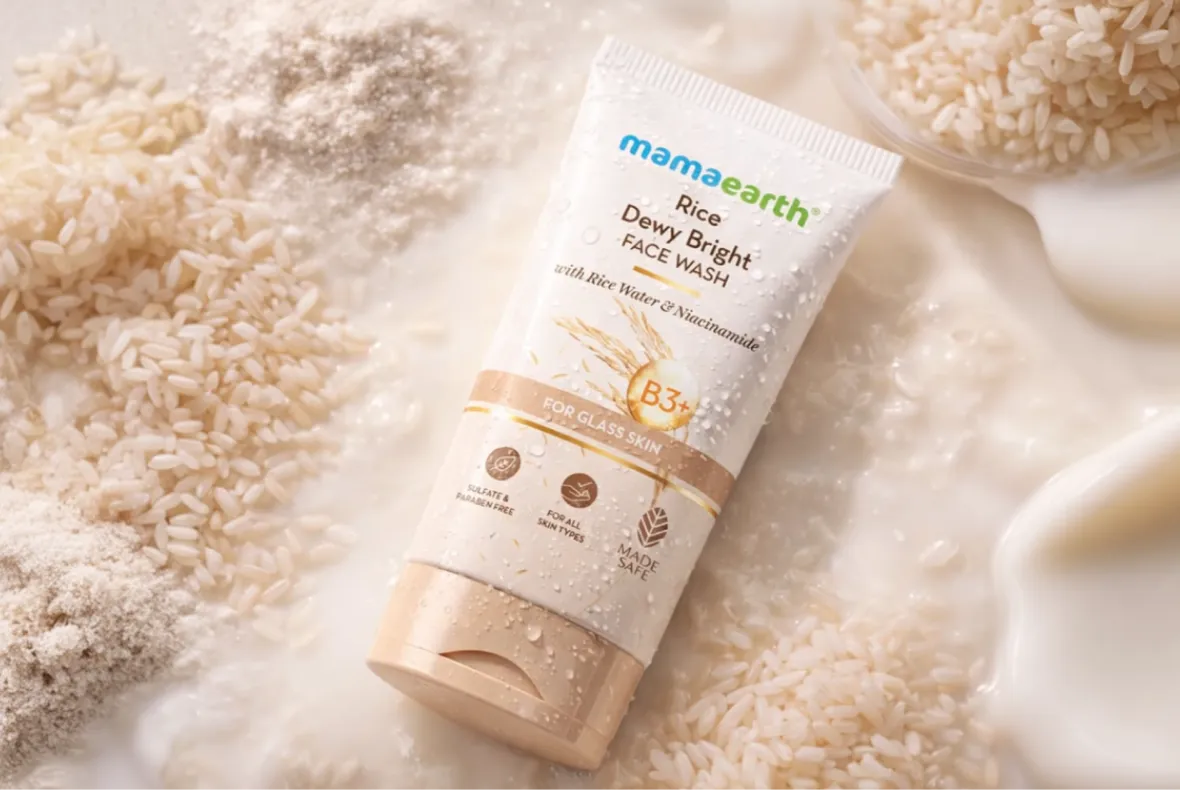
Legacy oil giants like Marico and Bajaj have distribution scale, while D2C natives like Mamaearth and WOW Skin Science have the marketing firepower to flood the same listings.
Soulflower's logo is essentially the brand name set in a pleasant font, and it does its job without doing much more than that.
A brand this closely associated with nature, and with a name built from "soul" and "flower," has an obvious opportunity to build a distinctive mark around that imagery. Right now the wordmark carries none of the warmth the name itself already promises.
Soulflower's first and most important next move is a brand architecture decision, not a design flourish.
The most elegant answer is usually a clear structure that lets the specialist, higher-margin aromatherapy world signal genuine premium while the hair-care hero range reaches the widest possible audience, with a shared master brand that connects the two without flattening either.
The goal is not to split Soulflower in two, but to give it a spine, so every future launch knows where it belongs.
Soulflower's farm-to-face story is one of the strongest and least-exploited assets it owns, currently functioning more as a supporting claim than a designed part of the brand.
The opportunity is to make provenance visible and experiential, building a consistent visual and verbal language around origin that runs through packaging and content. A competitor can copy a rosemary oil, but it cannot copy a twenty-year sourcing history designed into every touchpoint.
The wordmark critique above points to a genuine opportunity rather than a flaw.
A distinctive mark built around the brand's own imagery, whether a flower motif or something drawn from the Soulflower Farm story, would give the brand a visual shorthand that a plain wordmark never can. This is exactly the kind of identity work Confetti does, translating a name that is already beautiful into a mark that carries equal weight.
Soulflower is a brand with a rare and valuable core, authentically early to clean beauty, holding genuine third-party credibility and owning a hero product with real cultural momentum.
The tension is that commercial momentum has, for now, outrun brand clarity, with the brand quietly split in two, its premium credibility sold at a discount, and its growth leaning on a single hero its larger rivals can copy.
None of these are fatal, and all of them are exactly the kind of problem good brand and design work can fix. Soulflower does not need reinventing, it has already won the hard commercial battle.
If you are building a natural or wellness brand and want your identity and brand architecture to carry the same weight as your product, get in touch with Confetti Design Studio.
Want strategic branding and packaging like this for your business?





.webp)
.webp)

.webp)
.webp)
.webp)
.webp)
.webp)







.svg)
.webp)





.svg)
.svg)


















































































































.webp)











.webp)


.svg)