%201.webp)
02
AI Snaps
.svg)
.svg)
01
Our Work
03
About Us
04
Brand Audit
05
Contact Us
06
Client Success
12
07
Blogs
08
Careers
Book A Call
.svg)




Need Help In Building Your Brand?
Click the button below & book a call with our founder directly.

Rishabh Jain
Managing Director
Forest Essentials | Confetti's Verdict ⭐⭐⭐⭐
Confetti Design Studio has analysed Forest Essentials, and this audit carries a particular weight because Confetti has worked directly on the brand's limited edition packaging, an experience that changed how the team understood what luxury actually means in a product context. Mira Kulkarni founded Forest Essentials in 2000 at the age of 45, as a single mother raising two children, with Rs 2 lakh and a batch of handmade soaps and candles. The brand grew to Rs 585 crore in FY25 revenue at 18% year-on-year growth, built a network of nearly 200 freestanding stores across India and internationally in the UK, UAE, Kuwait, Qatar, and Bahrain, became India's top-ranked brand in prestige skincare, and on 5 March 2026 announced that The Estée Lauder Companies would acquire its remaining 51% stake, completing an 18-year partnership in what ELC described as its first such engagement with an Indian brand.

Having worked directly on Forest Essentials' limited edition packaging, Confetti understands this brand's commercial model at a level that analysis alone cannot fully reach. Forest Essentials does not treat packaging as a container. It treats it as the primary communication of everything the brand charges a premium for.
The weight of the glass, the texture of the paper, the precision of the gold foiling, the ceremonial quality of the unboxing encounter: every physical detail is a brand argument for why this product costs what it costs. In luxury beauty, the product inside the bottle is rarely the whole story. What Forest Essentials understood from its earliest days, and has refined over 25 years, is that the consumer's willingness to pay a luxury price is directly proportional to how luxurious the entire encounter feels. This is extraordinary brand architecture, and it is the asset the Estée Lauder acquisition must be most careful not to rationalise away in pursuit of operational efficiency.

Most luxury brands do not begin with Rs 2 lakh and handmade soaps. Most luxury brands are either born from heritage or funded into existence. Forest Essentials is neither. Mira Kulkarni started at 45, as a single mother, with a personal investment most founders would consider insufficient for a grocery business, let alone a luxury one. The first product break came when the Delhi Hyatt Regency ordered her soaps for their rooms. By 2005 to 2006, revenue was Rs 6 crore. The brand she built from that beginning is now valued by Estée Lauder, one of the world's most sophisticated luxury beauty acquirers, as a globally scalable prestige brand.
The founding story is not decorative. It is a material part of the brand's credibility with the Indian consumer, who is inherently sceptical of manufactured heritage and responds deeply to authentic origin. The knowledge that Forest Essentials was built by one person's conviction, without any sort of institutional capital, or a blueprint, and without anyone believing the premise before it became real, is the kind of origin story that luxury cannot buy and that no competitor can ideally really replicate now.

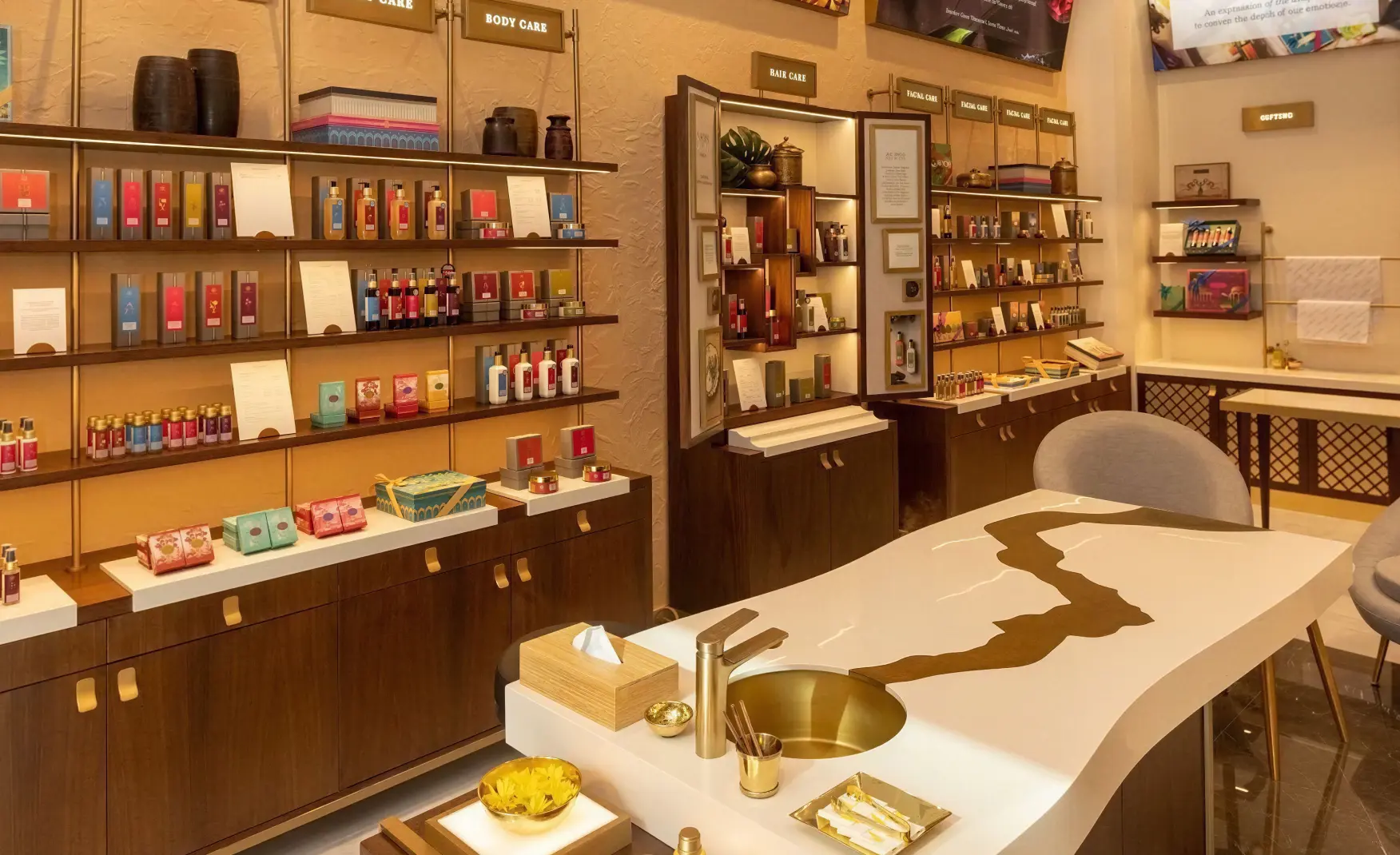
Most brands that reach Rs 500 crore and above are primarily online. Forest Essentials built nearly 200 freestanding stores, spaces physically designed to communicate the brand at its full depth. These are not stockists or shop-in-shops. They are brand environments, curated spaces that smell, look, and feel like Forest Essentials, that allow consumers to experience the product in the brand's context before committing to a purchase.
This retail footprint is an extraordinary asset for three reasons. It creates daily brand experiences for thousands of consumers. It provides the gifting occasion the brand depends on, a consumer who walks past a Forest Essentials store, steps in, and finds a gift they did not know they were looking for. And it is the infrastructure template for whatever global retail expansion follows the ELC acquisition. A brand that has already solved the problem of creating an immersive luxury retail experience at nearly 200 locations has solved the most capital-intensive problem in luxury brand building.
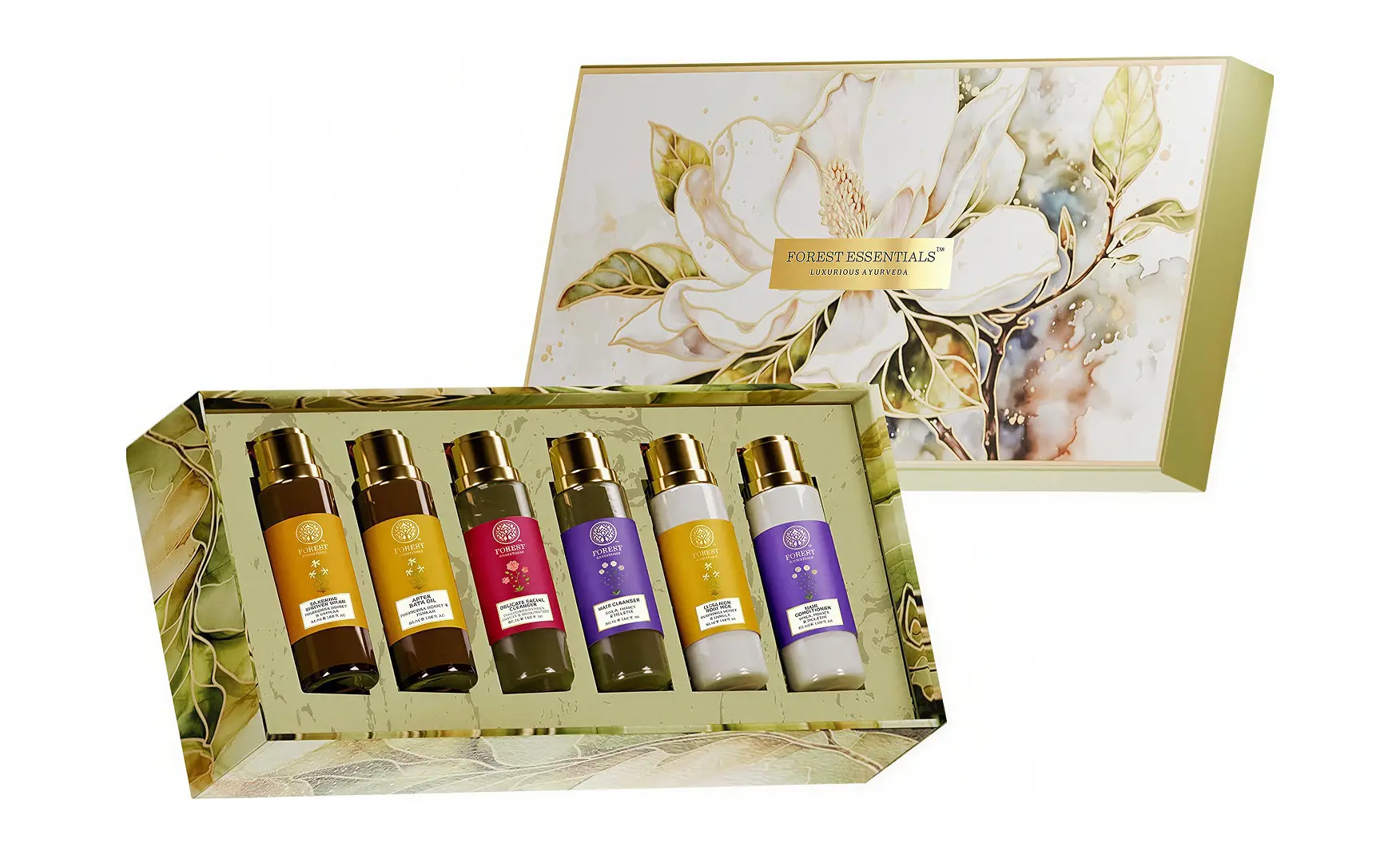
Forest Essentials is one of very few Indian brands that has genuinely cracked the high-value gifting occasion. The product quality, the ceremonial packaging, the in-store discovery experience, and the price point all converge to make a Forest Essentials gift feel considered and meaningful rather than generic. In a country with a deep cultural relationship to gifting across corporate, festive, celebratory, and personal contexts, a brand that can reliably serve as "the impressive but Indian gift" is building recurring revenue with almost no acquisition cost.
Every person who receives a Forest Essentials gift and has not previously encountered the brand is a new customer brought in by someone else's endorsement. The gifting cycle is both a revenue channel and a brand discovery engine, perhaps the most capital-efficient form of brand building available to any premium Indian brand. Internationally, this dynamic becomes even more powerful: a Forest Essentials gift set in London or New York is a novel and culturally specific luxury object that no global competitor can replicate.
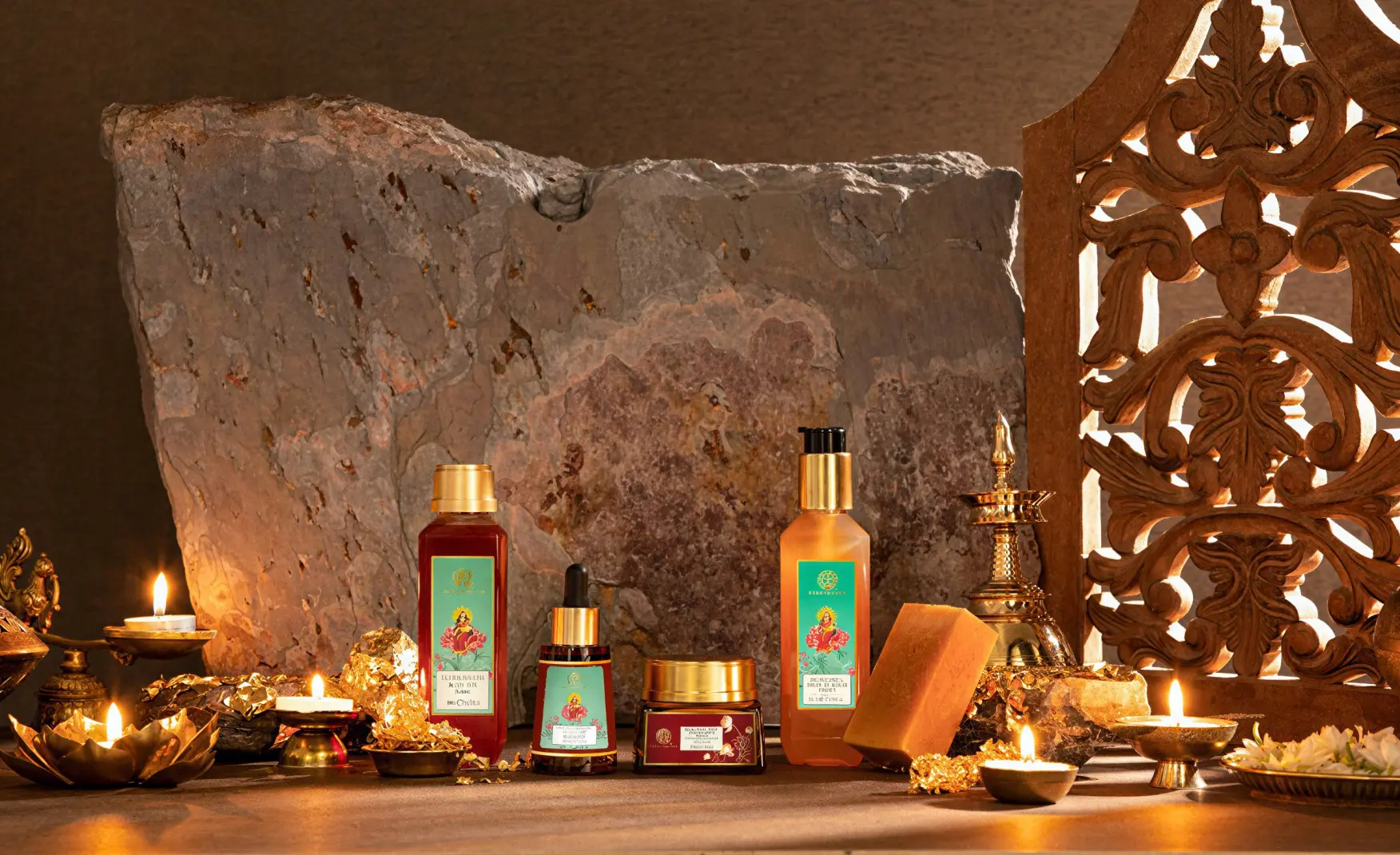
Forest Essentials achieved something that should not be taken for granted: it made ancient Indian Ayurveda genuinely aspirational and premium in a market conditioned to believe that Western science is the benchmark of quality. In a beauty category where Korean skincare, French pharmacy brands, and American dermatological ranges carry enormous cultural credibility, Forest Essentials convinced the Indian premium consumer, and an international audience, that Indian botanical knowledge, properly presented and rigorously formulated, is at least as compelling as anything imported.
That cultural work, reframing Indian knowledge as luxury rather than alternative, as sophisticated rather than traditional, took 25 years of consistent brand expression. The packaging, the language, the ingredients presented as luxury botanical assets rather than generic traditional remedies, and the "Modern Luxurious Ayurveda" positioning are all part of the same sustained argument. It is one of the most coherent and consequential brand-building exercises in Indian consumer history, and it is the cultural work that made the Estée Lauder acquisition possible at all.
The full Estée Lauder acquisition is the most significant event in Forest Essentials' history, and its implications for the brand are not simple. ELC's commercial playbook involves global distribution, accelerated NPD cycles, and efficiency gains that come from integrating a brand into a large corporate structure. These are not inherently bad, but they are in genuine tension with the things that make Forest Essentials exceptional: the artisanal formulation philosophy, the founder's aesthetic sensibility, and the sense that every product is made with unusual care.
The context for this tension is important: ELC is itself in the middle of a significant restructuring, cutting up to 10,000 jobs globally under its "Beauty Reimagined" turnaround plan. A conglomerate under this level of internal financial pressure may face commercial pressures that conflict with the long-term brand discipline Forest Essentials requires. Mira Kulkarni's continued role as Founder and Managing Director, with her son Samrath Bedi as Executive Director, is the most important structural protection the brand has. It is also a protection that depends entirely on ELC honoring its public commitments about preserving creative and operational autonomy.
A slowly forming sentiment is visible among Forest Essentials loyalists: a watchful uncertainty about what the brand becomes once it is fully owned by an American conglomerate. The brand's deepest equity is rooted in being genuinely Indian, not performing Indianness for a global audience, but actually being rooted in Indian botanical knowledge, Indian aesthetics, and an Indian sensibility produced in manufacturing facilities in Haridwar and Tehri in Uttarakhand.
The concern is not dramatic or immediate, and Kulkarni's stated confidence in ELC's respect for the brand's Indian identity is genuine. But the consumer who chose Forest Essentials because it felt like something India had built for itself will be paying attention to whether that remains true as global distribution priorities take hold. The brand has the protection of public ELC commitments to preserving Indian operations intact. Whether those commitments survive commercial pressure in five years is the question no one can answer today.

Having worked directly on Forest Essentials' limited edition packaging, Confetti understands that the premium the brand commands is built into every physical decision: the weight of the glass, the feel of the paper, the specific sensory quality of an in-store encounter. These are not aesthetic preferences. They are commercial assets that justify the pricing, build the consumer relationship, and differentiate the brand from every competitor in its category.
The most important brand governance work of the next 24 months is the explicit codification of the Forest Essentials physical and sensory standards, what cannot be changed in the packaging material specifications, the store design, the product presentation, and the formulation philosophy, regardless of what efficiency pressures emerge from the parent company. A brand identity that exists primarily in the founder's sensibility is vulnerable during ownership transitions. A brand identity that is formally documented and contractually protected is not.
Before attempting mass global expansion into markets where Ayurveda requires extensive consumer education, Forest Essentials' most coherent international opportunity is the Indian diaspora in the UK, the US, Canada, Australia, and Singapore. This consumer already has cultural fluency with Ayurveda, already understands what Indian luxury looks and feels like, and already has a frame of reference for why a Forest Essentials product is worth its price.
This market does not require category education. It requires availability and consistency of experience. ELC's international distribution infrastructure can deliver exactly this, and the diaspora market captured well becomes the bridge to the broader Western wellness consumer who is being introduced to Ayurveda through cultural influence rather than brand advertising. Forest Essentials already has stores in the UK: the infrastructure for this expansion is already partially built.
Mira Kulkarni starting Forest Essentials at 45 with Rs 2 lakh and handmade soaps sold to a single Delhi hotel is one of the great founding stories in modern Indian consumer history. In the domestic market, this story is known and valued. In international markets, it is largely untold, and it is one of the most powerful brand differentiation tools available.
In global luxury beauty, the brands that carry the deepest consumer conviction are those with founding stories that feel human rather than corporate. LVMH has heritage & L'Oréal has scale. What Forest Essentials has that neither of them can claim is the story of a single person who started from nothing, in India, building something that the world's largest beauty company eventually needed to own. That story, told confidently in every international market the brand enters, is worth more than any campaign budget ELC could deploy on the brand's behalf.
Forest Essentials is among the most remarkable brand stories in Indian consumer history. A company that made ancient Indian Ayurveda into a globally credible luxury category, built a Rs 585 crore business from a standing start with no precedent for what it was attempting, earned the ultimate institutional validation in a full Estée Lauder acquisition, and did it all while Mira Kulkarni retained the creative authority that makes the brand what it is. Having worked with this brand directly, Confetti rates it from the inside as well as the outside: the product quality, the packaging standards, and the brand discipline are all real and all exceptional.
The rating reserves one star for what the acquisition will test. The question the next chapter must answer is whether everything Forest Essentials built survives the transition from founder-led brand to corporate asset at a conglomerate managing a global restructuring. The public commitments from ELC are strong. Mira Kulkarni's continued presence is the most important structural protection. And the brand's 25 years of built equity is durable enough to survive a great deal. The honest uncertainty is whether it is durable enough to survive everything the next decade will ask of it.
If you are building a luxury, heritage, or craft-rooted brand and want packaging and brand architecture that earns premium positioning and survives transitions in ownership and scale, Confetti can help you build the brand infrastructure your product deserves.
Want strategic branding and packaging like this for your business?





.webp)
.webp)

.webp)
.webp)
.webp)
.webp)
.webp)







.svg)
.webp)






.svg)
.svg)























































































.webp)











.webp)


.svg)